Feeds:
Posts
Comments

Posts Tagged ‘follower of Christ’

Go ahead. I dare you. What criteria will you use? There are lots to choose from: kindness, selflessness, sacrifice, humility, and so on. Who do you know? Who’s on the list? Am I? Are you?

I John 3:10
This is how we know who the children of God are and who the children of the devil are: Anyone who does not do what is right is not God’s child, nor is anyone who does not love their brother and sister.

All right, I admit it, I’m being cantankerous. I keep thinking about all the times people say, “Remember who you are, remember that you are a Child of God.” And I wonder, am I only this child positionally (that is, as a result of my belief in the Christ) or is there evidence of my family affiliation? Is there a family resemblance?

Standing in a line-up, do I look any different than I did before Christ?

I am a follower of Christ but have I embraced being a child of God, or as the Amplified translation states, “…by this it is made clear who take their nature from God and are His children. . .”? Am I assimilating the very nature of God?

Or, am I still in the “terrible two’s,”? Investigative three’s? Adventuresome school years? Rebellious teens?

A child, in a happy and secure family, trusts the parent, looks up to the parent, finds comfort in those arms, and is encouraged by the looks and words from the parent. But a child must also grow up. A child must learn to walk in the world and become a parent as well. What is the relationship of an adult child to a healthy parent: respect, appreciation, admiration even, and thankfulness for the gifts of life, love, and wisdom.

I want to grow up.

Read Full Post »

Want to experience authentic Christ followership? It’s the opposite of everything imaginable: love enemies, serve to lead, sit to stand, humbleness for glory, just to name a few. The key to all faith paradoxes is trust and confidence in the God who operates outside of natural laws, basics, like gravity.

I Peter 5:6-7
Humble yourselves, therefore, under God’s mighty hand, that he may lift you up in due time. Cast all your anxiety on him because he cares for you.

Grace is a paradox too.

I’ve been captivated by paradox within my faith for the last three years. I can’t seem to get away from it, as though this one understanding is waiting to be fully embraced, as though I am on the precipice of really “getting it.” Something inside me keeps saying, “once this truth is broken apart, I will be stepping into the deepest places where faith, trust, hope, and love are the norm.

It would be a spiritual Sadie Hawkins life when those seemingly opposite behaviors would be natural. Expectations would no longer drive my emotional responses; disappointment wouldn’t overpower faith; fear would be a memory; anger wouldn’t be a useful tool to get my way; and controlling words would be unfamiliar.

If I could “cast my anxieties” on Christ, there would be nothing to carry.

Read Full Post »

Water baptism is controversial among various denominations, from dunking to sprinkling, from adults to infants, required or not required, and so on. But, according to Peter, it can be symbolic, it can be a moment in time when the person says, “Yes, from this day forth . . . ”

I Peter 1:21a
. . . and this water symbolizes baptism that now saves you also—not the removal of dirt from the body but the pledge of a clear conscience toward God.

I suppose then, if parents want to mark a day for their babies (at Christenings and dedications and such), is that a bad thing? Does the infant have an unclear conscience, not really. Is the day meaningful for the child, no. But it can be important for the parents on behalf of the child and whatever has gone before that child’s birth. Perhaps they need to mark a moment in time to let go of former circumstances or negative thoughts about the child, this bundle of life that has changed their lives forever. Perhaps they need to make a pledge that day, to move forward and not look back. I like the idea although I doubt it’s a concept shared with young parents. Wish it were.

Now, as to adults and baptism . . .

When I made the decision, some thirty years ago, to become a follower of Christ, I was “all in” except for the church thing. It took me several months before I could go through any of those motions or rituals. My childhood experiences with people of the church and its liturgies had been discouraging. Eventually, I did attend a church in Manhattan, an anachronism to say the least (beehive hairdo’s, long black dresses on the women, knee thumping gospel, etc.). But after some weekly exposure to the Pentecostal teaching, I was drawn to being water baptized as an adult.

Even then, with little understanding of Christian norms, I knew it was a symbol; it was a personal gesture; it was an act of submission to God; it was an agreement between us; it was my pledge to let go of everything that had gone before and to move forward with God and Christ. It was a “yes.”

Do I believe I could be a Christ follower without the dunking pool? I do. Did it seem odd and a little ridiculous at the time? It did. Was I self-conscious of its process? I was.

But I am not sorry I did it. And in a way, I’m thinking water baptism should be considered as an act that can be done more often, much like communion, as an expression of intent, an agreement, a promise.

This, too, then is a “start-over.” It makes a lot more sense when we re-examine the baptisms that John the Baptist ran before Jesus had even started his ministry. It was a gesture of hope back then too.

Read Full Post »

We have three foundations to belief in God: faith, hope and love. And although love is the greatest of these (I Corinthians 13), Peter exalts faith. Much like the challenge of loving an enemy, faith too must do battle, but with doubt.

I Peter 1:7a
So that [the genuineness] of your faith may be tested, [your faith] which is infinitely more precious than the perishable gold which is tested and purified by fire. [This proving of your faith is intended] . . .
[Amplified]

No one wants to go through trials and grief, but there is no question that difficulties make human stronger. Whether those situations give more experience or wisdom, they also build faith. This is nothing new.

Today, however, I pondered the idea of faith being precious though challenged. What would make faith so dear, so prized, so valuable that it must also “suffer slings and arrows?” At its root then, faith must be protected, or at the least, treated with great care.

I think about the absurdity of the treatments often used to fight cancer, chemicals that kill all fast growing cells and ultimately, a few others along the way. The body is threatened with death with each and every treatment. And yet, if the body can survive, can withstand the treatments, there is a chance for remission. Core cells are needed to sustain life: they are precious.

There are core cells to faith as well. It is the pulsing center of faith, the heart. Where is this heart? I don’t know. I think it’s different for each person, but I believe it’s the “Keep” of faith and must be revered.

I believe each person has a faith-planting moment. Perhaps it’s the point of accepting the Christ leadership or the indwelling of the Holy Spirit or perhaps it was a miracle like healing or escape from danger. For me, it was the day I stepped into my apartment in New York and I had a “whoosh” feeling, dropped everything from my arms onto the floor and wandered around my apartment singing the only Christian song I knew: “Jesus Loves me, this I know” for about forty minutes, over and over again. I knew that I knew that God was real and I would follow and believe. My precious faith was born that day.

Read Full Post »

I am not very good at waiting for the fruit of anything. I am a product of my culture and generation. I want it now. But faith in the good ending of a situation is the cornerstone of hope and takes time.

Hebrews 12:11
No discipline seems pleasant at the time, but painful. Later on, however, it produces a harvest of righteousness and peace for those who have been trained by it.

It takes practice to believe in the good end despite the circumstances. It also takes experience. The more personal examples I have of God’s reliability, the easier it is to trust God the next time.

And, apparently, each instance of my faith and hope in God, lays a path for others to follow. That is a by-product of my journey, my willingness to hold my hand to the plow.

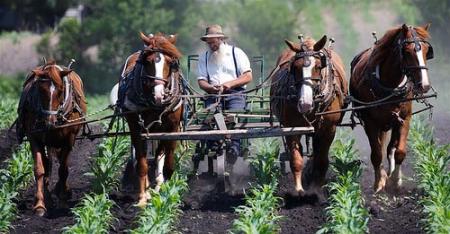
I live in northern Maryland near the Pennsylvania line and a few times a year, we take a trip up into the Lancaster area where many Amish communities have evolved. I really enjoy watching the spring planting season as the men work the ground with teams of horses or mules and plows. It’s clearly hard work but it is also a kind of dance. Like any farmer, these men are trusting that their labor will bear a plentiful harvest. Outside forces can impact their efforts, but they still carry on, believing that all will be well.

A God follower is similar to these farmers, willing to cultivate the land of human, believing the ground can be tamed, seeds can grow and new life can flourish.

But, like the farmer, this process is long and painstaking. I cannot rush through it. Just as plants grow on their own timetable, so do souls.

In the Amplified translation of this verse, righteousness is expanded to mean “conformity to God’s will in purpose, thought, and action, resulting in right living and right standing with God.” This is true human and this is the harvest we are intended to pursue here on Earth. And with this relationship comes peace within.

This is the promise, the ultimate fruit of discipline.

Read Full Post »

Cloud of Witnesses by Jean Moore

Is it really Abraham and Isaac and Jacob? What about the disciples or maybe a few of the women who managed to get their names in the book? Or what about all the unnamed saints? Is it one cloud for all of us? Maybe they’re color coordinated.

Hebrews 12:1
Therefore, since we are surrounded by such a great cloud of witnesses, let us throw off everything that hinders and the sin that so easily entangles, and let us run with perseverance the race marked out for us.

Honestly, there are a lot of dead souls between the Old or New Testament times and now. Who are these people? And what do they see?

I would assume that most traditional Christians believe these cloud formations are all the folks in heaven, especially the long-gone relatives and extended family who are cheering them on. Big family: big cloud.

But I’m not from a big family nor have I done much in the genealogy department to scout out family members I never knew I had. I suppose the cloud could be my “church” family but then, let’s be honest, do I believe they would keep checking on me if I’m not connected to that “building” where they met me in the first place?

I know I’m being flip, but I want to challenge the concept in my own head. What have I speculated over the years? I’ve read this scripture hundreds of times. It always sounded nice, the uncountable numbers celebrating when a “lost one is found” like the lost coin of the old wife [Luke 15:8-10] or the shepherd who searched until he found his lost sheep [Luke 15:4-6].

But I’m not lost (at least I hope I’m not). Instead, I’ve been treading Christian waters for thirty years: is the cloud still around? Are they applauding or are they waiting for me to get on with it? Is the cloud “individual” or corporate (like the “hive mind” of the Borg in Star Trek)?

Or is it time to let go of the literal image and consider the essence of this verse?

Didn’t Solomon capture it: “What has been will be again, what has been done will be done again; there is nothing new under the sun.” [Ecclesiastes 1:9] Our cloud of witnesses faced similar challenges to the ones we face today: they grieved and laughed, they grew families and lost them, they saw success and failure, they laughed and cried. Life goes on. They did it, we can do it. They lived by faith, we can live by faith. They trusted God, we can trust God.

It’s a cloud of love, a cloud of hope, a cloud of humanity that made it through and learned the deep lessons. They are part of the realm that the Holy Spirit embodies. And just as we have access to the Holy Spirit; through that same Holy Spirit, we have access to the cloud who lived and live still outside our understanding.

So, I thank you “cloud of witnesses” and I thank you Holy Spirit. Keep me running and mindful of your presence. Keep me in the race.

Read Full Post »

It’s hard to change and then return to one’s old environment. So often, acquaintances and even family can’t see the metamorphosis, or they resist the transformation, or worse, they treat the person as though nothing has happened. It’s obvious, if Onesimus changes, then so must they.

Philemon 10-12
I appeal to you for my son Onesimus, who became my son while I was in chains. Formerly he was useless to you, but now he has become useful both to you and to me. I am sending him—who is my very heart—back to you.

When I first accepted Christ, back in the day, I woke up the next morning (Christmas morning, actually), and felt compelled to tell my family that I had made a huge decision in my life, a new commitment to Christ. My mother stared at me momentarily and then said, “Don’t worry, this too shall pass,” and went back to drinking her morning coffee. In essence, don’t be ridiculous.

Men and women who are released from prison often find themselves thrown back into the same crowd and ultimately the same behaviors that got them into trouble in the first place. Generally, a former prisoner is better off starting over in a new setting, a new town, a fresh beginning. But the loneliness and lack of support is overwhelming. Everyone wants to be loved and acknowledged for the “new” self. The decision to change is hard work.

Alcoholics and addicts are constantly undermined by friends and family, with phrases like, “oh, just once won’t hurt you,” or “it’s a special occasion, come on!” Even dieters are sabotaged with offers of cookies and treats over and over again. What is the message? Don’t change. Don’t make me adapt this new self. Don’t make me look at myself in a new way by your decision to take a different path.

Onesimus escaped the household of Philemon as one person and under the loving care of Paul, became a believer and follower of Christ. He was not longer the same man. In order to successfully return to Philemon, he would need the support and acceptance of that family. They would have to look with new eyes, hear with new ears, and willingly, break old habits and build new ones.

Twitter was ablaze yesterday about men and women who made decisions to follow the Christ. But what happens next? They must still walk back through the same front door, sit at the same kitchen table, and wake to the same alarm this morning. They must go to work and wonder, can anyone tell? Should I say something? What do I say? And if I do say something, will I be under the microscope?

What is my role in such a scenario? I remember an old friend who hated being called “Tammy.” I asked what she really wanted and she said she wanted to be called “Tamera,” her given name. And so we agreed, she would commit to telling people of the change and I would commit to the new name. It took about six months but it worked; she grew into her beautiful name and so did others. Change is a team effort.

Lord, today, give me sensitivity to the personal revolutions of others around me. Show me how to be a safe haven for new things, new birth, new hope, new directions.

Read Full Post »

« Newer Posts - Older Posts »