Feeds:
Posts
Comments

Posts Tagged ‘God’

I should write a book: “My Favorite Bible Metaphors.” There are a zillion ways that Jesus used to communicate with the people about faith and the Kingdom of God from seeds to light to fish to sheep to salt to cooking. These word pictures were then passed down through stories. They still work today.

Galatians 5:7, 9
You were running a good race. Who cut in on you and kept you from obeying the truth? . . . “A little yeast works through the whole batch of dough.”

One of my good friends bakes bread several times a week to provide this staple for her family. Her father baked it for their family when she was growing up and it’s a tradition she has continued. Whenever I think of yeast-rising bread, I think of her.

I did my own stint at bread making some years ago. At first, the hand method (which is preferable) and eventually to a bread machine. The smell would envelop our house. I actually gave up the practice because my husband and I were devouring a loaf a day and our waists followed suit. But it might be time, with teens in the house, to return to this simple practice of adding yeast, working dough, watching it rise, and then shaping into a tasty loaf. There’s something a little “zen” about it.

Bread of all kinds is staple for all cultures. Everyone understands the yeast/dough image. It only takes a small amount of yeast to transform bread from flour, salt and water. Yeast affects all the dough. It too transforms itself to have the effect.

As a metaphor, it is a simple message. In Galatians, Paul refers to the “yeast” of a misleading but charismatic preacher who was drawing the original Christ believers back toward Jewish law, particularly circumcision.

It only takes one person to change a group. It only takes one to deadlock a jury. It only takes one to break consensus. It only takes one to undermine a team. It only takes one to start a war. But it also works the other way, it can be the one who motivates a group to higher challenges, or one to bring a family back together, or one to inspire a nation, or one to raise the flag of peace, or one to be the watchman crying out a warning.

Many years ago, I was on a women’s retreat and we were all assigned to a certain discussion group that would meet and discuss the teaching sessions. (For those in the know, this format is used in a variety of parachurch organizations like Cursillo, Walk to Emmaus, Tres Dias, and so forth.) The first day I was sure I was assigned to the wrong group. Each woman came with so much baggage, even the assigned facilitators were a mess. The first couple of discussion sessions were painfully dull or fraught with misunderstandings and confusion. I cried. Can’t anyone see I’m miserable? Can’t I change to that happy group over there? Can’t I be with the fun group on the far side of the room, or the clever group behind us? Finally, God “smacked me up side the head!” And I literally heard a voice from within say, “It’s you! You! You are not being the yeast or the salt.” I had come to that retreat experience with some expectations, not realizing that I wasn’t entering the story. I was sitting back and waiting for story to come to me. When I finally engaged fully and lovingly, everything changed. By the end of that weekend, our group became the most impacted, the most cohesive, warm, and authentic. There was much healing.

Lord, give me courage to be yeast in the right circumstances. And when it’s yeast coming against me, help me jump out of the bowl. 🙂


Read Full Post »

Paul is certainly confident as a prototype for believers: become like me, follow me, imitate me. Paul was a zealot before he met Christ and he was certainly one afterward. I could no more imitate him than I can imitate Christ. Ah, there’s the difference. . .

Galatians 4:12
I plead with you, brothers, become like me, . . .
I Corinthians 4:16
Therefore I urge you to imitate me.
I Corinthians 11:1
Follow my example, as I follow the example of Christ.
Philippians 3:17
Join with others in following my example, brothers, and take note of those who live according to the pattern we gave you.

To follow Paul is an outside/in method while following Christ is an inside/out endeavor.

Despite the freedoms Paul articulates as a follower of Jesus, having been a Pharisee for many years, he still had a very law-based mentality and world view. He was an administrator, an organizer. He could see how things would work out best. He loved his churches and he loved his people, but he did get frustrated. He was impatient. He continually aimed for perfection (Christ) and condemned himself often (not in a bad way, just as a confession) for missing the mark. He knew he was less than perfect and only Christ within made up the difference. Nonetheless, it was Paul who set up the churches with structure. He was an academic. He laid out the reasons for everything he said. He was a man of logic and reason. I’d say a good portion of our modern day churches have evolved out of the teachings and interpretations of Paul.

But when Jesus calls us to “follow him,” I think he is drawing us to the Kingdom. It is Jesus who consistently lays out the paradoxes of internal following. Everything is the opposite of what we would think: turning the other cheek, loving our enemies, going the extra mile, meekness is victor, weakness is strength and so on.

For Jesus it is not really “become LIKE me,” it’s become ME.

This is much more mysterious. When Jesus taught about “eating his flesh and drinking his blood,” a lot of disciples fled. This entire teaching on Jesus being the “bread of life” terrified most of his followers. [John 6:41-66] They fled because they understood, not because it was beyond them. Every time Jesus spoke bluntly about his intentions, there was an uproar.

With Jesus, what seems impossible is possible; what is lost can be found; what dies can be raised up.

In the face of these kinds of truths, do the outer trappings really matter: Robes or no robes, dunking or sprinkling, wine or grape juice, men or women, buildings or no buildings, and so on.

“On that day you will realize that I am in my Father, and you are in me, and I am in you.” [John 14:20]

Read Full Post »

This is what a lot of contract lawyers get paid to do: one to make the covenant and another to find enough loopholes to break it. What contracts or promises do we have to today that are truly binding? Partnerships? Marriage? Last Will and Testament? BFF? Pinky swear?

Galatians 3:15
Brothers, let me take an example from everyday life. Just as no one can set aside or add to a human covenant that has been duly established, so it is in this case [between God and Abraham].

The covenant promise between God and Abraham happened 430 years before the laws were established through Moses. But we are told, it was still rock solid after all that time. In fact, of the three parts of the covenant (land, blessings & a Messianic descendant), it is the third part that created the expectation or anticipation of a savior.

There are two kinds of covenants: conditional and unconditional. In the conditional covenant, both parties must agree and both must live up to their agreement. If either side breaks the covenant, then it is no longer binding. An unconditional covenant only requires the completion or fulfillment of the covenant by one side. The Abrahamic covenant only required God’s participation. Abraham just had to “show up.”

Once this covenant was completed with the arrival of the Messiah, he entered into yet another binding, unconditional covenant: Grace, which would manifest in eternal salvation (our sins covered by the blood sacrifice of the Christ).

Like Abraham, I just have to show up. I just have to say yes to this covenant. This is the contract of redemption.

But for me, the excitement is not in showing up. It’s taking full advantage of the covenant. It’s participating in the process. It’s being present in the story. It’s having a relationship.

Like a marriage, the wedding ceremony is nice and the symbols of rings, kisses and blessings are edifying and even memorable. But it’s what happens later that really counts.

Unlike a marriage, God is willing to take me back again and again when I fall away or stray. Though I be like Gomer [Book of Hosea], my God is patient, and gracious, and loving. This, then, is the covenant of hope.

Read Full Post »

Back in the day, particularly for the Israelites, the Law was everything. The law was their standard, their crutch, their security, their hope. Why a curse? Because no one could follow every jot & tittle of the law, and for this reason, they participated in the rituals of sacrifice and atonement. That was the point. The Messiah was promised to be the ultimate reconciliation.

Galatians 3:10
And all who depend on the Law [who are seeking to be justified by obedience to the Law of rituals] are under a curse and doomed to disappointment and destruction, for it is written in the Scriptures, Cursed (accursed, devoted to destruction, doomed to eternal punishment) be everyone who does not continue to abide (live and remain) by all the precepts and commands written in the Book of the Law and to practice them.
[Amplified]

This was the proposed road for the Israelites. For them to accept Jesus as the Messiah, they had to accept one final sacrifice as efficacious and complete. To accept the Messiah and then go back to the old way, was restoring the power of the curse.

The second leap for the Jews who accepted Jesus as the Messiah was to accredit the blessings of Abraham (once relegated to their people alone) to the Gentile believers. The exclusive club was no longer a matter of birthright, history, or ancestry.

A single act reboot the system.

As a believer, I am confessing that the work of Christ is the restoration act between me and God. Where the door was closed, it is now open. I may enter the realm of God, the divine. I may participate in holiness. I am permitted to be in relationship . . . not because of what I have done (or not done) but because of who “He” is, that is, the Christ/Messiah for the world.

Read Full Post »

Art by Walter Thomas Sacks

The path to Christ begins with the One God. The whole point of Christ’s presence in the world is based on the covenants, mandates, and promises of Yahweh. If there is no God, then Christ is a non-issue.

Galatians 2:20
I have been crucified with Christ and I no longer live, but Christ lives in me. The life I live in the body, I live by faith in the Son of God, who loved me and gave himself for me.

I know there are a lot of people who struggle with the idea of the Christ as the “only” way to God. And who am I to say that this is definitively true. However, it is clear to me that it is a way that God provided, a way that was established in the laws of the Jews (a people group who worshiped that One God through time immemorial).

If God is in the “house” then Christ is the door. If someone else wants to try to get in through the chimney or the plumbing, who am I to stop them?

Besides, it’s not just getting in, it’s relationship. The way of Christ opens the door as well as providing an automatic translator. The Christ spirit cleans up the signal.

But, like the teenagers in our home, no matter how many times I say that I can show them how to do something easier, they want to try it their way first. That’s fine. Sometimes, we need to go through the process, the cycle of learning. I did the same thing.

But now I know. I chose this way of Christ. I accepted the offer. I want to see it through. Amen.

Read Full Post »

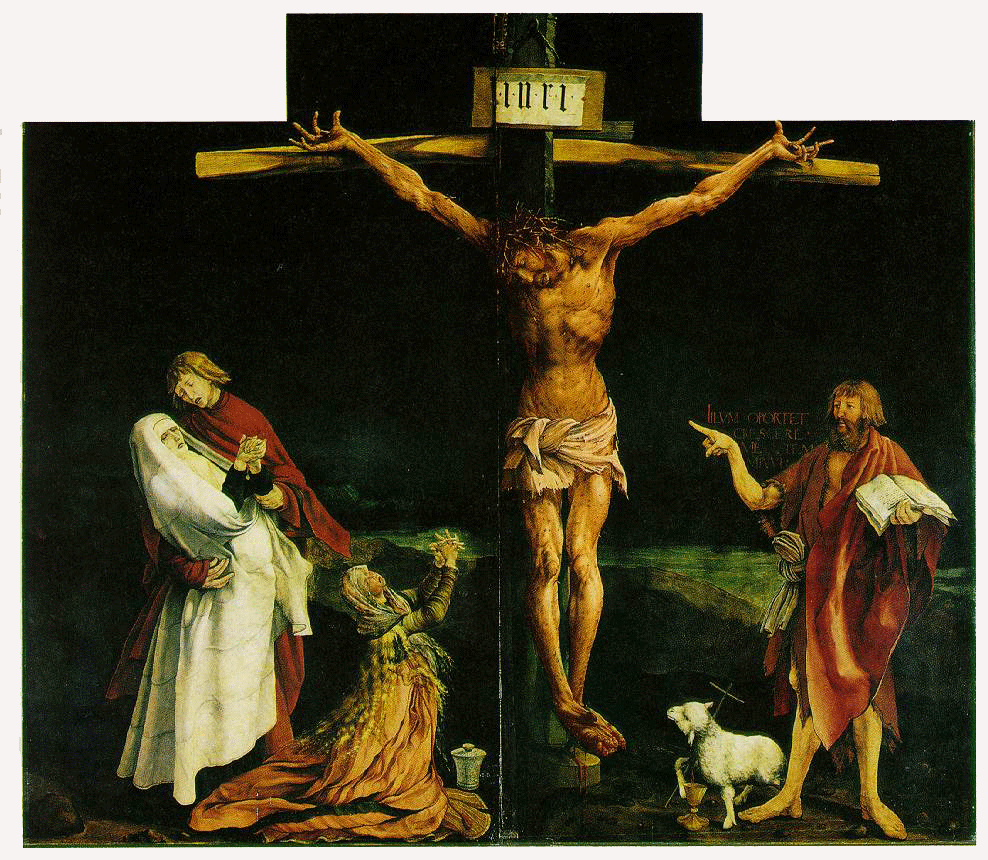
Did the ones who stood vigil at the cross really believe Jesus would die? I don’t think so. They expected a reprieve or a last minute miracle. After all, this was the man who stilled a storm, gave sight to the blind and raised a dead man. Was this his final display of strength in weakness?

II Corinthians 13:4
For to be sure, he was crucified in weakness, yet he lives by God’s power. Likewise, we are weak in him, yet by God’s power we will live with him to serve you.

It’s all there in the crucifixion story: die to live, weaken to strengthen, submit to rule, forgive to trust, suffer to heal, and so forth. These opposites trail after me. When am I going to get it?

Last night I had a dream about a very large black dog that charged toward me and instead of running away or standing stock still, I squatted down, held out my arms to hug him and nuzzle him. I seriously doubt this technique would work in real life. But in the dream, the dog responded and simply rubbed my face and neck the same way my big Snooki dog (a black lab mix) does. It’s a start.

Weakness can be a choice for the good of the moment.

For me, this means saying, “You’re right,” more often or “I take full responsibility for that mistake,” or “I was wrong.” It means listening even when I disagree. It means giving opportunities to others that I would like to have. It can mean serving without recognition or diligence without admiration. It can mean accepting surprises and unintended consequences with grace. It can mean a certain lack of control.

My big joke about myself has always been that I prefer “planned spontaneity.” When an old friend who was a 5th grade science teacher told me she would run experiments in class without knowing the outcome, I paled. How often have I told people, “I’ll do it!” not because I wanted to help but because I didn’t trust anyone else to “do it right.”

That’s a shame to me now. It’s time to respond differently. It’s time to let go of my controlling nature. It’s time to stop previewing the future, planning every step, and manipulating outcomes.

I’m not so sure that even Jesus knew how things would play out. But his trust in God was rooted deeply and in the end, even in fear and doubt, he died with hope. Was he surprised when he found himself back in the world? We’ll never know. But he certainly walked about in new understanding.

This is what can happen to us as well. Once we let go of “our way,” we are able to discover another way that is God-breathed.

Read Full Post »

I know God is trying to get my attention: sometimes through people telling me of roadblocks ahead while other times through circumstances. But, like a bull in a china shop, I tend to charge right in. On occasion, the china escapes unscathed. But too often, there’s a great sound of shattering glass.

II Corinthians 12:20
For I am afraid that when I come I may not find you as I want you to be, and you may not find me as you want me to be. I fear that there may be quarreling, jealousy, outbursts of anger, factions, slander, gossip, arrogance and disorder.

My independent streak started at a young age. My father died when I was only nine and I was a latch key kid for several years. My mother was a difficult woman who suffered from bipolar disorder (we only figured that out much later). She was unpredictable and ultimately, for me, unsafe. I told her as little as I could and I made many of my own decisions. These choices included getting married at eighteen (I was already a Junior in college), because I was sure I was ready to be out on my own, divorcing 5 years later, moving to New York City to be come “rich and famous.” These early years set up lots of walls.

It’s hard to hear or see warnings when a person is so doggone “capable.”

Somehow, I have allowed myself to believe that warnings are a negative thing. They are restrictions. They are penalties. But today, I have a new view.

God’s warnings are actually lighthouses. The beams of light give instruction and information: be careful, danger is nearby, be alert, watch! Everything is fine, just be on guard for challenges. Avoid unnecessary consequences. Change course if necessary. There is always another way to get there. I love you. I care about you.

As a parent, I have tried to be a lighthouse for my children. And don’t I do this out of my love for them? Would God do any less?

Read Full Post »

« Newer Posts - Older Posts »