Feeds:
Posts
Comments

Posts Tagged ‘Jesus’

Of the people in my world, few are under the rigors or traditions of Jewish law. Instead, we have allowed ourselves to be directed by the laws of modernity, culture, and the man-made rules and traditions of the institutionalized church.

Galatians 4:1a, 2-3, 4a, 5
What I am saying is that as long as the heir is a child, he is no different from a slave, . . . He is subject to guardians and trustees until the time set by his father. So also, when we were children, we were in slavery under the basic principles of the world. But when the time had fully come, God sent his Son, . . . to redeem those under law, that we might receive the full rights of sons.

When John the Baptist and Jesus shook up the Jewish people by announcing the long-awaited Messiah and the fulfillment of the ultimate promises that went back as far as Abraham, people freaked. They understood the implications of a Messiah in their world. They understood the law would be superseded by whatever He brought along. They understood there was an inheritance involved.

We don’t.

By “putting on Christ,” I am no longer just female or American or middle class. I am the seed of Abraham because Christ is the seed. [Gal 3:26-29]

It reminds me of the sad stories of wealthy men and women passing their money, their companies, their knowledge, and all their worldly goods to their descendants but it’s all destroyed or lost. The inheritance was full of promise but it was unrealized.

I feel like a modern day prodigal, wasting away the gifts of the Christ. I am a slave instead to my lifestyle, my debt, and my self-image. I am perpetuating 20th century goals and dreams to my children.

What does it really look like to wear Christ in the world?

Read Full Post »

From cupids to angels floating over the beds of children, I think our culture has made angels into Tinkerbell. Nothing could be farther from the truth if angels were involved in “putting the law into effect.” These messenger/warriors work directly with God’s anointed on Earth. They are formidable.

Galatians 3:19
What, then, was the purpose of the law? It was added because of transgressions until the Seed to whom the promise referred had come. The law was put into effect through angels by a mediator.

I have a friend who believes she saw an angel in her house while she was in prayerful intercession for her adopted toddler who was being pulled from their family and returned to his bio-father. She said the angel was more male than not, but also gender neutral. The angel was tall and barely fit in her dining room. He stood in what she interpreted as warrior regalia, including a sword. He stood as a though he were a guardian. He stood watch. At the time, she thought the angel was a sign and they would keep their son, but that was not the case. Apparently, there was some other danger in this situation. And although this was one of the most devastating circumstance, she experienced the power of angelic presence.

Apparently, angels do not just appear to anyone. They are God’s worker bees and they have purpose. They are sent. They interact with humans as needed. Angels cannot be prayed to or called upon.

I’m thinking that people who think they have had experiences or manifestations on earth with Christ or the Holy Spirit, may have actually had contact with an angel.

I have never seen an angel. But I have known people who I believe are mediators, who are totally submitted to the spirit of Christ, who have, indeed, been touched by angels.

What about you? Do you have a story?

Read Full Post »

This is what a lot of contract lawyers get paid to do: one to make the covenant and another to find enough loopholes to break it. What contracts or promises do we have to today that are truly binding? Partnerships? Marriage? Last Will and Testament? BFF? Pinky swear?

Galatians 3:15
Brothers, let me take an example from everyday life. Just as no one can set aside or add to a human covenant that has been duly established, so it is in this case [between God and Abraham].

The covenant promise between God and Abraham happened 430 years before the laws were established through Moses. But we are told, it was still rock solid after all that time. In fact, of the three parts of the covenant (land, blessings & a Messianic descendant), it is the third part that created the expectation or anticipation of a savior.

There are two kinds of covenants: conditional and unconditional. In the conditional covenant, both parties must agree and both must live up to their agreement. If either side breaks the covenant, then it is no longer binding. An unconditional covenant only requires the completion or fulfillment of the covenant by one side. The Abrahamic covenant only required God’s participation. Abraham just had to “show up.”

Once this covenant was completed with the arrival of the Messiah, he entered into yet another binding, unconditional covenant: Grace, which would manifest in eternal salvation (our sins covered by the blood sacrifice of the Christ).

Like Abraham, I just have to show up. I just have to say yes to this covenant. This is the contract of redemption.

But for me, the excitement is not in showing up. It’s taking full advantage of the covenant. It’s participating in the process. It’s being present in the story. It’s having a relationship.

Like a marriage, the wedding ceremony is nice and the symbols of rings, kisses and blessings are edifying and even memorable. But it’s what happens later that really counts.

Unlike a marriage, God is willing to take me back again and again when I fall away or stray. Though I be like Gomer [Book of Hosea], my God is patient, and gracious, and loving. This, then, is the covenant of hope.

Read Full Post »

Back in the day, particularly for the Israelites, the Law was everything. The law was their standard, their crutch, their security, their hope. Why a curse? Because no one could follow every jot & tittle of the law, and for this reason, they participated in the rituals of sacrifice and atonement. That was the point. The Messiah was promised to be the ultimate reconciliation.

Galatians 3:10
And all who depend on the Law [who are seeking to be justified by obedience to the Law of rituals] are under a curse and doomed to disappointment and destruction, for it is written in the Scriptures, Cursed (accursed, devoted to destruction, doomed to eternal punishment) be everyone who does not continue to abide (live and remain) by all the precepts and commands written in the Book of the Law and to practice them.
[Amplified]

This was the proposed road for the Israelites. For them to accept Jesus as the Messiah, they had to accept one final sacrifice as efficacious and complete. To accept the Messiah and then go back to the old way, was restoring the power of the curse.

The second leap for the Jews who accepted Jesus as the Messiah was to accredit the blessings of Abraham (once relegated to their people alone) to the Gentile believers. The exclusive club was no longer a matter of birthright, history, or ancestry.

A single act reboot the system.

As a believer, I am confessing that the work of Christ is the restoration act between me and God. Where the door was closed, it is now open. I may enter the realm of God, the divine. I may participate in holiness. I am permitted to be in relationship . . . not because of what I have done (or not done) but because of who “He” is, that is, the Christ/Messiah for the world.

Read Full Post »

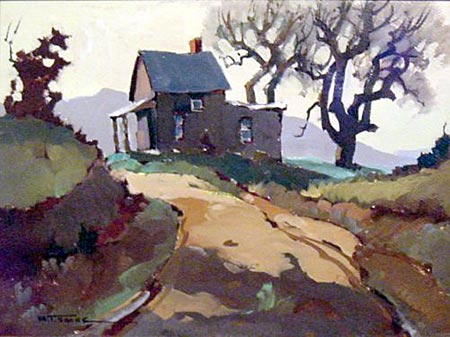
Art by Walter Thomas Sacks

The path to Christ begins with the One God. The whole point of Christ’s presence in the world is based on the covenants, mandates, and promises of Yahweh. If there is no God, then Christ is a non-issue.

Galatians 2:20
I have been crucified with Christ and I no longer live, but Christ lives in me. The life I live in the body, I live by faith in the Son of God, who loved me and gave himself for me.

I know there are a lot of people who struggle with the idea of the Christ as the “only” way to God. And who am I to say that this is definitively true. However, it is clear to me that it is a way that God provided, a way that was established in the laws of the Jews (a people group who worshiped that One God through time immemorial).

If God is in the “house” then Christ is the door. If someone else wants to try to get in through the chimney or the plumbing, who am I to stop them?

Besides, it’s not just getting in, it’s relationship. The way of Christ opens the door as well as providing an automatic translator. The Christ spirit cleans up the signal.

But, like the teenagers in our home, no matter how many times I say that I can show them how to do something easier, they want to try it their way first. That’s fine. Sometimes, we need to go through the process, the cycle of learning. I did the same thing.

But now I know. I chose this way of Christ. I accepted the offer. I want to see it through. Amen.

Read Full Post »

How do I convince someone that what I’m saying is the truth? I mean, really! People lie all the time. Show me a person who says he/she doesn’t lie and I’ll show you someone who is lying. It’s human nature: a slight embellishment, a minor distortion, a self-protection. And yet, when it’s really important . . .

Galatians 1:11, 20
I want you to know, brothers, that the gospel I preached is not something that man made up. . . . I assure you before God that what I am writing you is no lie.

How can I “make” someone believe me? Answer? I can’t.

“I believe you” must first be built on a foundation of trust. If trust is missing or lost, all bets are off. As soon as trust is broken, it’s a very long road back to acceptance. Betrayal is the antithesis of trust. They cannot co-exist.

In Galatians, Paul is trying to remind those churches of the bedrock he laid down for them while he was among them. Jesus did the same thing before his final sacrifice, he built trust and believability. He didn’t just walk up to people and say, “By the way, I’m the Son of God and I’ll be dying for your sins.” He would have been led to the nearest loony bin.

It’s really a simple equation: to the degree that I trust a person, it’s the same degree to which I will believe.

I trust God. I trust Christ.

But here’s what I’m thinking. The next time I don’t believe someone, I need to figure out what would change my mind. What is my criteria for trust? And the same in reverse. When someone doesn’t believe me, I must ask, “what do you need from me to believe me?” If there is no paradigm, then I can’t shift it. If the person cannot articulate what is needed to bring change, no change can happen. And that reality works both ways as well.

Read Full Post »

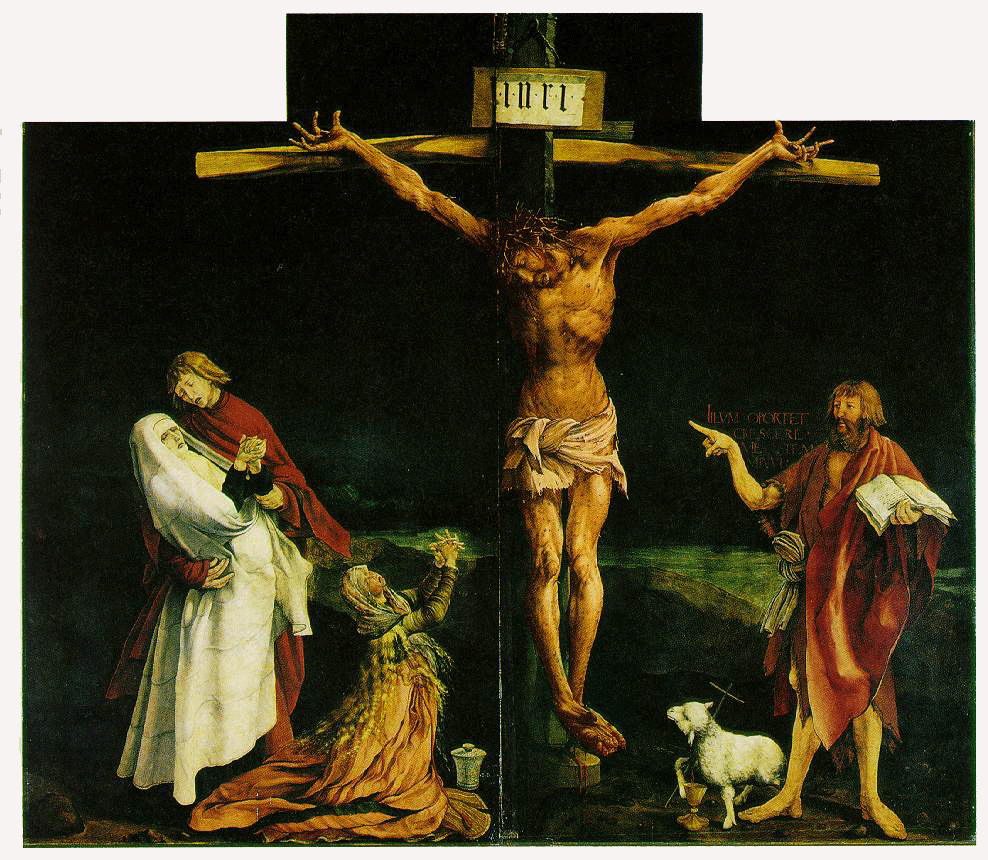
Did the ones who stood vigil at the cross really believe Jesus would die? I don’t think so. They expected a reprieve or a last minute miracle. After all, this was the man who stilled a storm, gave sight to the blind and raised a dead man. Was this his final display of strength in weakness?

II Corinthians 13:4
For to be sure, he was crucified in weakness, yet he lives by God’s power. Likewise, we are weak in him, yet by God’s power we will live with him to serve you.

It’s all there in the crucifixion story: die to live, weaken to strengthen, submit to rule, forgive to trust, suffer to heal, and so forth. These opposites trail after me. When am I going to get it?

Last night I had a dream about a very large black dog that charged toward me and instead of running away or standing stock still, I squatted down, held out my arms to hug him and nuzzle him. I seriously doubt this technique would work in real life. But in the dream, the dog responded and simply rubbed my face and neck the same way my big Snooki dog (a black lab mix) does. It’s a start.

Weakness can be a choice for the good of the moment.

For me, this means saying, “You’re right,” more often or “I take full responsibility for that mistake,” or “I was wrong.” It means listening even when I disagree. It means giving opportunities to others that I would like to have. It can mean serving without recognition or diligence without admiration. It can mean accepting surprises and unintended consequences with grace. It can mean a certain lack of control.

My big joke about myself has always been that I prefer “planned spontaneity.” When an old friend who was a 5th grade science teacher told me she would run experiments in class without knowing the outcome, I paled. How often have I told people, “I’ll do it!” not because I wanted to help but because I didn’t trust anyone else to “do it right.”

That’s a shame to me now. It’s time to respond differently. It’s time to let go of my controlling nature. It’s time to stop previewing the future, planning every step, and manipulating outcomes.

I’m not so sure that even Jesus knew how things would play out. But his trust in God was rooted deeply and in the end, even in fear and doubt, he died with hope. Was he surprised when he found himself back in the world? We’ll never know. But he certainly walked about in new understanding.

This is what can happen to us as well. Once we let go of “our way,” we are able to discover another way that is God-breathed.

Read Full Post »

« Newer Posts - Older Posts »