Feeds:
Posts
Comments

Posts Tagged ‘within’

Treasures

heart sunDo not store up for yourselves treasures on earth, where moths and vermin destroy, and where thieves break in and steal. But store up for yourselves treasures in heaven, where moths and vermin do not destroy, and where thieves do not break in and steal. For where your treasure is, there your heart will be also. [Matthew :19-21]

What do I treasure really?

I cherish my family and feel very fortunate to have a nice home, a stable marriage, and three good kids who are growing up to be productive adults. I love my extended family and in general, they are also secure and in relative good health. But, are they my treasures. Really?

I adore my pets (all six of them) and I miss them terribly when I travel.

I have very few precious jewels, in fact, I’m pretty sure I only have one and I wear it every day on my ring finger. I have a few antiques of minimal value and I have some paintings that were done by friends and family which I would grieve if they were lost in a fire or whatever.

I have my manuscripts, still in progress, and that would be devastating, so much work lost. And yes, I truly do treasure these personal efforts, these collected words of heart. I think I should probably back those up.

I would hate to lose my good camera or the hard drive with all the pictures. I would hate to lose the things I purchased as mementos of my travels or the books I’ve accumulated over the years.

None of these things, not people, not things can I take with me into the next dimension, that other world, that heaven. It is only spirit that travels on and the strength and wholeness of my spirit is dependent on the care with which I have interacted with the Holy Spirit. My faith now will make a difference. The way I live in the Presence changes me. The Christ directs me . . . if I allow it.

It’s the surrender part that always gets in the way. And yet, I know, intellectually, how critical it is for this surrender to take place daily, hourly, and even minute by minute. It is surrender to the Spirit that builds treasure, an everlasting treasure. This is part of the mystery.

Read Full Post »

It’s so much easier to speak of the spirit world in different contexts, fantasy for instance. In those circles, it’s the norm to speak of spirits, magic, miracles, powers, spiritual enemies and spiritual good guys. But we have lost our ability in this age to speak of the Spirit World.

I John 4:4
You, dear children, are from God and have overcome them, because the one who is in you is greater than the one who is in the world.

Despite the fact that numerous references are made to this spirit world in scripture; I am particularly thinking of Ephesians 6:12 as a good example, “For our struggle is not against flesh and blood, but against the rulers, against the authorities, against the powers of this dark world and against the spiritual forces of evil in the heavenly realms,” we hesitate to claim it as our own. It’s all woohoo stuff! And so, most folks shrug off spirit talk.

But I cannot. The epistle of I John speaks at length about spirit relationships: our own spirits, those of the “anti-christ” opposed to all Christ spirit, the spirits of the world, the spirits of believers, and the spirits of God followers. This is the unseen world and yet, more and more, I do believe it is the most important part of our existence.

We are multi-dimensional for a reason. And there are enough people, even in modern times, who have had significant experiences with Spirit that it seems foolish to disregard this aspect of our humanity, our spirituality, our essence.

I guess the big question is in the tension that arises when we refer to “good” and “evil” spirits. And I understand that hesitancy, but there is simply too much evidence to deny them. For me, the truth of evil places human depravity at the feet of its source: the realm within.

Do we really think that the battles we carry on in the flesh will change the spirit? Will our wars block the power of evil’s presence and influence? Will our gun laws prevent their distribution on the streets of our cities? Will our capture of kilos of cocaine prevent the fields of poppies from being grown again?

We are back to the single word that explains the Way of the Spirit realm: paradox. It’s not the very reasonable approaches to problems of our world that will change it, but the opposite. If not, if it’s all Pollyanna, then why did Jesus bother to say any of it? I know things are bad now, but things were bad then too: almost everyone was poor or under the iron fist of a dictator or slave owner, violence was the norm and so was hunger. There was no “upward mobility,” there was no middle class. Back then, it wasn’t just the 99% but 99.9% of the people who suffered under human indignity and loss.

They had good reason to look and wait for a revolution. Instead, Jesus proclaimed a victory for the interior life as the starting point for change. Do we follow? Do we believe?

Read Full Post »

For years, I have always thought of the “Anti-Christ” as a person. I supposed it’s all that Tim LaHaye & Jerry Jenkins stuff, pre-tribulation, pre-millenialism, and the rapture. Those folks have an entire time line for the appearance of the Anti-Christ. But John sheds a different light on the concept in his letter.

I John 4:2-3
By this you may know (perceive and recognize) the Spirit of God: every spirit which acknowledges and confesses [the fact] that Jesus Christ (the Messiah) [actually] has become man and has come in the flesh is of God [has God for its source]; And every spirit which does not acknowledge and confess that Jesus Christ has come in the flesh [but would annul, destroy, sever, disunite Him] is not of God [does not proceed from Him]. This [nonconfession] is the [spirit] of the antichrist, [of] which you heard that it was coming, and now it is already in the world.
[Amplified]

If John is to be believed, a simple litmus test is the willingness of the spirit to confess that Christ is indeed, the long-awaited Messiah. In biblical times, maybe this was easier to do. After all, the Jewish people had been waiting for the Messiah for centuries, his coming foretold by prophet after prophet. They expected and even longed for that day, anticipating a revolution of epic size that would, once and for all, free Israel from its enemies and usurpers.

Immediately after Christ’s appearance, ministry, execution, and resurrection, the guidelines were clear-cut: a person accepted Christ as the Messiah or not. If there was no Messiah, then there was no Christ, and Jesus was a nice guy who turned their world topsy turvy for for no good cause.

So, anti-Christ is not necessarily an individual per se, but a belief, or rather, a disbelief. And I think it’s called a spirit because belief happens within. It is my spirit that chooses, that part of me that works with my mind and soul, to unify the interior life and direct my actions & choices.

In modern times, this confession or lack of confession, is less understood or accepted. We have more relativism and few people (outside the circles of denominational Christianity) like the “black and white” feel of this mandate. Plus, other requirements have been added such as a verbal confession or attendance in church or getting splashed/dunked with water, just to name a few.

But, I remember vividly, my spirit confessed the Christ, because of statements like these written as the word of Jesus, “If I am telling the truth, why don’t you believe me? Whoever belongs to God hears what God says. The reason you do not hear is that you do not belong to God.” [John 8:46b-47] I could not call Jesus the lie. And I wanted to hear God. I wanted to be part of the God equation, the interaction, the indwelling of Messiah through the Holy Spirit.

And so, this is the one confession: I believe the source of Christ was and is God. And as a result, the Holy Spirit dwells within me.

My primary responsibility as a result of this confession is to love God with all my heart, soul, strength, and mind, and to love my neighbor as myself. The rest is human confusion.

Read Full Post »

Anyone want comfort or rest? Then it is right here: God is greater than our hearts–my heart. God’s spirit occupies more of me than myself, if I so allow. Where many of today’s protest encampments are full of angst and anger, this occupation is mutually agreed upon and full of promise.

I John 3:19-20
This is how we know that we belong to the truth and how we set our hearts at rest in his presence: If our hearts condemn us, we know that God is greater than our hearts, and he knows everything.

But, as I tell my children, over and over again, “Ya gotta want it.” We all know, whether we are in our twenties or in our sixties, life is difficult. There are brick walls that rise up along the way and, in our own strength, we can either choose to climb over, break through, or walk away. Within the presence of God however, these life choices can be different. Why? Because living in the Presence, is walking out an enormous set of paradoxes, one after the other. The brick walls can shift before our very eyes, the pathways re-orient, the solutions morph, the night become day, the sorrow become joy.

In the presence of a Holy God, anything can happen. In the presence of a Holy God, I transform and I can stop the old games, the old scripts, the old desires. I can because I want, I desire to participate in this interior life.

OK, a lot of this is still theory. I mean, I am so sure that this is what can happen within, but I have not quite gotten the hang of it yet. I have not quite surrendered to that Holy Spirit. There are glimpses though, and that’s why I know it’s real. But then, like Peter walking on the water, I become fearful: it’s not the norm, it’s a different “matrix.”

This is where some of the “new age” folks are closer to the truth that the Christ-followers. We keep putting God in a box, as they say, or confine God to our limited understanding. We keep putting a white-haired, long-bearded man on the “throne of heaven” and teach our kids that God is like this – some white-robed Santa or friendly Zeus.

It is my own heart that limits the wonder of God in my life, that constrains the grace of Christ, that distrusts the benevolence of the Holy Spirit.

Lord, forgive me. I want to walk on water in your Presence.

Read Full Post »

In Him, that would be Christ, no sin abides. So what does that mean? I love asking such questions, particularly with familiar verses. And what is “sin” really? The Amplified translation gives some extra hints:

I John 3:5b-6
And in him is no sin. No one who lives in him keeps on sinning. No one who abides in Him [who lives and remains in communion with and in obedience to Him–deliberately, knowingly, and habitually] commits (practices) sin. No one who [habitually] sins has either seen or known Him [recognized, perceived, or understood Him, or has had an experiential acquaintance with Him].
[Amplified]

To be “in Christ,” then is to be in relationship or communion with Christ–it means, having such an intimate knowledge of Christ that I would know what would displease Christ’s Spirit within me. I would recognize what is often called “a check in the Spirit,” that still small voice that says, “not that way, this way,” or “eat this, not that,” or even more simply, “let go of that thought.”

This relationship is nurtured in personal prayer, devotion, worship, and ideally, fellowship with like-minded people who are also “in Christ.”

It’s like being in a swimming pool together: everyone is wet, sharing the water, but we’re all doing different activities, we’re all in various depths. The more experienced ones know how to swim while others merely wade or stand around. Some love it so much, they can swim underwater the whole distance of the pool.

Sin is a buzz word that has gotten a bad rap. I have actually seen people roll their eyes when the word, sin, comes into the conversation. I’m not sure how this has happened. Perhaps it’s the growing relativity of our actions. It’s become more and more difficult to identify sinful behavior. Truly. And I’m not saying I can be the one who draws that particular line in the sand either. Most will say the Bible itself identifies sin, but in a post-modern world, that may not be so black and white. Oh, there are entire groups of people, denominations or sects, or whatever, who believe they have it down, but I’m not so sure anymore. After all, whether we like it or not, there are many modern behaviors and practices that were clearly sin in the past but which society, in general, has embraced (divorce being the most prevalent).

Don’t get me wrong, I love the Bible and all that it has to teach me. And there are some clear parameters that humans have accepted over the test of time: murder, for instance. But few people would acknowledge that coveting (a popular American sport), is truly a sin anymore.

All right, sin is a huge topic and cannot have a full discussion here. But I did want to make one point that I learned from Joyce Meyer, that sin is birthed in the mind (see her series on Battlefield of the Mind). And this is the key to the whole thing.

If I am in deep relationship with the Christ spirit within (in Christ, Christ in me), then the inklings of sin, the desires, the intentions, the motives, the impetuses, will not germinate. That is part of the role of the Holy Spirit, to mirror my thoughts, to cleanse, to reveal the implications, to heal, to winnow the seeds of actions that will harm me and others. Sin usually dies on the vine if it is never watered or fertilized in the mind and heart. Selah.

Read Full Post »

It’s not the perfection but the imperfections of our lives that make place for the Word, the divine message, the working out of becoming more like Christ. When I try to act like Christ on my own, I crowd out the essence of my formation and transformation within.

I John 1:10
If we claim we have not sinned, we make him out to be a liar and his word has no place in our lives.

Our new church is starting a series of services that are being coined “Deeper.” I like this characterization of the process of becoming, of making place, of re-engineering our interior maps. In order to have a deeper relationship with our God, we must be more courageous–that is, courageous about revealing the truth, or better said, revealing the lies we tell ourselves.

In the deeper place, the sins are equally prevalent as the ones people can see on the outside: the over-eating, the lusting, the coveting, the breaking of laws (both small and large), the deceptions. Those manifestations found root inside first.

The first lie is the one we tell ourselves.

Read Full Post »

I am no scientist so I don’t have much to add to any discussion about “light” as a phenomenon. I know that light travels very fast and mostly we see light as a reflection. I know light can be a wonderful respite in a dark place and intolerable with a migraine. But am I in relationship with Light?


I John 1:5, 7a
This is the message we have heard from him and declare to you: God is light; in him there is no darkness at all. . . . But if we walk in the light, as he is in the light, we have fellowship with one another, . . .

It’s difficult to talk about light in some new way that hasn’t already been investigated, sermonized, or otherwise been fully covered through exegesis. The only opening in this very crowded marketplace would be something very personal.

So what could that be? How do I engage light in my daily life? The light I read by at night in my bed? The lights of my car when I’m driving at night, less and less securely? The light of the computer screen? The light of candles that dot most of the surfaces in my home? The only time my family doesn’t complain about the candles are those infrequent days when the electricity goes out. There is the light in the refrigerator that I take for granted. There is the light in my stove that has never worked. There is the street light outside that manages to seep through my blinds and twinkle just enough to wake me in the middle of the night. There is the light show from my cable and router, day and night, pulsing out the information bits that stream across my desk.

But all of these lights are outside of me.

Do I know the light within? Is it just an idea, a way of expressing an unknowable, unseen presence? Or is there light in the soul, the heart, the spirit?

Other faiths speak of the light as well. New Age folks as well as various Eastern religions follow the idea that the light within is one of the most powerful energies in the Universe. The Light of the World.

Light to light: heart to heart: human to human: God to human and back again.

Don’t get me wrong, I don’t want to artificially “glow in the dark” which is apparently now possible in animals through some kind of scientific hi jinx. Here’s a story about glowing cats. But I would like to experience the light within in a tangible way. Is that stupid? I suppose some would say I’m talking about “aura” or some other para-psychological phenomenon.

I don’t mean that either. God is Light and God is within. Therefore, light is within and that light must be of greater value than just a nice metaphor.

Relax, everyone. I’m just thinking out loud. Has anyone out there had a Christ-based experience with Light? I’d be interested in your stories.

From the web: (an excerpt from the publication, Sacred Architecture)
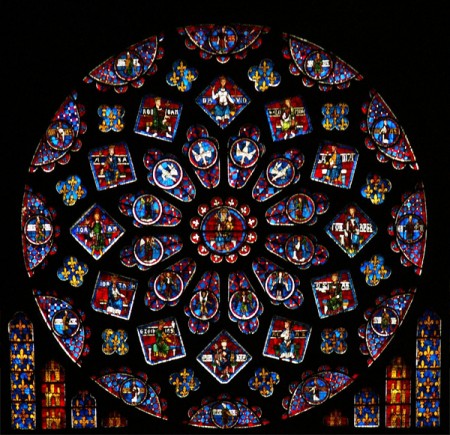
Light, then, formed the “medium and message” for illiterate Christians of the Middle Ages, using narrative and metaphoric imagery to convey the truths of the Faith while steeping the faithful in the spiritually evocative experience of the beauty of God with a mystical atmosphere created by jewel-toned pictures written in light, as well as subtly changing colors in the air and on interior stone walls. The faithful, accustomed to learn aurally, received the message of the Gospel verbally—but with reinforcing visual images created by light, sources of beauty and awe that, it was believed, could mystically connect the eyes of the beholder with the truths depicted, and thus remain lifelong reminders of catechetical knowledge and of the experience of God.

The modern church would do well to rediscover these proven catechetical techniques, filling church interiors with beautiful images of colored light, thereby satisfying human desires for visual stimulation, symbolic representations of theological truths, and the touch of the mystical in prayer. Modern eyes are exposed to so much sophisticated visual imagery; our catechetical efforts should include much more than written words by building upon the rich heritage of visual catechesis displayed by the traditions associated with stained glass windows. The Church teaches that eternal bliss in Heaven is the Beatific Vision—an experience expressed as a “visual” encounter with the knowledge of God, a “light” that fulfills and completes each person’s existence for all eternity. By providing visual and atmospheric beauty that captures the eternal truths in “lights of Faith,” the windows in our churches can teach as before and give an experience of the transcendent to the faithful, to “go beyond mere teaching—unless the sudden instinctive recognition of beauty is the greatest lesson of all.” — Lights of Faith, Stained Glass Windows as Tools for Catechesis by Carol Anne Jones

Read Full Post »

« Newer Posts