Feeds:
Posts
Comments

Archive for the ‘Advent’ Category

numbersWhat is it with human beings and counting? How many kids do you have? How many dogs and cats? How many people came to church on Sunday? How many books were checked out of the library? I mean, what does it really mean anyway, these sum totals?

 In those days Caesar Augustus issued a decree that a census should be taken of the entire Roman world. [Luke 2:1, NIV]

Apparently, the main reason that censuses were taken in the past was for tax purposes. According to the article in Wikipedia, the census around the time of Jesus birth was actually the Census of Quirinius, based on the history written by Josephus (however, there are historical problems with this date and the generally accepted date of Jesus’s birth–a challenge for the scholars I suppose, but that relevant to me. However, for more about this conflict, read the article). And apparently, the Jews resented the taking of the census anyway because of its implications for the domination of Rome over their country and their livelihoods. The prevailing opinion was that the taxation would be too high (sound familiar?). The zealots began their rebellion during these times.

In modern times, the census (supposedly) ensures that all people will be adequately represented in our government through representatives and senators and the like. However, that system is currently very broken and no census will fix it.

So, let’s go back to the more general idea of counting. Why do we count the number of people or things in a place at a certain time? Why do we believe that the higher the number, the more successful we are or the more plenteous our booty? When it comes to money, the rich get richer and the poor wish harder.

By the way, there’s no census in heaven.

In fact, all of this counting and measuring is human in origin. As is time. How much and how little? How many and how few? How long and how short? We compare to one another and we compare to history (as though the circumstances in the past could actually compare to whatever is now). Sort of silly really.

There is another biblical story about the census that has completely different aspect [I Chronicles 21], in which David declares thatcounting days a census would be taken, without the blessing and/or direction of God. According to one scholar, “. . . God was angry at David, in those times, [because] a man only had the right to count or number what belonged to him.” And I find that concept fascinating. Perhaps we need to consider if we are counting too many things that are not ours to count?

This then begs for the challenge, does God own everything? Have I given over that “ownership” or not?

Read Psalm 50:10-12: ” . . . for every animal of the forest is mine,
    and the cattle on a thousand hills.
I know every bird in the mountains,
    and the insects in the fields are mine.
If I were hungry I would not tell you,

    for the world is mine, and all that is in it.

For if everything I own is God’s, then I don’t need to really count or worry about that number being large or small. If I could just stay focused on the quality of my relationships, the quality of my service, the quality of my work and lifestyle, then the numbers game could fall away and into the very hands of the Christ who lives within me: teacher, guide, savior, CEO.

Read Full Post »

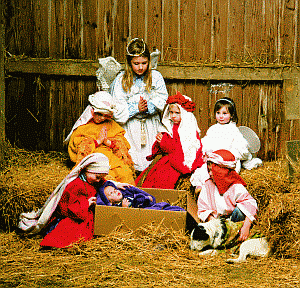
nativity scene with childrenIf you went to church as a kid, you know that the Baby Jesus was born in a manger because there was no room for them at the inn. Many of us have been in those Christmas pageants, where one of the girls got to play Mary (coveted role) while another girl had to play Joseph  with a fake beard and they walked across the stage from inn to inn asking for a place to stay because, after all, Mary was preggers. All the innkeepers shook their heads no until one nice one agreed to put them up in the stable (or was it a cave–biblical scholarship is mixed on this minor point).  But then, voila, baby appears in a soft bed of hay with a pretty blue blanket.

While in Bethlehem, she went into labor and gave birth to her firstborn son. She wrapped the baby in a blanket and laid Him in a feeding trough because the inn had no room for them. [Luke 2:6b-7, The Voice]

But really, don’t we all know, having a baby in a stable could not have been a picnic. And don’t we wonder, did Joseph help Mary through her labor, telling her to breathe rhythmically? I doubt it. There may have been a midwife, but we will never know this part of the story. It’s been sanitized over the years and honestly, by the men who wrote it. Back in those days, having babies was woman’s work.

Did Mary wonder? First a bright, slightly overwhelming Angel comes to her with the big news that she’s having a baby by the touch of God and then, her world begins a slow crumbling until her ends up in a strange city, pregnant, with not even a bed to give birth to this wunderkind. Oh yes, Mary had lots to ponder in her heart [Luke 2:19].

I can imagine that throughout the time of her pregnancy and the birth of her son, she was feeling ostracized from her community and her family. I doubt very seriously that anyone around her (except for Elizabeth who lived in a different city altogether), believed Mary was the anointed mother of the Messiah.

There was no room for this story as it was happening.

All she had was a prophecy, a promise, a supernatural appearance, and a dream to hold on to through their trials. They were homeless and alone. They were poor and without many resources.

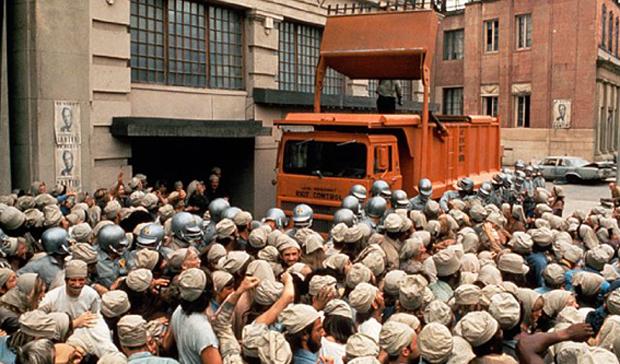
soylent greenWhen the phrase “no room” came to me, outside of the Bethlehem story, I remembered the science fiction movie, Soylent Green, a film that was loosely based on Harry Harrison’s novel, “Make Room! Make Room!” :  a civilization gone mad, over-populated and consuming green wafers made from– (well, you should watch the movie or read the book). There was little room for anything or anyone. No room for human caring, no room for individualism, no room for random acts of kindness. Nothing, just survival: food, shelter & clothing. Is it too much to ask?

But are we doing much better? Have we such busy lives that there is no room? Have I? Is my schedule so packed that there’s no room for the unexpected need, the human soul in distress, the unforeseen incident or meeting? Am I turning away a Mary or a Joseph because I am too busy? Am I turning them away because I am protecting my own little half acre? Really? No room?

Who am I in the real Christmas story played out every day?

Read Full Post »

Second_Sunday_of_AdventThe word does not appear in scripture as part of the Advent story. In fact, the four references in the New Testament have to to with the day before Sabbath or the day before Passover. It is a time for getting ready. It is one of the reasons Jesus was taken down more quickly from the cross in response to a request from the Jewish leaders. In most Advent traditions, the second week is given the word, preparation. paraskeuē
means to make ready or equip.

In the old testament, one of three appearances of this word is this:
Go, consecrate the people. Tell them, ‘Consecrate yourselves in preparation for tomorrow; for this is what the Lord, the God of Israel, says: There are devoted things among you, Israel. You cannot stand against your enemies until you remove them. . . . ” [Joshua 7:13, NIV]

In this case, it is part of the story of Achan who, when the army of Israel under Joshua destroyed the city of Jericho, everything was to be killed except for Rahab and her family and all of the gold, silver, and other precious treasures were put in the treasury of the Lord’s temple; the rest was burned. But Achan coveted and secreted a few beautiful things and silver. And when they went to battle a second time, 36 men died and the army fled from the men of Ai. When Joshua lamented to God, he heard from God clearly of betrayal in the camp and for this cleansing, everyone needed to prepare, for the perpetrator would be revealed the following day.

Preparation then is a combination of cleansing and equipping. Since the Israelites were not allowed to work (even the women), all work had to be completed on the 6th day. The 7th day was a day of rest and this was a day for the Lord, time in study, prayer, and worship. This was God’s day. In some ways, even in Achan’s story, it was God’s day, who identified the sin and cast it out from among them. So, God can cast out our own sins, if we confess and lay them out honestly before God.

Jesus came to us as a baby, in innocence of experience but still full of the Holy Spirit. And perhaps it is one of the mysteries of being “born again,” to return to a purer time when the fullness of the Spirit has reign and learned responses to the world do not win out of habit.

Christmas time is also a time of much preparation. Unfortunately, we have lost most of the purpose of this preparation. The apex or crowning moment would be the symbolic birth of Christ celebrated and remembered. It is could be a holy day of remembrance. Instead, it has become a day of consumerism gone wild. I am no different from you. I do the same. I don’t really know how to stop it without the buy-in of family.

Too much effort in the preparation and not enough effort in the day at the end, the day of rest and remembrance.

Read Full Post »

Once Johnson & Johnson took over the word Pledge, it’s lost some of its power. Despite the fact that children and adults “pledge” allegiance to our flag, sometimes as often as daily, its meaning has been lost. The word is actually in the “vow” family, but that too has lost much of its significance, in an age of quick no-contest divorces. Most folks think of a pledge (perhaps it’s all those non-profits and churches) as a good-natured “I will if I can” kind of thing. But honestly, the definition is much more binding, a legal relationship, a solemn promise. I’m thinking that when we break a pledge, it sets all kinds of sowing/reaping and karma into motion.

This is how the birth of Jesus the Messiah came about: His mother Mary was pledged to be married to Joseph, but before they came together, she was found to be pregnant through the Holy Spirit. [Matthew 1:18, NIV]

pledged to marryThe word pledged in this passage is the NIV version of course, most standard translations render mnēsteuō  as “betrothed” and more reader friendly versions translate the Greek word to “engaged.” In our day and age, we treat this relationship equally lightly. Give back the ring, shed many tears, post it on Facebook, remove one’s relationship status, and we’re done.

But in the day of Mary and Joseph, the betrothal was virtually equal to the marriage vow itself. To break a pledge of this type required a formal divorce. And the only way a man could divorce a woman in those times was for the cause of infidelity (a one-sided benefit by the way, since a woman could not divorce a man). Joseph was within his rights to have Mary stoned.

It has been said that the church is the bride of Christ (see Revelation 19-7-9) and upon Christ’s return (whatever that might really mean), a great wedding will take place. So, if the wedding is yet to come, we, who have accepted Christ are actually betrothed or pledged to Christ. Will we take this role lightly then or consider it in its most serious form: a vow, a sacred promise to be faithful?

Read Full Post »

Art by Desexign

What is a dream? Night time dreams and daydreams are what I think of first, but other symbolic uses come up as well. I suppose the most prevalent one is the speech by Martin Luther King, Jr., who said “He had a dream . . . ” as he looked to a brighter future. He was a visionary. And I think of Don Quixote who “Dreamed the Impossible Dream.” Quotes aplenty sprinkle the web. Check them out for encouragement.

But after he [Joseph] had considered this [divorcing Mary quietly], an angel of the Lord appeared to him in a dream and said, ‘Joseph son of David, do not be afraid to take Mary home as your wife’ . . .  When Joseph woke up, he did what the angel of the Lord had commanded him . . . ” [Matthew 1:20a; 24a, NIV]

But I am looking at a specific kind of night dream that a humble carpenter had when his fiancee became pregnant. Being a nice guy of sorts, he decided to divorce her quietly, although I find that amusing since her pregnancy, without his protection, would have ended her stoning. I think he was rather more interested in a) not participating in the punishment, and/or b) disassociating with her and her family. Also, he was a fearful man who could not imagine dealing with the fall-out.

And yet, he had a dream.

How do we know when a dream is from God? I’d say, in general, that the dream contradicts our normal thinking about an event. A dream brings in new information that we would normally suppress. And I believe it’s straightforward.

When I was still struggling with my decision about accepting the Christ, I had a vivid dream of standing on rope bridge. Below me, what initially looked like roiling water and waves, was human bodies. At one end of the bridge was a woman who was interested in enticing me into her lifestyle, both decadent and exciting. At the other end, was a man who had introduced to the stories of Jesus and prophecy in the Old Testament, a “holy” life I could not fathom for myself at the time. I was torn between the two but knew I had to choose one way or another or I would be pulled into the maelstrom below, lost to both. This was a dream from God, still distinct in my mind after more than thirty years.

I am without doubt that Joseph’s dream stayed with him until he died. We don’t have a record of Joseph’s later life, how he died or when. He and Mary bore other children after Jesus, so we know he didn’t disappear and he was still on the scene when Jesus was twelve. But after that? We’ll never know. But we have a dream and savior because one man submitted to a dream.

To accomplish great things, we must not only act, but also dream; not only plan, but also believe. Anatole France.

Read Full Post »

It’s a baby, a little, little baby. How sweet. How cute. What potential!

This will be a sign to you: You will find a baby wrapped in cloths and lying in a manger. [Luke 2:12, NIV]

babyIn Greek, the word is brephos, which can either mean an unborn child or a newborn child, but interestingly enough, this word is gender neutral. As a result, this is the same word that is used for the baby that Elizabeth carries in her womb and “leaps for joy” when Mary came to visit [Luke 1:41], along with six other references. And my favorite reference is in I Peter 2:2, where brethos is used to describe young believers who should crave “spiritual milk,” and cast off the food of the world.

But I’m getting off track. I wanted instead to talk about a baby’s potential. You see, from the outside in, we do not know what is in store for every baby we see. Facebook is filled with pictures of babies, taken by proud parents, who are full of hope and expectations for their baby. They want to give this baby the best of everything, the opportunities, the nourishment, the foundation. They love this baby so much.

And yet, how many mothers collapse in grief when their child becomes a murderer or a drug addict or an abuser? How did this happen? What happened to all that potential?

We know that prophecies abounded about the Christ child who would come into the world innocently enough, but who knew his life would only last 33 years? Who knew he would be mostly rejected? Who knew, really, that it would all happen to this particular baby? Not even the mother knew for sure, despite the miraculous circumstances of his birth. She continued to ponder all those things in her heart [Luke 2:19]

A baby depends on the “village” around him/her to grow and become. If we succeed, if God’s intent is encouraged and prevails, we have a saint. But if we fail that child, what then?

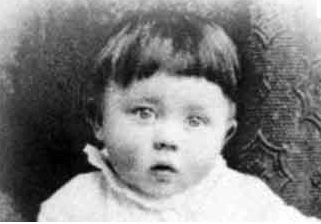
Hitler’s First Photograph
——-Wislawa Szymborska

And who’s this little fellow in his itty-bitty robe?
That’s tiny baby Adolf, the Hitlers little boy!
Will he grow up to be an LL.D.?
Or a tenor in Vienna’s Opera House?
Whose teensy hand is this, whose little ear and eye and nose?
Whose tummy full of milk, we just don’t know:
printer’s, doctor’s, merchant’s, priest’s?
Where will those tootsy-wootsies finally wander?
To garden, to school, to an office, to a bride,
maybe to the Burgermeister’s daughter?

Precious little angel, mommy’s sunshine, honeybun,
while he was being born a year ago,
there was no dearth of signs on the earth and in the sky:
spring sun, geraniums in windows,
the organ-grinder’s music in the yard,
a lucky fortune wrapped in rosy paper,
then just before the labor his mother’s fateful dream:
a dove seen in dream means joyful news,
if it is caught, a long-awaited guest will come.
Knock knock, who’s there, it’s Adolf’s heartchen knocking.

A little pacifier, diaper, rattle, bib,
our bouncing boy, thank God and knock on wood, is well,
looks just like his folks, like a kitten in a basket,
like the tots in every other family album.
Shush, let’s not start crying, sugar,
the camera will click from under that black hood.

The Klinger Atelier, Grabenstrasse, Braunau,
and Braunau is small but worthy town,
honest businesses, obliging neighbors,
smell of yeast dough, of gray soap.
No one hears howling dogs, or fate’s footsteps.
A history teacher loosens his collar
and yawns over homework.

— Stanislaw Baranczak and Clare Cavenagh, translators
from The People on the Bridge


Read Full Post »

Hope Floats by Lori McNee

Hope Floats by Lori McNee

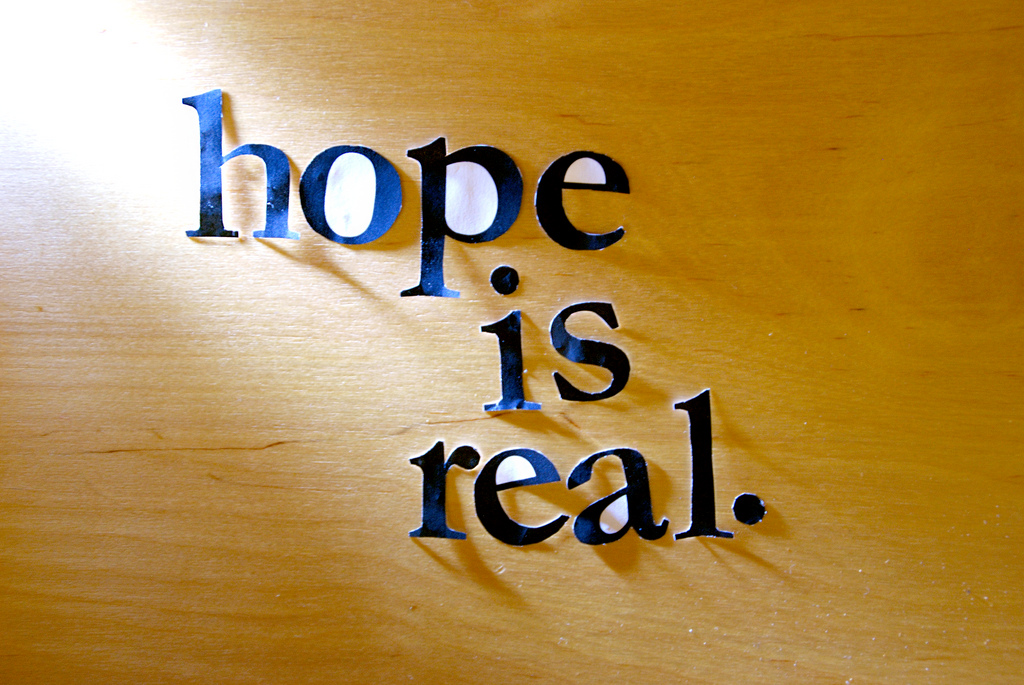
For the first Sunday of Advent, churches all over the world are lighting a single candle and speaking of HOPE: essentially the hope is of Christ whose coming has been promised and whose coming, we know, did happen. But then, if that Christ came, what is our hope today? Merely for His coming again or something else?

For in this hope we were saved. But hope that is seen is no hope at all. Who hopes for what they already have? Romans 8:24 [NIV]

“The virgin will conceive and give birth to a son, and they will call him Immanuel” (which means “God with us”– Isaiah 7:14). Matthew 1:23

Today and tonight, our church also began this Advent season with a cry for hope but with much more power. Jess Bousa announced “It is time for us to stop thinking of the Christmas story as a baby shower.” Yes, it’s sweet that Jesus is depicted as coming among the poor, entertained by mild cows and sheep, and witnessed by the outcast shepherds of the day. But what of the other point? That God sent Spirit into a human woman to create a Savior, someone who could both live and die for us, fully human and fully God, sacrificing all, in order to deposit the Holy Spirit into each one of us : Emmanuel, God with us (in us).

So, if we have Emmanuel. Tonight, one of our worship leaders, Dale Woodring, shared: “If we have Christmas inside us every day and every month, then there is no need to fear holiday commercialism or misplaced focus, God is bigger than all that. God is not worried about the point of Christmas being missed because we have Emmanuel inside of us.”

We don’t have to hope for Emmanuel, if we have accepted the truth of the work of Christ to re-establish our relationship with God, then the Spirit is within us.

So, what dHopeo we hope for? Manifestation of Emmanuel in us. We hope for an explosion of a unified Spirit in humans, the ultimate human who lives and breathes and walks in the power of grace and mercy and love, fully trusting the Presence within, accepting the ongoing paradox of a life in Christ, for to live, truly live, is Christ [Philippians 1:21].

Hope is a word of confidence, an expectation of a good result, with or without evidence, hope remains. Hope is active, not passive. Hope can be regenerated. Hope loves. Hope sees. Hope is born in Emmanuel.

Read Full Post »

« Newer Posts - Older Posts »