Feeds:
Posts
Comments

Archive for the ‘Praying the Psalms’ Category

Sometimes it simply comes down to this basic request of God: Teach me! Even the disciples, in all of their travels and time spent with Jesus, still didn’t get it and all they could say was, “teach us.” [Luke 11:1] But of course, in order to learn, I must be open to the information.

WhichwayTeach me how to do Your will,
    for You are my God.
Allow Your good Spirit to guide me
    on level ground, to guide me along Your path. [Psalm 143:10, The Voice]

First of all, I must know and trust the teacher. In Psalm 143, David identifies clearly his relationship to the teacher for it is God alone who has the ability to teach was David needs in that moment. His life is at a cusp, a turning point and David must figure out what to do next. The only course to take is God’s way, but what is it? This is the eternal dilemma of most believers at one point in our walk or another.

Which way? Where next? What next?

And so, I must turn to God and ask for direction or even better (as translated in the voice), ask for instruction to determine God’s will (both this time and the next time and the time after that).

As part of this request, I am hoping for a little extra help in discerning the way. This time, I say, I really don’t know which way to turn, what to say, how to proceed. Guide me, Lord, and as your Spirit guides me from within, use this opportunity to teach me how you work both inside me and outside me.

So often, I find myself on an uphill climb and I sense it’s not the best way to tackle my issue, my understanding. I may even be making things more difficult than they need to be.

I need to stop striving so. I need to stop, right where I am and confess my “control freak” self has taken over the reigns again and I’ve managed to get myself back into a difficult state of affairs. I didn’t pay attention to the Spirit before I started out on this path. I didn’t even bother to “check in.”

Forgive me Lord. Like Sara of old who thought she had to help out prophecy and gave her handmaiden, Hagar, to Abraham that Hagar  might bear a child whose destiny would be to populate the earth. O Sarah, foolish bride, set a great nation in motion that may have never intended to be one.

Each of us set change in motion by our actions, our words, our decisions: sometimes for good and sometimes not.

I let go of the past. I trust in God’s future for me. Teach me about the now of my life.

Read Full Post »

Psalm 143 is filled with urgency and no less in these two verses:

hidingplaceLet the morning bring me word of your unfailing love,
    for I have put my trust in you.
Show me the way I should go,
    for to you I entrust my life.
Rescue me from my enemies, Lord,

    for I hide myself in you. [Psalm 143:8-9 NIV 2011]

I don’t know this kind of urgency very often. From day to day, I live a life of relative ease. There might be emotional upheavals and drama (after all, I have two young adults still living at home with us), but none of these cause me to burrow into the hiding place of God. I do not live in a foxhole as many people do throughout the world today. Instead, for all I know, I may be luxuriating in pot of water on the stove, getting warmer and warmer, but not realizing I am actually dying.

Well, we all are. From day to day, closer each day to some inevitable transformative moment that will take us out of our bodies in an instant or on a journey of pain and disease, a slower but nonetheless equally lethal end. This is part of living, the dying.

There have been several deaths around me of late: husbands of friends, old friends, passing acquaintances, relatives of colleagues, and on and on the list seems to get longer each year. We have a patron who comes into the library every week to look at the local newspaper for one thing only, to check the obituaries. There is always someone she knows, she has lived in this same community all of her life.

Is the shadow of death the only real urgency in a life? Or, is that merely self-serving to the end?

Or, are we to live with empathy for others in their crisis?

No one can sustain the stress of true crisis for an extended time. The body cannot generate enough adrenalin. I could help by if I knew how to envelop this person in need with the love of God, with the touch of authentic human, with the promise of rest. But then, I must really know what it means to shelter in God before I can bring someone else into the hiding place.

Back in my childhood, I was never very good at playing hide and seek. Either my hiding place was too good (and no one could find me so I would come out – who wants to be alone in a hiding place?) or the spot was too easy and I was found right away. Often, I would keep peeking out just to see what was going on around me. Just in case. And of course, this would be another way I would be pulled free from safety.

And there’s the problem, the human tendency to peek. To hide in God works better as a permanent solution, not just in a state of emergency. If I could stay in the hiding place of God, within the Spirit of Christ, my view of the world would be through a completely different lens. I would see more clearly; I would recognize needs in others; I could envelope and invite them in, for the place is large and plentiful. The hiding place of God knows no limits, nor does it include chains. It’s a choice to remain, just as it is a choice to enter.

So, does the hiding place mean I won’t experience urgency and fear and pain? On the contrary, those moments will still happen, I’m sure of it. The difference is in walking out trauma with an ongoing confidence in the Presence: “We are confident that God is able to orchestrate everything to work toward something good and beautiful when we love Him and accept His invitation to live according to His plan” [Romans 8:38, The Voice].

And remaining “in” God. No peeking.

Read Full Post »

I love the verbs in this Psalm. If I took those verbs into my heart, I would have a prayer life that could change the world.

prayers are manyLord, hear my prayer,
    listen to my cry for mercy;
in your faithfulness and righteousness
    come to my relief. . . .
The enemy pursues me,
    he crushes me to the ground; . . .
I remember the days of long ago;
    I meditate on all your works
    and consider what your hands have done.
I spread out my hands to you; [surrender]
    I thirst for you like a parched land. [Psalm 143:1, 3a, 5-6]

It’s so simple.

I ask God to hear, listen & come, while the “enemy” pursues & crushes, but I am busy: remembering, meditating, considering, surrendering and thirsting [desiring] after the things of God: voice, heart, peace, and confidence.
If I am to successfully face the trials of life, this must be my mode of operation. There is no trial or circumstance that has not been covered by the promises of God when I am surrendered to God. The deal was struck through the covenant relationship that God has with human. . . . and with me.

Trials and disappointments will still be around. In fact, the world pursues us all, through the evil actions of others which cause hurricanes of pain and sorrow. I cannot stop the flood of terror or violence or stupidity fueled by selfish ambitions and delusion. I cannot always understand what drives others. I can only do my part: remember who God is my life; meditate on the presence of Christ’s Spirit within; consider the implications of living a surrendered life; and desiring God’s way and not my own.

This is what it means to pray.

Read Full Post »

We are living within patterns and cycles. Nature teaches about the seasons; each year the same and yet each year different, affected by a combination of forces, some human-made, some divine.

harvestLove and faithfulness meet together;
    righteousness and peace kiss each other.
Faithfulness springs forth from the earth,
    and righteousness looks down from heaven.
The Lord will indeed give what is good,
    and our land will yield its harvest. [Psalm 85:10-12, NIV]

Here’s how I imagine this verse playing out: love and faithfulness are the human response. Out of the meeting of love (unconditional love, that is), faithfulness springs forth. What is faithfulness but trust and dependability and truth. Love is the ground from which these are born. Righteousness is the yardstick that emanates from God. It is only in God that righteousness and peace can dwell and prosper together. But here is the promise in this verse: as our love and faithfulness grow here in this three-dimensional world, God sees and we are blessed.

But what then is the harvest that God is blessing? I remember an old friend was adamant that a believer “bearing fruit” meant bringing more and more people to the Christ. I always felt like he was notching his spiritual guns. But today, I find myself leaning to a different understanding.

The harvest is the result of seeds planted, tended, and reproducing themselves. Wheat makes more wheat. Apple seeds make more apples. I am not a single seed but many. All humans are a composite. We see some of our reproduction capabilities in our families. If we are bitter, we bear more bitterness. If we are selfish, we teach the same (most often by example). But, if I love, then love is born in others. If I am faithful, a synergy is created like an unstoppable wave. Love and faithfulness are the strongest and most powerful forces and yet, the least appreciated. Instead, we have cheapened love to mean sex and heaped faithfulness with a list of exit clauses and “what ifs.”

These are the ones to practice and nurture: love and faithfulness and then righteousness and peace will pour down like rain.

Read Full Post »

listeningWhat does it mean to listen to God?

I will listen to what God the Lord says;
    he promises peace to his people, his faithful servants [saints]—
    but let them not [re]turn to folly. [Psalm 85:8, NIV, 2010 with words inserted from 1984 version]

When I was in acting school, we used to have a teacher who tried to teach us how to center down into ourselves, to experience “constructive rest,” to align our bodies, to know “neutral” in ourselves. Much of that time was spent on the floor and breathing. At the time, I was simply too immature to appreciate what she was trying to accomplish. One of her exercises required us to listen: to listen to the sounds outside the room, then inside the room, and then inside our bodies. In a way, this is technique that can also be used to settle the mind down in preparation to listen to God. It’s pretty hard to listen to God while being busy doing other things. [Unless anyone has cultivated the habits of Brother Lawrence, and his Practice of the Presence of God.]

But I believe, more than anything else, that the heart must be prepared to hear before listening will occur. It is up to me to establish that environment, like preparing garden soil to be sown. I can help this preparation of the heart along by reading or singing or breathing.

In this process, I should also know the subject matter. In other words, I believe the most productive listening is done when focused on a situation or topic or question. (And I don’t mean a yes or no question, but a more open-ended one, that allows room for God to expand the answer.) But here is the vital key: I must be at my wit’s end, so to speak. If I really want my heart to be open to the voice of God, then I must know that my resources have been expended, my “way” has not worked, my solutions have been exhausted.

surrenderOtherwise, I think my very human tendency, once I “hear” God’s response, is to compare it to all the other answers out there. It’s not the way God works. If I am truly coming to the God of the Universe for help and illumination, then I can’t treat the answer as though God is simply weighing in on the possibilities like another girlfriend at a kaffeeklatsch.

Do not, then, go to God lightly. For in the breadth of this one verse, Psalm 85:8, there is a warning about returning to our folly (our own way). To ask God, the Holy Spirit, to help and then to choose another way, is, indeed foolishness.

In the older 1984 NIV version, the translation reads that God promises peace to his saints. In later years, this term has been replaced with culture friendly phrases like “faithful servants” or “the holy people He loves.” We are adverse to calling ourselves saints and yet I know it’s not a word to be taken lightly, it is the one that speaks of total surrender to the Christ. A saint is totally sold out to God. A saint hears God and listens and then acts upon the information.

Clearly, the opposite of a saint is a fool.

Read Full Post »

Oh foolish we who don’t believe we need salvation.

heal the worldRestore us again, God our Savior,
    and put away your displeasure toward us. . . .
Show us your unfailing love, Lord,

    and grant us your salvation. [Psalm 85: 4, 7; NIV]

It’s gotten corrupted, this idea of being “saved.” I suppose we can blame all the good-hearted Christians who claimed the “born again” phrase and the Bible thumping preacher whose gaze pierced the crowd and said, “you must be saved!” And we’re all looking around and saying, “saved from what?” The whole saved got totally personalized. And although it’s true, we all do need personal salvation (or in my view, better described as surrender), it is global salvation we should think about now.

Our world is in deep danger.

According to the United Nations Food and Agriculture Organization one in eight people in our world is starving to death. Most of these people live in developing countries. Of the 10.9 million children deaths, almost half are due to malnourishment and hunger. In 2005, the World Bank estimated that almost 1,400 Million people live on $1.25 or less per day. According to a 2002 World Health report, 1.6 Million people lose their lives to violence. Just in America alone, over 30,000 people commit suicide every year [Suicide Facts]. And the number one cause for suicide is “untreated depression.” In 2004, NIMH estimated that 26% of all Americans, 18 and over, could be diagnosed with some kind of mental disorder in a given year.

Naturally, none of these statistics is hard and fast or specifically represents where we are today, but regardless, the numbers are staggering.

Humanity is in need of saving. We are dying. We are killing ourselves. And who knows when the next “real” weapon of mass destruction is loosed upon humans. We are killing each other.

Personal recovery is important. I know that very well. I lay out my state of soul to God each day, asking forgiveness and renewal. But I find my God asking me to reach out for the greater good. The psalms are teaching me about praying corporately, with a wide net.

“Show us your unfailing love, oh Lord . . . “

Read Full Post »

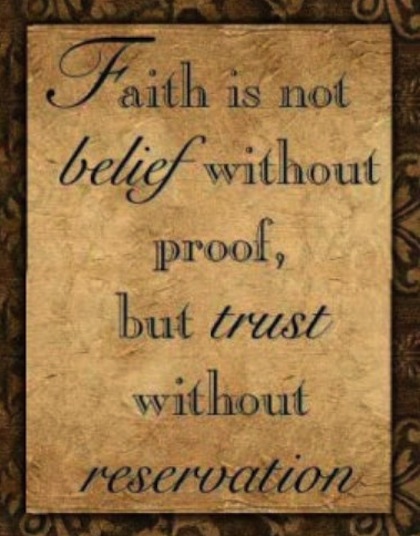
trust2It’s the ultimate question, really. Do I trust God or not? It is a question who’s answer is black or white, yes or no. Any answer close to “maybe” is a no. It is the essence of faith; they work in tandem, they need each other.

Lord Almighty,
    blessed is the one who trusts in you. [Psalm 84:12, NIV 2011]

It is trust that operates outside of the tangible world. Trust is the foundation upon which I can continue forward in the face of trouble, in the face of terror, in the face of sickness or collapse.

Trust and faith are spirit words. They are not driven by circumstances or the weather. When I live in the realm of trust and faith, I am living in the Maker’s world.

Read Full Post »

« Newer Posts - Older Posts »