Feeds:
Posts
Comments

Archive for the ‘Time Up to Pentecost’ Category

All believers are stepping stones

Apparently I still need a priest. That title is not in my tradition although there has always been the pastor/preacher who was meant to guide or shepherd the church body (and thereby, me too) as well as deliver messages or teach by way of the inspiration of the Holy Spirit. In truth, the human versions are often found wanting. Naturally.

Hebrews 7:26, 28b
Such a high priest truly meets our need—one who is holy, blameless, pure, set apart from sinners, exalted above the heavens. . . . made perfect forever.

On occasion, there are ministers who have crossed my path who have changed my course. In my early days as a Christian in New York, I attended a pentecostal church (much to my own dismay) led by a very old pastor from Norway. I had no personal relationship with him, nor did I find him particularly accessible, but his instruction gave me a hunger for understanding scripture and he was able to explain passages that had stumped me on my own.

Another key pastor in my life was during my early years of marriage while living in Atlanta. He was a brilliant speaker, always intriguing and interesting from the pulpit. He engaged people personally and I am pretty sure everyone who attended that small church had dinner in his home several times a year. It was how his (very southern) family operated. Everyone knew him, warts and all. Through other para-church activities, we became friends and although he was flawed in many ways, his transparency, intelligence, and knowledge of the Bible made a lasting mark. He was our tipping point.

Since then, I have sat under pastors for short periods of time and long. In recent years, I’ve known several pastors of great intelligence who I admired and who gave many words of wisdom and yet, the one thing I longed for was a more personal connection, a sense of camaraderie and kinship. But how could I expect someone who was “ministering” to hundreds or even a thousand of people to guide me? They were simply too busy, too torn by their responsibilities to church and family, too sapped of energy by the truly needy. Oftentimes, I felt like the capable child in a family who everyone assumed was fine, strong, and secure which made it easier to spend time and energy with the struggling one, the emotionally unstable one. It wasn’t anyone’s fault, it’s just how things seemed to evolve.

So, what is my relationship really supposed to be with a pastor now? Having known and followed Christ over 30 years, do I still expect a pastor to be a kind of visionary guide who will come and say, “Jesus told me” that you should do such & such? I would be suspicious of that kind of approach anyway.

All right, all right, I know that Christ is the perfect pastor/priest. Christ is the ultimate shepherd, the ultimate guide, and the one to whom I should be looking for direction. I know that, honestly I do. (I also know that the success of such a relationship depends a great deal on my participation, my willingness to listen, and my time spent in silence. This is not a Sunday morning activity alone, but daily. I get that.)

But what, then, is my relationship to these human pastors? These flawed, but loving men and now women, who have felt called to operate in the role of church leader to “equip the saints.” I believe, at this point, based on experience and a certain amount of self-sufficiency (i.e. self-taught Bible study), that I want to walk beside. I skimmed an interesting online article by Craig Bluemel (who on further browse, appears to be controversial), but I did appreciate his view of the “elders” of the church as co-workers with the pastor. That we are no longer in a time when the church should be a pyramid. We all have something to share and teach by the leading of the Holy Spirit. We are all called to serve. We are indeed that priesthood of all believers [I Peter 2:9]. We need to stop looking elsewhere for “spiritual food” and spend more time looking within and sharing with others what we know.

Christ is our High Priest and will be, forever, yes. But we are the bumbling hands and feet and voice, whether trained or not. We are all imperfect. And so, we should combine our gifts and use them corporately to nurture and celebrate the Holy Spirit on earth.


Read Full Post »

This is another place where modern Human trips up. An indestructible life smacks of Superman and other “super heroes.” Miracles in general are not the food of modernity. We are all about logic and facts and evidence. But, I can only ask those who cannot fathom the miraculous, what if?

Hebrews 7:14-16
For it is clear that our Lord descended from Judah, and in regard to that tribe Moses said nothing about priests. And what we have said is even more clear if another priest like Melchizedek appears, one who has become a priest not on the basis of a regulation as to his ancestry but on the basis of the power of an indestructible life.

What if there was that indestructible one who wielded enough power to sustain life (and that crosses all dimensions of living), forever?

In these mid-range chapters that I am studying in Hebrews, the writer (and personally, I don’t hear the voice of St. Paul at all), the whole point is to examine the believability of Law changing because the priesthood was changed forever with the coming Messiah. That Jesus, as Messiah, was of another tribe (Judah) and like Melchizedek (who is mentioned several times in Hebrews 7), the ancestry does not line up with the law of the time. Melchizedek had an unknown genealogy while Jesus was affiliated by his birth mother to the wrong one and the next leap is Jesus’s true genealogy as divine.

It’s funny really, the ancient peoples struggled with Jesus’s genealogy while modern people struggle with the supernatural. The people of Israel had a history of miracles; this they could accept, but his lineage was a huge problem if he was to be their true priest-king with the authority to change their laws, the foundation of their faith. While today, that’s a more insignificant problem, it’s all the other stuff: virgin birth, bringing dead people to life, sight to the blind, hearing to the deaf, and of course, resurrection.

But, I say again, what if that kind of power did exist? What would we do in the face of an indestructible life, that is, directed, perpetual energy?

Read Full Post »

A good portion of Hebrews 7 is devoted to the mysterious Melchizedek, the priest-king to whom Abraham tithed “10% of everything.” One of the great wonders to the believers of that time was his lack of genealogy. Who was this guy? Many theories, but no one really knows. Nevertheless, he had the authority to bless, even the patriarch, Abraham.

Hebrews 7:2b-3
“. . . First, the name Melchizedek means “king of righteousness”; then also, “king of Salem” means “king of peace.” Without father or mother, without genealogy, without beginning of days or end of life, resembling the Son of God, he remains a priest forever.”

Questions that can send silent shudders up a librarian’s spine are from the amateur genealogists seeking out their family line. They are an enthusiastic bunch and quick to tell of their latest discoveries. The librarian nods her head and smiles while the genealogist explains the depth of his or her line. There is great pride in sleuthing out names and dates and long lost relatives that go back to the American Revolution or even earlier.

But in Jewish history, the genealogical line was even more important. People were rooted in their community or accepted into a new community by the veracity of their genealogical line. In modern times, this is sometimes mirrored in small communities where being “from” there requires the person to be “born there.” And certainly, in the Mormon church, genealogy is critical to leadership. Most of the best genealogical records of modern times have been stored and digitized by that group.

But here is Melchizedek, apparently quite powerful and respected which is reflected in the 10% of all “booty” that Abraham and his men give to him after defeating the kings of Sodom. We know so little of his story that he has become the subject of much speculation, particularly among various teachers and rabbi’s. Some claim he was divine which explains his lack of lineage while others say he was simply an anointed king of the era.

I am captivated by this story because of its mystery. The Bible has many such characters who appear briefly and then are heard of no more. There is usually significance in their appearances, but I’m not sure what it is.

Today, I am simply struck by the idea that there is always someone higher than us. No matter how much fame or fortune or power we attain, there is always someone who has more. God places each of us in that continuum, in some cases, it is we ourselves who are the “higher one,” perhaps by income or status or position at work. We are inside the sandwich of authority.

Melchizedek blessed Abraham first and then the gift was given willingly. Isn’t it important for me to bless those around me who are in a different part of the sandwich. It’s so important to speak blessings to everyone in our circle of influence, but even moreso to those who have less than we do. A blessing calls on God to fill in where human cannot.

The trick is not to envy or become jealous of the blessings, for some will be called to the higher table at the banquet.

Read Full Post »

Nowadays, swearing and oath-making are not very common. Of course, I’m not talking about profanity, there’s plenty of that. Funny, the same word, swear, has such opposing uses: one as a debasement while the other is a promise that is binding because of the witness of someone “higher” in power, class, or position.

Hebrews 6:16-17
Men swear by someone greater than themselves, and the oath confirms what is said and puts an end to all argument. Because God wanted to make the unchanging nature of his purpose very clear to the heirs of what was promised, he confirmed it with an oath.

There are only a few places where the full intent of swearing is still recognized: a wedding where vows are made between two people; a swearing in to public office; and a swearing to tell the truth in a court of law. In all three of these cases, people are asked to “swear” over a Bible with the implication that they are “swearing by” God. Supposedly, they are saying the words that can be and should be witnessed by God who will/can affirm their truth. Hmmmm.

Sorry, but I don’t think people take these oaths very seriously anymore. Marriage oaths are broken every day. In fact, there are great numbers of people who consider divorce their first option if “things aren’t working out.” I know this attitude well, I had it myself when I married the first time. I had all kinds of provisos: If he does this or if he does that, or doesn’t do this or doesn’t do that, I’ll just get a divorce. Big deal, in other words. I’ll do what I want to do.

I certainly don’t feel so cavalier today. In fact, I’m beginning to wonder if there aren’t some serious repercussions for swearing or making an oath with little intent to keep it. In the Sermon on the Mount, Jesus discouraged his followers from making oaths, “. . . I tell you, do not bind yourselves by an oath at all: either by heaven, for it is the throne of God; Or by the earth, for it is the footstool of His feet; or by Jerusalem, for it is the city of the Great King. And do not swear by your head, for you are not able to make a single hair white or black.Let your Yes be simply Yes, and your No be simply No; anything more than that comes from the evil one.” [Matthew 5:34-37, Amplified]

Throughout this morning, a partner verse keeps coming to my mind about the sowing and reaping principle: “Do not be deceived: God cannot be mocked. A man reaps what he sows.” [Galatians 6:7, NIV 2010] A vow or oath is a type of sowing, it’s a promise, and it’s the beginning of a process; when that promise is broken, the process is aborted and something else will happen instead. There has to be a reaping.

For this reason, I think, Jesus advises us to avoid these situations.

And, as an afterthought, perhaps the profane kind of swearing also bears some unpleasant fruit (or reaping) for the speaker. Wikipedia states that the original meaning of “profane” was “outside or in front of the church.” It is something that does not belong to the church. Interesting tidbit.

Before my Christ-centered days, I could swear up a blue streak and probably “out-swear” a truck driver if need be (not that truck drivers necessarily swear). I could also drink just about anyone under the table. I was proud of my ability to appear really “bad.” Inside, I don’t think I was much different than anyone else. I just covered up a great deal of my insecurities with behavior.

So, my take away for today is two-fold: I should be much more circumspect about the promises I make as well as more prudent in my words. I don’t profanely swear on a regular basis but I do find myself lapsing into some old bad habits. It’s unproductive, or worse, when directed at someone else, it’s “outside the Spirit.”

Read Full Post »

What is a useful crop? I’m sure there would be lots of answers to this question depending on one’s point of view. Is my life producing anything useful? Beautiful? Memorable? Helpful? What is ultimately driving me? I am so very busy all the time. Maybe it’s time to rotate the crop?

Hebrews 6:7
Land that drinks in the rain often falling on it and that produces a crop useful to those for whom it is farmed receives the blessing of God.

When I was a younger Christian (back in the day is the latest phrase — of course, the kids who use it crack me up, it’s hard for me to consider their tween lives as “back in the day”), I was taught a similar sounding verse from John 15:8, “This is to my Father’s glory, that you bear much fruit, showing yourselves to be my disciples,” and that fruit meant converts. My fruit was supposed to be notches on my belt, the number of people “brought to Christ.”

But really, is it just about that? Or is fruit like the crops and what is truly important is that they be “useful.” Whatever I produce should have some purpose. Naturally, sharing my faith with others and the story of my transformation as a result of that commitment to the Christ is useful. But, there are other things: providing food and shelter for those who don’t have it or giving a family to an orphan, or guiding someone to resources they need to take the next step. These are all good.

What about beauty? Is art useful? Is music? Is drama or writing?

Too many people lose sight of the power of the arts and nature to feed the soul and to transcend circumstances.

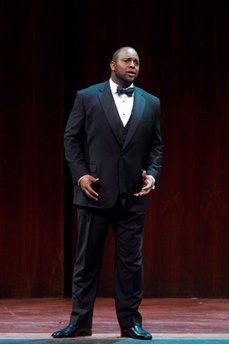
Yesterday, I read in the New York Times Magazine about a young African American who grew up in the projects where deep poverty and casual violence was the mainstay of his life. And somewhere along the way, Ryan Speedo Green found the joy of music and now, he won an “idol” type contest by the Metropolitan Opera. Someone gave him this opportunity and it was more than “useful,” it was life-changing.

We never know who we will touch with our fruit but as long as it is nurtured with love and is an authentic expression of ourselves, there will be someone to eat.

Read Full Post »

Of all the senses, I find it fascinating that the writer of Hebrews uses taste twice in the same sentence to describe the human experience of the things of God, that is the heavenly gift and word of God. That sense we use every day when eating but rarely do modern believers “taste” God.

Hebrews 6:4-6a
It is impossible for those who have once been enlightened, who have tasted the heavenly gift, who have shared in the Holy Spirit, who have tasted the goodness of the word of God and the powers of the coming age, if they fall away, to be brought back to repentance . . .

Even back in Psalms [34:8], we are encouraged to “Taste and see that the LORD is good; blessed is the man who takes refuge in him,” or in verse 119:103, “How sweet are your words to my taste, sweeter than honey to my mouth! ”

There must be something then about the intimacy of eating and tasting that is particular to the Word of God (both Jesus Himself [“eat of my body and drink of my blood” John 6:52] and the words imparted to us through scriptures), as well as the heavenly gift (which could be any number of things, but in my mind, it’s pure grace).

Just a cursory glance through commentaries about these verses shows many have decried and argued and professed to know what they really mean. I can’t begin to make such a claim. I don’t even want to discuss what it might be to taste these things and then, by virtue of “falling away,” losing access to repentance. The whole idea gives me the heeby-geebies. The texts that fall on both sides of the aisle are numerous from the simplified “once saved, always saved,” to the stricter interpretation of “human will” to the more Calvinist interpretation that all human acts fall under the express sovereignty and rule of God. I realize there are issues here.

But what about this taste business? If I just focus on this one piece of information, this one phenomenon, I believe there is something here for me today that can transcend all of the rhetoric and apologetics.

Taste is a matter of detection, discovery and discernment. Everyone responds to foods differently, depending on the sophistication of their palate. Some people have affinities for certain tastes and aversion to others. On average, the human tongue has between 2,000 to 8,000 taste buds. It’s highly personal and individualistic.

And so, here’s my small point: when we taste the things of God, we all have a different experience. For some, it is a rich, sweet taste and suffuses the mind. For others, something else, like savory [or to use the latest word, umami] and maybe, depending on the circumstances, even bitter or sour or salty.

But in any case, the taste is strong and unique. Like the spelled “turkish delight” that drove Edmund in the Lion, Witch & the Wardrobe to make all kinds of poor choices, the taste of heavenly things is intimately memorable. I’m guessing or supposing that the taste sense somehow brings into sharp focus the other senses so that what is seen or heard or touched suddenly has a much needed added dimension.

Perhaps the next time I sit at a meal and pray a blessing on the food, I might add a silent prayer to expand my understanding of tasting the things of God.

Read Full Post »

Artwork by Gretchen Smith

Most of us know the short verse, “Jesus wept” [John 11:35]. We might even get a warm and fuzzy feeling at the picture of a sympathetic Christ, weeping for his friend. But how often does anyone quote this verse in Hebrews, where Jesus cries out loud and sheds tears before God?

Hebrews 5:7
During the days of Jesus’ life on earth, he offered up prayers and petitions with loud cries and tears to the one who could save him from death, and he was heard because of his reverent submission.

After a quick look at some of the commentaries, it’s interesting to me that most writers place all this “weeping and wailing” right before his death in the Garden of Gethsemane, as though this is the one time Jesus encountered his destiny and travailed before the Father. But I propose that the prayers and supplications of Jesus were ongoing. Think about it: how many times did Jesus miraculously escape the authorities? How many times did he suspect danger in his life, anticipate a shortened ministry, protect himself and his work by discouraging loose talk or gossip among his followers?

Jesus knew his life was forfeit but I can imagine him praying regularly, “Not yet . . . not yet. Give me a little more time.”

Jesus needed help and protection from God continually, not just in the garden, but throughout his ministry life. And in the same way that he emptied his heart and soul before God at Gethsemane, I believe he did this regularly and undoubtedly during many of those solitary prayers he sought out on the mountainsides, away from the disciples.

Lastly, I am intrigued by the idea of a noisy Christ. I mean, I don’t know about you, but a mental picture of Jesus roaring or wailing before God is difficult to wrap my mind around. And yet, why not? Isn’t it culturally appropriate? Would Jesus be “above” such behavior, such expression of need, desire, or supplication? Not at all.

I have experienced deep crying out to God and weeping but only at those times of deepest despair, betrayal, or fear. When I cried out to God at such times, I confess, it wasn’t that I put all my trust in God, I was merely bereft of hope, overwhelmed, and felt as if there was nowhere else to turn, I was “poor in spirit.” It was my last chance.

I wonder, were there circumstances and situations that Jesus did not expect to happen? Was he ever surprised (or surprised all the time)? Did he expect/hope his follower-disciples would “get it” sooner than they did (or did they get it while he was still alive at all?); was he troubled by the masses of people who easily followed him day after day for “bread and fish” but could not grasp the food of the Spirit; was he frustrated by his own inability to break through thousand-year-old traditions and beliefs? Did he cry out to God the day he called himself the “bread of life” and taught them about eating his flesh and drinking his blood–so many deserted him that day. I can imagine him saying, “Father, how do I reach them?”

And yet, each day, he submitted again and again and again to the role he was given to endure (in the order of Melchizedek); he pressed on. He woke up, he prayed, he taught, he ate, he miracled. And finally, he reached that God-ordained last day, that last supper, and that last prayer. My spirit tells me now: his garden prayers were not the first time he bled in sweat nor flooded the ground with his tears. His life in the Father was full of prayers and supplications every day.

Holy tears for me. Thanks be to God.

Read Full Post »

« Newer Posts - Older Posts »