Feeds:
Posts
Comments

Archive for the ‘Time Up to Pentecost’ Category

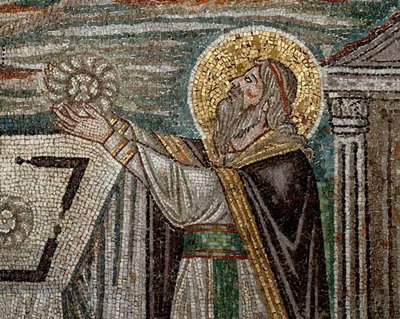
Melchizedek

When the Temple was destroyed in Jerusalem (70 AD), as much as I understand such things, the high priesthood dissolved for the Jews. And yet, the Christians, both East and West, have carried forward a similar hierarchy through the institution of Popes, Bishops, and Patriarchs, but none after the order of Melchizedek.

Hebrews 5:1, 5a, 6
For every high priest chosen from among men is appointed to act on behalf of men [and women] in things relating to God, to offer both gifts and sacrifices for sins. . . . So too Christ (the Messiah) did not exalt Himself to be made a high priest, but was appointed . . . As He says also in another place, You are a Priest [appointed] forever after the order (with the rank) of Melchizedek.
[Amplified]

I confess, I’m not the best one to write or discuss authority structures in the Church. I’m a bit of libertarian in those circles and not well versed in its history. But I do understand that one of the key roles of the Messiah is his Melchizedekian inheritance: he is both High Priest and King. He is both judge and mercy-giver. He can make the laws and forgive us for breaking those laws. He is Human and Spirit, King and Priest; Christ is paradoxical.

Melchizedek, priest and King of Salem (Jerusalem), lived in the time of Abram, 2000 BCE. And this role has been assigned to the Christ to come.

But what do we know of Kings in our age? Who do we have to model this role? What do we learn from the kings and queens of Great Britain (and their protectorates) or the Kings of Belgium, Sweden, or Norway, or the absolute monarchs of Saudi Arabia, Oman, or Qatar? [Incidentally, the Pope is also considered the absolute monarch of Vatican City.]

There are a zillion protocols for approaching a Royal, such as bowing, curtseying, proper address, proper distance, and so forth. Do I imagine King Jesus in this way? I usually ignore this perspective, don’t you?

And on the High Priest side, my only exposure to priests has been local Catholics and Episcopalians who are generally laid back around town and wouldn’t expect me to bend and kiss a ring or insist on addressing them as Father or Brother. That’s not to say the same for the “higher” priests. The protocols for the Pope, bishops, and patriarchs are equally submissive and quite extensive. Do I imagine Priest Jesus in this way? Not really.

None of these human examples of high priests or kings give much meaning to my Messiah-King. But isn’t some of that my own fault?

Are we all too casual in this day and age? Have we gotten too comfortable with our mauve carpeting and coffee club church services? Have we spent too much time humanizing Jesus/God (e.g. paintings of the laughing Jesus) or emphasizing his gentleness (drawing of Jesus with the lamb) or putting emphasis on our “family status,” making Him just one of the guys?

This is one reason why I am trying to spend more time on and in my relationship with the Holy Spirit. This is not king or priest, but a spirit union with me. This One is sister, brother, counselor, lover. Yes, I understand we learn about Jesus in those same ways, but honestly, I think we’d better understand His role as Melchizedek too. And in that semblance, I doubt I’ll be jumping up into his lap like Santa Claus.

Something to think about today.

Read Full Post »

If I am supposed to have more confidence in the Christ, who acts in the role of high priest for me (whatever that means), and who supposedly has bona fide empathy with my temptations, then I’d better be clear on what they are.

Hebrews 4:15
For we do not have a high priest who is unable to sympathize with our weaknesses, but we have one who has been tempted in every way, just as we are—yet was without sin.

Secretly, I’m pretty sure I don’t really believe Jesus experienced all of my temptations and I’m guessing I’m not alone in that deep, dark truth.

Do I really believe that Jesus was tempted by anything like a Dunkin’ Donut or Creme Brulee? Did he worry about the number of calories consumed in a day or the sense of body betrayal when my favorite clothes no longer fit? Was Jesus ever tempted to give up and become a beached whale on the couch because nothing seemed to work?

Was Jesus tempted to run away from all of his responsibilities? Did he consider suicide? Was he tempted to get drunk and stay drunk because life was too overwhelming? And what about all the plights and dangers of love relationships, broken relationships, or marriages built on lies and convenience?

Or what about getting old? Did he look in the mirror and pull up on the crows’ feet around his eyes or stretch the skin around his mouth and consider plastic surgery? Did he stare at old people being helped out of cars with walkers and wheelchairs and contemplate such a future for himself?

I know I’m being ridiculous and yet, am I the only one who chafes, even just a little, at the idea that Jesus, Human for 33 years, could sympathize or empathize with the details of my life’s temptations?

The answer is right there of course. It’s not in the detailed temptations at all, but in the one big temptation that encapsulates them all: being in charge. The temptation is to do it “all myself” and to solve all my problems alone. It’s “kicking against the goads” [Acts 26:14]. It’s following the Eve and Adam story line.

How am I tempted? I am tempted to be a god and manipulate my environment and I am regularly disappointed in the results. And so, yes, it is this person who is asked to come to the Throne of Grace and ask for mercy and help. And the courage to surrender.

Each day.

Read Full Post »

What is the Word? Some say it is the Christ Himself, some say it is the “whole of divine revelation” and some say it is the Gospel message. There is agreement however, that this Word is an instrument of disclosure and exposure.

Hebrews 4:12a, 13
For the word of God is living and active. Sharper than any double-edged sword, . . . Nothing in all creation is hidden from God’s sight. Everything is uncovered and laid bare before the eyes of him to whom we must give account.

My first image is that of Adam and Eve who are the first to experience the penetrating power of “the Word.” Not long after the eating of the notorious “apple,” God comes seeking them in the garden, calling out even, “Where are you?” They hide. We are still trying to hide today.

People smile at the ludicrous behavior of Adam and Eve, after all, how can they expect to hide from their all-knowing, all-seeing God? And yet, we believe we can cover up our own sins, thoughts, and actions. We put fig leafs on our brains and our hearts.

I think God knows all along what is happening within. The real problem is getting Human to face the truth of ourselves.

People have asked me why we should bother to pray if God knows everything and I maintain that prayer is really about our own discoveries. What is important? What is a hindrance? Where are we kidding ourselves? What is the desire of the heart?

Sometimes, God uses the Christ through the Holy Spirit to cut through the bull crap with a sword — the sword of truth. Like the “refining fire” that burns up the dross of our hearts, so the sword must sometimes cut away the dead stuff that prevents us from growing and healing. Like irrigating an infected the wound, it may hurt in the process, but the repair will move more swiftly later on.

Lord, I embrace your Word and your Sword.

Read Full Post »

Photo By Irm Brown

Is this the ultimate Sabbath-rest — is this heaven? Having gotten excited about Rob Bell’s Love Wins and the idea of heaven on earth and the manifestation of the Kingdom within now, I have to ask, what is this? Or is it a call to a 7-day week with a rest day?

Hebrews 4:9-10
There remains, then, a Sabbath-rest for the people of God; for anyone who enters God’s rest also rests from their works, just as God did from his.

Instead, I’m thinking it’s more inclusive. The 6-day work week and the 7th day rest has been a classic model throughout Jewish history. It was cultural as well as mandated by the law. Why, it’s even in the Ten Commandments: (Number Four) “Remember the Sabbath day, to keep it holy. Six days you shall labor and do all your work, but the seventh day is a sabbath to the LORD your God. On it you shall not do any work . . .” [Exodus 20:8-10a]

But, when I look more closely at these rather convoluted passages from Hebrews Four, I must re-think this idea of work and no-work. The Sabbath is a no-work day, but really, who’s doing that? We still cook, we teach Sunday School, we check e-mail, we cut the grass, we go shopping. And these are the light days! We are the lucky ones who don’t have to show up and stand behind a register all day or take food orders or hold bedpans. Are we sinning to “work” on this day?

Or is their another rest? Is there a rest that comes merely from entering and operating in the world of the Christ? Wasn’t it proclaimed that the Messiah would complete all things? There would no longer be sacrifices for sins nor striving to be good to be accepted by God. Jesus said, at the last, “It is finished.”

Perhaps we need to worry less about doing the right thing on the 7th day and spend more time building the 8th day, the time of new beginnings. Followers of the Christ are actually living in that day and time: grace above all, without condemnation, ongoing forgiveness, love as a force, while transparency and authenticity reveal the life to those who don’t know.

“This is the Day the LORD has made; let us rejoice and be glad in it.” [Psalm 118:24]

Read Full Post »

The first step is belief. “I believe you; I believe what you are saying; I believe YOU are speaking truth.” But the next step is critical, when the listener moves belief into the realm of faith. Here is where the content has meaning for the listener. And here belief can grow.

Hebrews 4:2
For we also have had the gospel preached to us, just as they did; but the message they heard was of no value to them, because those who heard did not combine it with faith.

Life in the Spirit is cyclical. With this scripture, I understand it even more than before. Belief prepares the ground of my heart to have faith, that confidence in things not seen or proven. And when faith expands, then I am able to understand more of the “message.” I understand more about the messenger.

As soon as I give room to doubt, the process slows down. It still works, but more methodically. The doubter is looking for more to believe, more information, more facts, more stories, more exposure. And when all goes well, the tipping point is reached and the process begins again.

“Then he [Jesus] said to Thomas, “Put your finger here; see my hands. Reach out your hand and put it into my side. Stop doubting and believe.” [John 20:27]

Read Full Post »

In our 3-D world, the Devil (I know, I know, that label is “oh so old-fashioned”) has the power of death and as a result, the ability to cultivate a fear of death. If I succumb to that fear, I am enslaved by it. The Christ mission broke death-power and its sidekick, fear.

Hebrews 2:14-15
Since the children have flesh and blood, he [Christ] too shared in their humanity so that by his death he might break the power of him who holds the power of death—that is, the devil—and free those who all their lives were held in slavery by their fear of death.

As long as we fear death, audacious faith is more difficult to grasp and hold and act upon.

Supposedly, the Christian norm has been to look forward to heaven, that eternal reward promised when we die. And yet, there are few who rejoice when a loved one perishes, few who can face their own end without navigating the stages of dying and grief: denial, anger, bargaining, depression, and only, at the last, acceptance. Christian or no, most of us still fear the unknown of body death.

I think it has to do with a bit of tenuousness in the faith journey. If I put all my faith eggs in a basket and actually pray/expect a miracle, what if . . . what if . . . it doesn’t happen? If I put my faith on the line like that, won’t it break? If I am disappointed again and again, won’t my faith suffer? Better to be safe and secure and lukewarm. Not.

No surprise here . . . I don’t exercise my faith in the majors much: you know what I mean, things like raising the dead, healing the terminally ill, bringing sight to the blind, hearing to the deaf, and so forth. I fear the death of my faith. And so, the “Devil” wins again.

The Devil is not a man but an entity. We can no more understand what/who the Devil is than we can understand the transfigured Christ. To say the Devil is an “angel of light” [II Corinthians 11:14] on one hand and a fallen angel [Isaiah 14:12, Luke 10:18] on the other isn’t much help either.

We live in a world of balancing opposites like night and day, darkness and light, yin and yang etc. But the most potent set of opposites are love and fear. That’s right, the opposite of love is fear, not hate (which is merely a subset of fear). If I want to do battle against fear, that includes the fear of anything–including death, I must enfold, exude, swell, manifest, embrace, share, and trust the power of love. I’m thinking that miracles, birthed by the Holy Spirit, must be an outgrowth of this powerful and singular energy.

“[That you may really come] to know [practically, through experience for yourselves] the love of Christ, which far surpasses mere knowledge [without experience]; that you may be filled [through all your being] unto all the fullness of God [may have the richest measure of the divine Presence, and become a body wholly filled and flooded with God Himself]!” [Ephesians 3:19, Amplified]

“Whoever does not love does not know God, because God is love.” [I John 4:8]

I am no longer a slave to fear by the authority and work of the Christ. Isn’t it time I stopped acting like one?

Read Full Post »

Photo by H. Graham Smith

Tomorrow has no real meaning in the world of encouragement while yesterday is too late. If I am to make a difference in a person’s demeanor or frustration, in his/her sorrow or disappointment, in a time of loss or unexpected change, it is now . . . today.

Hebrews 3:13
But encourage one another daily, as long as it is called Today, so that none of you may be hardened by sin’s deceitfulness.

Encouragement is a cheap price to pay for the sake of another. It doesn’t have to be particularly articulate or well thought out. I can give comfort in words or actions, or I can be present — be there, as they say. It may require a little active listening and definitely without censure, but most of all, it must be authentic.

So often, I fail in the encouragement department because I mistakenly believe it requires “advice.” I get caught up in wanting to help the person get a better perspective or help solve the problem. Some people say this is a male trait, but I confess, I am notorious for this bad behavior. I count myself a problem solver when, in actuality, my problem solving might even add to the problem.

But let me get back to the idea of immediacy. Non-judgmental, authentic encouragement is powerful in the now. The hope would be that consolation and compassion would be spontaneous and timely. We should never withhold encouragement. No matter what has happened, there is room in the moment, to give a boost, even the tiniest fragment of hope, love, and camaraderie. The message is simple: “Today, you are not alone.”

Because, it could be in this day, the world will change for that “other person.” It could be.

I can only imagine what the potential power would be if I gave a word or touch of encouragement to each and every person with whom I came into contact in a single day.

Anyone want to take on that challenge with me? Today?

Read Full Post »

« Newer Posts - Older Posts »