Feeds:
Posts
Comments

Coming Home

After 70 years, when Jewish exiles returned to Jerusalem and the Second Temple reconstruction was completed and dedicated by the shedding of much animal blood, they celebrated the Passover, eager to seek God through their age-old rituals and traditions. They were home.

Ezra 6:21
So the Israelites who had returned from the exile ate it [Passover lamb], together with all who had separated themselves from the unclean practices of their Gentile neighbors in order to seek the LORD, the God of Israel.

What is my first order of business upon returning home from a long absence? Although I have no hard and fast religious practices to resume, I am anxious to get back into my routine. There is comfort in the familiar. I am happy to greet my dogs and take them outside. I peruse the mail, I make a cup of tea.

There are very few things that I can only do at home and yet, when I do, I am more contented. I can pray anywhere, but when I sit in my favorite chair, I fall into a quick communion with Christ. I can read scripture when I am away, any access will get me there, but my well-worn black leather Bible still comforts me by feel and sound, as the thin pages crackle.

Returning to church after a time away is also consoling with the familiar music and warm engagement with friends. For me, even my work, which can feel redundant and tedious sometimes, breathes into me when I walk through the door, breathes welcome.

There are amazing stories of families who have been separated by years and years through political insanity, such as the Berlin wall that divided East and West Germany or the Iron Curtain or the North Korean Demilitarized Zone, still active today. But when those barriers came down, families found one another again and fell upon each other joy and weeping. The touch of a beloved one.

Even I, when I met my half sister (who lives in Estonia) for the first time in 1996, we embraced fiercely, for we were bound by blood, the same father, and it sustained us. On the same trip, I met my aunt, my mother’s sister for the first time, and her heart exploded when we clung to each other. I was in foreign lands where I did not speak the language well, where homes were completely different from my own, where the culture had suffered from the cruel and powerful through communism, and yet, I was also home.

In May of this year, I will be retracing my steps and re-uniting again my half-sister and aunt. And my heart craves for that time together.

This is a type of longing that God wants me to have for the Holy Spirit every day.

“Come away, my beloved . . . ” [Song of Solomon 8:14a]; come home.
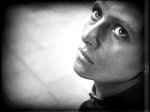
Joan of Arc as played by Renee Jeanne Falconetti, 1928

The Lectionary readings for this day, the Second Sunday of Lent, are Genesis 17:1-7, 15-16; Psalm 22:23-31; Romans 4:13-25; and, Mark 8:31-38 or Mark 9:2-9.

From these readings comes a theme of covenant, promise, and faith. From it also comes this verse in Romans 4:16b-17: He [Abraham] is the father of us all. As it is written: “I [God] have made you a father of many nations.” He is our father in the sight of God, in whom he believed—-the God who gives life to the dead and calls into being things that were not.

The God who calls into being things that were/are not. For me, this phrase is worth holding onto forever, this is a game changing verse.

But, what is even more intriguing is the crossover of events and messages that I experienced today. First, in church, our pastor started a new series on praying boldly, which means to pray the big things, the larger than life prayers. If those prayers come to fruition, there is no doubt that God is in the results. Elijah was known for these kinds of prayers. And like Abraham’s faith, it’s believing God can bring things that are not, into existence.

Secondly, I went to Voices of Light: the Passion of Joan of Arc, an oratorio with Silent Film presented by the Baltimore Symphony, the Baltimore Choral Arts Society, and four soloists. The original music was composed by Richard Einhorn who was also present at the concert and introduced afterwards. The film, from 1928, was directed by Carol Theodor Dreyer and starred French actress, Renee Jeanne Falconetti, who, incidentally, never acted in another film after this one. The film was based on the actual court record of questions that religious authorities asked Joan D’Arc and her subsequent answers. And although her story ends in her death at the stake, her short life, driven by her voices and visions from God, crowned a king (Charles VII) and turned an army in despair into hope. Her faith was so authentically depicted, I could only weep at her inner battle. We saw her fears and faith seeking dominance.

Can I walk with such faith? Can I pray boldly? Can I challenge my fears and overcome them with my faith? Can I trust in the covenant I have made with God through the Christ?

Who is Watching?

We tend to forget that our behaviors are being scrutinized. Not so much by casual acquaintances and co-workers (although somewhat), but mostly by the children and teenagers in our lives. They don’t look like they are even paying attention. Don’t be fooled.

II Chronicles 34:3
In the eighth year of his reign, while he [Josiah] was still young [16 years old], he began to seek the God of his father David. In his twelfth year he began to purge Judah and Jerusalem of high places, Asherah poles and idols.

Josiah was the grandson of Manasseh, one of the most notorious kings to rule Judah. Manasseh ruled for 55 years and up until his last years, played havoc with the country doing everything he could to destroy the foundations of faith through mockery, idol worship, and decadent priests and priestesses who proselytized for other gods. He even sacrificed his own children to these gods. But in his last years, Manasseh was overthrown and taken to Babylon with a ring in his nose. He was humbled. In that place, he sought out his one true God who heard him and restored his to throne. This was an abrupt about face, a transformation.

Who was watching? A little boy named Josiah who was just old enough to understand, just old enough to absorb the impact, just old enough to remember.

There was another who saw the change, Manasseh’s son Amon who became king after him. But Amon did not believe in the change in his father and he pushed Judah back toward the pagan gods for two years before he was assassinated. Apparently, there were others who had watched Manasseh’s metamorphosis and believed.

When young kings come to power (Josiah was only eight when he was crowned), there is usually a regent who handles the daily affairs and instruction of the boy-king. This person is not named but we can extrapolate his presence. Whoever he was, he set a standard that set Josiah on a different path, that gave him a thirst for knowing the God of his forefathers.

My children never knew me before I walked with God. They never saw those years of transition from living a degenerate life to living in God through the Holy Spirit. But I know many people whose children and grandchildren have seen the adults in their lives take a shift for good.

It is never too late to change. The children are watching.

I Promise

What is a promise? I know what it should be. I know that it should be binding and carries with it an expectation. If I promise to do something, the person expects me to follow through. A covenant is the next step up and just below law. Our culture has never mastered covenant.

II Chronicles 15:12
They [Asa and the people of Judah] entered into a covenant to seek the LORD, the God of their ancestors, with all their heart and soul.

Covenant is harder. Despite the promises and the expectations and outward signs of agreeing to a covenant, it can be broken with no apparent ill effects. At least that’s what people seem to think. The most controversial covenant is the marriage. Couples stand before witnesses and make vows, they agree, they promise, they share ritual, and yet, divorce statistics range near 50% for first time marriages and higher for second and third marriages.

I am one of those statistics. I married for the first time at eighteen. And although I was “in love,” I also had this reasoning in the back of my mind: if it doesn’t work out, I’ll just get a divorce. It’s not a good start to a promise.

As a parent, I have tried to avoid the “I promise” phrase because I know how easy it is for things to go awry, for circumstances to change, for promises to be broken.

But today, as I traverse then Lenten time, I feel compelled to make and hold to some promises. I have committed time to God in prayer, meditation, and writing. I have promised to seek God throughout this journey. And I feel the weightiness of this agreement in a way I never have before.

When I was twelve, my mother had tried to find a new spouse by answering personal ads in the Latvian newspaper. One of those men invited us to visit him in Niagara Falls, Canada. I didn’t like this man at all and one night, when the two of them had gone out on a date and stayed out very late, I prayed fervently and made many deals with God if would break up this couple. I believe this was a girl’s version of a foxhole conversion. My mother never remarried, but I didn’t follow through either. Or did I? Was my rediscovered faith at 28, a consequence after all? Did my promise bear fruit?

Sometimes, I think it does work out that way.

The things we say, the words we speak, have power, particularly if they are heartfelt. In that other world, inhabited by spirits and angels and so forth, what happens to the promises we make?

Art by Joseph Liner

Thirty two years ago, I responded to a nation-wide call to Christians around the country to fast and pray in Washington, D.C. II Chronicles 7:14 was the keystone verse to that call and that day became known as Washington for Jesus. I arrived with national hope for healing but left with disappointment.


II Chronicles 7:14
“. . . if my people, who are called by my name, will humble themselves and pray and seek my face and turn from their wicked ways, then I will hear from heaven, and I will forgive their sin and will heal their land.”

I had taken the call seriously. I traveled a long way, prepared myself to fast, and meditated on the scriptures. In my imagination, the Mall would be filled with prayer like in the days of David and Solomon and the Shekinah glory would fall. Instead, there was amplified praise music and prayer from the stage area, political rhetoric, picnics, vendors selling “Jesus Junk,” street proselytizing, and tracts, tracts, tracts. Hope was being directed to a political agenda and not to the instruction and promises God had given to Solomon.

Granted, it is much more difficult to turn a country’s focus. Change begins at the grass roots level, it begins with the individual.

So, here are the steps to healing that I have gleaned from this scripture. This is where I must begin:

  1. Know who you are. God is speaking to the “people called by my name.” Am I a child of God? I am. I have accepted God’s authority over my life.
  2. Humble yourself. As long as I believe my way is the best way, I can interfere with the divine plan. Humility with others is tough; with God, moreso.
  3. Pray. There are thousands of ways to pray, from casual chat to ritualized liturgy. They are all useful as long as the heart is bent toward God.
  4. Seek God’s face. A little different from prayer, but certainly an aspect of prayer, this seeking implies expectation. If I am told to seek then I am expected to find. The key is understanding that God’s face is reflected in a myriad of ways including the faces of human beings.
  5. Turn aside from the old ways and habits. This is probably the most difficult step if it’s done out of order. It’s not just a quarter turn, it’s a 180. It’s a decision. I don’t even have to walk in that new direction, just turn, and God will show up.

These are steps that will bring healing to any situation. And physical healing? I don’t know, perhaps that too. Perhaps, as the heart and soul are healed, the body follows. But I can’t speak with any authority about that, I have not yet grappled with serious illness.

The promises are threefold if we follow the five steps: God will hear, God will forgive, and God will heal.

I am reminded of the four friends who broke through a ceiling to lower their paralyzed friend down to Jesus [Mark 2:3-5] and it’s revealing to me that Jesus forgave his sins first.

I don’t know how to bring a nation around, but I believe we could start with our own lives. The “land” is basic, it’s the foundation of our Earth. What is foundational in our daily lives?

When God searches my heart, I believe it’s a cooperative effort. In other words, I don’t think God is lurking around my heart and soul without my acquiescence (not that God couldn’t, but doesn’t). If I practiced more mindfulness and stayed in tune with the Holy Spirit, the process would be deeper.


I Chronicles 29:9a
And you, my son Solomon, acknowledge the God of your father, and serve him with wholehearted devotion and with a willing mind, for the LORD searches every heart and understands every desire and every thought.

I don’t believe God searches my heart like an airport full-body x-ray scan, where I am humiliated and exposed by the discoveries God might make about me. God is not looking for weapons of mass destruction or examining my heart just to find the mistakes and evil lurking there. Instead, God is teaching me about myself and about my Spirit-self. God is lighting up my interior.

Depending on my willingness to learn, God will do a basic search or a more advanced one. If I am closed off to the idea of transparency and truth, if my fears about my past and future are more powerful than my desire to know, then God’s search is less invasive. Holy Spirit, as teacher and guide, operates at my pace. I can choose to remain at a cursory level or I can open the closet doors, the cellar doors, and the attic drop down ladder.

This is a trust issue. The more I can trust God, the more likely I will go deeper into the heart of God within.

Ceramic tile by Katherina Short

Imagine being in that early flush of honeymoon love and waking in the morning. The first thing I do is turn to look at my beloved. A wonder. If he has risen beforehand, I might call out the name or simply rise to seek him out. I know he is there. So it can be with God.

I Chronicles 16:10-11
Glory in his holy name; let the hearts of those who seek the LORD rejoice. Look to the LORD and his strength; seek his face always.

To seek God does not need to be a quest, it’s just turning my head to look, to really look. It’s like being at a party and for a moment, losing sight of my date. I look for that familiar head of hair or the clothes I know he wore. There he is. All is well. I don’t need to rush over and clutch at his sleeve. We are in the same room. We are together.

Sometimes seeking God is simply a reawakened awareness of God’s proximity to me.

As children grow into toddlers, the first thing they want to do is stretch the boundaries of their independence. One of two things happen, the child ventures away but keeps checking back to make sure Mom or Dad can be seen, can be reached in need. Often, the toddler will make a number of trip back and forth, out into the bigger space and back to Mom. Yep, he knows the way and he fees secure. The next foray may be further and maybe out the door. But, if the toddler goes too far, the parent senses his absence and will follow.

I want to capture this truth today. Not just now as I’m writing, I want to pull myself away from what I’m doing and intentionally look for God–in the eyes of a friend, the walk of a stranger, the wet nose of my dog, in a handshake, in a flight of birds, in the wind or warmth of the sun.

Look! Look!