Feeds:
Posts
Comments

Preparing for Lent

To my faithful readers and subscribers as well as those who are new to my writing, I wanted to give you a heads up that I will be taking a break from my systematic walk through the New Testament in order to do a Lenten series.

As I considered where to begin, I imagined Jesus’s 40 days in the desert. Although it is often called his time of temptation, I believe he was seeking confirmation and enlightenment, communion with the Father, and focus for the days beyond. Beginning with Ash Wednesday, I will be doing the same, based on a series of scriptures taken from the Old Testament and the New.

Please join me on this daily journey, a type of discipline, a quest for understanding.

Some years ago, a dear priest friend of mine always said that Lent should be a time of letting go, a fasting, if you will, from some of the life’s luxuries but it is also a time for adding things of the spirit, time devoted to the things of God.

This is my Lenten offering to God and to you.

Seal of God

The locust attack from the Abyss comes after the sounding of the 5th trumpet. The first four are equally devastating, from “hail & fire mixed with blood” to a huge blazing meteoric object as big as a mountain to comet-like star (or person?) that turns water to Wormword and a consuming darkness to follow. Not a good time to be hanging out on Earth.

Revelation 9:4
They [the locusts from the “shaft of the Abyss”] were told not to harm the grass of the earth or any plant or tree, but only those people who did not have the seal of God on their foreheads.

Of course, no one really knows what any of these images or trumpet blasts really mean. It could be representative of things to come, things that have already happened, or things happening now. I do think it’s a little amusing to read the various interpretations that specifically write with great sounding authority. But really, these are just ideas and “plausible” explanations. I don’t really believe anyone today has the inside track on these symbols and images.

And yet, I am intrigued by the idea of the seal of God. This, too, has many interpretations, some believe it’s an actual mark on a person’s forehead while others claim it’s a mark of obedience to the laws and words of God in the mind. Some view it as the antithesis to the “mark of the beast” which is described in some detail in Revelation 13.

But here’s all that matters to me: the seal of God is a mark of ownership. No one (and I believe this wholeheartedly) can “earn” the seal of God. It’s a gift. It’s a grace.

I have that. Now. Whether I will suffer or not suffer in some time of trial and tribulation, I don’t know. But I know I am God’s own, a follower of the Christ, in communion with the Holy Spirit within. There is no 666, no barcode, no QR code, no tattoo, no other mark that will change the God-mark on my heart. Amen. So be it.

Time and Tribulation

From this point in the book of Revelation and forward, there is a flurry of activity, none of it good. But the “white robed ones” are the survivors. Like most God events, I believe this tribulation multitude stands outside of time.

Revelation 7:14
And he said to me, These are they who have come out of the great tribulation (persecution), and have washed their robes and made them white in the blood of the Lamb.
[Amplified]

My slow walk through the book of Revelation is becoming more and more difficult. Yes, this book is rich with symbolism but it is also filled with confusing texts and “timelines” that have been peeled apart by the most studious of scholars. As noted before, I am totally out of my element. And yet, I want to get something from the book that I can use and apply to my life, that I can engage in my heart and embrace. I am not interested in the controversies of pre-millennial or post-millennial; pre-tribulation or post-tribulation. I just want a nugget of understanding, a glimpse of truth.

The multitude referenced in verse 14 is huge, uncountable. This is no special group of 144,000, but another collection that represents the peoples of the earth. These are people who have known deep affliction, persecution, and sorrow. Are the tribulations or grievous trials referenced here, are they the ones to be described next (linearly). Or, are we simply seeing the “survivor benefits” on the front end, or, is this some huge group of people that has already had enough pain and are being given a reprieve? I don’t know. Does it matter?

In my “earthly time,” I’m not in this group on either score.

But there is an inherent promise to the verses, 15-17. Extrapolating from the description, I see these promises:

  • to experience close proximity to God;
  • to have opportunity to serve and interact with God;
  • to be protected from any subsequent dangers;
  • to be satisfied and all needs met;
  • to be comfortable;
  • to be guided and have clear direction;
  • to be filled; and,
  • to be happy.

Some people have taken these promises as the state we will enter in “heaven.” And perhaps that’s true. These are the goals that most humans seek in their corporeal lives, aren’t they? Isn’t everything we do, particularly as believers, built on these long-term objectives?

Life is hard. Whether people are rich or poor, healthy or sick, there are challenges and tragedies which cross most human lives. Why do we bother to keep living? Because we believe in life. We believe in the evolution of the soul; we believe in the presence of the Holy Spirit; we believe in a purpose.

Or, we die. Those who have lost sight of the “golden ring,” no longer believe in human, in God, in a future, often give up and choose death over suffering.

People who dissect the book of Revelation believe the worst is yet to come. And that may true, but that should not discount the sorrows, the wars, the persecutions, the deaths, the miseries, the tortures that have already happened to many parts of the world, to many people through human history.

In or out of time, there is still the promise of the divine.

Offerings

Photo by Fr. Lawrence Lew

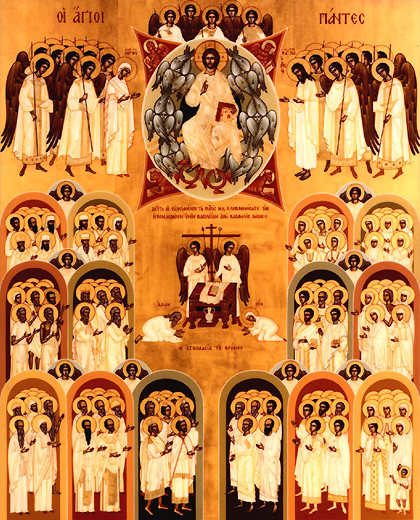
The ultimate offerings at the center of the universe then, this throne that is surrounded in concentric circles of devotees, are seven words or seven blessings. They identify the One who is worthy to receive them and they engage the giver who recognizes their value.

Revelation 7:11b-12
They [angels and elders] fell down on their faces before the throne and worshiped God, saying: “Amen! Praise and glory and wisdom and thanks and honor and power and strength be to our God for ever and ever. Amen!”

1. Praise: approval and admiration; good job! way to go.
2. Glory: resplendent beauty and magnificence as well as “high praise” and distinction.
3. Wisdom: knowledge of what is true and right coupled with justice; enlightened understanding.
4. Thanks: expression of gratitude, appreciation, and acknowledgment.
5. Honor: honest, fair, and worthy of respect.
6. Power: marked ability to do or act; a force.
7. Strength: courage, firmness, as well as mental and/or physical power.

Amen, they cried out. So be it. This is the God we worship. This is the God we trust. This is the God we love.

And these are the merits and offerings we should be recognizing and offering to others. If Spirit is source, then these must also come from there. Is there anyone who cannot benefit from them?

Want to pray for something? Pray for these.

How Many Must Die?

Martyr has become a dirty word over the last twenty years as Islamic terrorists and extremists have usurped its meaning through rampant suicidal bombings in the name of their God. And yet, even they fit the basic definition: a willingness to suffer or die for a belief or cause. Would I?

Revelation 6:9, 11
When the Lamb broke open the fifth seal, I saw at the foot of the altar the souls of those whose lives had been sacrificed for [adhering to] the Word of God and for the testimony they had borne. . . . [they were] told to rest and wait patiently a little while longer, until the number should be complete of their fellow servants and their brethren who were to be killed as they themselves had been.
[Amplified]

And there’s yet another negative definition for martyr, that one who seeks attention by feigning or exaggerating pain. Sometimes, it’s just a person who dramatically takes on the weight of any project with great long suffering. It’s a sham.

How has this word and its intended meanings gotten so distorted?

Of course, not every martyr must die to show his or her strength in following the heart of God. Many are persecuted today in various closed or restricted countries for their faith such as China, Zimbabwe, Eastern European countries like Uzbekistan and Turkmenistan, Muslim countries where western faith is scorned, and so on. These men and women are often imprisoned for basic activities such as prayer, bible reading or distribution, and corporate gatherings. Other martyrs are those work with the poor and sick such as Mother Teresa, William Booth (Salvation Army), David Livingstone (Africa), and Corrie Ten Boom [see more]. They are following an inner vision, a knowing that this is the way they must walk.

In John’s time, martyrdom had become a norm for the Christ follower, in fact, persecution and execution continued up through the 4th century until the time of Constantine. These deaths were not the result of a person’s actions, but merely by their affiliation. Other faiths and peoples have experienced this same kind of broad swathe of death, such as the Jews in Russian pogroms and throughout World War II, or the genocide of Rwandan Hutus in 1994 or African-Americans in our country. The list goes on and on.

So, there are two questions in all of this? Would I have the courage to stand for my faith in the face of death? And secondly, why must it be necessary?

In John’s vision, the implication is that more would die. Apparently, that magic number has yet to be reached.

Even in today’s pop culture, there’s this idea that a lover would die for another:

I’d catch a grenade for ya (yeah, yeah, yeah)
Throw my hand on a blade for ya (yeah, yeah, yeah)
I’d jump in front of a train for ya (yeah, yeah , yeah)
You know I’d do anything for ya (yeah, yeah, yeah)
Oh, oh
I would go through all this pain
Take a bullet straight through my brain
Yes, I would die for ya baby
But you won’t do the same . . . [Bruno Mars]

But really, isn’t it all just a type of posturing?

And yet, some men and women do enter the armed forces and put their lives on the line. Perhaps some don’t really believe they will die but others know, the possibility is there and something inside drives them. They are called heroes. It’s an idealism, a sense of sacrifice for the sake of the many, a belief in good and evil. Is my faith so strong?

How many more must die?

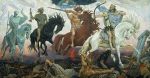
The four horsemen of the Apocalypse are well known by all, particularly as a metaphor for global death and destruction. But I want to know is what these passages have to say to me as an individual. Who are these horsemen to me?

Revelation 6:1a, 2-3a, 4a, 5a, 7a, 8
I watched as the Lamb opened the first of the seven seals.. . and there before me was a white horse! . . . and he was given a crown, and he rode out as a conqueror bent on conquest. . . When the Lamb opened the second seal, . . . another horse came out, a fiery red one. Its rider was given power to take peace from the earth and to make people kill each other. . . . When the Lamb opened the third seal, before me was a black horse! Its rider was holding a pair of scales in his hand. . . . When the Lamb opened the fourth seal, . . . and there before me was a pale horse! Its rider was named Death, and Hades was following close behind him. They were [all] given power over a fourth of the earth to kill by sword, famine and plague, and by the wild beasts of the earth.
[emphasis mine]

Whether it’s the new enthusiasm in the coming close of the Mayan calendar or extremist predictions of the end of the world, they all focus on a cataclysmic finale. The four horsemen fuel this expectation. Historically, the most popular meanings of the horses and their riders are:

  • White Horse: tyranny and the threat of power
  • Red Horse: slaughter
  • Black Horse: famine
  • Pale Horse: death

In actuality, the commentaries and books about these horsemen and their significance are innumerable. Amazon alone displays almost 3,000 titles about the four horsemen. Many speak of the end times, while some hold the view that these destructive events have already happened in the post-Jesus era, and still others view the horses as representative of various epochs. See a concise Wikipedia article on these interpretations for an overview.

But can I relate to any of these interpretations? Am I to watch the skies and quake at the slightest inkling of the end? Do I pray for a quick finale or plead, as Abraham did, for God’s hand to delay for the sake of ten righteous souls? [Genesis 18:16-33] Does it really matter to my daily life whether I believe the horsemen and their seals portend the future or the past in this world? Does it build my faith or set me on fire to act for the good of humankind?

I am thinking the four horsemen, their weapons, and their capabilities are broad stroke types for the attacks on the individual soul. Human is the microcosm of earth. Which horse will strike a person most effectively? I can see how each individual is taunted or seduced or tempted by one or more of the horsemen.

For me, the white horse is plenty effective. I can see where the machinations and impact of the rich and powerful through our Western culture on me every day. Truthfully, haven’t I succumbed, buffeted by a desire to have more and more, both in worldly goods and personal power and influence at work or in my community? This attack begins from the outside but consumes the soul all the same. For others, this power may be more manifest through local governments, dictatorships, verbal abusers in a family, or control freaks. It’s pressure, it’s pushing the right buttons, it’s influence.

The red horse brings the evil of violence against one another. Individuals are hurt every day through the lashing out of physical power: shootings, beatings, torture, and unrelenting restraint tear away at the fabric of the human spirit. Where the white horse evil is exercised through laws or rules or containment, the second one is hands on and brutal.

The black horse symbolizes famine or deprivation. Any news story of third world countries will show the power of lack, whether it’s food or water or shelter. The human’s will to survive is strained to its greatest limits physically and mentally.

And lastly, the pale horse, the one that brings death, may not necessarily bring death to self (a release from pain and sorrow), but the death to those around us, loved ones and innocents. It is a mind game, a despair game, telling the survivor that life is no longer of value when death cheats love, family, community. Catastrophic illness is another player in the game of soul killing, putting the specter of death before a person each day as he or she faces trauma, humiliation, weakness, and body disintegration.

Recently, I had sinus surgery, a minor operation really, and although I had some days of pain and discomfort, it was a far cry from a death march. And yet, those days were spiritually empty. I did not pray or contemplate my inner life. I did not rest in the arms of spiritual bliss. It was all about my physical discomfort. I didn’t need one of the four horsemen to visit, a little pony was plenty.

So, this is my own discovery: the four horsemen may not be some future phantasm at all, but a way of identifying the main pressures along our quest to be fully human. These are our archetypes.

Of the few commentaries I read, I was struck by an older one written by Earl E. Palmer, a popular Presybterian minister, now retired. What captivated me in his comments about the horsemen was the reminder that they were given “boundaries.” They may not be the boundaries that I would like or want, but there is comfort in knowing that they exist. Pain and sorrow and loss and death will not carry the day. This release may come through discovery, through grace, through stubborn resistance, but it will come.

I am looking for this boundary. I want to come out from the influences of the white horse. This is something tangible and real, hand in hand and heart in heart with the Holy Spirit who can direct me onto the more unlikely path, the paradox road, where true power manifests in humility, service to others, and sacrifice: the road less traveled.

A Coronation Tale

If you thought the wedding of Prince William and Catherine Middleton was a extravagant affair, just wait until the next royal or papal coronation. I reviewed the YouTube footage of Queen Elizabeth’s coronation in 1953: thousands and thousands and tens of thousands . . .

Revelation 5:11, 13
Then I looked and heard the voice of many angels, numbering thousands upon thousands, and ten thousand times ten thousand. They encircled the throne and the living creatures and the elders. . . . Then I heard every creature in heaven and on earth and under the earth and on the sea, and all that is in them, saying: “To [the one] who sits on the throne and to the Lamb be praise and honor and glory and power, for ever and ever!”

This is the picture I imagine as John describes his vision of the throne, the lamb, the living creatures, the elders, and the angels, all singing, all joining voices in adulation. For John to be able to describe this picture, he is somehow separate from it, like a television camera. He is not in the event nor part of the event. He is an observer, a witness of a unique sort, a reporter.

Here in the United States, it is outside our ken. We have well attended inaugurations and there is a type of pomp but nothing on the order of Great Britain’s royalty. And now, with modern television, the numbers who are watching have multiplied exponentially. It is as though the the entire earth can witness these events.

This “heavenly” coronation image is the only way John can wrap his mind around and give image or voice to the importance of the moment. The Christ, who entered human form and by God-given power, was able to propitiate (satisfy or atone) for a previously made agreement or covenant that Human made with God and then broke.

This is not the stuff of soccer and Facebook, football and Miss America. This has to do with the fabric of creation outside of our three-dimensional sensibilities.

John did the best he could with what he knew.

In today’s world, we have other visionaries and artists who try to imagine or conceptualize this non-dimensional place or rather, an actuality. But we fall short. Instead, we have our own versions of celebrations and weddings and coronations in an attempt to capture the importance and wonder of a vow, a promise, a covenant, a new identity, a new responsibility.

Why do we have ceremony? Why do you? What is the message?