Feeds:
Posts
Comments

Posts Tagged ‘belief’

What is a promise? I know what it should be. I know that it should be binding and carries with it an expectation. If I promise to do something, the person expects me to follow through. A covenant is the next step up and just below law. Our culture has never mastered covenant.

II Chronicles 15:12
They [Asa and the people of Judah] entered into a covenant to seek the LORD, the God of their ancestors, with all their heart and soul.

Covenant is harder. Despite the promises and the expectations and outward signs of agreeing to a covenant, it can be broken with no apparent ill effects. At least that’s what people seem to think. The most controversial covenant is the marriage. Couples stand before witnesses and make vows, they agree, they promise, they share ritual, and yet, divorce statistics range near 50% for first time marriages and higher for second and third marriages.

I am one of those statistics. I married for the first time at eighteen. And although I was “in love,” I also had this reasoning in the back of my mind: if it doesn’t work out, I’ll just get a divorce. It’s not a good start to a promise.

As a parent, I have tried to avoid the “I promise” phrase because I know how easy it is for things to go awry, for circumstances to change, for promises to be broken.

But today, as I traverse then Lenten time, I feel compelled to make and hold to some promises. I have committed time to God in prayer, meditation, and writing. I have promised to seek God throughout this journey. And I feel the weightiness of this agreement in a way I never have before.

When I was twelve, my mother had tried to find a new spouse by answering personal ads in the Latvian newspaper. One of those men invited us to visit him in Niagara Falls, Canada. I didn’t like this man at all and one night, when the two of them had gone out on a date and stayed out very late, I prayed fervently and made many deals with God if would break up this couple. I believe this was a girl’s version of a foxhole conversion. My mother never remarried, but I didn’t follow through either. Or did I? Was my rediscovered faith at 28, a consequence after all? Did my promise bear fruit?

Sometimes, I think it does work out that way.

The things we say, the words we speak, have power, particularly if they are heartfelt. In that other world, inhabited by spirits and angels and so forth, what happens to the promises we make?

Read Full Post »

Here’s the little truth that came to me through this verse about doubt: no one forces us to pray, there is no mandate, we pray by choice. And if that is so, why pray if we don’t believe God hears, receives, responds?

James 1:6-7
But when you ask, you must believe and not doubt, because the one who doubts is like a wave of the sea, blown and tossed by the wind. That person should not expect to receive anything from the Lord.

We are living today, the result of our prayers of faith. Whoa! you say, but honestly, could it be any other way? Did you pray? Didn’t I? Or, am I living the life of a doubtful prayer?

I don’t think it’s a bad thing to question things we hear or read; it’s reasonable to challenge ideas that don’t line up with our understanding. Without questions, we cannot learn and grow. Without examination, we become dull and follow blindly, sometimes to our own detriment.

But prayer is different because it’s personal. If I choose to pray, to engage with the Holy Spirit, to enter into the realm outside of time and space, then I should do this with the force of conviction that prayer is real, meaningful, and effective.

I think I have been expecting the Christ to cherry-pick through my requests: this one is valid, this one makes sense, this one isn’t a good idea, this one is beyond reason and so forth.

The important factor here is giving up my interpretation of the results as well as my time table. This is essential reasoning behind the classic phrase, “give thanks for all things” [I Thessalonians 5:18] because whatever is happening in the now is part of the answer of a prayer. I’m speaking in broad strokes now. I understand how devastating that would be in the face of a horrible illness, loss of life, or unexpected tragedy. How could these things be part of an answered prayer? I don’t know. It simply could be that one thing had to happen before something else could.

But let me go back to the start of this idea, the moment of prayer and the decision to ask. I saw it so clearly in my quiet time. (And yet I don’t pretend to know all the ins and outs of the meaning.) Yesterday, I had an epiphany about wisdom being part of a daily dose, through prayer. This is a given. I ask, God gives: wisdom for the day. As a result, I can choose better, understand better, and answer better.

But wisdom is not alone in this package, as a brother articulated, much of these requests lie within a prayer we say all the time: the Lord’s prayer. We have simply lost its depth of power and meaning through familiarity.

And what about those people we have held up in the light of prayer? Isn’t God moving and working there? Is God waiting for a finite number of prayers before moving? I don’t think so. We just can’t see the results so we doubt. It’s a human soul with free will. God will not run hilter skilter over that person’s own choices and desires. As my pastor said in services, “God is working both ends of every situation.” And I would add, God is working the middle too.

For me, the point of this discovery is to pray with care, with consciousness, with confidence [Hebrews 10:19-23], with intention. If I doubt God’s ability to move in a situation, then I should save those prayers for another day.

Read Full Post »

Obedience stories really, that’s what most of the faith stories are all about. The ancients heard a call and followed, even though they did not see what was promised, they believed the One who called.

Hebrews 11:7b-8
By faith Noah . . . built an ark to save his family. . . . By faith Abraham, when called to go to a place he would later receive as his inheritance, obeyed and went, even though he did not know where he was going.

There are a few prerequisites in these faith transactions. As noted earlier, one must believe that God exists. Once a person is past that hurdle, the next one is to trust that God is sovereign and can do all things, change all things, maintain all things. And God’s motive is pure.

So far, these traits pretty much go against human norms. We tend to disbelieve what we cannot see, we are slow to trust (particularly those in authority because we have observed so much abuse of power), miracles seem few and far between, and finally, our motives are usually self-oriented.

Nonetheless, there are humans who have traveled upstream. We have these old examples, but I need to look for contemporary examples. Is it possible to recognize the men and women of faith in the midst of their lives? Maybe not. Perhaps it is history that gives context to faith. That would make sense.

Something to ponder today: who is hearing God clearly enough to follow despite the appearance of conflict, blockades, poverty, global change, and fear. What is the message?

Read Full Post »

Most of Hebrews 11 is a cursory overview of some of the great men and women of faith who acted with determination and courage. Their faith was their talisman for relationship with God. And for me?

Hebrews 11:4, 5a, 6a
By faith Abel offered God a better sacrifice than Cain did. . . . By faith Enoch . . . And without faith it is impossible to please God, because anyone who comes to him must believe that he exists. . .

Abel’s stories is one of the first. It’s so interesting that Adam and Eve are bypassed here, more than likely because their faith was wanting. Out of their union, two men were born whose stories have survived through the ages. One son was driven by a pure motive of faith in God and possibly driven by a desire to return their lives to the original purpose and intent of “Eden.” The other son, Cain, seemed to live on the other side of that coin: being more self-sufficient and clearly, my the story’s end, self-absorbed because he couldn’t bear to have his brother’s offering accepted while his was not. I have always believed that motive drove their differences.

In the second story of this chapter, we are given only the second reference to Enoch (now, I am not speaking of the controversial Book of Enoch – which I would like to read one day soon), first in Genesis 5:24 and then again, here in Hebrews 11. And although much is not said of Enoch, there seems to have been knowledge of this one as a prophet, some seven generations before Abraham. The first key for me, based solely on these brief references, is trust. Enoch believed and trusted that God was God and, as a result, anything was possible. Apparently, he transcended the norm, by disappearing without a trace. Although modern times may find this easily explained, there was no need back then for the FBI, pictures on milk cartons, or APB’s. People knew each other and their whereabouts. It was still a small world. His disappearance was supernatural and it occurred out of his faith.

So, what do these stories tell me today? Faith begins out of a decision to believe in the face of all circumstances. Faith begins each day. Faith is rewarded in order to build more faith. Faith is available.

Read Full Post »

The first step is belief. “I believe you; I believe what you are saying; I believe YOU are speaking truth.” But the next step is critical, when the listener moves belief into the realm of faith. Here is where the content has meaning for the listener. And here belief can grow.

Hebrews 4:2
For we also have had the gospel preached to us, just as they did; but the message they heard was of no value to them, because those who heard did not combine it with faith.

Life in the Spirit is cyclical. With this scripture, I understand it even more than before. Belief prepares the ground of my heart to have faith, that confidence in things not seen or proven. And when faith expands, then I am able to understand more of the “message.” I understand more about the messenger.

As soon as I give room to doubt, the process slows down. It still works, but more methodically. The doubter is looking for more to believe, more information, more facts, more stories, more exposure. And when all goes well, the tipping point is reached and the process begins again.

“Then he [Jesus] said to Thomas, “Put your finger here; see my hands. Reach out your hand and put it into my side. Stop doubting and believe.” [John 20:27]

Read Full Post »

Empty Room by Tom Burke

Believing in a future is part of the faith package. We can’t know what that future will actually hold for us, but that does not preclude us from embracing all the possibilities. So much of tomorrow hinges on today.

Philemon 20
And one thing more: Prepare a guest room for me, because I hope to be restored to you in answer to your prayers.

Paul believed he would be cut loose from prison. He asked his friends and his followers to believe the same thing, despite the circumstances.

I can function fairly well in this part of the equation, but I’m not so good when that future I had prayed about, asked for and even envisioned, doesn’t happen. I am disappointed. This is a trap for me.

Intellectually, I understand what it should be. I can preach about it and I can teach about. I can offer all kinds of advice, quotations, and scripture references. Honest, I get it. But the reality of living the other answer is not always my best day.

Instead of disappointment, when the alternate future presents itself, I need to joyfully envelop it and give thanks because God, all sovereign, heard my prayer and took my future onto a different way. When I don’t get “out of prison,” when I don’t get the job, when my kid doesn’t go to college, when my project is not accepted, when . . . when . . . when, it’s no less intentional from the God perspective.

I’m reading a book by Steven Furtick called Sun Stand Still. He’s a young, exuberant pastor from Charlotte, North Carolina, who planted a church that grew into the thousands in a very short time. He’s all about audacious prayers and expecting God to do impossible things. He has seen such prayers answered every day. His faith is infectious. He challenges his church to do the same, like Paul, he says, “do as I do, believe as I believe, trust as I trust.”

Have a I become too jaded in my walk to drum up this kind of enthusiasm? I don’t know. It’s not that I don’t believe God can do great and wondrous acts. God can and does. But I want to be able to walk on through despite the outcomes. I want to have a faith that isn’t wrapped around the answers. Because, quite honestly, my requests are not always in the best interests of the whole picture; I know that instinctively. I can only dream my dream and put my desires out there. But I could be way off.

When I was younger and went through those terrible years of barrenness, I came to a peace when I accepted the reality of my body. It was no less God’s plan and, in the end, we built a family through adoption, three kids who didn’t know that God had prepared a room for them here.

Everything is connected, every dream, every future, every room. Keep me mindful Lord, when I step into the room prepared for me today, that I don’t forsake it just because it’s not painted the color I had imagined or it’s not furnished with the expected furniture or populated by certain people.

Help me dream and even dream big still, but help me engage in today fully as well. Today is part of yesterday’s dream.

Read Full Post »

In several places Paul tells his followers to trust his message because his very life is a testament to his faith. In today’s world, there are those we know and have known, whether they are friends or family, and because we know them, we trust them. Or do we?

II Timothy 3:14
But as for you, continue in what you have learned and have become convinced of, because you know those from whom you learned it, . . .

Trust is a funny thing. It can be taken for granted or it can be nurtured consciously and strengthened over time. The longer and deeper I know someone, the more likely I am to discern whether he/she is trust “worthy.” Relationships are built on trust because people must be transparent to be trusted. Without transparency, the foundations of a relationship are built on sand. And yet, despite, weeks or months or years of building trust, it can be broken with a single word, a single act, a single observation.

As soon as mistrust raises its unholy head, there’s hell to pay. Rebuilding trust after a betrayal (whether perceived or real) takes longer than the first time around. We place the other under the microscope and we find additional reasons to “not” trust. We look for the lie. We look for the secrets. We expect the worst.

I believe this “breaking of trust” moment must be examined carefully and weighed against knowledge and familiarity and love.

In the past week, I have seen three relationships within my immediate family ripped apart (possibly in a permanent way) because of broken trust. Somehow, whatever was known about each other before that moment came, was not enough to stay the doubt and suspicion, to balance the scale of possibilities, to hold the cracks together. Whether it’s teenagers falling in and out love or mature adults running from the possibility of being hurt yet again, the process is the same and one or the other says, “I don’t believe you.”

And then, on top of that, in a public forum, I witnessed palpable abusiveness and accusations because of a perceived certainty that trust was broken. I wanted to stand up and yell, “Stop! You’re talking about my friend, you’re calling into question the integrity of someone I have known for twenty years.” I trust my friend. I trust my friend’s intentions. And it hurt me to watch the bubbling cauldron of bitterness and rejection. The words were different, but it sounded the same, “I don’t believe you.”

And that’s when I saw it, this moment of decision, to stand by what has been shared and spoken before, to remember the conviviality and the good intentions, to hold fast to the history. . . or not.

Paul tells Timothy to trust in the truth of what he has learned from his mentor, from his friends, and from his family. This is Paul’s last letter to his protege. Many, many people attacked Paul in the same way that the authorities attacked Jesus. They called them liars, fakes, and charlatans. They called them destroyers and divisive elements in the faith.

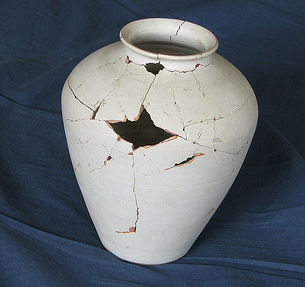
Who will we choose to trust in that moment when the vase is about to shatter? Who will we believe?

Read Full Post »

« Newer Posts - Older Posts »