Feeds:
Posts
Comments

Posts Tagged ‘crucifixion’

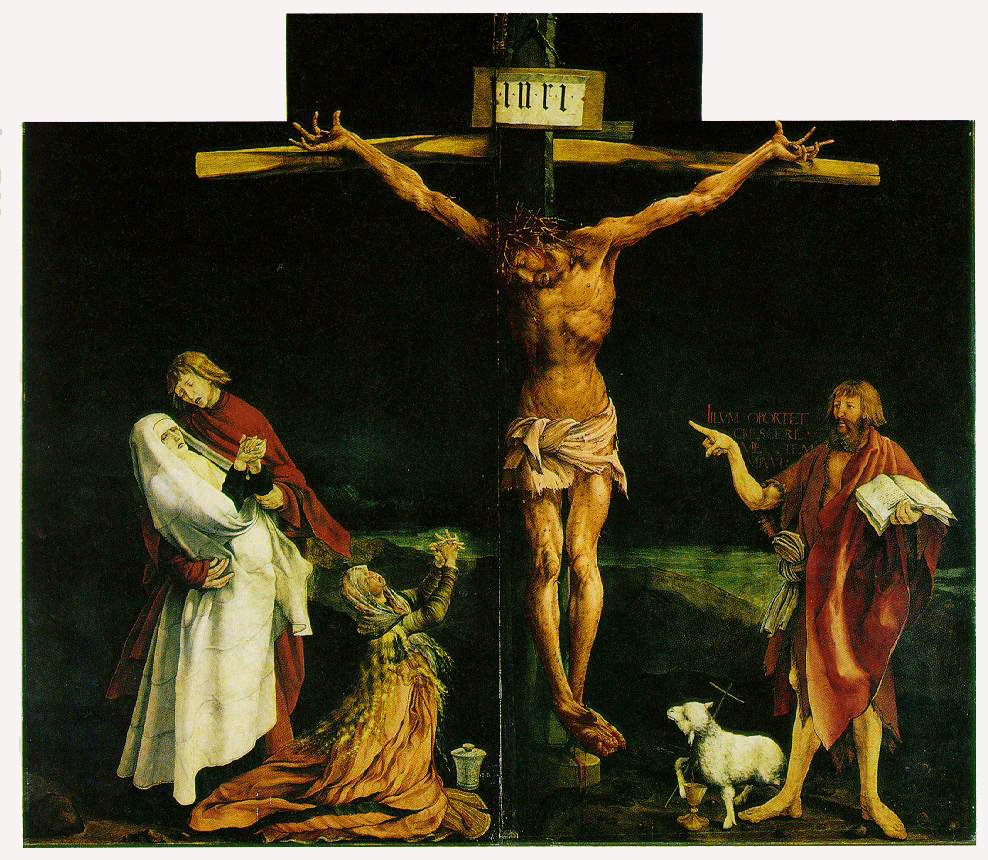
Did the ones who stood vigil at the cross really believe Jesus would die? I don’t think so. They expected a reprieve or a last minute miracle. After all, this was the man who stilled a storm, gave sight to the blind and raised a dead man. Was this his final display of strength in weakness?

II Corinthians 13:4
For to be sure, he was crucified in weakness, yet he lives by God’s power. Likewise, we are weak in him, yet by God’s power we will live with him to serve you.

It’s all there in the crucifixion story: die to live, weaken to strengthen, submit to rule, forgive to trust, suffer to heal, and so forth. These opposites trail after me. When am I going to get it?

Last night I had a dream about a very large black dog that charged toward me and instead of running away or standing stock still, I squatted down, held out my arms to hug him and nuzzle him. I seriously doubt this technique would work in real life. But in the dream, the dog responded and simply rubbed my face and neck the same way my big Snooki dog (a black lab mix) does. It’s a start.

Weakness can be a choice for the good of the moment.

For me, this means saying, “You’re right,” more often or “I take full responsibility for that mistake,” or “I was wrong.” It means listening even when I disagree. It means giving opportunities to others that I would like to have. It can mean serving without recognition or diligence without admiration. It can mean accepting surprises and unintended consequences with grace. It can mean a certain lack of control.

My big joke about myself has always been that I prefer “planned spontaneity.” When an old friend who was a 5th grade science teacher told me she would run experiments in class without knowing the outcome, I paled. How often have I told people, “I’ll do it!” not because I wanted to help but because I didn’t trust anyone else to “do it right.”

That’s a shame to me now. It’s time to respond differently. It’s time to let go of my controlling nature. It’s time to stop previewing the future, planning every step, and manipulating outcomes.

I’m not so sure that even Jesus knew how things would play out. But his trust in God was rooted deeply and in the end, even in fear and doubt, he died with hope. Was he surprised when he found himself back in the world? We’ll never know. But he certainly walked about in new understanding.

This is what can happen to us as well. Once we let go of “our way,” we are able to discover another way that is God-breathed.

Read Full Post »

John 18:12a; 15a
From then on, Pilate tried to set Jesus free, but the Jews kept shouting, “If you let this man go, you are no friend of Caesar…” …they shouted, “Take him away! Take him away! Crucify him!”

Once you get a crowd started, it’s pretty hard to change its direction. Once it gets hold of a picture or a phrase, it’s next to impossible to replace with another. The phrase or picture becomes some kind of mantra and repetition breeds crowd think.

Even if Pilate had released Jesus (which he thought he could control [see vs 10]), the crowd would have carried out their judgment in one way or another. Jesus became, for the crowd, a scapegoat.

This kind of crowd think is still happening today. There are influential people who can get a crowd going with just a few buzz words or volatile images. This week, there was a huge brouhaha over the education speech President Obama offered to all schools around the country as a live feed. The reaction to this proposal was fueled by words like “brainwashing” and “socialism.” Once those words were out there, the crowd (particularly the virtual one) could not be turned.

Crowds can be manipulated for good or for evil. It just depends who gets hold of them first. In previous generations, this work was done in person: a charismatic leader would speak and arouse a crowd’s sentiments. Today, this kindling of emotions is done on the Internet and by email. It’s a stampede of messages.

Once a crowd is on the “march,” it’s only violence or time that can break through the din. This kind of crowd cannot hear logic or respond to pleading. Either the pushback is of equal intensity (think of demonstrations) or the intensity peters out because it cannot sustain itself over time.

I imagine there were a lot of people who regretted their participation in the crowd think that called for the crucifixion of Jesus. We should also take care that we aren’t getting caught up in crowd think.

Read Full Post »

Romans 8:11
And if the Spirit of him who raised Jesus from the dead is living in you, he who raised Christ from the dead will also give life to your mortal bodies through his Spirit, who lives in you.

Yesterday, Pastor Craig gave a powerful message for Easter calling us to strength, calling us to engage that same Spirit that raised Jesus from the dead to raise us from our own crucifixions. When we face our most difficult trials, we must look to the One who can teach us, who can show us, who can uphold us from within.

Like all of the fruits of the Spirit (Galatians 5:22-23), strength is like them and comes from within; it, too, is an attribute of the Kingdom of God within us (Luke 17:20-21).

There is a tension between our own way and the way of Jesus. There is a tension between our own ways and the ways of the kingdom of God. We must surrender to this Way daily (… your Kingdom come, Your will be done in Earth as it is in heaven…). Note, I have changed “on earth” to “in earth” because I also think of Earth as my body… the flesh, the three-dimensional self and then the three-dimensional world/environment around me. “For nothing is impossible with God.” (Luke 1:37)

Read Full Post »

Mark 38-39
The curtain of the temple was torn in two from top to bottom. And when the centurion, who stood there in front of Jesus, heard his cry and saw how he died, he said, “Surely this man was the [or a] Son of God!”

An epiphany is “a sudden, intuitive perception of or insight into the reality or essential meaning of something, usually initiated by some simple, homely, or commonplace occurrence or experience.” For the centurions with execution detail, this was a commonplace experience. They had killed hundreds and hundreds of men. They had nailed them and stripped them and mocked them and thrown dice over their belongings. It was tedious work.

But at least one centurion began to see this man in a new light. He listened to his words. He watched him suffer and he watched him die and then he understood. They had just crucified a holy man, a son of God, a man, and yet not a man. Nor was this a quiet time; it was frightening. Darkness had descended upon the place followed by a great earthquake at Jesus’ death. People must have been running and screaming as anyone would during a cataclysm.

And what was next for this centurion? What did he think or do? Did he believe it was too late? Did he bow down before his new Lord right then? Did he weep like Peter or despair like Judas? Did he change?

My mind keeps going to that wonderful old book (by Lloyd C. Douglas, 1942) and the 1953 movie by the same name, The Robe (with Richard Burton and Victor Mature). Here Centurion Marcellus (Burton) does not transform immediately but over time, having won Jesus’ robe, he is affected by the proximity of the robe and haunted by his experiences on Golgotha. Eventually, he becomes a believer, joins the other Christians and ultimately he is martyred as many were under Caligula.

What does any of this mean for us… for me? I know what it means to have an epiphany… a true insight from God, but I confess I have archived most of them in distant reaches of my brain. Abba, forgive me. Give me mindfulness that I might build on the truths you reveal to me.

Read Full Post »

Satan Entered Judas

Luke 22:3-4
Then Satan entered Judas, called Iscariot, one of the Twelve. And Judas went to the chief priests and the officers of the temple guard and discussed with them how he might betray Jesus.

How does it happen this “entering” of Satan? I don’t believe a person is just fine one day and like a virus or bacteria, he or she picks up Satan off of a doorknob. And yet, in the same way that Jesus spoke of the fertile soil that is needed to nurture the seed of the gospel, there is also fertile ground for Satan.

Satan is not a person but an entity who is a ruler of that other plane (For our struggle is not against flesh and blood, but against the rulers, against the authorities, against the powers of this dark world and against the spiritual forces of evil in the heavenly realms. Ephesians 6:12) And so, we are dealing with the matters of the heart, soul, and mind.

Galatians 5:19-21 gives us a pretty good list of Satan’s fertile soil: …sexual immorality, impurity and debauchery; idolatry and witchcraft; hatred, discord, jealousy, fits of rage, selfish ambition, dissensions, factions and envy; drunkenness, orgies, and the like. So often, as we read through this list, we feel smugly safe, thinking how we haven’t participated in any orgies or witchcraft lately. But, we gloss over the other plants that may have found root in our inner garden: discord, jealousy, envy, idolatry… we have ALL experienced these to one degree or another.

Who knows what drove Judas? Some have said greed, but I don’t think so. I believe he had his own idea of how things should go. He disagreed with Jesus’ plan. And so he put his own plan into motion and Satan nurtured and watered that notion. And then the idea became an action and eventually had a life of its own that ultimately played itself out on the cross.

Each day, we must choose to pull weeds from our inner garden or they will grow and grow and soon, very soon, they take over.. It is much easier to pull them out when they are small… of course, if we take this gardening metaphor even further … it takes some knowledge to know which plants are which, what is a weed and what is not because, when they are very small, we don’t always recognize them.

So, we must be diligent, we must be knowledgeable and ask for help from the Master Gardener.

Read Full Post »

Matthew 27:46
About the ninth hour Jesus cried out in a loud voice, “Eloi, Eloi, lama sabachthani?”—which means, “My God, my God, why have you forsaken me?”

We don’t know how God will save. Despite Jesus being God in the flesh, he was also limited by this flesh and did not really know how the end (or the beginning) would manifest. All around him were mockers. All around him were soldiers “just doing their jobs.” And even, around him, were a few faithful, believing in him still… somehow. But what would happen next? He had already suffered so much: the betrayal, the false hearings before the Sanhedrin and Herod, the flogging, the long walk to his the Golgotha, the nails, the erecting of the cross with his body impaled upon it.

How much more could he bear? How would his salvation come? Would he know death? And still, the pain of the flesh overcame everything. And there was the most human experience of all: fear and doubt.

Had Jesus known these anytime before? I can’t think of one. Even in the face of Lazarus’ death, he sorrowed, but he knew. But here, I think he felt the intensity of our human fragility.

We don’t know how God will save. For Jesus, he went to the end of human life to find the beginning of new life. And this is so for many of our loved ones. But there are also dramatic reversals, healings, mercy, transformations, love, and renewal. Everything is possible now because Jesus pressed into the reality of his fear and doubt and still surrendered to the wisdom of God: “Father, into your hands I commit my spirit.”

Today I will remember surrender.

Read Full Post »

Mark 15:14-15
“Why? What crime has he committed?” asked Pilate.
But they shouted all the louder, “Crucify him!”
Wanting to satisfy the crowd, Pilate released Barabbas to them. He had Jesus flogged, and handed him over to be crucified.

In the end, Pilate satisfied the crowd because it was easier. He had no fear of Jesus. He discounted the warnings of his wife. He viewed the whole matter as an inconvenience. He made a few lame attempts at releasing Jesus instead of Barabbas. And I’m sure he even knew it was the priests who were driving the crowd. But most of all, he knew Jesus was innocent. He took the path of least resistance. Truth was not essential.

Today, I read in Luke 21:34… “Be careful, or your hearts will be weighed down with dissipation, drunkenness and the anxieties of life…” where Jesus warned the people that these things will prevent a person from recognizing the truth of events unfolding in the end times. A dissipated heart could be interpreted as a heart wasted away by misuse, drunkenness as “self-medication” and anxiety as fear of self-control (for in the end, anxiety occurs when we can’t control our circumstances). All of these prevent us from seeing the truth. And so, we take the easier path, just like Pilate. We have lost the ability to feel the pain of others, we run from our own pain, and we build walls around our world to keep out the messiness of life.

Today, I will seek courage for seeing truth and choosing the way of it. Today, I will exercise my heart, my mind, and my soul for the sake of Christ.

Read Full Post »

« Newer Posts - Older Posts »