Feeds:
Posts
Comments

Posts Tagged ‘faith’

The bride or the “body” of Christ is also the New Jerusalem, a city. Jerusalem of old was selected to be the place of the Temple where God would dwell among the people. It was a place of connection and interaction, devotion and sacrifice, symbolism and authority. And now, we are looking to the New Way.

Revelation 21:9b-10
“Come, I [the angel] will show you the bride, the wife of the Lamb.” And he carried me [John] away in the Spirit to a mountain great and high, and showed me the Holy City, Jerusalem, coming down out of heaven from God.

The New Jerusalem, although described as an object with gates and walls and jewel-like appearance, it is clearly John’s effort to describe the indescribable. It’s still a dwelling place, but different.

I am always reminded of one of the best sermons I ever heard on the resurrected Christ, that He was the same and yet different, in the form of a human, but with traits that exceeded anything observable as human: appearing and disappearing, solid but not solid, not confined to time and space. If the resurrected Jesus would be so different, doesn’t it make sense that the “bride” would be equally different.

In my mind, there is a foolishness to any attempts to truly understand the supernatural relationship between God and human. This binding is unique. And we can choose to be bound or be loosed from God.

Am I a spirit being or not? Is my essence within or not? I cannot convince another person of that reality through words alone because it’s not a “word” kind of thing.

Have you ever tried to remember something and seems to literally dance around the edges of your consciousness? This is how I think about the Spirit self. It’s there and not there. It’s tangible and not tangible. It’s the ultimate paradox.

And perhaps, whether it’s hard to imagine, there is something important to the otherness of Christ uniting with human. I think about the symbolism of Christ as male and the bride as female. There’s something in this oppositeness that changes the equation, that creates something new, that “New Jerusalem.” Marriages of today are experiencing a stretch beyond anything we could have imagined. Sexuality is also reaching past comfort boundaries of the past. But does that change the relationship of the Christ and the bride?

In Galations 3:28, “There is neither Jew nor Gentile, neither slave nor free, nor is there male and female, for you are all one in Christ Jesus.” These human differences do not exist in the Spirit realm, the ultimate relationship. So, despite the fact that it’s nice to have the symbolism of the traditional couple, it doesn’t necessarily mean that it’s necessary for the ultimate union. Just saying.
Read Full Post »

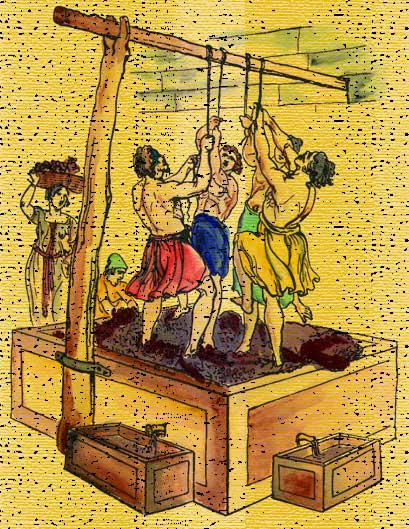
Throughout the Bible, the imagery of wine is used in a positive light, like Jesus turning water into wine or the Passover cup where it symbolizes the shedding of his own blood. But the winepress itself, the process, that pressure and transformation holds other implications.

Revelation 14:19
So the angel swung his scythe on the earth and stripped the grapes and gathered the vintage from the vines of the earth and cast it into the huge winepress of God’s indignation and wrath.
[Amplified]

It’s not a gentle business, the pressing of grapes, or for that matter, gathering them either. In the case of true wine making, there is a particular pressure applied to avoid smashing the seeds which give a more bitter flavor. Were they as concerned in ancient times? I don’t know since it was done with feet. In any case, once the grapes are smashed, they are no longer good as grapes. They must become something else.

Generally, I have only known the kinder forms of metamorphosis. The Holy Spirit is a gentle craftsman of my heart and soul. I am forgiven daily and given many, many opportunities to try again, to learn, to grow, to change and ultimately, to become a sweet aroma to both humankind and God. I want to translate myself into a creature of love and daring.

But I also understand that kicking against the goads of God’s will for me, fighting the process, forcing my way on the path, only makes it more difficult. And so, challenges and difficulties can arise to bring me back around.

It’s hard to see and understand the God way because it’s a way of mystery and paradox. It’s the path that Indiana Jones couldn’t see over the abyss. It cannot be seen or felt until one takes that step of faith. It’s not the golden chalice but the well-worn, humble one that is the Holy Grail.

Eventually, though, a day does come in the stretch of humankind when God allows the worst to happen. Like the pain of Job who lost everything to find everything, so it will be with Earth: a great shattering.

I don’t like the idea of contemplating such a turn of events nor do I want to be there. I don’t want to be there because of my own stubborn nature. I don’t want to know the winepress of wrath.

Read Full Post »

The two witnesses, as depicted in the Bamberg Apocalypse, an 11th century illuminated manuscript.

I really am trying to plow my way through these final chapters of Revelation, but it’s slow going. Not that I don’t understand what I am reading or appreciate the wonderful images and symbolism. I simply don’t know where the application for me, right now, might be hidden.

Revelation 11:3-5
And I will appoint my two witnesses, and they will prophesy for 1,260 days, clothed in sackcloth.” They are “the two olive trees” and the two lampstands, and “they stand before the Lord of the earth.” If anyone tries to harm them, fire comes from their mouths and devours their enemies. This is how anyone who wants to harm them must die.

I have always liked the story of the two witnesses in its seeming detail and yet, mysterious exclusions. After all, no one really knows who these two are or might be. Some claim they are Moses and Elijah (both seen at Christ’s transfiguration [Mark 9:2-9]) while others say they are two new characters in the end times story. In any case, they stand around for three and a half years prophesying and doing battle with anyone who tries to interfere with them. They are not depicted as particularly benevolent or nice. They are clearly on a mission.

And why just two? Are they symbols for two people groups or two types of ideas? Who knows? I don’t know. But based on the remaining events after their time, they do seem to represent a turning point, a kind of last chance to hear the message. After they finish their business, evil in the world brings out the “big guns,” that is, the Beast from the Abyss. Whoever or whatever this might be, it has the power to destroy the two witnesses and they remain dead for three and a half days. Then, miraculously, they are revived and ascend (or disappear). With their disappearance, there is a great catastrophic earthquake and 7000 people are numbered as dying. The survivors, even at this late hour in the long experiences of woes and angels and death and destruction, “give glory to God in heaven” [Revelation 11:13]. Go figure.

There are many examples in scripture about the number two: Noah’s ark animals two by two [Genesis 7:9] while Jesus sent his disciples out in pairs [Mark 6:7] and of course, there are a number of well known couples like Adam and Eve, Joseph and Mary, Jacob and Rachel. And we cannot forget the friendship pairs either: Ruth and Naomi or Jonathan and David. And like the yin and yang of Chinese tradition, the Judeo-Christians have their alpha and omega (the beginning and the end), light and dark, good and evil, heaven and earth, two witnesses are required to confirm a crime [Numbers 35:30], two lamp stands, two fish, and many more.

Who are the two witnesses in me? Do they speak the same message or are they opposites? Does one begin and the other finish? Is it the good cop/bad cop routine? Is it Abbot and Costello? Jerry Lewis and Dean Martin? The Smothers Brothers? Some duos are opposites while others are the same. Some compliment one another while others grind. Some war against each other while others make love and peace.

Is it possible the two within me are the old self and the new? Or my spirit and the Holy Spirit?

Part of the mission of becoming a follower a Christ is melding the two’s into one. The human model for that is supposed to be marriage where two become one.

I can well imagine that these two Revelation witnesses, once resurrected, also united. The work was finished.

And so, that is my application: two become one . . . eventually. Life is the process. Faith is the process. We don’t experience “one” until we have lived out the fullness of “two.”

Read Full Post »

Photo by James Thobe

Peace is another word for God as is Light and Love and Jesus. I seek and I find and then I must pursue the next seeking and the next finding.

I Peter 3:11
They must turn from evil and do good; they must seek peace and pursue it. [Psalm 34:14]

Through the course of this Lenten study on seeking, I have discovered that seeking is also asking, it’s an internal process, an acknowledgment of now and a need change, it’s humbling, it’s sowing, it’s trusting in both the process and the results, it’s repentance, it’s persistence and desire (as strong as thirst in the desert), and most of all, it’s learning to recognize the One who is sought. It’s a cycle of findings.

Like any other spiritual practice, it’s a discipline and requires both mindfulness and diffidence. This is a journey for the long haul. This is a lifelong practice.

I lose the sense of process so quickly along the way. My personality is one that prefers projects (beginning, middle, and END). I want to get there. I want to see the finish line so I know I’m going the right way.

But, alas, the walk of faith is not built this way. I know it in my head and yet, I keep trying to change the rules of engagement.

In nature, every season has a new challenge, it’s either too wet or too dry, too cold or too hot. Predators abound as do victims. Disease finds root and spreads. Death appears unyielding and potent, but then new life springs up with even more vigor, like new growth after a devastating forest fire.

Hope and faith are the fuel of seeking.

Read Full Post »

I’ve always wondered about the sequencing of this verse: ask, seek, and knock. Each of these actions has a promise of success. Yes, but first there must be intent and choice, a decision to do something different.

Matthew 7:7
Ask and it [the good gifts] will be given to you; seek and you will find; knock and the door will be opened to you.

When I ask, I am unsure about the present situation. I am curious about the possibilities. I am thinking that there might be a better way, a solution that is not immediately obvious. I am asking for information about the way to the good gifts, those things I may need in life to move forward. What do I need for my next step in life Lord? I’m just askin’.

When I seek, I am a little more sure of the end result. I’m thinking there is something specific that will improve my situation, that will bring clarity, that will meet my need. And I am encouraged to look. I have asked and I am getting the green light to go for it.

And finally, I am knocking for one of two reasons: I am announcing myself (I have arrived at the place of discovery). Or, I get there and I am facing an obstacle that I cannot move on my mind. It must be opened from the other side.

So what are the good gifts that are on the other side, at the end of my search, in the response to my questions?

“Which of you, if your son asks for bread, will give him a stone? Or if he asks for a fish, will give him a snake? If you, then, though you are evil, know how to give good gifts to your children, how much more will your Father in heaven give good gifts to those who ask him!” [Matthew 7:9-11]

It’s in the moment, in the now, that thing or knowledge or revelation which is needful. And not before. The good gifts are not the luxuries of life. The good gifts are the perfect gifts, those which we cannot, in that instant, provide for ourselves.

What good gift do I need right now, sweet Jesus?

Read Full Post »

It’s a process, this sowing and reaping thing. Generally, this pairing is used as a metaphor for the bad things that happen in our lives, but of course, good planting makes for good results. Unfortunately, the good seeds seem to grow a lot slower than all the rest.

Hosea 10:12
Sow righteousness for yourselves, reap the fruit of unfailing love, and break up your unplowed ground; for it is time to seek the LORD, until he comes and showers his righteousness on you.

I’m not really much of a gardener so I’m sure I’ll play havoc with this metaphor but there are some pictures that come to mind. For instance, the last time I tried to prepare and plant a 10×10 foot vegetable garden in my back yard.

Soil preparation was a complete nightmare. We live in one of those developments and didn’t realize how much refuse is buried on a lot before or while they are building a house. I found huge globs of cement, parts of boards, rocks, and even empty cans in that small plot of land I was trying to plow up by hand. And of course, the soil was as hard as could be. We finally had to buy top soil to dig into the original dirt which was worthless (it’s a wonder that grass could grow).

Finally, I got the dirt to look somewhat welcoming to a small starter plant or seed. And this was probably the best part of the process, the actual sowing or planting. Little did I know that the next challenges would be equally daunting: deer from the woods could easily hop over our split rail fence, our dogs and cats liked the new fresh soil for digging and leaving personal gifts, the weeds were indistinguishable from the plants (to my untrained eye), and the Maryland weather offered no assistance whatsoever.

So, after all that, what did I reap? Two broccoli heads, scrawny tomatoes, wilted lettuce, holey peppers, and three carrots of diminutive size. Go ahead and laugh. It’s a willow tree now anyway.

I’m glad the Holy Spirit is a better gardener/farmer than me. Oh, I know, I still have to participate, but I think the overall procedure is in God’s hands if I release my control, my time table, and my expectations.

Just keep doing the “right” thing, as best I can. Again and again and again. Keep trusting. Keep forgiving. Keep asking for forgiveness.

In both Mark 4:8 and 4:20 in the parable of the sower, I am promised a 30-60-100 fold return, but there is no promise about when.

Sowing in the Spirit realm is a marathon, not a sprint.

I love the idea of “unfailing love.” In this phrase is hope and promise, persistence and progress. I am actually living in the midst of unfailing love right now, no matter what my circumstances might try to negate. I have planted with Christ. Now, I must stand and give thanks because those other roads I could have taken, back there in my past, would have destroyed my garden altogether, I’m sure.

Read Full Post »

I am not poor. Of course, I’m working on it, what with spiraling debt and fruitless planning. But, in the greater scheme of things and the world at large, I am quite flush and comfortable. So, who am I speak about the promises of God for the poor?

Psalm 69:30, 32
I will praise God’s name in song and glorify him with thanksgiving. . . . The poor will see and be glad — you who seek God, may your hearts live!

And yet, promises and precedents do exist.

In the time of Christ, the poor saw Him first and recognized God in Him. The poor followed. The poor believed. The poor sustained the faith. And the rich worried.

But God’s empowerment is not a change of social status. In all the acts that Jesus did for the poor, he never made anyone richer. He healed, he fed, he taught. He gave hope where no hope had been. He gave strength to the weak. He spoke to the wealth within each and every human being. He loved.

One of the essentials to surviving and perhaps overcoming one’s circumstances is trusting God’s providence in the midst of difficulty. It’s living through this day because the next day is in God’s hands and anything can happen. This is the significance of praise: it’s trust.

Back in 1970, Merlin R. Carothers wrote a book, From Prison to Praise, that is still in print today and continues to change lives. A lot of us tried his formula but it always felt a little forced to me. I felt like I had to manipulate my circumstances to find something I could praise God for in the midst of them, like having a flat tire on the freeway, but “praise God,” a policeman stopped. And so forth. I’m not saying this way of looking for the silver lining in life events doesn’t have value, it does, but today, I’m thinking differently.

Instead, as in the case of the poor whose circumstances may not be dramatically changed from day to day, it’s trusting God in the midst of the worst. God is sovereign whether I can see it, feel it, or touch it.

Perhaps it’s too hard to say, I praise God in this nightmare, then say instead, “I trust God.” They are the same.

It’s not up to me to figure out which part of this crisis can be turned for good or how God will manifest nor do I need to be a Pollyanna . Instead, it is the simplicity of “I am here, God is here, I am here with God” [Brian McLaren, Naked Spirituality: a life with God in 12 simple words].

If it is hard for me to maintain a place of trust in God, how much more for those in crisis every day?

Read Full Post »

« Newer Posts - Older Posts »