Feeds:
Posts
Comments

Posts Tagged ‘God’

promises of GodJust a quick look in Google yields a number of websites people have created to lay out a full list of the promises of Christ, primarily based on things Jesus said, such as John 15:5, “I am the vine; you are the branches. Whoever abides in me and I in him, he it is that bears much fruit, for apart from me you can do nothing.” [Of course, that verse seems to be a combination verse, a promise and a consequence. Or are they the same?]

Near the end of the book of Joshua, it is written,The Lord gave them rest on every side, just as he had sworn to their ancestors. Not one of their enemies withstood them; the Lord gave all their enemies into their hands. 45 Not one of all the Lord’s good promises to Israel failed; every one was fulfilled. [Joshua 21:44-45, NIV] Most of these promises dealt with the land and conquering the pagan peoples who lived in those lands. All was fulfilled in that time. But we know how the story goes; not long afterward, the people jettisoned the plan and the covenant once Joshua passed and the last of the generation that saw God’s miracle-working power from Egypt to the promised land.

We are no different.

The words are still out there for us to embrace. The promises are still real and concrete. But we hedge our way, like the story of Eve and serpent, we hear these words instead, “Did God really say . . . ?” [Genesis 3:1b] Really? Did God promise this or that? Did Jesus really mean . . . isn’t it more likely that . . . ” And on and on and on we go, further afield of the simplicity of the gospel, either making it too complicated or too simplistic and in both cases, opening a door for doubt and confusion.

Today, I read on Facebook of a woman who was struggling with someone who questioned the “race” of Jesus. Was he white? Was he black? And so on. Is this a worthwhile discussion? Does it do anything for our faith? Or, is it just a surface issue that bypasses the central truth? Also today, I attended a funeral of a 19 year old daughter of a family friend and my own adult daughter was surprised how the young woman in the coffin did not really resemble the girl she knew. I had to remind Lily, the body is but a shell and it is the Spirit that gives the human body dynamics and life. Hannah was no longer there.

Painting by Jonas Gerard

Painting by Jonas Gerard

So it is with all things of God. The promises of God may appear to be about outer things, land and so on, but in reality, they are about the inner truth, the inner person, the relationship between my “self” and the God who lives in us through Christ. God’s promises are about eternity and living outside and beyond the body, the truly promised land. The enemies we face are the challenges of 3-D life: sin and selfishness, distrust and fear, evil from without determined to destroy the good within.

If only we . . . well, I can’t speak for you . . . if only I could engage fully in the truth of the fulfilled promise. It’s all done, completed from the day of Joshua to the day of Jesus, also a Joshua, who fought for my salvation and won. It is finished.

Read Full Post »

holy objects TabernacleBack in the day, they had some seriously sacred and holy objects. Everything in the Tabernacle (tent of meeting) was holy and could only be handled, touched, or carried by certain people and in a certain way. Any deviation could mean death. Does anything in our contemporary world compare?

They [Kohathites clan] are the ones who shall deal with the most sacred objects associated with the congregation tent. . . . When Aaron and his sons are done covering all the holy objects and furnishings, then and only then (so that they don’t touch the sacred things and die), the Kohathites can approach. They are the ones who shall transport these items of the congregation tent. [Numbers 4:4, 15]

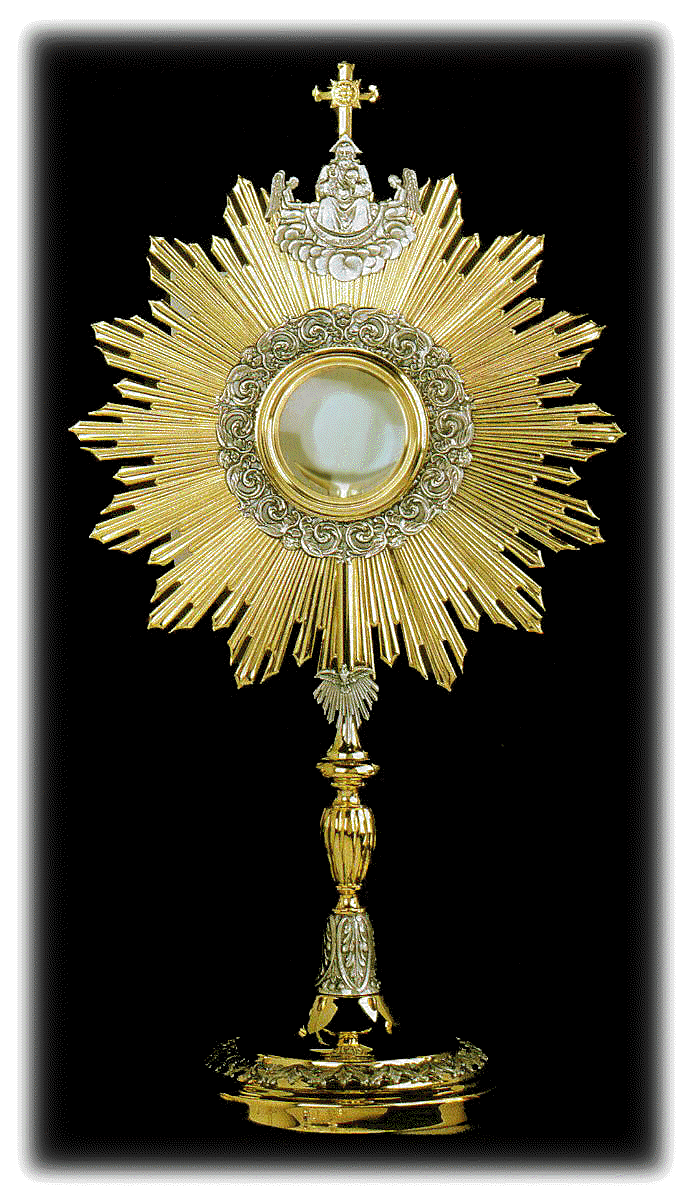
There are religions around the world that do have sacred objects and although none have the death penalty, they do carry severe holy eucharistpenalties. In Western culture, mostly it’s the high church denominations such as Catholicism and Orthodox who revere things, be it the Eucharist (sacramental bread), icons, relics, or specific objects that have been blessed or designated for holy use. In Muslim culture, it’s my understanding that the Quran (book itself) should never touch the floor or have anything laid on top of it and believers should not touch its pages without formal ablutions.

But the idea of holiness in our midst, whether in objects or places, has been lost, in large degree, by the vast numbers of believers who have embraced a friendlier God whose grace extends to jeans, casual environments, electronic texts, and handy communion elements. I am not condemning the practice per se; after all, I attend such a church myself. It’s modern and relevant and loud; it appeals to a broad range of people and is designed to be accessible to both believers and non-believers alike.

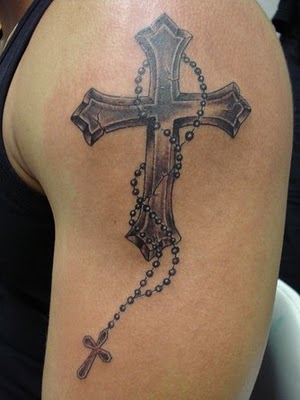
cross and rosaryIn Christianity, the cross, the instrument of torture used by the Romans to execute criminals has become so ubiquitous that both believers and non-believers can be seen wearing t-shirts, earrings, and tattoos with the cross prominently displayed. Go figure.

What is holy in my own life? I find myself hungering sometimes for the holy or sacred experience. In new cities, I love finding older church buildings and sitting in the quiet spaciousness of the place. I love to listen to sacred music alone or practice the praying of the hours. There is a respect for the time and the place that feels different, that engages me spiritually in a way that other things do not. Don’t get me wrong, I love contemporary worship with its upbeat sound, waving hands, and corporate experience. But it does not speak of holiness. It’s praise and adoration of a type, but I would never assign the word holiness to it.

There are times in nature when I have felt a holy presence, but it cannot be re-created at home. And I have had remarkable revelations while reading my Bible and yet, I know I treat the book itself somewhat cavalierly (besides, I must have about twenty different versions all over my house). If I can’t find one, there’s always a back up. It’s not holy or sacred in that other way at all.

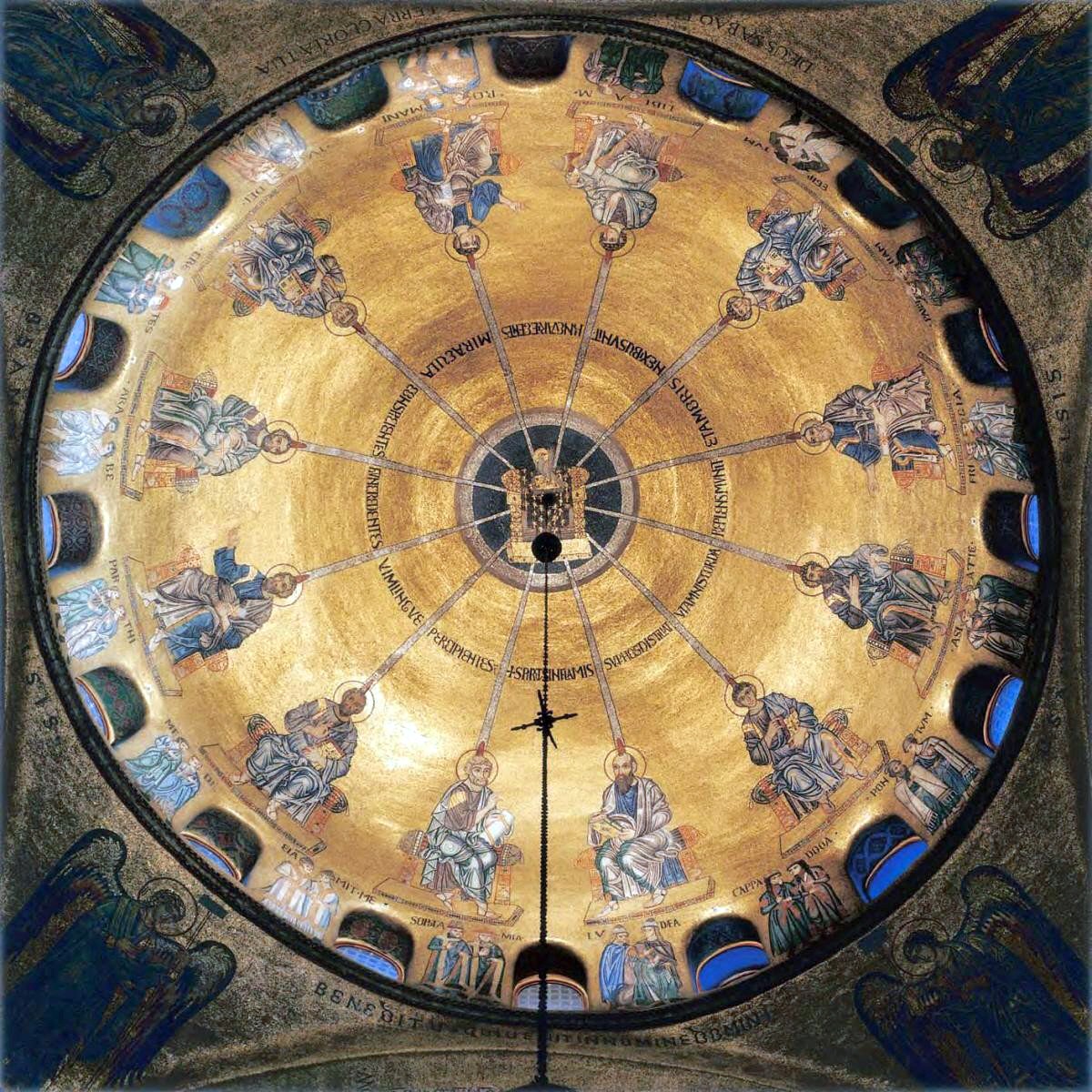
Of course, one cbasilicaan ask if holiness or sacred objects are needful in today’s culture? Perhaps not. But I wonder, are we missing something?

My husband’s conversion story includes a moment when he heard the voice of God ask what he would do if Christ appeared to him in the flesh? And Mike’s internal response would be that he would bow down and worship him. For him, a holy moment, no doubt. But we have so few of those moments today. Bowing down as a symbolic gesture of surrender or subservience is foreign to most of us. In the face of foreign “royalty,” Americans tend to bristle a little at the idea of bowing to them. Even the idea of a “king of kings” is honestly unfamiliar. These are merely words, not actual feelings of reverence or awe.

As I think about Lent, I want to search out the holy in my heart as well as my environment. It will be the focal point, I think, to my 40 day journey.

Read Full Post »

jubilee2Just try to figure out how that actually worked back in Old Testament times. If you think scholarship over the New Testament issues is hot and contested, check out the controversies over this Levitical proclamation in chapters 26 and 27. At first, it seems relatively clear cut, but apparently, a closer examination reveals a number of issues.

Count off seven sabbath years—seven times seven years—so that the seven sabbath years amount to a period of forty-nine years. Then have the trumpet sounded everywhere on the tenth day of the seventh month; on the Day of Atonement sound the trumpet throughout your land. Consecrate the fiftieth year and proclaim liberty throughout the land to all its inhabitants. It shall be a jubilee for you; each of you is to return to your family property and to your own clan. The fiftieth year shall be a jubilee for you; do not sow and do not reap what grows of itself or harvest the untended vines. For it is a jubilee and is to be holy for you; eat only what is taken directly from the fields. In this Year of Jubilee everyone is to return to their own property. [Leviticus 26:8-13, NIV]

Entire articles are written on whether the Year of Jubilee is indeed the 50th year in addition to the 49th year which would make it a Sabbath Year times two (really? two years with no planting?). Others argue over the start date, when is year one? And then still others question the intricacies of all of these transfers of property and slaves in the same year throughout the land. Havoc.

Honestly, I’m not that interested in the intricacies of implementing this law. But I do find the concept fascinating. In essence, ownership of land or slaves had an original possessor (in this case, based on the tribes and families who entered the promised land upon leaving Egypt). And as a result, anything and everything after that, was a lease, a rental, a borrowing contract. Nothing outside of the original grant was permanent.

native americansThis idea reminds me of some of the historical documents that reveal a basic misunderstanding between the Native Americans and the white interlopers from Europe. While the pilgrims and pioneers thought they were buying the lands, the Native Americans always considered these agreements to be temporary and somewhat silly. How could they sell to the whites what they did not own. The land belonged to nature, to God, to Spirit.

How different things would be if we understood today that our lands as well as our wealth and buildings, out cities and our systems are merely leased for a season. God can take them all back in a moment. Nature can easily supersede our so-called ownership and if left fallow, even for a short time, man-made things are engulfed and buried, if necessary, to start anew.

I don’t know when year one is in God’s eyes either. But there is some evidence that our lives and our world do run in cycles. I seriously doubt I could figure out that cycle, but in the spirit of Jubilee, I could proclaim it. I could choose a year of Jubilee, a year of letting go, a year of freedom, a year of rest, a year of renewal. What would I do in a year like that? A true sabbatical.

ResetI don’t really honor the cycle of seven days, resting on the seventh (as in Sunday). Every day is full of activity and obligations, shoulds and musts. Nor have I considered the seven year cycle, re-evaluating my world each seventh year. It’s not required anymore, I know that, but there might be something in this idea of rest and renewal, stopping and starting, taking a deep breath and releasing the past.

In October of 2014, I will reach the 9th set of sabbatical years. I would like to mark the following year as a Jubilee. I’m not sure what that will be exactly, but I’m putting it out there now. To ponder, to think, to imagine, to plan, to reset.

What would you do in a year of Jubilee?

Read Full Post »

freedomInteresting. In today’s world, how often does a person use as their defense, “I didn’t know” or “Nobody told me.” And as a result, they believe this lack of knowledge absolves them of the crime. You’d think we’d get over it. After all, the “I didn’t see the stop sign” defense does not work in court, nor does “I didn’t know the speed limit” prevent an officer from giving us a ticket. And yet, we still say it and claim it and believe it.

 If anyone commits a sin by violating the directives I have given you—even if he was unaware of it—once he realizes it, he bears the guilt and must still accept the consequences. [Leviticus 5:17, The Voice]

The law works differently than grace. The law is immutable and enduring. The law has not gone away because of grace, it still exists; it is only our relationship to the breaking of law that has changed through Christ. For this reason, “. . . all have sinned and fall short of the glory of God.” [Romans 3:23] Sin still exists. Intentional or unintentional, blatant or secret, repeated or isolated, sin happens. Mistakes happen.

mercy on meInitially, I wasn’t fond of the centuries old Jesus prayer: “Lord Jesus Christ, Son of God, have mercy on me, a sinner” because I didn’t see myself as a sinner. I saw myself as foolish perhaps or selfish, but honestly, it wasn’t like I had killed anyone. (Why killing seems to be norm for being a sinner, I don’t know, but most people who say this phrase, use that act as the litmus test.)

During Jesus’s ministry, he called his disciples to the highest plateau of faith by telling us to walk the paradox line: love enemies, go the second mile, enter through the narrow gate, turn the other cheek, and so forth. And then, he tops these off with the ultimate impossibility: “Be perfect as your Father in heaven is perfect!” [Matthew 5:48] What? Absurd. That’s inaccessible. No one can do that. No one can be even close to the perfection of God. And I can just imagine Jesus smiling: “Yep. That’s the point.” And apparently, anything less than perfect is sin.

Sin is part of life. But how do we respond to it? Do we yield to sin and its backlash (as they say, “Karma is a bitch”) or do we call on the power of the Cross of Christ to stand between? It is the point.

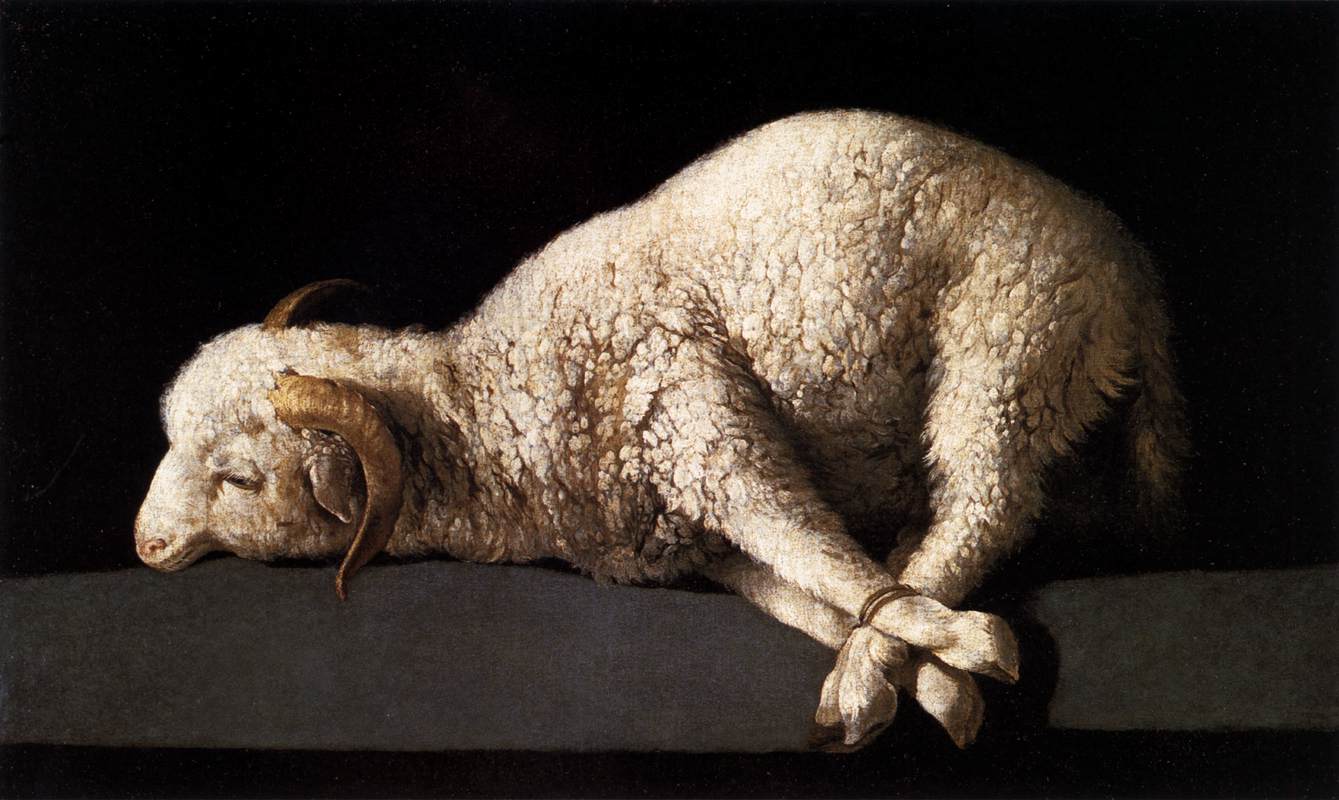
sacrificePeter writes, “Above all, love each other deeply, because love covers over a multitude of sins.” [I Peter 4:8] But Christ’s love covers ALL sins. We are encouraged to model our behaviors after Christ and practice love so that we can learn to be more generous of heart to one another. But there is only One who covers them all, from small to large.

Own up to the sin. But even better, own up to the sacrifice of blood that protects us all from the kismet of life’s choices.

Read Full Post »

givingCan you imagine it? The call had gone out to all the Israelites to contribute freely to the building of the Tabernacle, an extensive list of what was needed from gold to silver to bronze and precious jewels and fabrics. And over time, they collected more than enough. The people had to be restrained from giving more. What minister or leader wouldn’t mind being in that situation?

Then Moses gave an order and they sent this word throughout the camp: “No man or woman is to make anything else as an offering for the sanctuary.” And so the people were restrained from bringing more, because what they already had was more than enough to do all the work. [Exodus 36:6-7, NIV]

But that would be rare indeed. Instead, the issue of giving seems to be the bane of every organization, whether religious or secular. There never seems to be enough money to go around. Is it the lack of money really or is the projects we are hoping to fund? Are there more good ideas than there are resources?

Back in those days, there was only one primary task before them: the building of the Tabernacle and setting up the tools and arena for worshiping the God; that same God who saved them in the desert, who brought them out of Egypt, who showed them miracle after miracle. And in their midst, the evidence of God was still quite present: the cloud during the day and the fire at night.

What do we have? We have many, many good causes raising the call for donations. Many churches are also looking to build their buildings or their programs, to expand their reach, to broadcast their message. Humanitarians are looking to ease the burdens of hunger and poverty, inequalities and tragic losses. Those affected, either directly or indirectly, are raising consciousness about various diseases that need more research or children dying unnecessarily. Others are fighting causes to protect the unprotected, the weak or the disadvantaged. And still others are fighting for funds to raise brighter, stronger, smarter, and more valiant children, the next generation to whom a troubled world is being inherited. And still others are simply looking to brighten our world with beauty, art, and music, but lack the means to be effective.

All of these enterprises have value, some for many and some for only a few. Where do I put my energy? Where do I put my funds? To whom do I commit my dollars? My time? How do I choose? And what portion is appropriate? Is it just the sacred tithe of ten percent or more? What does my own family require or not?

I think sacrificial giving, which has become a real buzzword in the church, is a dangerous misnomer. It implies a painful aspect, giving beyond what one is comfortable giving. It implies that one’s own needs may not be met in the face of giving for the sake of another. The sacrifice is not in the giving itself but in the heart. It is giving out of commitment and belief that the gift will matter and will make a difference.

Giving may do better with intent and outcome. I mean, anyone can give a dollar to a homeless person on the street and feel some relief but the bigger picture has not been touched by the gift. If my heart is sincere about this person’s needs or situation, then the gift must go deeper and further. It simply must or it’s just a spray of pennies.

When the Israelites gave for the building of their Tabernacle, they knew that the one gold bracelets would be melted into the ton of gold that was used to cover the poles and the Ark and the table. They saw the gold every day and knew, one fraction was theirs. And it was theirs too. They gave out of a passion for the place in which God was present.

Passionate giving has power.

Read Full Post »

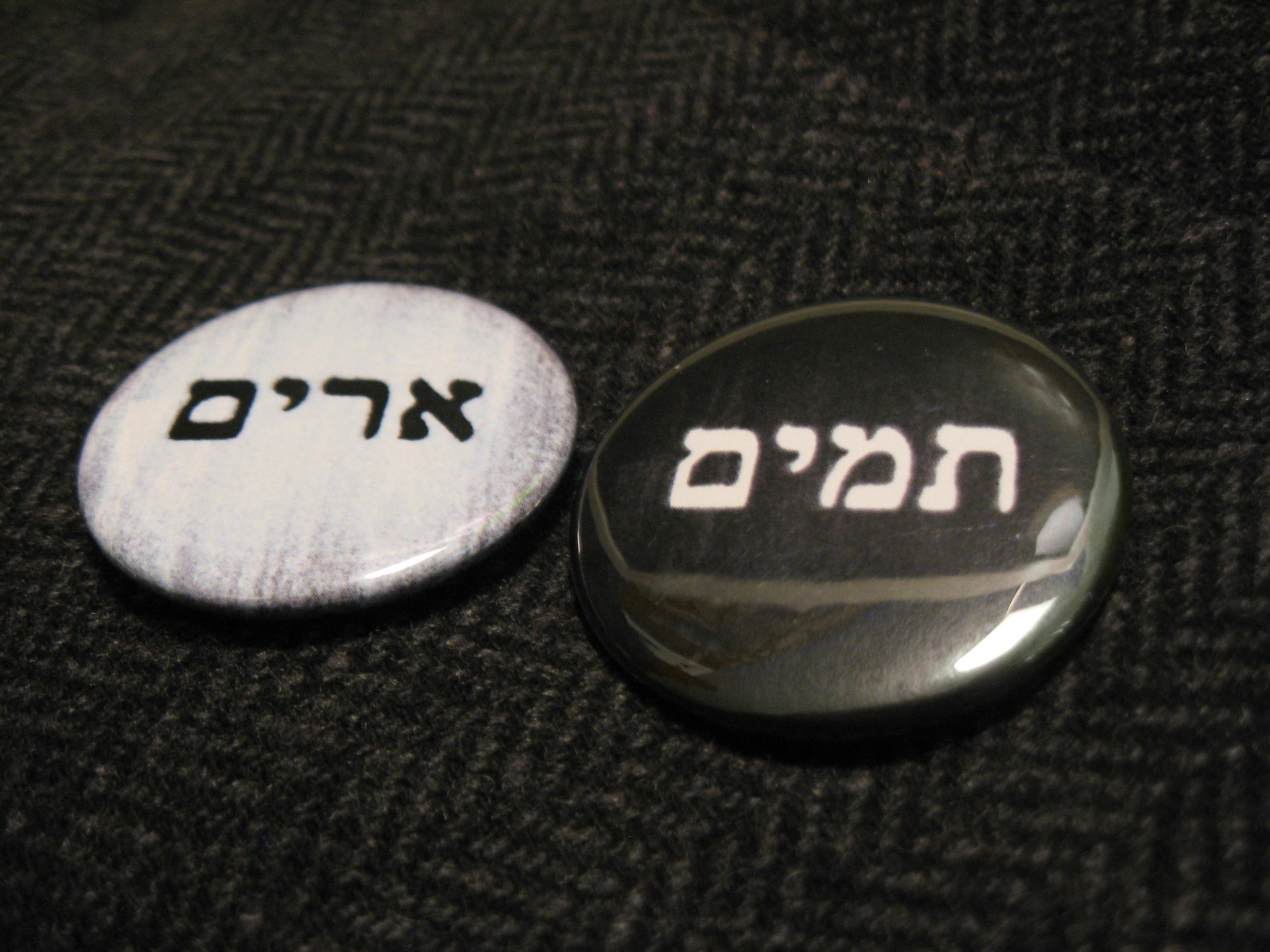
urim_thummimIt’s a fascinating idea really, the Urim and Thummim. Apparently, the priests used special stones to cast for a decision or divination. Some scholars translate the words as “revelation” and “truth” but I’m not sure that helps understand how they were actually used. Another interpretation is that the words essentially mean “innocent” or “guilty.” And in this way, groups of people or ideas where honed down by castings, Urim or Thummim, divided and divided until only one remained.

Also put the Urim and the Thummim in the breastpiece, so they may be over Aaron’s heart whenever he enters the presence of the Lord. Thus Aaron will always bear the means of making decisions for the Israelites over his heart before the Lord. [Exodus 28:30]

flip-coin_5Ultimately, it sounds a lot like flipping a quarter. The result is random except for one difference, the people who threw the stones as well as the people who asked the questions, wholeheartedly believed that God alone drove the results.

Would that make our lives easier today? Like the picking of daisy petals, “he loves me, he loves me not,” could we abide by the final outcome? Or would we hedge it? Wouldn’t we really just look for confirmation and not decision?

In some cases, the coin toss works very well, when nothing too particular is at risk. I mean, whether Harry or Sally go first in a game or the Ravens kick-off instead of the Colts, these are not a deal-breakers.

But what if it was life or death? What if it was getting married or not? What if it was to move our of state or not move? In today’s culture, could anyone give those decisions completely to God in such a manner?

Bottom line: do I believe in luck or destiny? Does God need the Urim & Thummim to drive my life?

If I gamble or play the lottery, I must still believe in luck. Or do I?

lottery ticketThere’s a joke about a man who prayed every day for months that God would allow him to win the lottery but he never did. Finally, he complained to God, “Why haven’t I won?” and God answered, “You should have bought a ticket.” Does God need the efforts of human?

It’s a complicated question and one I cannot fully unwrap.

So, truthfully, I can’t really say I don’t believe in luck at all, I’m sure God supersedes luck, but perhaps God allows luck too. So, I occasionally buy a lottery ticket, wondering if God would like to bless me this week, you know, when the prize is really, really, really big. But, in my gut, do I believe God would pick me for an undeserved splash of wealth at that magnitude? These purchases are really “just in case.” I’m hinting. I’m directing God: “Hey God, this would be a great way to bless me, if You have a mind do it. What do you say?” (And secretly, I even promise to tithe on it. Oh brother, what a conniver.)

Silliness.

love the lord your godLet me step back still further. God has been pretty clear about the best life for Human and summarized it in two sentences: “Love the Lord your God with all your heart and with all your soul and with all your strength and with all your mind; and, Love your neighbor as yourself.” [Luke 10:27] And every action we take, every decision we make, could be in answer to these directives.

Too many of my decisions are about me. Not God and not others. Lottery tickets included. Time to re-focus the heart.

Read Full Post »

promiseWhich is it? When we say we will do something, when we agree, when we say yes, is there power in it? Three months after their exodus from Egypt, they arrived at Mt. Sinai and before any commandments were given, before any rules were laid down, God said this:

Now if you obey me fully and keep my covenant, then out of all nations you will be my treasured possession. Although the whole earth is mine, you will be for me a kingdom of priests and a holy nation”. . . . [and they answered] “We will do everything the Lord has said.” [Exodus 19:5-6a, 8b, NIV]

It’s a similar response that a bride and groom make to one another. Sometimes the answer is “I do” and sometimes the answer is “I will,” but in both cases, they are responses to a question that might be something like this, “will you have ‘so and so’ to be your wedded husband/wife, to live together after God’s ordinance in the holy estate of matrimony; will you love him/her, comfort him/her, honor and keep him/her, in sickness and in health, and forsaking all others, keep yourself only for him/her so long as you both shall live?”

And God  basically asked the same of the Israelites. Will you obey me fully and they said we will.

But they did not. They thought they could. They thought they would. But they did not. And for this reason, for this “fail,” the history of these people was changed forever, yet again. And Jesus asked for no less, “Love the Lord your God with all your heart and with all your soul and with all your mind. This is the first and greatest commandment. And the second is like it: Love your neighbor as yourself.All the Law and the Prophets hang on these two commandments.” [Matthew 22:37-40, NIV]

And did we? We did not. We do not.

It’s not rocket science, this living within the parameters of God’s plan: love, obey, trust, believe. And why don’t we? I can say we are still like Eve and Adam. We want more than what God offers. We believe we know better. We believe we might miss something if we agree to this small world. I see myself kicking against the limitations I perceive God has made against me, not seeing that following with abandon, in trust, opens the world to me. I must let go to have. I must give to receive. The paradox continues.

Today, God is still asking me, will trust God to be God in my life?

Read Full Post »

« Newer Posts - Older Posts »