Feeds:
Posts
Comments

Posts Tagged ‘Jesus’

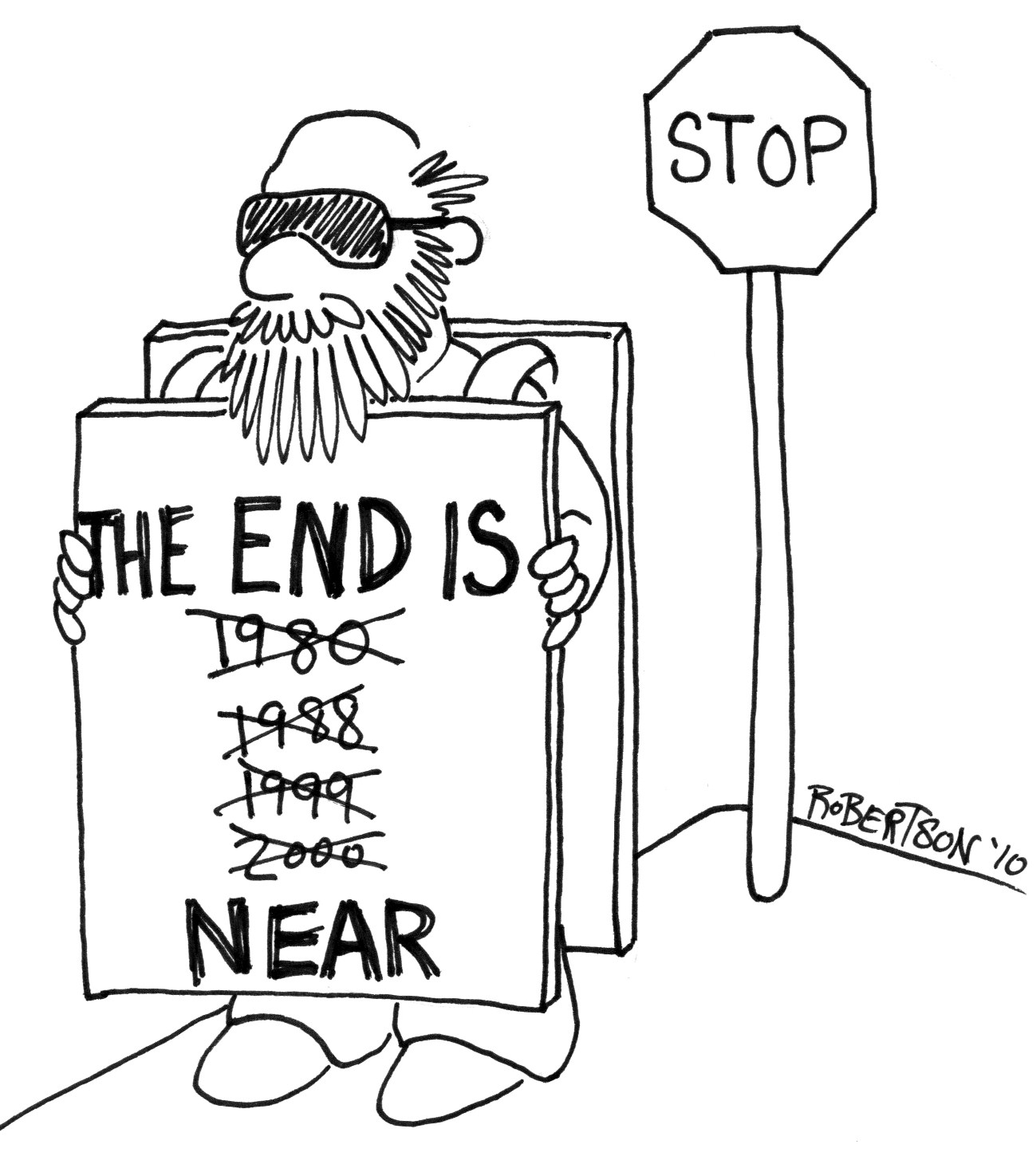
Oh, there’s lots to be read about the “last hour” or the “last time” or the “end times.” Books and books and books can be found so what can I possibly add. Some speak of the “last dispensation” meaning this period, after Christ, is the last big chance from God for humans to “get it.” Maybe so.

I John 2:18
Dear children, this is the last hour; and as you have heard that the antichrist is coming, even now many antichrists have come. This is how we know it is the last hour.

Clearly, John was worried about this last hour, whether it’s dispensational or just post-apostolic (since he was the last living apostle by the time he wrote this letter). And here we are, still in it: the last hour.

We’re in a time, a human time, that has stretched out for two thousand years and yet, we haven’t come to the end of the hour. Some say we’re in the last five minutes of that hour.

Is it all coming together? Is it the Christian version of 2012? Are we in the wrap-up?

The world is so full of everything: all kinds of teachings and faiths; personalities and predictions; anti-christs and anti-muslims; wars and rumors of wars; cataclysmic weather and heavenly anomalies.

And have I been chosen to walk out the last hour? Have you?

There were those who were chosen to walk in the time of Christ: a time like no other time. And yet, there is still another time: the last hour.

So many times people have proclaimed the end of time. Sometimes, the predictions were ludicrous; sometimes dangerous. More often than not, it seemed like foolish eccentricity.

And yet, and yet. I wonder.

Read Full Post »

This text caught me off guard today. I’ve always thought of “the world” as those “things” that suck me away from the heart of God. But it’s not the things at all. It’s the verbs in me. Just like we mistake money as evil when it’s the “love of money” that is the problem: so it is with everything else.

I John 2:16
For everything in the world—the cravings of sinful man [or woman], the lust of his [her] eyes and the boasting of what he [she] has and does—comes not from the Father but from the world.
[NIV, 1984]

It’s my intentions, my desires, my personal cravings that drive me into the world. I see and then I want. I listen and then I desire. I remember and then I pine for the source of that memory. I am Edmund (The Lion, the Witch & the Wardrobe).

Craving is an intense desire. Do I crave God or what God can do for me?

Among the definitions for lusting (beyond the obvious sexual context) is a “passionate or overmastering desire or craving, usually followed by a lust for power.” At my age, sex is not much of a driver, but power, well, who am I kidding if I say that has no enticement? In my head, I know it’s the antithesis of all things Christ, and yet I know it’s there, waiting for the cage door to open and spring out. I think it’s married to another secret desire I have had throughout the years: Fame. It has tainted every venture. It has muddied every project. And lust laughs every time.

Boasting has two elements: one is exaggeration and the other is pride. Hence, in subsequent translations of this verse, it is wrapped up in a single phrase, “the pride of life.” It’s simple really, like a two-year old who insists on “doing it alone.” In some ways, I can see the root of it in the disappointments of my early years where there didn’t seem to be anyone to truly guide. My mother was caught in her own web of pride and self-control. From her perspective, if she didn’t do the work, no one would. If she didn’t make it happen, it wouldn’t happen. And this “gift” she passed along with a vengeance.

Again, the head knows all of this intellectually. But the soul cries out to surrender, to trust, to let go, to accept, to embrace contentment, to engage the interior life and not the ephemeral cravings, lustings, and boastings of the ads in the New York Times, the promotions, the landscaped yards, the exquisite furniture, the honor roll students, the wine cellars, the brilliant geeks, the skinny models, the tech toys, the romances, the published authors, the movies, the stars, the travel guides, the vistas, the sailboats, the beach houses, the Old Spice man, and even the full breed dogs and cats. Stupid, right?

I want, I wish, I desire. I crave, I lust, I boast.

When he noticed how the guests picked the places of honor at the table, he told them this parable: “When someone invites you to a wedding feast, do not take the place of honor, for a person more distinguished than you may have been invited. If so, the host who invited both of you will come and say to you, ‘Give this person your seat.’ Then, humiliated, you will have to take the least important place. But when you are invited, take the lowest place, so that when your host comes, he will say to you, ‘Friend, move up to a better place.’ Then you will be honored in the presence of all the other guests. For all those who exalt themselves will be humbled, and those who humble themselves will be exalted.” [Luke 14:7-11]

Read Full Post »
I thought a quick search on “sacred command” would reveal what this really means. Not so. There are some who believe it’s the whole of the ten commandments and some who believe it’s the whole of the gospel and still others who say it is the law in its totality. Only Clark’s Commentary hit the nail on the head.

II Peter 2:21
It would have been better for them not to have known the way of righteousness, than to have known it and then to turn their backs on the sacred command that was passed on to them.

The holy commandment – The whole religion of Christ is contained in this one commandment, “Thou shalt love the Lord thy God with all thy heart, with all thy soul, with all thy mind, and with all thy strength; and thy neighbor as thyself.” He who obeys this great commandment, and this by the grace of Christ is possible to every man, is saved from sinning either against his God or against his neighbor. Nothing less than this does the religion of Christ require.

And there you have it. Didn’t Jesus say the same thing in Matthew 22:36-40? The simplicity of it is its greatest power. Sometimes, we make our faith walk too complicated, to ethereal, too full of mumbo-jumbo.

If anyone turns his/her back on this sacred command, no longer loves (acknowledges or “fears”) God, more than likely, he/she will be unable to authentically love others, and person’s road will spiral away from him/her. Some might believe that they can love their neighbor without loving God, but I disagree, since love is God and God is love. It becomes a quality issue. We can love as human, but love through God is different. God’s love flows, like a spring, it is endless. Human love is finite. It just is. I’m sure of it. If it were not so, we would be able to love the unlovely more readily; we would not hold back; we would give freely; we would step down so others could step up; we would live the paradox of love.

Oh, Sacred Command, find root in me this day.

Read Full Post »

Despite the fact that “eyewitnesses” usually screw up the details of what they witness, they do get the big picture: they know it was a bank robbery, a car accident, a outpouring of power. And then, too, repetition tends to solidify an account, like one miracle after another.

II Peter 1:15-16
And I will make every effort to see that after my departure you will always be able to remember these things. For we did not follow cleverly devised stories when we told you about the coming of our Lord Jesus Christ in power, but we were eyewitnesses of his majesty.

Peter was “all in” (the new phrase moving through contemporary churches). While accompanying Jesus he was a doubter, a slacker, and a chameleon even, but once the Christ was revealed fully through his death and resurrection, he got it. It was just at the point when his world fell apart that his world fell together. And there was no turning back. There was only forward and the story, that one story that everyone had to hear.

In the same way that people recount eye-witnessed tragedies over and over again(the falling of the twin towers, the floods, the tsunamis, etc.), so also would transformative experiences be on the tip of the tongue. We remember because we tell the tale. Families reminisce at the dinner table and stories live on, memories are stirred, feelings are reborn. Where there was joy, joy is recreated (and the same for sorrow, but somehow, the sorrow is more tempered by time).

What is my story? Isn’t my writing part of this process? Remembering, reviewing, reliving. Re-re-re… again and again.

Thirty plus years ago, I encountered Peter’s same Christ, and it was real and true and life changing. That’s my story and I’m sticking to it.

Read Full Post »

I have heard it said that everything we need—we have, in order to accomplish what is needed to fulfill God’s destiny. This is so easy to say but so hard to live, to believe. If anything, I see myself (and those around me) always looking for more and still more, thinking that will make the difference.

II Peter 1:3
His divine power has given us everything we need for a godly life through our knowledge of him who called us by his own glory and goodness.

I remember during the season of the “Toronto Blessing” when a great outpouring of delights and miracles seemed to be endless at the Toronto Airport Vineyard Church of the mid-nineties. In addition to a variety of phenomenon from laughing to falling out in the Spirit to shaking, a buzz word of that time was “soaking” in the Spirit and asking for “more.” More, Lord, more.

In hindsight, this call seems self-indulgent. It feels too much like more Edmund in The Lion, The Witch, and the Wardrobe who, under the influence of the evil White Witch, could not get enough of Turkish Delight. When she asked what he liked the best, this was the first thing that came to mind, this sickly sweet candy. And then, he was driven by his desire for it, excluding all else.

Do we really want more? Do we really want Divine Power? Would we know how to wield it if had hold of it consciously? Would we merely laugh and shake and cry? Or worse, be like Bruce Almighty, who uses this temporary power for personal gain.

Or, do we want “more” power because we have our own vision of what we want to do or be?

God’s divine power is available to us for one purpose, to live a godly life. And what is a godly life: to love others, to serve those less fortunate that we are, to worship and adore God.

And out of that, comes, on occasion, an opportunity to make a difference.

Read Full Post »

Peter is quite concerned about authority, whether it’s in reaction to his own or it’s the culture in which he lives. In any case, his beloved Jesus submitted to human authority too. Do we?

I Peter 2:17
Show proper respect to everyone: Love the brotherhood [family] of believers, fear [reverence] God, honor the king [emperor].

What is the meaning of authority in our lives? What is authority? In some cultures, it’s inherited, in others, it’s traditional, and still others, it’s won through battle.

I’d say respect for authority in Western culture is at an all time low. Certainly, there is little “positional” authority – that is, respect for the position (police, politician, principal, teacher, doctor, judge, or president) and not particularly the person. If anything, people are looking for opportunities to bring down respect. There may be a grudging respect initially, but a wrong statement or misstep of judgment, and the person is dragged through the press or gossip mill.

Some people say “respect should be earned.” I understand this point of view, but I’m wondering if we, and that is cultural we, haven’t taken this doctrine too far. Can we expect others to constantly prove themselves worthy, only to make a mistake and lose all that has gone before.

On the other hand, those who are in positions of authority today seem to have lost something vital to commanding respect. Our society has become so jaded that the tenets of honesty, authenticity, trust, character, and commitment have stretched beyond our grasp.

It must be old-fashioned to want to believe in the vows of marriage, the truth of law, the honesty of leaders, and the greater good. It’s Pollyanna-ish.

Faith has a measure of authority as well and although some can embrace that easily others will not and never will without divine intervention. If God is sovereign, then God has ultimate authority over everything. Face it, that’s not always easy to swallow in a world that challenges the existence of such things: entropy is all around us as well as violence, greed, self-aggrandizement, and disloyalty.

How does one show respect in this day and age? What does it look like? Who deserves it?

Read Full Post »

Change is hard today and I doubt it was any easier at the height of the Roman domination over Judea. After all, codified Judaism had been around for 1250 years since the time of Moses. And Jesus wanted to do what? Build a new structure? A new type of temple? No way.

I Peter 2:5
[Come] and, like living stones, be yourselves built [into] a spiritual house, for a holy (dedicated, consecrated) priesthood, to offer up [those] spiritual sacrifices [that are] acceptable and pleasing to God through Jesus Christ.
[Amplified]

I have written about this before, but it keeps coming up in the epistles. When it finally dawned on the disciples what Jesus was offering, what he was asking of them, it was hugely shattering to their world. One of the reasons the priests and scholars were in an uproar sooner than later was probably due to the fact that they understood exactly what Jesus was proposing. And they would have none of it: blasphemy!

The temple structure would be torn down under the new way. Animal sacrifices would no longer be necessary (the entire commerce that was wrapped around this procedure would fail). The authority of priests would be diminished, their extended families and tribe would be undermined. The temple was a huge operation; it kept a lot of people working and fed.

Jesus, as the cornerstone of a new and “living” way, was rejected for a lot of reasons. It was not about “dullness” of mind or a hard heart.

So, now, it’s been 2000 years plus, and all this time, those who have followed Jesus and spread his message of a new structure, a new way, were supposed to be getting people into the building of spiritual houses where spiritual sacrifices were being made daily. Is this happening? Did we get off the road somewhere?

I look around and it appears to me that we’re building a lot of brick and mortar, just as expansive as the temple of old. Huge budgets, salaries, and programming. People in these settings would be equally reticent to “change.” I’m pretty sure these structures are not particularly necessary to building a spiritual house.

Here’s a list of the types of spiritual sacrifices that are mentioned in scripture (copied from a sermon outline website):

TYPES OF SACRIFICES TO BE OFFERED BY CHRISTIANS…
1. Our bodies, as “living sacrifices” – Ro 12:1-2
2. A lifestyle characterized by sacrificial love – Ep 5:1-2
3. Praise and thanksgiving, which we do in prayer and song – He
13:15
4. Doing good and sharing with others – He 13:16; Php 4:15-18
5. Even in the way we die for the Lord! – Php 1:20; 2:17; 2Ti 4:6

There’s nothing in here about building buildings or huge organizational structures. It’s about our personal behavior, our commitment, our giving of time and energy to God. Now, I know, some people consider their contributions to a local church as the expression of these sacrifices and may be it is.

But I think that’s a bit of a cop-out. So much is put on the leaders of these organizations while the “body” merely pays for it. We are losing our real roles as priests and builders of the structure within.

There are a lot of young and exuberant believers (see tags) who are calling for the same revolution that Peter espoused: to rebuild our spiritual houses on the cornerstone of the Christ.

Read Full Post »

« Newer Posts - Older Posts »