Feeds:
Posts
Comments

Posts Tagged ‘paradox’

The goal is the prize but it’s not the finish line. In human terms, that may seem illogical, but it’s important to remember that God doesn’t operate on our human terms. Our “template” for the ultimate prize is revealed in the Christ.

Philippians 3:13b-14a
But one thing I do: Forgetting what is behind and straining toward what is ahead, I press on toward the goal to win the prize for which God has called me. . .

One of my favorite movies is Forrest Gump. At one point in the early part of the movie, he is chased by bullies and his little friend, Jenny, tells him to “run, Forrest, run.” And as he does run, the braces come off and he becomes stronger and stronger with each step. And soon, running becomes a testament or symbol of who he is and who he can be throughout the film.

Paul is telling us the same thing: to run, to run the race with perseverance, and to keep our eyes on the future, for tomorrow is full to the brim of prizes and surprises.

Part of running the race is developing a sensitivity to the paradoxes of life in Christ. In Christ’s universe, the tortoise can beat the hare, the weak can outlast the strong [II Cor 12:10], and the barren can have more children than the Duggars [Isaiah 54:1]. The rule of perfection is a different measurement. It all happens within.

Of course, my outside behaviors and decisions are imbued by the presence of the Holy Spirit, but the prize is not there. Like the voice of God that Elijah sought on the mountain, it was not in the wind, the earthquake, or the fire, but in the stillness.

Life is not just a carousel where we strain to pluck the brass ring to get the prize. It’s a life in conjunction with the Holy Spirit who is perfection. [Matthew 5:48]

The goal/prize is captured in these loaded phrases: to live IN Christ, to live IS Christ, to be found IN Christ, and to know Christ.


Read Full Post »

To know . . . to know . . . to know. What does it mean to know Christ? What does it mean to know the power of his resurrection? And what does it mean to know the fellowship of his sufferings? I mean, really!

Philippians 3:10a
I want to know Christ and the power of his resurrection and the fellowship of sharing in his sufferings . . .

To understand with certainty, that’s one definition. Or, to establish or fix something in the mind (like memorization). Or, to be acquainted with (like a friend). Or, to understand with experience (like baking a cake). And finally, to be able to distinguish one thing from another (like right from wrong).

In some ways, each one of these definitions can be applied to this verse. Like Paul, I want to “know” Christ with certainty. I don’t want a casual acquaintance but a deep knowing that comes from exposure. I want the sunburn of Christ (no sunscreen) inside and out. With that kind of knowing, there is trust, contentment, patience, confidence, and security. To the degree that I don’t have those attributes is the degree to which I don’t really know the Christ. Perhaps “to know” really means “to love” (which is how the more archaic definition for knowing meant a sexual union). There is nothing more beautiful than transparent sex, the give and take of pleasure, the concern for other. Too bad. most sexual unions miss the sacred part.

And how about knowing the “power of his resurrection?” That’s formidable. Can anyone imagine being acquainted with this type of knowledge or certainty? That is supposed to be the case for every Christian, but we don’t walk our lives with that kind of confidence. I know I don’t: I still fear illnesses and teens driving home late at night and violence. Besides, isn’t Paul actually asking for the knowledge of this power to operate in the present and not just for raising his own body. Undoubtedly, this kind of power heals the sick, makes the blind see, the deaf to hear, and the lame to walk. Same power, I’m sure of it.

And lastly, to know and share in the afflictions that Christ suffered: not just physical but emotional, mindful, and spiritual. Can I bear the pain? Can I accept it? Or do I still run away from pain. Sweet paradox again.

I’m thinking they all go together. I cannot “know” one aspect without the other. I cannot be acquainted with healing power without knowledge of pain and hardship. My certainty is strengthened by the operation of all three in my life.

Read Full Post »

Paul is certainly confident as a prototype for believers: become like me, follow me, imitate me. Paul was a zealot before he met Christ and he was certainly one afterward. I could no more imitate him than I can imitate Christ. Ah, there’s the difference. . .

Galatians 4:12
I plead with you, brothers, become like me, . . .
I Corinthians 4:16
Therefore I urge you to imitate me.
I Corinthians 11:1
Follow my example, as I follow the example of Christ.
Philippians 3:17
Join with others in following my example, brothers, and take note of those who live according to the pattern we gave you.

To follow Paul is an outside/in method while following Christ is an inside/out endeavor.

Despite the freedoms Paul articulates as a follower of Jesus, having been a Pharisee for many years, he still had a very law-based mentality and world view. He was an administrator, an organizer. He could see how things would work out best. He loved his churches and he loved his people, but he did get frustrated. He was impatient. He continually aimed for perfection (Christ) and condemned himself often (not in a bad way, just as a confession) for missing the mark. He knew he was less than perfect and only Christ within made up the difference. Nonetheless, it was Paul who set up the churches with structure. He was an academic. He laid out the reasons for everything he said. He was a man of logic and reason. I’d say a good portion of our modern day churches have evolved out of the teachings and interpretations of Paul.

But when Jesus calls us to “follow him,” I think he is drawing us to the Kingdom. It is Jesus who consistently lays out the paradoxes of internal following. Everything is the opposite of what we would think: turning the other cheek, loving our enemies, going the extra mile, meekness is victor, weakness is strength and so on.

For Jesus it is not really “become LIKE me,” it’s become ME.

This is much more mysterious. When Jesus taught about “eating his flesh and drinking his blood,” a lot of disciples fled. This entire teaching on Jesus being the “bread of life” terrified most of his followers. [John 6:41-66] They fled because they understood, not because it was beyond them. Every time Jesus spoke bluntly about his intentions, there was an uproar.

With Jesus, what seems impossible is possible; what is lost can be found; what dies can be raised up.

In the face of these kinds of truths, do the outer trappings really matter: Robes or no robes, dunking or sprinkling, wine or grape juice, men or women, buildings or no buildings, and so on.

“On that day you will realize that I am in my Father, and you are in me, and I am in you.” [John 14:20]

Read Full Post »

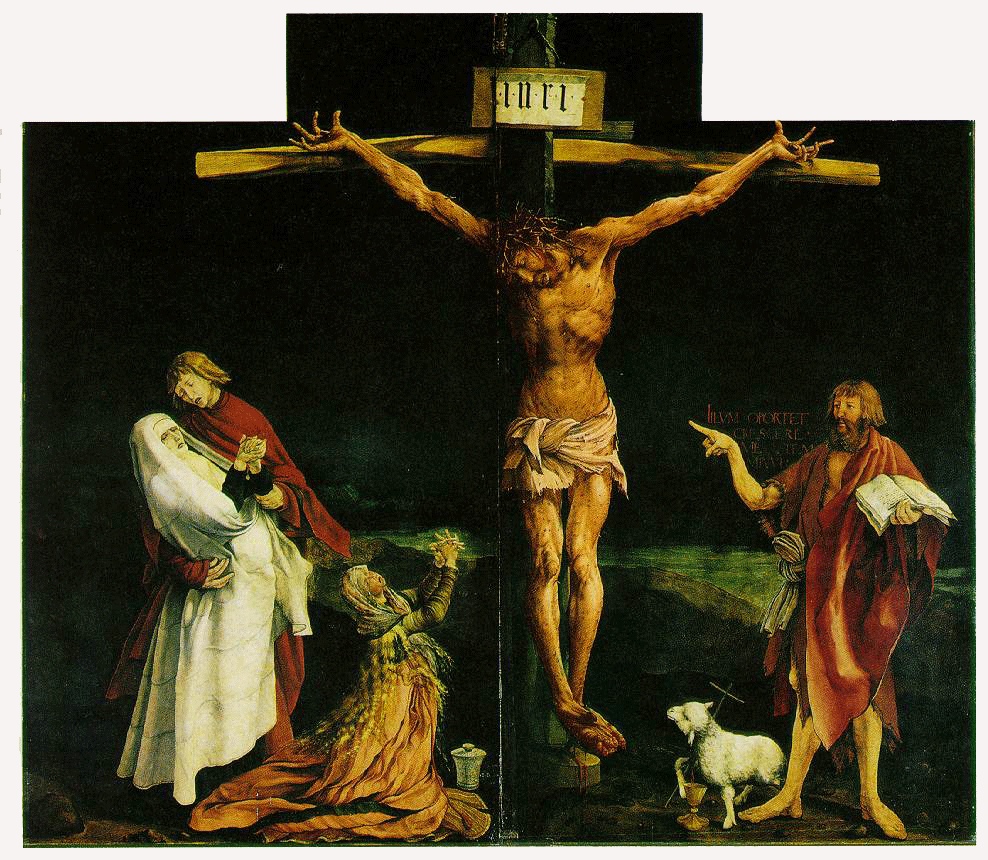
Did the ones who stood vigil at the cross really believe Jesus would die? I don’t think so. They expected a reprieve or a last minute miracle. After all, this was the man who stilled a storm, gave sight to the blind and raised a dead man. Was this his final display of strength in weakness?

II Corinthians 13:4
For to be sure, he was crucified in weakness, yet he lives by God’s power. Likewise, we are weak in him, yet by God’s power we will live with him to serve you.

It’s all there in the crucifixion story: die to live, weaken to strengthen, submit to rule, forgive to trust, suffer to heal, and so forth. These opposites trail after me. When am I going to get it?

Last night I had a dream about a very large black dog that charged toward me and instead of running away or standing stock still, I squatted down, held out my arms to hug him and nuzzle him. I seriously doubt this technique would work in real life. But in the dream, the dog responded and simply rubbed my face and neck the same way my big Snooki dog (a black lab mix) does. It’s a start.

Weakness can be a choice for the good of the moment.

For me, this means saying, “You’re right,” more often or “I take full responsibility for that mistake,” or “I was wrong.” It means listening even when I disagree. It means giving opportunities to others that I would like to have. It can mean serving without recognition or diligence without admiration. It can mean accepting surprises and unintended consequences with grace. It can mean a certain lack of control.

My big joke about myself has always been that I prefer “planned spontaneity.” When an old friend who was a 5th grade science teacher told me she would run experiments in class without knowing the outcome, I paled. How often have I told people, “I’ll do it!” not because I wanted to help but because I didn’t trust anyone else to “do it right.”

That’s a shame to me now. It’s time to respond differently. It’s time to let go of my controlling nature. It’s time to stop previewing the future, planning every step, and manipulating outcomes.

I’m not so sure that even Jesus knew how things would play out. But his trust in God was rooted deeply and in the end, even in fear and doubt, he died with hope. Was he surprised when he found himself back in the world? We’ll never know. But he certainly walked about in new understanding.

This is what can happen to us as well. Once we let go of “our way,” we are able to discover another way that is God-breathed.

Read Full Post »

What is my weakness? Is it my besetting sins or lack of will power? Is my weakness in my aging body that can no longer do what it used to do? Is it my fears? Is it my lack of resolve? Does it matter?

II Corinthians 12:9a, 12b
But he [Jesus] said to me, “My grace is sufficient for you, for my power is made perfect in weakness.”. . . when I [Paul] am weak, then I am strong.

Another enigma to chew on today. What is weakness and what is strength? Why is weakness held up to be a good thing? Isn’t it weakness that opens a door to people hurting me, either physically or emotionally? Won’t people take advantage of me if I am weak? Won’t I be chastened for not carrying my share of the burden?

Who proclaims weakness as a good thing? That’s crazy!

Or is it? How many times have my “strengths” gotten me in more difficult circumstances? How many times has my confidence become pride? How often have I tripped while running too fast, like a little kid at the pool?

St. Paul was a natural in the “strength” department. At least, that’s how he started out. He had money, power, education, and ambition. He was a “Pharisee of Pharisees.” He was undoubtedly being groomed for great things.

When he was called into the ministry of Christ, these attributes of his had to be shed in order for him to experience more fully the power and strength of Jesus–a different kind of strength. Not Paul’s way but the way of Jesus, the way of paradox, the unexpected path, the narrow road.

We are not called to be like Paul. We are called to be like Jesus. And what does that mean for each person . . . for me?

The appearance of strength is not strength; nor is the appearance of confidence, the real thing. Underneath all of the bluster is weakness. It’s not like I have to “become” weak to be strong in Christ. I already am. I just have to be willing to reveal it.

Read Full Post »

For those who read my meditations regularly, you know I am intrigued by the sweep of paradox in scripture. Strength in weakness is one of the most difficult concepts to put my head around since the display of strength is my security blanket.

II Corinthians 11:30-31
If I must boast, I will boast of the things that show my weakness. The God and Father of the Lord Jesus, who is to be praised forever, knows that I am not lying.

Back in the day, I worked with a small group of friends to build an avant garde dance theatre company in New York City. These types of projects are always a bit “hand to mouth” and poorly funded. It can be very stressful. I was in charge of the finances (using mostly my personal funds) and the administration of the company in addition to working full time and going to school. After a year of this, I was at the breaking point. At one of our meetings, I confessed, I was falling apart inside and I couldn’t continue to be the rock anymore. They would not allow it. “You have to be strong. We depend on you to be strong.”

And then I knew we had, all of us, put our confidence in the wrong thing: my strength and confidence That kind of strength is an illusion.

It is God who arms me with strength and makes my way perfect. [Psalm 18:32]
God is our refuge and strength, an ever-present help in trouble. [Psalm 46:1]

But God cannot arm me with strength or “be” my strength as long as I continue in the “world’s strongest woman competition.” I have to believe in the promise. I have to be willing to reveal my weakness and only then will God’s strength be visible. My strength is a mere veil to the real thing.

Some of the tools:

  • Be willing to say, “I don’t know.”
  • Choose silence.
  • Acknowledge the successes of others.
  • Accept mistakes.
  • Forgo the praise of others.
  • Relinquish control.
  • Embrace the feelings.
  • Open the heart.
  • Submit to outside circumstances.
  • Build trust.
  • Pray.
  • Respond to the Holy Spirit.

It is one thing to talk about paradox but it’s another to actually live it. This takes a great leap of faith. It’s time to jump.

Read Full Post »

Who wants to be held captive? Just the idea of it makes me want to run the other way. Like most people of our culture, this sounds like the opposite of freedom. Ah, it’s another paradox of the faith: captivity is freedom in the realm of Christ.

II Corinthians 10:5
[Inasmuch as we] refute arguments and theories and reasonings and every proud and lofty thing that sets itself up against the [true] knowledge of God; and we lead every thought and purpose away captive into the obedience of Christ (the Messiah, the Anointed One) . . . [Amplified]

I remember visiting a church once and being totally turned off. The message was about the “mind” and all its evils. The mind was the whole problem, he said. The mind caused every sin and every mistake. The mind was to blame. Both Mike and I walked out of there to never return. At that time, we equated the mind with intelligence, creativity, and logic, not evil.

But now, I think I have a clearer understanding of the mind’s role in my faith. The mind is the initiator of all things: both good and bad. The spark of an idea comes from the mind. Christ dwells in the mind as well, but without a whip. The mind must be tamed with love.

To bring the mind into captivity is to harness the thoughts that may initiate the wrong direction, a poorly conceived plan and unintended consequences.

The mind is where resentments can grow unfettered. The mind is where “Pete and Repeat” live: they go over and over the words someone said to me or what I should have said back or worse, reminding me of what I did or said that hurt others. Pete and Repeat live in a cesspool of words and feelings.

There are two possible solutions. One is to use the Jesus duct and to allow that cesspool to drain periodically. If not, it gets so full, eventually, one way or another, that stuff starts building a home in the heart and coming out of the mouth. The second solution is to put those thoughts and words and feelings into captivity first, before they get too powerful, too sullen, too belligerent, too stubborn to remain corralled.

My picture of such a thing is a corral with little delinquents running around, hurting each other with name calling, punching and the like. And there is Jesus walking among them, laying a hand here or there, touching a head, or blowing away the hurt like a mom does for her little baby who fell down. He sits in the middle of the muck and slowly, their curiosity gets the better of them and they come closer and closer, to listen, to touch, to be healed, and to be renewed.

This captivity is a place where broken things are made whole again.

I yield.

Read Full Post »

« Newer Posts - Older Posts »