Feeds:
Posts
Comments

Posts Tagged ‘revelation’

If you thought the wedding of Prince William and Catherine Middleton was a extravagant affair, just wait until the next royal or papal coronation. I reviewed the YouTube footage of Queen Elizabeth’s coronation in 1953: thousands and thousands and tens of thousands . . .

Revelation 5:11, 13
Then I looked and heard the voice of many angels, numbering thousands upon thousands, and ten thousand times ten thousand. They encircled the throne and the living creatures and the elders. . . . Then I heard every creature in heaven and on earth and under the earth and on the sea, and all that is in them, saying: “To [the one] who sits on the throne and to the Lamb be praise and honor and glory and power, for ever and ever!”

This is the picture I imagine as John describes his vision of the throne, the lamb, the living creatures, the elders, and the angels, all singing, all joining voices in adulation. For John to be able to describe this picture, he is somehow separate from it, like a television camera. He is not in the event nor part of the event. He is an observer, a witness of a unique sort, a reporter.

Here in the United States, it is outside our ken. We have well attended inaugurations and there is a type of pomp but nothing on the order of Great Britain’s royalty. And now, with modern television, the numbers who are watching have multiplied exponentially. It is as though the the entire earth can witness these events.

This “heavenly” coronation image is the only way John can wrap his mind around and give image or voice to the importance of the moment. The Christ, who entered human form and by God-given power, was able to propitiate (satisfy or atone) for a previously made agreement or covenant that Human made with God and then broke.

This is not the stuff of soccer and Facebook, football and Miss America. This has to do with the fabric of creation outside of our three-dimensional sensibilities.

John did the best he could with what he knew.

In today’s world, we have other visionaries and artists who try to imagine or conceptualize this non-dimensional place or rather, an actuality. But we fall short. Instead, we have our own versions of celebrations and weddings and coronations in an attempt to capture the importance and wonder of a vow, a promise, a covenant, a new identity, a new responsibility.

Why do we have ceremony? Why do you? What is the message?

Read Full Post »

Most exegesis accedes that the “Lion of Judah” represents the Christ. And it is that One who is worthy . . . and able . . . to change the course of civilization in general and more specifically, to change my life.

Revelation 5:4-5a
I wept and wept because no one was found who was worthy to open the scroll or look inside. Then one of the elders said to me, “Do not weep! See, the Lion of the tribe of Judah, the Root of David, has triumphed. He is able . . .

Who is worthy in my sphere of friends, family, and colleagues to impact my life? Who has earned the right to speak into my choices, to redirect my path, to open my eyes?

There are people who took on influential roles and circumstances. My mother, by default, spoke into my life as I was growing up. She was able. My older brother, also, by proximity and sheer force of will, taught me lessons whether I wanted to learn them or not. Boyfriends and husbands carved out sections of my heart, by will or by relentless time. I learned through the silences of loss like my father’s death when I was nine, or the loneliness of being a latchkey kid, or the bitter and repetitive mistakes that led me down roads I regretted again and again. These people and experiences were “able” to bear upon my life. But who actually earned a place?

Here is the role of God, the mission of Christ, the engagement of the indwelling Spirit. God, by sovereignty is worthy; Christ by personal sacrifice is worthy; Spirit by faithful presence is worthy.

If these do not exist in my life, then where is my confidence? Human is fallible. All of us. When we trust people, we must understand that trust is given and received within the limits of human experience and faith. But it is elusive, at best. It is unreliable, no matter how hard we “try.”

The whole point is to trust God, not human, to trust the Christ, not leaders, to trust the Holy Spirit, not tradition. Freedom and forgiveness are possible and more easily extended to others when my expectation is solely on the One who is able and worthy to exist in our midst.

“Now to him who is able to do immeasurably more than all we ask or imagine, according to his power that is at work within us, to him be glory . . . ” [Ephesians 3:20-21a]

Read Full Post »

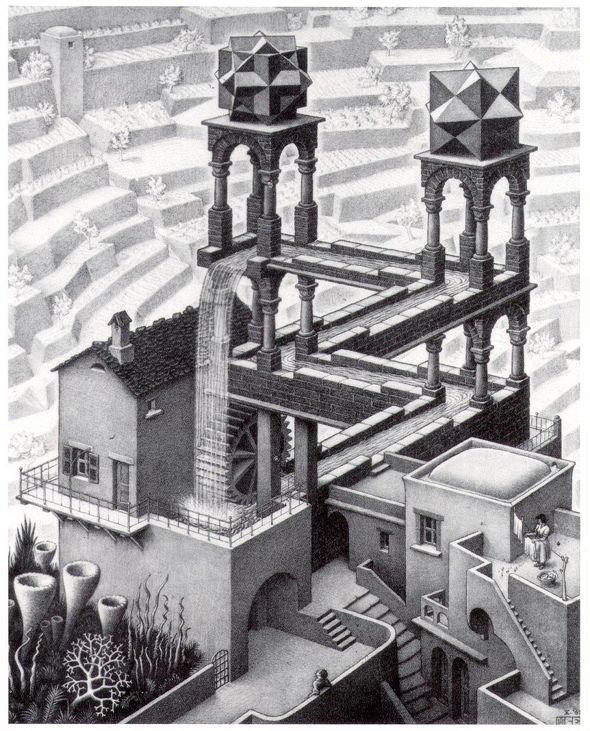
M.C. Escher

We see every day with our eyes. And we interpret. But how much do we really understand about what we see? How much is true and pure and how much is affected by our past experiences, our former seeings, our expectations?

Revelation 4:6-7
And in front of the throne there was also what looked like a transparent glassy sea, as if of crystal. And around the throne, in the center at each side of the throne, were four living creatures (beings) who were full of eyes in front and behind [with intelligence as to what is before and at the rear of them]. The first living creature (being) was like a lion, the second living creature like an ox, the third living creature had the face of a man, and the fourth living creature [was] like a flying eagle.
[Amplified] [emphases mine]

Some years ago, I was the victim of a theft at an ATM. Although it was terrifying, my first instinct was to give chase (too many television shows?). In the end, the purse snatcher realized I had the wallet under my arm and the bag was rendered useless. He stopped and tossed it back to me. Later, I sat on a short brick wall, nursing my scraped knee and listening to the various witnesses who “saw” what happened. Not one of us could agree on the clothing, the race, the height, the weight or anything else of the thief. We each saw and yet didn’t see at all.

In Revelation, John is in a spiritual trance of some kind and has visions. He is describing to us what he sees as best he can with an understanding born of his era. I cannot help but wonder how I would describe the same scene. Would the beings look “like” animals or something else? Would the images become a movie set? Would my love for fantasy enhance and exaggerate my imagination? Would my love for science fiction give me Star Trek interpretations?

How many miscommunications do we have every day? How many times do we misinterpret what we see in a gesture or a facial expression?

The other day, I was looking at a newspaper photograph and it actually took me a full thirty seconds to see the picture and understand its content. It was in a group of “art” photos and so I must have assumed it was something with deep meaning and ethereal intentions. Finally, my mind collected itself, and I realized I was looking at a ballet dancer’s shoe on point. That’s all. Why couldn’t my mind understand this image initially? Was it truly a “senior moment?” Is this how people who have suffered strokes experience the world? Inside, we know it’s something familiar but we cannot seem to process it.

I believe we are all doing this through the day: many assumptions, many judgments.

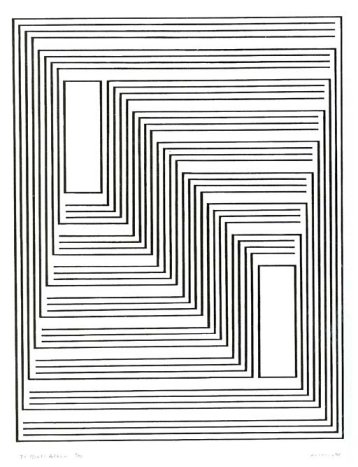
It’s one of the reasons people struggle with modern and post-modern art. Their minds are trying to “understand” what they are seeing. They want a label. Instead, I think these artists are calling us to simply see without words, to allow colors and shapes and densities to open up new synapses.

by J. Albers

I am just about sick to death of the phrase, “out of the box” thinking. Most people can’t “think” or “see” out of a box because those things defy easy description or understanding. Creativity demands a certain amount of sustained chaos.

The things of God, of Spirit, are no different. There is no single interpretation or understanding. God is fluid. Faith is a moving target. The Holy Spirit is outside of time. And the images that John saw in Revelation were his way of describing a vision, a vision of adoration and worship.

Read Full Post »

Duped by our circumstances, our relative comfort, our culture, we are missing a reality that God is offering. For us, for human, that life appears like a paradox where loving an enemy is the norm and humility is the paradigm.

Revelation 3:17-18a
You say, ‘I am rich; I have acquired wealth and do not need a thing.’ But you do not realize that you are wretched, pitiful, poor, blind and naked. I counsel you to buy from me gold refined in the fire . . .

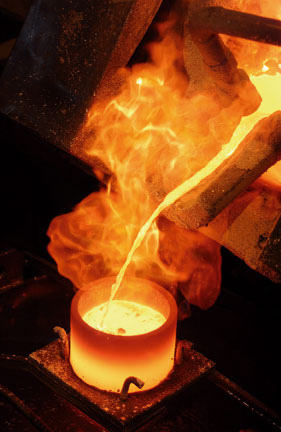
I have been intrigued by the “refiner’s fire” for some years. In fact, I remember when it started, at a Sunday School class. I remember we were talking about Solomon and the completion of the Temple [see II Chronicles 7] when the fire came down, consumed the offerings and then the Glory of the Lord filled the Temple. No one could enter for a time. This appeared to be a consuming fire, but it was really a cleansing fire. Everything of value remained. It was a distinguishing fire.

This is the same Refiner’s Fire that God promises to use on us. And like all of the seemingly self-contradictory statements in the scriptures, this fire will not destroy us either.

If we want to see beyond the every day, if we want to see God in our midst, if we want to enter into the mysteries of God, then we have to accept the refiner’s fire. It’s a leap of faith because this fire may consume the things we have held onto for years, our “things” that have given us a semblance of security.

Read Full Post »

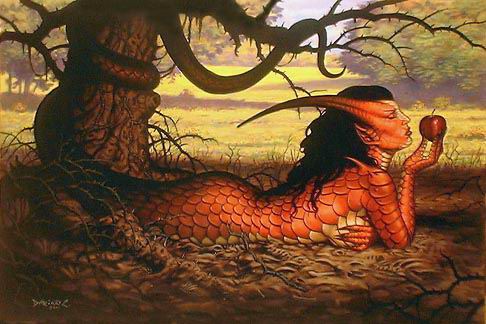
Jezebel, the historic Phoenician princess and widow of Ahab, dressed in her finery and makeup, hoping to seduce the new king. Instead, she was tossed out the window and eaten by wild dogs. To the bitter end, she defied man, society, and God. She lived without remorse.

Revelation 2:20b-21
. . . Jezebel, who calls herself a prophet. By her teaching she misleads my servants into sexual immorality and the eating of food sacrificed to idols. I have given her time to repent of her immorality, but she is unwilling.

This is the face of evil.

Despite everything Jezebel had done or said or connived, she believed there was always another loophole, another power play, another option. She was proud, confident, and self-absorbed. Nothing broke her resolve. She had a heart of stone and was unmoved by the needs or sorrows of others.

And yet, she was also beautiful.

As my children came into their teens and were exposed to all the anti-drug, smoking, drinking, and unprotected sex instruction in school while knowing kids around them (both younger and older) who were already indulging in one or more of these entertainments, there was always one piece of information that wasn’t given by the well-meaning instructors.

In the beginning, most of these vices are fun. Is that blasphemous? Well, it’s true. Why would people do them if it wasn’t fun. That’s the point! And for this very reason, the appeal of drugs and alcohol and free-range can be overwhelming. For me it was important to warn them of this important detail. The trick for young people (or any people for that matter) is to realize that it’s not the acts themselves but the over-indulgence in them: too much of a good thing. Each one of these vices begs for more. And with that seduction, begins the spiral.

Jezebel symbolizes them all, no less than our “other” enemy, captured in scripture as Satan, also an “angel of light” not as some pitchforked fanged creature at all. Who would be enticed by that?

I see myself captured in the smallest of Jezebel ways. It’s usually a way of thinking like “oh, I can have this, I deserve it, I worked hard today;” or, “It’s a holiday, I can treat myself;” or, “It’s just one . . .” And on and on an on go the justifications for indulgence.

And unfortunately, anything less than indulgence is considered deprivation. To stop eating large portions, excessive sweets, highly caffeinated drinks, beer or wine, is considered a “diet” and “doing without.” But honestly, if we lived in a third world country, the concept would be absurd, where a clean cup of water is a luxury and more than one meal a day, a blessing.

Jezebel is still busy in Western culture.

Read Full Post »

Album cover: Through the Open Door by Michael Anthony Miller

When formidable times come, it is more difficult to hang on to the truth of God’s sovereignty. Circumstances overwhelm the big picture and pain distorts understanding. Evil plays its hand and mocks the hand of God, claiming apparent victory. But we must look for the open door . . .

Revelation 3:7b-c
. . . These are the words of him who is holy and true, who holds the key of David. What he opens no one can shut, and what he shuts no one can open.

The supreme sovereignty of the Christ is captured in a single phrase about him, that is, the one “who holds the key of David.” The prophecies spoke of long lasting rule to the line of David in Israel. But even this rule was broken by imperfect rulers and inconstant followers.

While Jesus, the son of God, was perfect in plan and execution of God’s will, and now holds the key in perpetuity and rules humankind forever as the Christ.

This idea doesn’t sit well with human. We are a feisty, independent bunch and like our self-determination, despite the rocky outcomes (wars, rumors of wars, famine, uncontrolled disease, gluttony, murder, and conquest, just to name a few). We blissfully select presidents, prime ministers or simply allow dictators and totalitarians to rise up among us, but we (and I speak as “human” here) cringe or shrink away from the possibility of a divine God, a force unequaled on Earth, an entity outside of time but able to enter time at will. Why are we able to reconcile the one and not the other? Is it just too much science fiction?

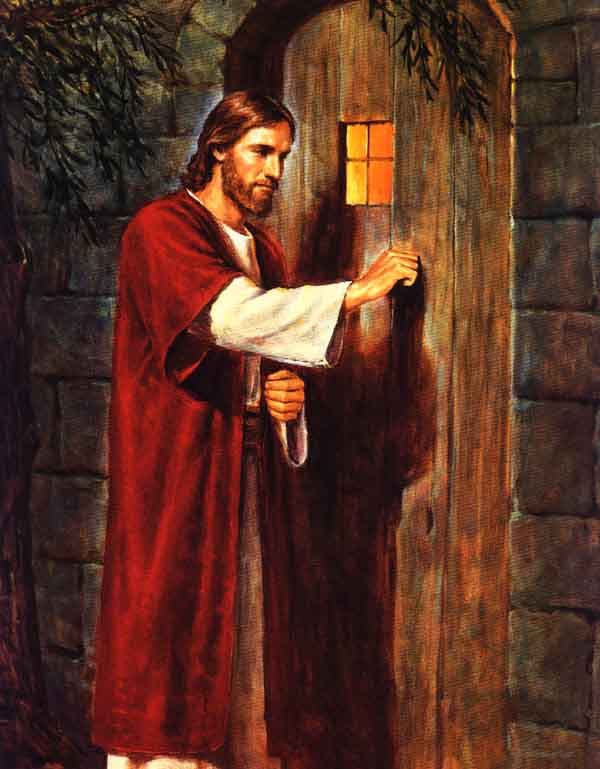
There is an extremely traditional painting of Jesus standing at a door knocking, based on Revelation 3:20a, “Here I am! I stand at the door and knock. . . .” a verse used to indicate that Jesus, like a visitor, is waiting to be invited into our homes, into our hearts. It’s a kind depiction.

But I have a stronger image, that of the open door. This representation is not from Christ’s perspective, waiting to be invited in, this is from my perspective, an invitation to walk through with no strings attached, the invitation implicit in its openness.

It reminds me of a phrase I tell people from out of town, particularly those I like very much and I want to communicate my fondness to them: “Please, come anytime, our door is always open.” I want them to feel free to enter, whether I am at home or not, because I trust them with my home, my sanctuary, my heart.

Jesus trusts me in that way too. And you.

Christ Jesus has the authority to open the door and keep it open until any human can see it, believe it, and walk through it. On the other side is sanctuary.

I remember hearing a story about people who were locked up in cages for a long time but when the door was opened, they did not leave the cage. Outside the cage, all was unknown. Inside the cage, all was familiar. Fear held them inside. Love is patient and kind and waits.

The only bad thing I can see about this open door is the ability of traffic to go both ways. I would love to say I went through the door once and never turned back. Not true. I have stepped back into the old world many times but each time, the open door draws me back, the spirit of God draws me, and I find my way through again.

Come and see, the door is still open. Like the tomb, open. Be set free.

Read Full Post »

In no way do I believe I can put forth a comprehensive discourse on the White Stone, particularly after reading some of the online commentaries about it. Besides Kary Oberbrunner has written a wonderful book about it, Your Secret Name, not to mention George MacDonald. And yet, my hand reaches for it. . .

Revelation 2:17b
. . . To the one who is victorious, I will give some of the hidden manna. I will also give that person a white stone with a new name written on it, known only to the one who receives it

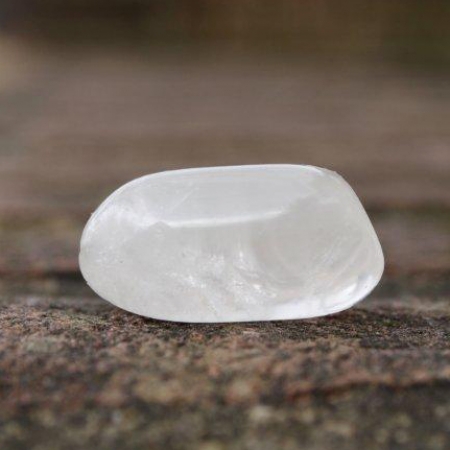
Perhaps I am intrigued from from years and years of picking up stones, rocks and shells when hiking or walking the beach. What is it about a smooth stone that captures my imagination? Surely, it’s some whisper of history: the inevitable forces of nature, the weathering of the ocean and sand or the pressure of dirt and wind. The smooth stone is a survivor.

I imagine my white stone as smooth to the touch, calming, and comfortable in the hand, not too big and not to small. I imagine a gentle warmth emanating from it and the word(s), the new name or secret name, unique to me, a mystery revealed. The white stone is a promise that I am undeniably unique and when I receive the stone, I will experience affirmation in my soul; I will hear God say, “I know you, I see you, I love you.”

Read Full Post »

« Newer Posts - Older Posts »