Feeds:
Posts
Comments

Posts Tagged ‘sacrifice’

What does it mean “to enter?” I guess there has to be a designated portal or opening, a path or direction. Entering implies leaving. Entering also implies that an observation is made from the inside, coming in.

Hebrews 10:19-20a; 22
Therefore, brothers [and sisters], since we have confidence to enter the Most Holy Place by the blood of Jesus, by a new and living way opened for us through the curtain, that is, his body, . . . let us draw near to God with a sincere heart . . .

I remember, back in Indianapolis, I was asked to pledge a high school sorority of some notoriety because it was made up of girls from three separate north side high schools. It had a very long history, apparently as far back as the 1930’s and, based on a cursory Internet search, it was still around in the 90’s. I only mention it because it was the first time I experienced the power of the word, “Enter.” Like most of these types of organizations, there was great hierarchy between the members and the pledges. There were many rules and a lot of “etiquette,” for lack of a better term. And one of the requirements before each pledge could come into a room of members, she had to ask permission to enter. I will never forget that feeling of being made to wait to “enter.”

Another strong memory about entering is from the theatre. There is nothing that can compare with the first entrance onto a stage. There are jitters and nerves, there are fears and expectations, as well as a zillion other feelings. To enter from the sidelines and into the performing area, is literally, like leaving one existence to penetrate another.

The Most Holy Place is not just a place where God hangs out sometimes. This is where God is all the time in a unique and accessible way. This IS God.

In Old Testament times, the “Most Holy Place” was only entered once a year, and then with grave and solemn preparations, including bells on the priest’s robe to insure the people could hear him moving around (some even said a cord was tied to his ankle to drag him out if he died in there – but this is not fully substantiated). That High Priest was the only one who could enter. That was the Law.

Then, a new way comes along and through the single sacrifice of the Christ: all could (and can) enter, all could (and do) have access, all (could and can) engage God in a personal and unique way.

Here’s the sad part: most of us don’t know how to stay there. Legally, through the work of Christ and our faith in the process, we’re in. But we don’t stay in. We act like high school sorority pledges who stand and wait until someone calls us in (perhaps through a Sunday morning worship service or particularly moving sermon or song). We stand like actors and actresses waiting in the wings for our “cue.” We forget about the freedom.

One of our family dogs, a black lab mix, is totally goofy. From the first day we adopted her (at about 4 months), she was afraid of doors and entrances. We had to coax and dangle treats and demonstrate over and over again that no harm would come to her. Finally, she would come in (or go out), and everything was fine. . . until the next time. And we’d have to start all over again.

Humans act the same way; bona fide Christ followers and yet we still stand at the entrance and wait, afraid to enter because it’s not familiar, it’s so unlike “here,” it’s Godspace. We forget the new and living way.

Read Full Post »

It’s important to seize and exercise forgiveness; otherwise, the whole point of the Christ/Messiah sacrifice is lost. It’s God’s forgiveness and intentional dis-remembering that manifests in the crucifixion and renews our direct access to God.

Hebrews 10:17-18
Then he adds: “Their sins and lawless acts I will remember no more.” And where these have been forgiven, there is no longer any sacrifice for sin.

It’s big: forgiveness. There is more power in forgiveness than any other aspect of faith. Forgiveness works for both believers and non-believers. It’s like gravity. If it’s genuine, it generates freedom.

But here’s the part that took me a long time to truly understand. Forgiveness is for the giver moreso than the receiver. It is my act of forgiving that frees me from the results of unforgiveness.

I did not say that this makes forgiveness easy. But it’s benefits are not lessened or increased by its difficulty.

Forgiveness begins with a choice, not with a feeling.

When I forgive, I can begin to let go of the expressions and allies of unforgiveness like anxiety, anger, distrust, bitterness, hardness of heart, worry, conversations and images stuck in replay, negative expectations, disappointment, and even ill health.

To withhold forgiveness is a direct assault on the heart that the Holy Spirit is mentoring within.

I begin each day now with my acknowledgement and need for forgiveness — specifically! I name everything that comes to mind. Sometimes, those things are from yesterday and sometimes, I’m surprised to find a piece of old baggage cropping up, a hidden room who’s door must be opened, a pebble that is not a pearl at all, but a stone of that has been secretly growing within a shell of resentment. God reveals as I am able.

Some people are slow to forgive because they believe this sets the other person free. Nothing could be further from the truth. Once we let go, the judgment lands at the feet of God. While I hold on to any pain that someone else has caused me, no matter how unfairly, I hinder the work of God.

“Beloved, never avenge yourselves, but leave the way open for [God’s] wrath; for it is written, Vengeance is Mine, I will repay (requite), says the Lord [Deuteronomy 32:35.” [Romans 12:19, Amplified]

Read Full Post »

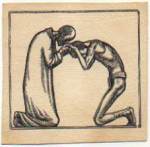
Wood Engraving by Gwen Raverat

Whenever the word inheritance comes up in scripture, my mind vaults to the story of the prodigal son [Luke 15] who is given and subsequently wastes his birthright share in “wild living.” But an everlasting inheritance can’t be expended, nor can it be given ahead of time, or can it?

Hebrews 9:15a
[Christ, the Messiah] is therefore the Negotiator and Mediator of an [entirely] new agreement (testament, covenant), so that those who are called and offered it may receive the fulfillment of the promised everlasting inheritance. . .
[Amplified]

So many Christian people are quite focused on the heavenly bequest and even use the promise as an appetizer to entice others into becoming followers of Christ. It sounds a little like the lottery, as though they are saying, if nothing else works out down here on Earth, at least we know we’ll have entry through the pearly gates and streets paved with gold; at last, a life of leisure with no pain, no worries, and no kids (only kidding on that last one).

But is that the point? Are we supposed to be toughing it out here because we can count on this inheritance later? This would be like our own children making no efforts now and simply waiting around until the parents kick off and the 401K’s are distributed.

I think the everlasting inheritance supersedes time. Just as there is no time in God’s world, our heritage is not limited to our death and subsequent afterlife. Instead, it was precluded by Christ’s death and the distribution included the Holy Spirit who lives in and among us now.

You want to spice up the Four Spiritual Laws or your personal proselytizing, then start including the wonder of the Holy Spirit who dwells within us now, who partners with us in this life, who draws us into being better Humans, who stimulates our internal compass toward those in need, to pricks our conscience, and teaches us to love others by loving us.

This is the everlasting inheritance that is here today.

Read Full Post »

Art by Ed Unitsky

What does the Godly life look like? And why would it be, that a person who is following in the way of Jesus, living out righteous, faith, love and peace, why would that cause persecution? It’s another type of contradiction.

II Timothy 3:12
In fact, everyone who wants to live a godly life in Christ Jesus will be persecuted, . . .

I have seen people hold this scripture up as a banner when their particular political cause or moral stand is shot down or watered down or disregarded in some way. Some people have a litmus test like abortion or birth control or the death penalty or gay rights, and anything outside of their view is perceived as persecution: “right” being attacked by some liberal/left point of view.

There is one sect of believers who are known for door-to-door evangelism to the extreme and if people are rude to them or shut a door in their faces, they report that “persecution” to the team-faithful. It’s to be expected they say; they are living the life.

But where do we see anything like this in the life of Jesus? Our Man/God was so comfortable in his skin that He could be anywhere and talk with anyone without harsh judgments. The truth was in Him, the Spirit close by and available, the ability to love and connect with everyone was apparent. His persecution came later.

His persecution did not really begin until he revealed his identity, an identity that challenged the traditions of authority.

The poor did not persecute Jesus nor did self-professed sinners. The hungry and the needy did not persecute Jesus. Only those who had an agenda that was jeopardized by the long-awaited appearance of a Messiah who would turn their world upside down. Actually, even the Romans did not persecute Jesus until He was dumped into their legal system.

Living the life is more like the first thirty years of Jesus’s life — the silent years. Did Jesus love less in those years than he did in his public ministry? Did he care less, speak less, understand less? Or did he wake each day with the Shema Yisrael and with mindfulness toward the presence of God, and thereby simply live and serve his immediate world.

So, is there persecution in my life? And if there isn’t any, does that mean I am not living a Godly life? Am I too homogenized into the cares of this world? Am I holding on too tightly to my comforts?

Oh, I suppose I could take a political stand about this or that; I could march in the streets for one cause or another, but in the end, I would still come home to my middle class life, my credit cards, and my steak on the grill.

The chorus of the song below was framed and given to me many years ago and, in its simplicity, this is the only way I can see how to “live the life” right now, today.

Read Full Post »

Forgiveness cancels and disarms. Cancellations are not easy; they imply change. They bring to mind a huge stop sign. Something that was planned and moving forward, is no more. All gone. Disarmament is not much different: whatever weapons we carry, we lay down . . . willingly and by agreement.


Colossians 2:13b – 15a
He forgave us all our sins, having canceled the written code, with its regulations, that was against us and that stood opposed to us; he took it away, nailing it to the cross. . . having disarmed the powers and authorities . . .

If I forgive you, I lay down my weapons and I cancel the plans I had toward you. If you forgive me, the same thing happens: I lay down my dagger and I remove the pay-backs. Everything stops. The old way is done. The previous mistakes, hurts, anger, frustrations, or attacks are no longer an option.

That’s how it’s supposed to work.

Another word is reprieve. It’s like standing before a firing squad or sitting in the electric chair, and someone comes in and says it’s over, no strings attached. Freedom.

You would think the reprieved criminal would be appreciative and transformed. Not always. Sometimes, he/she is cut loose and soon repeats the same actions, the same mistakes, the same crimes.

Are we much different? Am I? I have been reprieved as well. My Spirit has been awakened and I am in relationship with the Holy Christ Spirit. I am forgiven for my mistakes and I have been set free from layers and layers of synthetic and man-made theories, laws, rules, and interpretations.

These layers are a cage and although the work has been done (for everyone), I still have to step out of that cage to experience the freedom. I have to trust that no one will slam the cage door shut. I have to trust that the cancellation and disarmament are real. I have to believe. I have to operate in a new way. Caged life is different from meadow life.

Read Full Post »

That should get your attention. It got mine. The symbolism begins with the origin of the word: cutting around. This rite is performed by Jews, Muslims, and many Christians. Its been in practice for centuries. Circumcising the heart and soul, not so long.

Colossians 2:11-12
In him you were also circumcised, in the putting off of the sinful nature, not with a circumcision done by the hands of men but with the circumcision done by Christ, having been buried with him in baptism and raised with him through your faith in the power of God, who raised him from the dead.

By aligning myself with Christ, by submitting to Christ’s sacrifice and resurrection, I am allowing Christ to complete that process by cutting around and cutting off, the coverings of my heart and soul. I am laying myself open and bare to Holy Spirit. I am different.

The longer we wait for spiritual circumcision, just like physical circumcision, the more painful it becomes. Adult men who choose to be circumcised have a long recovery (up to six weeks) as well as the potential for unforeseen complications and infection. Spiritual circumcision is no different because we resist the process. We become used to the way it was. We may know we don’t have a robust relationship with the Christ Spirit and we understand intellectually that this circumcision is necessary to really experience and feel the Spirit, but we cower under the threat of pain and discomfort. The pain comes from what we try to hold onto and the habits that secure the layers of narcissism.

I’m afraid, unlike physical circumcision which is a permanent change, spiritual circumcision is not so everlasting. We have to actual pay attention and participate. It’s not strictly passive. I think my heart and soul have been covered over by my fears, my disappointments, my anger, and so forth. I’ve had a series of circumcisions of the heart.

I can only be grateful that Jesus is a good, kind, and patient medicine man.

Read Full Post »

I did a quick study of “drink offering” and two things stand out: the drink offering is always given along with something else (usually the meal offering); it is wine and represents the blood. It is often followed by oil which symbolizes the Holy Spirit.

Philippians 2:17-18
But even if I am being poured out like a drink offering on the sacrifice and service coming from your faith, I am glad and rejoice with all of you. So you too should be glad and rejoice with me.

He is saying that his death is poured out over their “sacrifice and service” and as such, will be additionally blessed. And later, Paul asks that his followers rejoice in this, rejoice in his offering, rejoice in the implications of their offerings, both his and theirs. It will be followed by the Holy Spirit who will give back life to their planted seeds. The seed must “die” to bring forth a plant [John 12:24].

But what is in this for me? I am not in the drink offering business. At least, not yet.

Perhaps I need to be aware of the sacrifices that others have made for me though. Do I appreciate the pouring out of my mother, let’s say, who gave everything for her children, even her emigration to the United States for our sakes, to have a better chance. She worked, she saved, she spent, she did the best she could with the resources she had.

I think about David in II Samuel 23:16, when three mighty warriors broke through Philistine lines just to get him a “drink of water” from the well near Bethlehem. Some find it odd that once the warriors brought the water, he would not drink it, but poured it out on the ground. In essence, I believe he was acknowledging it as a type of drink offering. It was holy and symbolized sacrifice for the cause.

To what have I sacrificed? Where is my drink offering? This offering is unlike the offerings described in the early chapters of Leviticus. I believe this offering is not mandated, it’s extra, it’s a choice.

Oh Lord, give me courage and desire to identify and pour out my offering when the time comes.

Read Full Post »

« Newer Posts - Older Posts »