
Photo by Ed Rybczynski
Leaving is not easy. Starting over is never easy either. But sometimes, that’s all we can do. Circumstances and time and emotions come to a head, and it’s clear, something must change. At this time of year, we mockingly call them resolutions (and I say mocking, because we laugh at our poor resolve over the years). But true change is no joke. True beginnings are powerful and even painful.
Genesis 31:3; 17-18
Then the Lord said to Jacob, “Go back to the land of your fathers and to your relatives, and I will be with you.” . . . Then Jacob put his children and his wives on camels,and he drove all his livestock ahead of him, along with all the goods he had accumulated in Paddan Aram,to go to his father Isaac in the land of Canaan.
Meaningful change is rarely made overnight with a glass of champagne in one hand and horn in the other. It’s rarely a wish list; it’s a must list. That kind of break with the past comes after a build up, a collection of situations, a norm that is no longer acceptable.
Often it takes an epiphany or insight, a new view of an old way, that becomes the impetus for change or builds a desire or appetite for metamorphosis. We see with new eyes. We see reality. We see truth. And it is longer acceptable.
In Jacob’s world, it took more than fourteen years to realize that something had to change. He had achieved the short-term goal of acquiring wives and even children, but he was still dependent on Laban. It was time to grow up.
I remember making a very small discovery, probably in my late twenties, that there was no one who would be picking up after me. If I chose to leave dirty dishes, they would be there the next day. If I put my clothes on the floor, they would remain. If I forgot to water the plants, they would die. If I wanted my immediate environment to be pleasant and acceptable, I would have to do it.
But sometimes, the changes are more challenging, like women who have entered abusive relationships or tied themselves to addictive personalities or other enslavements (drugs, alcohol, food, sex, television, and other mind-numbing substitutions for living). To see these situations in their true form is beyond difficult and may require divine intervention.
For myself, I pray for open eyes this day, to see clearly. I pray for God’s revelation and direction. I pray for loved ones whose eyes are still closed. I pray for my role in their lives. I pray for grace and mercy and courage. I ask for epiphanies to abound.
Today. Not resolutions but meaningful change.
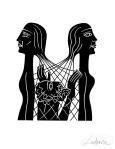
 Poor Esau. I mean it, really. Loses his birthright at the hands of his clever brother and then loses his blessing. In the natural order, he was “due” both of these things, and yet, at birth, it was prophesied while still in the womb that one would be stronger than the other and the older would serve the younger. Isaac’s blessing merely hammered that one home.
 Look, Esau was a simple man. He enjoyed simple pleasures and an outdoor life. Although he becomes bitter when his twin brother Jacob betrays him later, there is no real animosity at this point in the story. Esau, like most young men and teenagers, was not forward thinking. He was living a good life and no reason to believe anything would change. What would his birthright change for him?
 Abraham is old, really old, and decides to once again, take matters into his hands to find a wife for Isaac, who must be around forty by then. Abraham sends his highest ranking servant (unnamed throughout the story) to the land of his ancestors to find a wife. The servant puts out a kind of “


 Meditations from Zion