Feeds:
Posts
Comments

Urim and Thummim

urim_thummimIt’s a fascinating idea really, the Urim and Thummim. Apparently, the priests used special stones to cast for a decision or divination. Some scholars translate the words as “revelation” and “truth” but I’m not sure that helps understand how they were actually used. Another interpretation is that the words essentially mean “innocent” or “guilty.” And in this way, groups of people or ideas where honed down by castings, Urim or Thummim, divided and divided until only one remained.

Also put the Urim and the Thummim in the breastpiece, so they may be over Aaron’s heart whenever he enters the presence of the Lord. Thus Aaron will always bear the means of making decisions for the Israelites over his heart before the Lord. [Exodus 28:30]

flip-coin_5Ultimately, it sounds a lot like flipping a quarter. The result is random except for one difference, the people who threw the stones as well as the people who asked the questions, wholeheartedly believed that God alone drove the results.

Would that make our lives easier today? Like the picking of daisy petals, “he loves me, he loves me not,” could we abide by the final outcome? Or would we hedge it? Wouldn’t we really just look for confirmation and not decision?

In some cases, the coin toss works very well, when nothing too particular is at risk. I mean, whether Harry or Sally go first in a game or the Ravens kick-off instead of the Colts, these are not a deal-breakers.

But what if it was life or death? What if it was getting married or not? What if it was to move our of state or not move? In today’s culture, could anyone give those decisions completely to God in such a manner?

Bottom line: do I believe in luck or destiny? Does God need the Urim & Thummim to drive my life?

If I gamble or play the lottery, I must still believe in luck. Or do I?

lottery ticketThere’s a joke about a man who prayed every day for months that God would allow him to win the lottery but he never did. Finally, he complained to God, “Why haven’t I won?” and God answered, “You should have bought a ticket.” Does God need the efforts of human?

It’s a complicated question and one I cannot fully unwrap.

So, truthfully, I can’t really say I don’t believe in luck at all, I’m sure God supersedes luck, but perhaps God allows luck too. So, I occasionally buy a lottery ticket, wondering if God would like to bless me this week, you know, when the prize is really, really, really big. But, in my gut, do I believe God would pick me for an undeserved splash of wealth at that magnitude? These purchases are really “just in case.” I’m hinting. I’m directing God: “Hey God, this would be a great way to bless me, if You have a mind do it. What do you say?” (And secretly, I even promise to tithe on it. Oh brother, what a conniver.)

Silliness.

love the lord your godLet me step back still further. God has been pretty clear about the best life for Human and summarized it in two sentences: “Love the Lord your God with all your heart and with all your soul and with all your strength and with all your mind; and, Love your neighbor as yourself.” [Luke 10:27] And every action we take, every decision we make, could be in answer to these directives.

Too many of my decisions are about me. Not God and not others. Lottery tickets included. Time to re-focus the heart.

promiseWhich is it? When we say we will do something, when we agree, when we say yes, is there power in it? Three months after their exodus from Egypt, they arrived at Mt. Sinai and before any commandments were given, before any rules were laid down, God said this:

Now if you obey me fully and keep my covenant, then out of all nations you will be my treasured possession. Although the whole earth is mine, you will be for me a kingdom of priests and a holy nation”. . . . [and they answered] “We will do everything the Lord has said.” [Exodus 19:5-6a, 8b, NIV]

It’s a similar response that a bride and groom make to one another. Sometimes the answer is “I do” and sometimes the answer is “I will,” but in both cases, they are responses to a question that might be something like this, “will you have ‘so and so’ to be your wedded husband/wife, to live together after God’s ordinance in the holy estate of matrimony; will you love him/her, comfort him/her, honor and keep him/her, in sickness and in health, and forsaking all others, keep yourself only for him/her so long as you both shall live?”

And God  basically asked the same of the Israelites. Will you obey me fully and they said we will.

But they did not. They thought they could. They thought they would. But they did not. And for this reason, for this “fail,” the history of these people was changed forever, yet again. And Jesus asked for no less, “Love the Lord your God with all your heart and with all your soul and with all your mind. This is the first and greatest commandment. And the second is like it: Love your neighbor as yourself.All the Law and the Prophets hang on these two commandments.” [Matthew 22:37-40, NIV]

And did we? We did not. We do not.

It’s not rocket science, this living within the parameters of God’s plan: love, obey, trust, believe. And why don’t we? I can say we are still like Eve and Adam. We want more than what God offers. We believe we know better. We believe we might miss something if we agree to this small world. I see myself kicking against the limitations I perceive God has made against me, not seeing that following with abandon, in trust, opens the world to me. I must let go to have. I must give to receive. The paradox continues.

Today, God is still asking me, will trust God to be God in my life?

Passed Over

passover angelBack in the day when the Israelites were finally released from Egypt, it happened at great cost, the lives of all firstborn children and animals throughout the land (not to mention the previous nine plagues), except for those protected by God in Goshen: the chosen ones were passed over. How often are we passed over, thinking it’s a bad thing, when in reality, it is for a greater good?

On that same night I will pass through Egypt and strike down every firstborn of both people and animals, and I will bring judgment on all the gods of Egypt. I am the Lord. The blood will be a sign for you on the houses where you are, and when I see the blood, I will pass over you. No destructive plague will touch you when I strike Egypt. [Exodus 12:12-13]

So often, God’s timing is unclear in the moment. Only in hindsight, can we see the consequences.

I remember how disappointed I was when I was passed over for promotion after promotion in my work. And yet, looking back, the outcomes had their own blessings. In one case, a less challenging position offered me the opportunity to get a second Master’s degree. In another case, I was able to learn and grow in the cyber world and non-traditional librarianship (at the time). I learned what it meant to become an early adopter and to forge new paths in the computerized world. And later, another loss, merely opened a door that brought me back to my own community, where I now live, work, and worship. I am content here.

Perhaps it is a wisdom that comes with age and experience. The very thing that appears to be a calamity transforms into a grace.

Of course, in the Exodus time, the Israelites were saved from the grief of losing their firstborn children, but then they also left everything they knew to flee into a desert that challenged them daily. Not everyone was so sure that this passing over would come to good. Not all could not see that promised land of milk and honey; only those who embraced their faith in God.

It is no different today. I must believe in God’s ultimate plan for my good, or at the least, the good that may come after me because of where I live or how I live or the children I send forth into the world.

Today, in the New York Times, I read an OpEd piece by Frank Bruni, and although this piece was driven by his observations about age and wisdom in sports, specifically Peyton Manning, he included additional observations about maturity and our response to life events.

And it’s no accident that many of us, while remembering and sometimes yearning for the electricity of first loves and the metabolism of our salad days, don’t really want to turn back the clock. We know that for everything that’s been taken away from us, something else has been given. . . . We’re short on flat-out exuberance. We’re long on perspective. . . . Life is about learning to look past what’s lost to what’s found in the process . . . [Frank Bruni, Maturity’s Victories]


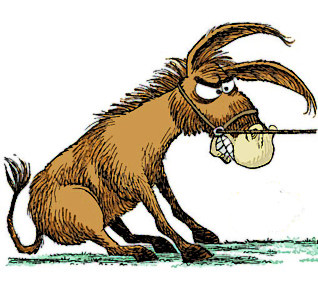
stubborn muleWhy did God choose plagues? In Exodus chapters 7-10, we read about liquid plagues, hopping plagues, flying plagues, buzzing plagues, animal dying plagues, skin plagues, weather plagues, lighting plagues, and finally, the straw that broke the Pharaoh’s back, people dying plagues.

But I will harden Pharaoh’s heart, and though I multiply my signs and wonders in Egypt, he will not listen to you. Then I will lay my hand on Egypt and with mighty acts of judgment I will bring out my divisions, my people the Israelites. And the Egyptians will know that I am the Lord when I stretch out my hand against Egypt and bring the Israelites out of it. [Exodus 7:3-5]

A cursory look at some commentaries indicates that many of the ten plagues appear to correspond with a particular “god” the Egyptians worshiped and in this way, Yahweh was demonstrating superiority over these gods. And certainly, if these miraculous plagues were intended to make a point, an indelible memory, they certainly did that. Although we may not remember all of the types of plagues or how many there were, most people have visceral reaction to one or more of the manifestations. (I’m glad he didn’t choose rats or spiders as I would be forever frozen at the thought of a teeming swarm of either. I barely recovered from the story of the Pied Piper as a child.)

But perhaps the most important aspect of these plagues to point out is that the plagues were explicitly devised to change the mind of Pharaoh and extract repentance. In this case, it took ten times.

How many times does God act to change me, to draw my attention to poor and selfish thinking, inappropriate behaviors, or simply, to sin? Am I equally stubborn?

In Pharaoh’s case, the letting go of the Israelites would alter Egypt’s way of life dramatically because slaves were cheap labor and there was plenty of it, in essence, the bedrock of that economy. He wasn’t just resisting God’s will, he was resisting change.

I just want to pay attention, that’s all. I don’t want to be a hard heart.

Plus, a hard heart can have collateral damage. In Shakespeare’s Romeo & Juliet, during the course of the two families bickering and fighting, it is Mercutio who is mortally wounded:

No, ’tis not so deep as a well, nor so wide as a
church-door; but ’tis enough,’twill serve: ask for
me to-morrow, and you shall find me a grave man. I
am peppered, I warrant, for this world. A plague o’
both your houses! ‘Zounds, a dog, a rat, a mouse, a
cat, to scratch a man to death! a braggart, a
rogue, a villain, that fights by the book of
arithmetic! Why the devil came you between us? I
was hurt under your arm.  [Mercutio, Act 3, Scene 1]

Such family quarrels continue in our modern world and who suffers? Stubbornness has no victor.

In Shakespeare’s tale, many more die, but in particular, both Romeo and Juliet lose their lives, choosing out of misplaced loyalty, somehow taught by their feuding families. In Pharaoh’s time, he lost his firstborn son, before he let go. But even that, was not the end of his stubborn, single-minded story.

God works in mysterious ways to bend the earth and its peoples to God’s will. For the best. And unfortunately, it appears we, as a human race, are feeling some of those plagues today. How many more tragedies and how many more deaths will we endure before we respond humanely to one another? Or will we continue to blame one another because of the color of our skin or history of our faiths or the geography of our land?

I amSo many times I have read about the great “I AM,” the God of all Gods, the one God who cannot really be named or explained. When Moses asked who should I tell the Israelites in Egypt sent me to them, and he was told:

God said to Moses, “I am who I am. This is what you are to say to the Israelites: ‘I am has sent me to you.’”God also said to Moses, “Say to the Israelites, ‘The Lord [I AM], the God of your fathers—the God of Abraham, the God of Isaac and the God of Jacob—has sent me to you.’ [Exodus 3:14-15]

But in the notes, this I AM phrase has alternative meaning: I will be what I will be. And decidedly, in English at least, this brings up a whole new array of possibilities.

I am still working on a full engagement with the present. This idea crosses over into a variety of disciplines both Eastern and Western. It is accepting the now, being full in the now, and living it without remorse for what is past or fear of the future.

But now I am challenged to consider as well this more open-ended God who is and will be. Not that I didn’t know that of course, but I find it intriguing to ponder God, perhaps as a point within me for the now and then stretching outward my center self in an ever growing, ever widening funnel of “God Self.” God is now but also God is potential, forever.

God is telling Moses, “No worries: here now and here tomorrow.” All of time is God’s now.

How can we not be grateful for the invitation to be in relationship with this God of today and forever? There are not enough songs to sing, poems to recite, or words to say that can capture the wonder of God in me and in the universe, a personal God and a cosmic One. This is the reason we glorify God. This is the reason we praise. This is the reason we surrender.

Who sends you?

make a wayWe all were. Sent ahead. In some cases, that is more obvious than in others, but if you think about it, we can each lay a path or new ground for our descendants and loved ones.

But God sent me [Joseph] ahead of you to preserve for you a remnant on earth and to save your lives by a great deliverance. [Genesis 45:7, NIV]

My mother and father left Europe and came to America and worked hard for the sake of their children and a new life. My mother’s mother left her village in Lithuania to go to Riga to experience city life. In my own life, bouncing from city to city, I eventually landed with a husband and a home here in Maryland and drew three orphaned children to us from Latvia and St. Petersburg, Russia, their lives forever changed.

We can each make a way. We can cut the brambles to the best of our ability so that others can walk behind.

But of course, some people refuse. The road ahead seems too difficult, too overwhelming. And so they sit in what small space they can carve out and wait. Reminds me of the parable of the “talents.” Three servants were entrusted with wealth to invest for the Master while he journeyed away. Two took risks and plunged ahead. But the one merely buried what he was given and although he returned it all, he had made not change or increase.

Humans are given gifts as well as challenges that make us who we are but also help make us what God intends. It is not about the money but about the attitude, the response to life’s events, accepting the truth of what is and making the very best of what that truth can contribute.

This process is true for organizations as well as individuals. Churches, in particular, have a mission to reach out to those stagnant souls who have lost their will or hope toward the next step. The Church, the Body of Christ, can do corporately what cannot always be done by the one. But it must be done in unity and love.

Look back: who is following you? Whose steps are landing in your footprints?

Dreams and Drama

dream and forgivenessIt’s not like Joseph had one God dream after another. He had a couple of foretelling dreams as a teen and no other dreams of his are shared through his time in Egypt. Instead, he turned to dream interpretation, but again, only a few. He known for being an honorable man, but not necessarily a diviner. Yet, God used him in this way at a point of need.

[Joseph said:] And now let Pharaoh look for a discerning and wise man and put him in charge of the land of Egypt . . . Then Pharaoh said to Joseph, “Since God has made all this known to you, there is no one so discerning and wise as you. You shall be in charge of my palace, and all my people are to submit to your orders. Only with respect to the throne will I be greater than you.” . . .  Joseph was thirty years old when he entered the service of Pharaoh king of Egypt.  [Genesis 41:33, 39-40, 46a; NIV]

After twelve years of servitude, Joseph is raised up to one of the highest positions in that world, second only to Pharaoh at the age of thirty, all because of a dream, an interpretation, a vision, and twelve years of leading in lower positions. Every year of his captivity was actually a year of practice and preparation for the big leap. He had no way of knowing that such a day would come.

What we don’t see is any record of built up resentments toward his half-brothers. The only hint that memories cause him pain comes in the naming of his sons: Manasseh (which appears to mean “forget” and Joseph writes that his son has been born to help him forget his father’s household) and Ephraim (which seems to mean “twice fruitful,” and Joseph writes that this birth symbolizes a new life of fruitfulness in the place of suffering). Suffering? Interesting.

By the time the brothers finally come from Canaan to ask Egypt for grain, Joseph has been away at least twenty years. He has a new name, a new life, and his own family. And yet, the moment of reckoning arrives–the moment of payback, the moment when he could, at a word, destroy all ten of his brothers for their betrayal. During this first visit, he is tempted but there is also his integrity fighting against it.

Resentments build fast in my world. I know it. I see it. I feel it. People will say, “oh, I forgave, but I will never forget.” I think it was my old friend, Mma Precious Ramotswe, from the mystery series The No. 1 Ladies Detective Agency, who said (more or less), “If we don’t choose to forget as well, the memory may very well erase the forgiveness.”

I can choose drama or I can choose dream. I can choose to forgive and forget. I can allow God’s dream to build a life or I can fight the way. I can complain of the time and the disappointments or I can trust in the preparation.