Feeds:
Posts
Comments

Posts Tagged ‘Christ’

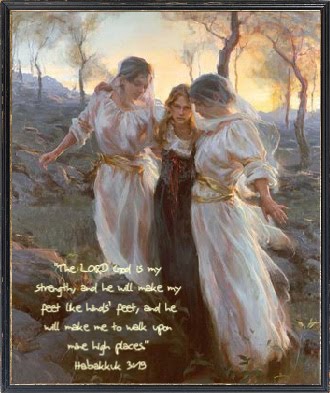
hinds_feetA good part of me is struggling with the word “sacrifice.” Just a quick look at the thesaurus and there’s no wonder I’m hedging, words like lose, endure, renounce, forfeit, and part with. They all resound loss. In our currently turbulent world, can I afford to lose anything more? Can I afford not to?

Therefore, I urge you, brothers and sisters, in view of God’s mercy, to offer your bodies as a living sacrifice, holy and pleasing to God—this is your true and proper worship.Do not conform to the pattern of this world, but be transformed by the renewing of your mind. Then you will be able to test and approve what God’s will is—his good, pleasing and perfect will. [Romans 12:1-2]

It feels like an oxymoron [self-contradictory]. How can I be a “living” sacrifice; won’t I be gone and spent? It’s the most blatant paradox in all of scripture and it’s repeated over and over again: to live is to die; to die is to live. [What you sow does not come to life unless it dies. I Corinthians 15:36]. We see it in nature all the time: the earth replenishing itself.

Too often, I can only see this life, this skin, this body. I try not to be afraid to die. I understand the promises of life after death, I espouse alternate realities and a rich spirit life in which the Presence of Christ is much bigger than this three-dimensional me. But I hold still fast to what I have. Perhaps it is rooted in our family’s poverty when I was young, but how long can I allow that wanting self to rule my life of plenty?

Many years ago, I read Hannah Hurnard’s “Hind’s Feet on High Places,” the allegorical story of Much Afraid whose Chief Shepherd encouraged to take a journey up the mountain with two companions, Sorrow and Suffering. She did not like these companions at first, at all. They seem to be taking her the wrong way, down and not up. But she is convinced to trust the Shepherd, and so she goes, marking that decision with an altar (a benchmark).

And so I am reminded that a living sacrifice is not a one-time, lay it down kind of thing. It’s a another journey. A living sacrifice is ongoing, daily, with understanding, becoming and transforming, letting go of one part, growing another. It is a renewal through pruning. It is communal and by agreement. I must choose.

Read Full Post »

kissandmakeupTherefore, if anyone is in Christ, the new creation has come: The old has gone, the new is here! All this is from God, who reconciled us to himself through Christ and gave us the ministry of reconciliation: that God was reconciling the world to himself in Christ, not counting people’s sins against them. And he has committed to us the message of reconciliation. . . . Be reconciled to God. [II Corinthians 17-19, 20b]
Big word: reconciliation. How often do you use that during the day? And yet, we are doing it every day.
As a parent, we are reconciling our children all the time: settling disputes, making compromises, restoring harmony. At work, we do the same, particularly if we work, as I do, in public service. Sometimes my front desk feels like nothing more than a complaint department.
The key to reconciliation is a willingness to participate in a two-way conversation. Both sides have to agree, both sides have to be in the game.
In the case of God, through the sacrifice of the Christ, the door is open for a permanent relationship with God. Many old rules have been cast aside and a new covenant was forged. But, we still have to go through the door and, as it were, sign our copy of the deal. It’s not that the deal is not a good one or that we need to dicker, we just need to recognize it for what it is, an offer to start over.
Here’s what is amazing to me. It’s never too late to “kiss and make up” with God. This offer is eternal.

Read Full Post »

Fig Tree by Dee Schenck Rhodes

Fig Tree by Dee Schenck Rhodes

A parable: “A man had a fig tree growing in his vineyard, and he went to look for fruit on it but did not find any. So he said to the man who took care of the vineyard, ‘For three years now I’ve been coming to look for fruit on this fig tree and haven’t found any. Cut it down! Why should it use up the soil?’“‘Sir,’ the man replied, ‘leave it alone for one more year, and I’ll dig around it and fertilize it. If it bears fruit next year, fine! If not, then cut it down.’” [Luke 13:6b-9]

One more year; one more growing season to change; one more opportunity to work with the gardener and produce fruit.

We’re not so great at parables anymore, or maybe we’re just as dense as the disciples were back in Jesus’s time. So many times the disciples had to ask Jesus to explain the stories. But not this one; this one is up to us to figure out.

Who is the owner of the vineyard? Who is the one who cares for the vineyard? Who is the fig tree? What is the fruit? Why didn’t the tree produce fruit? How would the soil be fertilized? And what does it mean to be cut down?

God is the owner. Jesus is the farmer/caretaker. I am the tree. But what is the fruit?

I did a little investigating and apparently the fig tree was one of the most valuable trees in Israel at that time because it bore fruit three times a year. So, in the parable, that means that this particular tree, still hadn’t produced fruit in any one of the seasons that had passed. So, why keep this tree? It was planted for the purposed of yielding fruit. That was the job of the tree, not acting as a shade tree, not as an art object, and not as a road marker. Fig trees bear figs. Fig trees don’t bear apples or peaches or cherries.

Each human “fig tree” has its own fruit as well. Oh, sure, there are the fruits of the spirit (See Galatians 5:22-23 if you want to review the list). And certainly, all trees should have these attributes. On the other hand, a friend of mine said that the fruit of the tree is more believers, more followers of Christ, more like-minded, like-spirited people. This interpretation makes me feel like it’s a numbers game (how many people have you “saved?”).

No, I’m much more interested in the specific and unique fruit that comes from me. Or you. Or any other believer. We each bring something to the table of community and to the Body of Christ. Sometimes, it’s a complex recipe and my part may be small compared to another, or vice versa. I know there are seasons I have missed. But I am grateful for a merciful gardener who is willing to tend and nurture my soil. I am still growing. I am still in the orchard.

The soil is fertilized through prayer and study and relationship.

I can only say, I am still here. And as along as I am, then I will take comfort that my seasons are more fruitful than I may realize. It is not I who must judge the harvest.

Read Full Post »

life deathJesus answered, “Do you think that these Galileans were worse sinners than all the other Galileans because they suffered this way? I tell you, no! But unless you repent, you too will all perish.” [Luke 13:2-3]

I had to go back and read this verse in context. What was Jesus really saying here? And then I understood. He is reminding the people, again (and again) that the death of the body is one death, but the death of the spirit is far more serious. If the personal spirit is in relationship with the Holy Spirit, if the life force within is right with God, when the body dies, there is more.

Apparently, based on this scripture, death is not a reflection of one’s goodness or evil: death comes when it comes for other reasons. And “like a thief in the night,” [I Thess 5:2] we cannot know the time of death anymore than we can know the  time of Christ’s return. Most of us can’t even fathom an early death. Not really. Who expects a child to die in three days time? Who expects a sister to die in the lobby of a hotel in Europe? Who expects a husband to die in a car accident?

When I was in school, I remember how much I hated pop quizzes. You know why? Because I was a last minute studier. I’d pull all-nighters the day before a big test or when an assignment was due. But a pop quiz? That would show the truth of it. I wasn’t on top of my work. I wasn’t doing a little every day. I was a procrastinator.

But this technique doesn’t work so well in the things of God, in the things of the Spirit, in the things of becoming more Human (that is the real intent for human). That journey is outlined for us all in the scriptures and writings of the ones who have gone before us. What are we waiting for? Granted, if I follow the paradoxes (love your enemy, give and it will be given to you, etc.), and the surrendered lifestyle, I am promised that my life here and now will be better for it. But more importantly, it is the life within that really counts.

How many ways does Jesus (or really, any of the saints and Spirit-led) have to tell us that there is more to “life” than what we see, hear, feel, and touch?

Do you want more? Are you thirsting for more of that promise? I am.

Read Full Post »

drink waterFor I do not want you to be ignorant of the fact, brothers and sisters, that our ancestors were all under the cloud and that they all passed through the sea. They were all baptized into Moses in the cloud and in the sea. They all ate the same spiritual food and drank the same spiritual drink; for they drank from the spiritual rock that accompanied them, and that rock was Christ.
[I Corinthians 10:1-4]

The theme for this week’s Lenten journey is “Thirst for God.” The Israelites suffered many hardships in the desert, but many of those difficulties they brought onto themselves through griping and complaint which was birthed from distrust. Early on, they were thirsty and cried out to Moses, forgetting the wonder of the parting waters and the Passover night and the plagues which bypassed them in Egypt. They focused on one thing: immediate need for water. And God provided water, despite their complaints, through the striking of a rock by the staff of Moses.

The rock is a symbol for the Christ. And the water, like the water mentioned here, is like the water in John 7:37, a water that quenches the deepest thirst. Water is used again with the woman at the well [John 4] whom Jesus invited to drink of living water and from which a person would no longer thirst again.

Where is my water? Where do I drink?

If anything, I feel more like the Samaritan woman, asking for that living water. Why don’t I feel like I can drink? I am trying to satisfy my inner thirst with the smallest amounts, like dew, floating on the surface. I am not drinking deeply.

My friends, Kathleen and Benedict Schwartz, started and run an orphanage called the Villages of Hope, AKCLI, in Zambia. Mike and I visited there early on in the process and one of their desperate needs was water. The drilling of wells was expensive and frustrating. Just across the road was a resort and golf course with plenty of water while their paltry fields were shriveling. They needed more than a trickle, they needed a gusher. And so they kept drilling, well after well after well until they hit the jackpot.

I don’t want to be satisfied with thimble-fulls of water anymore either. I have grown complacent with my little sips. It’s time to tap into the true groundwater, the lake underneath, the flowing waters of God’s love and renewal.

Read Full Post »

Looking for GodSeek the Lord while he may be found;
    call on him while he is near.
Let the wicked forsake their ways
    and the unrighteous their thoughts.
Let them turn to the Lord, and he will have mercy on them,
    and to our God, for he will freely pardon. [Isaiah 55:6-7]

It’s not that God is missing, you know, or that God is moving closer and farther away. It’s the seeker who is either ready or not to discover God in Spirit, working and moving, speaking and transforming our lives. And when we, as seekers, do have a personal experience with God, that is the best moment to ask those tough questions, to not let go, like the woman with the issue of blood [Matthew 9:20-22] or Jacob, as he wrestled the angel [Genesis 22:24-30]. Both of these people knew their time had come, their opportunity, to hold tight, to touch and encounter God.

When someone who does not know God has that initial epiphany, it’s as though God appears out of nowhere, and suddenly, their new found belief, brings God close, brings in the reality of Christ Jesus, and the Presence of the Holy Spirit. It’s an “aha!” moment. In those first flushed days, it is the easiest time to ask forgiveness, to surrender the sins and bad choices, to confess.

But later on, we become more closed and closeted, despite being faithful followers of God. It’s like running into someone you know . . . I mean, you know you know the person, you go to church together or you were at meetings together, and yet, no matter how hard you try, you can’t remember the person’s name. Do you confess that you don’t remember or fake it? That would be me, at least. I am too embarrassed to confess. And so I have been with my God, too embarrassed to review that same error in judgment, that same mistake, that same blasphemy. It’s not like God doesn’t know. But I am the one who cannot bear it. So, I open up the secret room and toss yet another “truth about me” inside and shut the door.

Jesus even taught that we are to forgive one another, not just seven times, but seventy times seven times [Matthew 18:22], symbolically meaning that forgiveness has no limits. Would God do less?

I say I am a seeker of the Christ and the fullness of the Spirit within, and yet, I withhold my truths and sins. When I do this, I am not seeking at all, but hiding, like Adam and Eve in the garden [Genesis 3:8]. God sought them. God is doing the same with me.

It’s so simple: when I seek, I find.

Read Full Post »

waterCome, all you who are thirsty,
    come to the waters;
and you who have no money,
    come, buy and eat!
Come, buy wine and milk
    without money and without cost. [Isaiah 55:1]

It’s really rare that I experience true thirst, perhaps on those rare occasions when I work out or I am outside on a very hot day, but really, water is usually at arm’s length. I live in a society where water is so plentiful (for now), that I can choose other things to quench my thirst, like tea or soda or beer. It’s not like I have to have water.

But if I lived in a parched land, in a desert, I would have a different attitude toward water, I’m sure of it. If I really experienced a drought in my body that only water could refill, I would not be so cavalier about this drink, this fluid that is actually the bulk of my physical being (90%).

That is the kind of desire that would change my faith walk with God. That kind of need and craving for the things of God, for the Presence of the Holy Spirit, for the quenching power that only God can give. If I wanted God the way a truly thirsty person wants water, then I would have fullness. I would recognize God more clearly; I would hear God’s voice; I would “feel” God.

Truly, I believe it.

Instead, I continue in this rather off-hand existence with God. It’s simply not intentional in my surrender.

Don’t misunderstand me. I get thirsty for God. And I drink and I am, for that time, aware of God’s Presence and amazed by the wonder. But then, I grow complacent and dilute the drink. Funny, right? The idea of diluting “water” with other things? But it is so.

Lord, I want to drink of you this day.

Read Full Post »

« Newer Posts - Older Posts »