Feeds:
Posts
Comments

Posts Tagged ‘faith’

passover angelBack in the day when the Israelites were finally released from Egypt, it happened at great cost, the lives of all firstborn children and animals throughout the land (not to mention the previous nine plagues), except for those protected by God in Goshen: the chosen ones were passed over. How often are we passed over, thinking it’s a bad thing, when in reality, it is for a greater good?

On that same night I will pass through Egypt and strike down every firstborn of both people and animals, and I will bring judgment on all the gods of Egypt. I am the Lord. The blood will be a sign for you on the houses where you are, and when I see the blood, I will pass over you. No destructive plague will touch you when I strike Egypt. [Exodus 12:12-13]

So often, God’s timing is unclear in the moment. Only in hindsight, can we see the consequences.

I remember how disappointed I was when I was passed over for promotion after promotion in my work. And yet, looking back, the outcomes had their own blessings. In one case, a less challenging position offered me the opportunity to get a second Master’s degree. In another case, I was able to learn and grow in the cyber world and non-traditional librarianship (at the time). I learned what it meant to become an early adopter and to forge new paths in the computerized world. And later, another loss, merely opened a door that brought me back to my own community, where I now live, work, and worship. I am content here.

Perhaps it is a wisdom that comes with age and experience. The very thing that appears to be a calamity transforms into a grace.

Of course, in the Exodus time, the Israelites were saved from the grief of losing their firstborn children, but then they also left everything they knew to flee into a desert that challenged them daily. Not everyone was so sure that this passing over would come to good. Not all could not see that promised land of milk and honey; only those who embraced their faith in God.

It is no different today. I must believe in God’s ultimate plan for my good, or at the least, the good that may come after me because of where I live or how I live or the children I send forth into the world.

Today, in the New York Times, I read an OpEd piece by Frank Bruni, and although this piece was driven by his observations about age and wisdom in sports, specifically Peyton Manning, he included additional observations about maturity and our response to life events.

And it’s no accident that many of us, while remembering and sometimes yearning for the electricity of first loves and the metabolism of our salad days, don’t really want to turn back the clock. We know that for everything that’s been taken away from us, something else has been given. . . . We’re short on flat-out exuberance. We’re long on perspective. . . . Life is about learning to look past what’s lost to what’s found in the process . . . [Frank Bruni, Maturity’s Victories]
 

Read Full Post »

dream and forgivenessIt’s not like Joseph had one God dream after another. He had a couple of foretelling dreams as a teen and no other dreams of his are shared through his time in Egypt. Instead, he turned to dream interpretation, but again, only a few. He known for being an honorable man, but not necessarily a diviner. Yet, God used him in this way at a point of need.

[Joseph said:] And now let Pharaoh look for a discerning and wise man and put him in charge of the land of Egypt . . . Then Pharaoh said to Joseph, “Since God has made all this known to you, there is no one so discerning and wise as you. You shall be in charge of my palace, and all my people are to submit to your orders. Only with respect to the throne will I be greater than you.” . . .  Joseph was thirty years old when he entered the service of Pharaoh king of Egypt.  [Genesis 41:33, 39-40, 46a; NIV]

After twelve years of servitude, Joseph is raised up to one of the highest positions in that world, second only to Pharaoh at the age of thirty, all because of a dream, an interpretation, a vision, and twelve years of leading in lower positions. Every year of his captivity was actually a year of practice and preparation for the big leap. He had no way of knowing that such a day would come.

What we don’t see is any record of built up resentments toward his half-brothers. The only hint that memories cause him pain comes in the naming of his sons: Manasseh (which appears to mean “forget” and Joseph writes that his son has been born to help him forget his father’s household) and Ephraim (which seems to mean “twice fruitful,” and Joseph writes that this birth symbolizes a new life of fruitfulness in the place of suffering). Suffering? Interesting.

By the time the brothers finally come from Canaan to ask Egypt for grain, Joseph has been away at least twenty years. He has a new name, a new life, and his own family. And yet, the moment of reckoning arrives–the moment of payback, the moment when he could, at a word, destroy all ten of his brothers for their betrayal. During this first visit, he is tempted but there is also his integrity fighting against it.

Resentments build fast in my world. I know it. I see it. I feel it. People will say, “oh, I forgave, but I will never forget.” I think it was my old friend, Mma Precious Ramotswe, from the mystery series The No. 1 Ladies Detective Agency, who said (more or less), “If we don’t choose to forget as well, the memory may very well erase the forgiveness.”

I can choose drama or I can choose dream. I can choose to forgive and forget. I can allow God’s dream to build a life or I can fight the way. I can complain of the time and the disappointments or I can trust in the preparation.

Read Full Post »

women and storyAbraham protected himself by claiming that Sarah was his sister in the land of Abimelek (Abimilech) and here, Isaac does the same thing, in the same geographical area, with another king (perhaps a son?), also called Abimelek (Abimilech). Scholars are not in agreement about these accounts since they are mirror of one another in so many ways. But for my purposes, they cause a completely different resonance: one that makes my blood boil if you want to know the truth.

When the men of that place asked him about his wife, he said, “She is my sister,” because he was afraid to say, “She is my wife.” He thought, “The men of this place might kill me on account of Rebekah, because she is beautiful.” [Genesis 26:7, NIV, emphasis mine] (See Genesis 20 for Abraham’s version.)

In some quarters, commentators have said that these parallel stories show God’s protection over the patriarchs and the beauty of their women. How swell. But in neither story, as told by the Old Testament historians, is there much information about the women and the circumstances in which they found themselves as a result of their husbands clever misinformation (lies). The reason for their deception, in both cases, was to protect their own lives because the ruler might kill the husband to acquire the wife. But a sister? Piece of cake, just hand her over (with gifts from the household of the King to the patriarch, I’m sure).

And so the women, beautiful they may have been, were thrust into the households of foreigners. Nice. Convenient and cunning.

I am more than aware that culturally, in those days, women were a type of property or chattel. They were owned by their husbands and subservient to the lord of the house. Despite these restraints, many women of that period still accomplished great things and often, with courage, they turned their world, the Esthers and Abigails and for all we know, many who went unnamed. But these accounts are few and far between.

Women are a often strong and flexible and most tenacious. They can take a bad situation and make it better. They can tolerate much. They are survivors. But not all women. Too many other women fall in the face of men who strike with force to gain their will. Other women self-medicate to beat back emotional pain. And still others eat until their bodies betray them altogether and beauty is no longer apparent.

I suppose Abraham and Isaac could be commended for their clever little deception. They both gained immeasurably by it and found much favor from the Abimileks in their sojourns. But for the women, it was a sacrifice. And I want to remember that.

As a contemporary reader of scripture, I often remind myself that it’s critical to look between the lines, to pray and contemplate the untold story. So often, scripture time is compressed into a single phrase but it’s really months or years. And in those time frames, there are women living, crying, hoping, and maintaining their faith, often in the face of trial. whats_your_story

For my sisters in faith today, I challenge you, don’t read like a man. Read from your unique femaleness. For it may only be us who hear and see and can recognize those underlying truths. In the centuries since those days, many women’s stories have been lost. We need to remember and we need to repeat our own narratives, to our daughters, to our nieces, to our girlfriends.

Tell your story. No one else is more qualified than you.

Read Full Post »

quiet placeIn Genesis 23, almost the entire chapter is dedicated to the negotiations between Abraham and the local Hittites about a parcel of land and a cave in which to bury Sarah. And although my Bible [NIV] has labeled this chapter “the death of Sarah,” I think it should have been called Abraham’s necropolis.

Again Abraham bowed down before the people of the land and he said to Ephron in their hearing, “Listen to me, if you will. I will pay the price of the field. Accept it from me so I can bury my dead there.”Ephron answered Abraham, “Listen to me, my lord; the land is worth four hundred shekelsof silver, but what is that between you and me? Bury your dead.” [Genesis 23:12-15]

This negotiation, I understand, was rather standard for the day with the exception that it was between a foreigner (Abraham) and a local (Ephron) Hittite. No one believes that Ephron would have given the land to Abraham, that wasn’t how things were done. Instead, there was a lot of “saving face” and gestures of respect and false civilities.

In any case, Abraham would never allow himself to “owe” Ephron for the gift of land. After all, gifts of this kind usually carry strings attached. And perhaps Ephron thought Abraham’s sojourn in the land of Canaan was relatively temporary. We’ll never know. But for Abraham, this was the promised land of God and it was his belief that one day his descendants would indeed conquer the land. This parcel became the first parcel in that conquest. And in later years, not just Sarah, but Abraham himself along with Isaac, Rebekah, Leah, and even Jacob’s bones were carried there by his son, Joseph, many generations later. Only Rachel was buried elsewhere, not far, but immediately after dying of childbirth.

So, why devote an entire chapter to this negotiation? I think the land was important as “Abraham’s little green acre.” I think it symbolized Abraham’s faith in God’s promise, which drove Abraham all of his life. I believe he expected this land and cave to be come the great tomb of the patriarchs. This little piece of land was Abraham’s personal investment in the promise.

He wasn’t trying to “make” things happen (unlike Sarah who had tried to hurry things along by giving Hagar to Abraham to prime the pump for descendants). Abraham was simply putting a standard in the ground, and saying, “we begin here.” In the end, Abraham was still considered a nomad until the day of his death and he never saw the true occupation of the land by God’s people, but he is buried there. He took a foreign piece of land and transformed it.

Then there is a lesson for me. How often have I been overwhelmed by circumstances and unable to see how situations could change or be different? But I think I see a way here. I only have to claim one small piece of the situation. As my pastor suggested, I only have to do the one possible thing, that choice that is within my power or ability to do, and then God can do the rest. I lay down an anchor but God calms the sea.

Read Full Post »

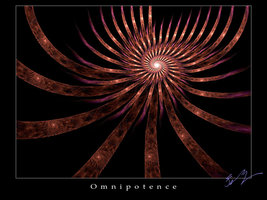
omnipotence

Art by Neon Rauschen

Conceptually, I can’t really wrap my head around omnipotence, infinity, or the universe. And not just because of the vastness, although that plays a part, but mostly because the idea is so very non-human. We are bound by many sets of limitations whether self-imposed or a product of our very nature. We are encased in skin and held up by a skeleton of bones and we are locked in time. Both of these parameters keep us out of the God realms.

 Job answered the Eternal One.
 Job: I know You can do everything;
        nothing You do can be foiled or frustrated.
You asked,
        “Who is this that conceals counsel with empty words void of knowledge?”
    And now I see that I spoke of—but did not comprehend—
        great wonders that are beyond me. I didn’t know. [Job 42:1-3, The Voice]

I didn’t know, Job says. And I say, he couldn’t know. We’ll never know, not while we’re walking the earth.

Oh, we’ll get glimpses of truth, snippets of the secret knowledge, flashes of insight even. But the “why” is not for us to understand. I am reminded of a Corrie Ten Boom story when she was a little girl on a trip with her father and she wanted to carry one of the pieces of luggage and her father denied her. It would be too heavy for her.

And so it is with omnipotence: the ability to see through time and space and change, the beginnings and the ends.

For this reason, we are asked to trust in God, the Eternal One, the Omniscient. It’s the old iced tea commercial, where we are asked to fall backward into the water, without looking. It’s the more recent cliche of choosing to be “all in.”

I am still not there. I don’t understand my own reticence. Somewhere along the way of my life, I have learned skepticism and fear of being fooled or deluded. I continue to test the waters first, walking in slowly, just in case there are surprises underneath, ready to nibble my toes and ankles. I do not plunge.

But I will. I know that too. I’m not sure what that will look like yet, but I am certain that I will have my Job revelation too. And in that day, in the same way that “The Lord blessed the latter part of Job’s life more than the former part” [Job 42:12a], so I will experience saturation in omnipotence.

Read Full Post »

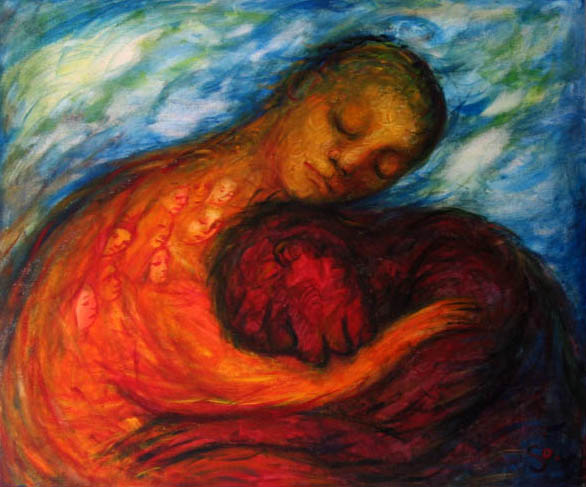
Art by Gil Bruvel

Art by Gil Bruvel

I tried to do a cursory read of some of the commentaries on the three sons of Noah (Shem, Ham, & Japheth) and immediately realized I could never cover all of this controversy in a single post. It’s a big deal, the descendants of these three and the curse that Noah placed on Ham’s son Canaan (specifically) due to some kind of drunken episode (verses 20-27). The theories are many, the results undeniable, if genealogy is indeed the culprit, that, and a popular term of today: “generational sin.”

The sons of Noah who came out of the ark were Shem, Ham and Japheth. (Ham was the father of Canaan.) These were the three sons of Noah, and from them came the people who were scattered over the whole earth. (Genesis 9:18-19, NIV)

The oldest is actually Japheth and his name means opened. And a quick look in chapter ten shows that his descendents appear to be the great travelers who spread humanity the furthest. And then, the middle son, is Shem and to him is attributed the line of Abraham, David, and the Christ through Mary (Luke 3). And so, they were known as Semites, which became another way to refer to the Israelites and Jews of later days. And lastly, there is Ham, whose son was Canaan (among others) and who received the curse which many attribute to the seemingly endless animosities between those generations and all other peoples. Is it so? I really don’t know. There are even scholars who have credited the various races and skin color to those three family lines (which seems a little ridiculous to me).

But then, is it really necessary to “explain away” our current world tensions by marching back in time through scripture to put the whole thing down to a younger brother seeing or possibly engaging his naked father in some way? Really? I think generations of transgressions and the human tendency toward self-preservation and righteous indignation have done enough damage along the way, with or without the curse.

Genealogies are good for hindsight I suppose. It’s fun to go back, using a 20-20 lens to see what happened and how each person/choice turned the wheel of time. And one day, I suppose, our own descendants will look back on our now as well. “What were they thinking?” They’ll never understand our choices anymore than we understand the choices of our own ancestors. Lessons could be learned, since it is said, again and again, (thank you George Santayana), “Those who cannot remember the past are condemned to repeat it.” But do we?

In reality, we change history all the time. In fact, our individual histories are more fiction than truth. We remember what we want to remember and fill in the rest. “Memory is fiction. We select the brightest and the darkest, ignoring what we are ashamed of, and so embroider the broad tapestry of our lives.” (Isable Allende.) [For more on this topic, read Luc Sante in the New York Times Sunday Book Review, March 12, 2010.]

So many people are on the genealogical bandwagon. Even celebrities have joined in the foray, looking for lines of descent as though this might explain who they have become outside of mere circumstances or serendipity, or simply God’s will and hand moving through Spirit.

We can study and we can ponder what has been or could have been, but the moment of greatest concern should be now, for it is our response to the events and knowledge of today that will turn the world (both the microcosm and the macrocosm).

Read Full Post »

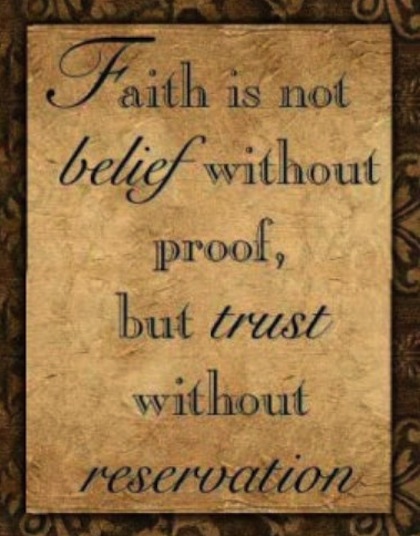
trust2It’s the ultimate question, really. Do I trust God or not? It is a question who’s answer is black or white, yes or no. Any answer close to “maybe” is a no. It is the essence of faith; they work in tandem, they need each other.

Lord Almighty,
    blessed is the one who trusts in you. [Psalm 84:12, NIV 2011]

It is trust that operates outside of the tangible world. Trust is the foundation upon which I can continue forward in the face of trouble, in the face of terror, in the face of sickness or collapse.

Trust and faith are spirit words. They are not driven by circumstances or the weather. When I live in the realm of trust and faith, I am living in the Maker’s world.

Read Full Post »

« Newer Posts - Older Posts »