Feeds:
Posts
Comments

Posts Tagged ‘God’

Cloud of Witnesses by Jean Moore

Is it really Abraham and Isaac and Jacob? What about the disciples or maybe a few of the women who managed to get their names in the book? Or what about all the unnamed saints? Is it one cloud for all of us? Maybe they’re color coordinated.

Hebrews 12:1
Therefore, since we are surrounded by such a great cloud of witnesses, let us throw off everything that hinders and the sin that so easily entangles, and let us run with perseverance the race marked out for us.

Honestly, there are a lot of dead souls between the Old or New Testament times and now. Who are these people? And what do they see?

I would assume that most traditional Christians believe these cloud formations are all the folks in heaven, especially the long-gone relatives and extended family who are cheering them on. Big family: big cloud.

But I’m not from a big family nor have I done much in the genealogy department to scout out family members I never knew I had. I suppose the cloud could be my “church” family but then, let’s be honest, do I believe they would keep checking on me if I’m not connected to that “building” where they met me in the first place?

I know I’m being flip, but I want to challenge the concept in my own head. What have I speculated over the years? I’ve read this scripture hundreds of times. It always sounded nice, the uncountable numbers celebrating when a “lost one is found” like the lost coin of the old wife [Luke 15:8-10] or the shepherd who searched until he found his lost sheep [Luke 15:4-6].

But I’m not lost (at least I hope I’m not). Instead, I’ve been treading Christian waters for thirty years: is the cloud still around? Are they applauding or are they waiting for me to get on with it? Is the cloud “individual” or corporate (like the “hive mind” of the Borg in Star Trek)?

Or is it time to let go of the literal image and consider the essence of this verse?

Didn’t Solomon capture it: “What has been will be again, what has been done will be done again; there is nothing new under the sun.” [Ecclesiastes 1:9] Our cloud of witnesses faced similar challenges to the ones we face today: they grieved and laughed, they grew families and lost them, they saw success and failure, they laughed and cried. Life goes on. They did it, we can do it. They lived by faith, we can live by faith. They trusted God, we can trust God.

It’s a cloud of love, a cloud of hope, a cloud of humanity that made it through and learned the deep lessons. They are part of the realm that the Holy Spirit embodies. And just as we have access to the Holy Spirit; through that same Holy Spirit, we have access to the cloud who lived and live still outside our understanding.

So, I thank you “cloud of witnesses” and I thank you Holy Spirit. Keep me running and mindful of your presence. Keep me in the race.

Read Full Post »

Obedience stories really, that’s what most of the faith stories are all about. The ancients heard a call and followed, even though they did not see what was promised, they believed the One who called.

Hebrews 11:7b-8
By faith Noah . . . built an ark to save his family. . . . By faith Abraham, when called to go to a place he would later receive as his inheritance, obeyed and went, even though he did not know where he was going.

There are a few prerequisites in these faith transactions. As noted earlier, one must believe that God exists. Once a person is past that hurdle, the next one is to trust that God is sovereign and can do all things, change all things, maintain all things. And God’s motive is pure.

So far, these traits pretty much go against human norms. We tend to disbelieve what we cannot see, we are slow to trust (particularly those in authority because we have observed so much abuse of power), miracles seem few and far between, and finally, our motives are usually self-oriented.

Nonetheless, there are humans who have traveled upstream. We have these old examples, but I need to look for contemporary examples. Is it possible to recognize the men and women of faith in the midst of their lives? Maybe not. Perhaps it is history that gives context to faith. That would make sense.

Something to ponder today: who is hearing God clearly enough to follow despite the appearance of conflict, blockades, poverty, global change, and fear. What is the message?

Read Full Post »

Julian of Norwich

I had a personal epiphany this evening about Julian of Norwich’s famous line, “All shall be well, and all shall be well and all manner of thing shall be well.”

Hebrews 11:1
Now faith is confidence in what we hope for and assurance about what we do not see.

It’s faith, simple faith, as written here in Hebrews 11, the famous “faith” chapter. But before the long list of examples begin, there is the basic definition of faith as this confidence in what we hope for coming to pass, no matter what or how things may appear now.

It’s a trajectory that I can begin each morning, before anything has happened in my day, I can speak this Norwich phrase with a deep sense of understanding that I do have this faith, I can have it today, I can enter my day with confidence . . . if I choose.

It’s when I head off the path of faith/wellness, that other prayers are needed. When I stumble be cause the way is hard, I can ask for help and when I err and hurt others because I’m trying to “make things well” on my own, I can ask forgiveness. When my confidence diminishes throughout a day, I can ask for assurance. When I am afraid of what is in my path, I can ask for revelation and wisdom. When I am angry or resentful about my relationships or my situation, I can ask for renewal and Spirit companionship.

This way of faith, this way of confidence in what I hope and believe in, the ever present God who promises that all things in my life will come out well in the end, this is “the” Way.

And for this reason, He can say, “I am the Alpha and the Omega, the First and the Last, the Beginning and the End.” [Revelation 22:13] and I can say, I believe.

Read Full Post »

What does it mean “to enter?” I guess there has to be a designated portal or opening, a path or direction. Entering implies leaving. Entering also implies that an observation is made from the inside, coming in.

Hebrews 10:19-20a; 22
Therefore, brothers [and sisters], since we have confidence to enter the Most Holy Place by the blood of Jesus, by a new and living way opened for us through the curtain, that is, his body, . . . let us draw near to God with a sincere heart . . .

I remember, back in Indianapolis, I was asked to pledge a high school sorority of some notoriety because it was made up of girls from three separate north side high schools. It had a very long history, apparently as far back as the 1930’s and, based on a cursory Internet search, it was still around in the 90’s. I only mention it because it was the first time I experienced the power of the word, “Enter.” Like most of these types of organizations, there was great hierarchy between the members and the pledges. There were many rules and a lot of “etiquette,” for lack of a better term. And one of the requirements before each pledge could come into a room of members, she had to ask permission to enter. I will never forget that feeling of being made to wait to “enter.”

Another strong memory about entering is from the theatre. There is nothing that can compare with the first entrance onto a stage. There are jitters and nerves, there are fears and expectations, as well as a zillion other feelings. To enter from the sidelines and into the performing area, is literally, like leaving one existence to penetrate another.

The Most Holy Place is not just a place where God hangs out sometimes. This is where God is all the time in a unique and accessible way. This IS God.

In Old Testament times, the “Most Holy Place” was only entered once a year, and then with grave and solemn preparations, including bells on the priest’s robe to insure the people could hear him moving around (some even said a cord was tied to his ankle to drag him out if he died in there – but this is not fully substantiated). That High Priest was the only one who could enter. That was the Law.

Then, a new way comes along and through the single sacrifice of the Christ: all could (and can) enter, all could (and do) have access, all (could and can) engage God in a personal and unique way.

Here’s the sad part: most of us don’t know how to stay there. Legally, through the work of Christ and our faith in the process, we’re in. But we don’t stay in. We act like high school sorority pledges who stand and wait until someone calls us in (perhaps through a Sunday morning worship service or particularly moving sermon or song). We stand like actors and actresses waiting in the wings for our “cue.” We forget about the freedom.

One of our family dogs, a black lab mix, is totally goofy. From the first day we adopted her (at about 4 months), she was afraid of doors and entrances. We had to coax and dangle treats and demonstrate over and over again that no harm would come to her. Finally, she would come in (or go out), and everything was fine. . . until the next time. And we’d have to start all over again.

Humans act the same way; bona fide Christ followers and yet we still stand at the entrance and wait, afraid to enter because it’s not familiar, it’s so unlike “here,” it’s Godspace. We forget the new and living way.

Read Full Post »

It’s important to seize and exercise forgiveness; otherwise, the whole point of the Christ/Messiah sacrifice is lost. It’s God’s forgiveness and intentional dis-remembering that manifests in the crucifixion and renews our direct access to God.

Hebrews 10:17-18
Then he adds: “Their sins and lawless acts I will remember no more.” And where these have been forgiven, there is no longer any sacrifice for sin.

It’s big: forgiveness. There is more power in forgiveness than any other aspect of faith. Forgiveness works for both believers and non-believers. It’s like gravity. If it’s genuine, it generates freedom.

But here’s the part that took me a long time to truly understand. Forgiveness is for the giver moreso than the receiver. It is my act of forgiving that frees me from the results of unforgiveness.

I did not say that this makes forgiveness easy. But it’s benefits are not lessened or increased by its difficulty.

Forgiveness begins with a choice, not with a feeling.

When I forgive, I can begin to let go of the expressions and allies of unforgiveness like anxiety, anger, distrust, bitterness, hardness of heart, worry, conversations and images stuck in replay, negative expectations, disappointment, and even ill health.

To withhold forgiveness is a direct assault on the heart that the Holy Spirit is mentoring within.

I begin each day now with my acknowledgement and need for forgiveness — specifically! I name everything that comes to mind. Sometimes, those things are from yesterday and sometimes, I’m surprised to find a piece of old baggage cropping up, a hidden room who’s door must be opened, a pebble that is not a pearl at all, but a stone of that has been secretly growing within a shell of resentment. God reveals as I am able.

Some people are slow to forgive because they believe this sets the other person free. Nothing could be further from the truth. Once we let go, the judgment lands at the feet of God. While I hold on to any pain that someone else has caused me, no matter how unfairly, I hinder the work of God.

“Beloved, never avenge yourselves, but leave the way open for [God’s] wrath; for it is written, Vengeance is Mine, I will repay (requite), says the Lord [Deuteronomy 32:35.” [Romans 12:19, Amplified]

Read Full Post »

The second appearance of the Christ is critical to the faith. But I must say, it’s been an event a long time coming. No one can really imagine what the Second Coming might look like. Scriptures are fairly vague at best.

Hebrews 9:28
. . . so Christ was sacrificed once to take away the sins of many; and he will appear a second time, not to bear sin, but to bring salvation to those who are waiting for him.

There’s Revelation 1:7 — “Look, he is coming with the clouds, and every eye will see him. . . ” and Matthew 24:30 — “Then will appear the sign of the Son of Man in heaven. And then all the peoples of the earth will mourn when they see the Son of Man coming on the clouds of heaven, with power and great glory.” and II Thessalonians 1:7b — “This will happen when the Lord Jesus is revealed from heaven in blazing fire with his powerful angels.”

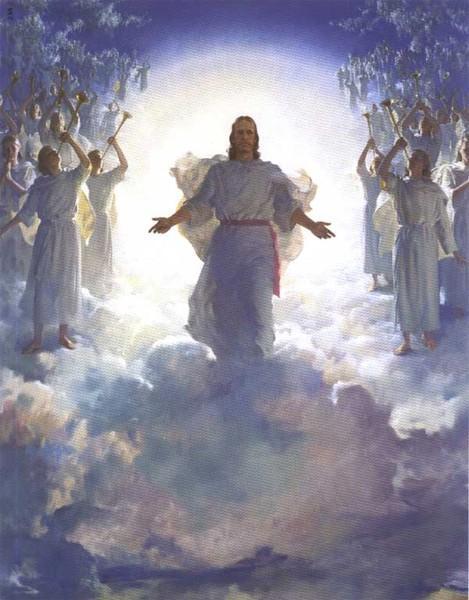
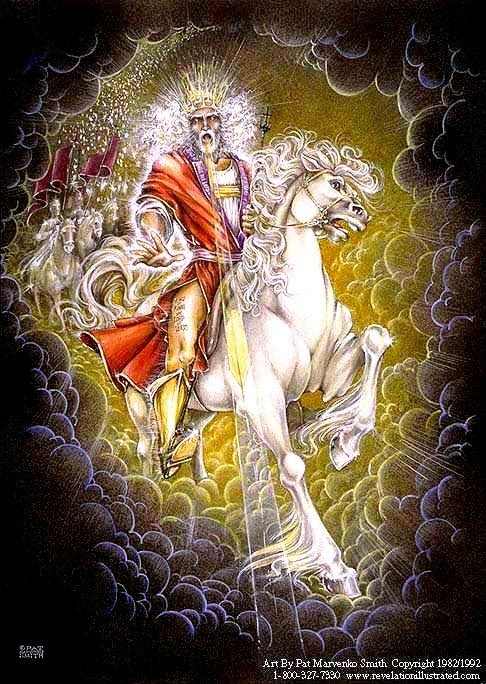
So what do we have here: clouds, flames, and signs with the Son of Man manifesting in the midst of it all. Artists have rendered this idea/image as either the Bible School Jesus all in white, robes flowing, or some kind of King image, all in gold, often times on a horse, and full of majesty (whatever that means). In either case, he is recognizable. Me? I don’t think so. I don’t think we’ll understand the Second Coming any more than we understand the ways of nature. We may be able to describe its properties, but not its essence.

Some people talk about the Second Coming of Christ as their chance to say to unbelievers, “See, I told you so,” “I warned you!” They act as though they wouldn’t be in the same shock and terror and wonder! Face it. How many times do things appear out of nowhere in the sky? I have to laugh as I consider whether all the spaceship movies are getting us ready for that appearance.

Of course, not everyone believes this can even happen. I remember standing at a bus stop every day to wait for the public bus that would carry me to high school (this is pre-school buses in Indianapolis). On the corner was a church of some type or another and on their sign, it always said, “Jesus is coming soon!” From my limited understanding of Christianity in those years, I thought they were really stupid. How could Jesus come again if he had already come. This was a teaching I never got (or understood) in Vacation Bible School or the more formal Latvian Lutheran church services. I don’t think I was alone.

A Second Coming is not something which we can prepare for in any way. When Harold Camping touted his May 21st forecast of judgment day (now pushed back to October 21st), he made it sound like people could actually do something in time for that day. That’s not the purpose of Christ’s coming. It’s the end of the age. Whatever happens next will be new, different, not recognizable. It may mean death or it may mean transformation. It’s a nexus moment. When the Christ comes, and if indeed, it’s “in the sky,” then the universe has changed dramatically. Both things cannot co-exist and be the same as before.

And why do the scriptures say that people will mourn? Is it because they didn’t believe or is it the loss of what we know. Our children and our children’s children will not know life as we know it. Everything must change. Everything will change. And if we don’t like change now, “Baby, you ain’t seen nothin’ yet.”

Read Full Post »

Art by Catherine Andrews

The implication then is this: if the Christ appeared in a more perfect tabernacle not of “this” creation, there must be other creations. Hmm. The psalmists write, Selah, “pause and calmly think of that.”

Hebrews 9:11
But [that appointed time came] when Christ (the Messiah) appeared as a High Priest of the better things that have come and are to come. [Then] through the greater and more perfect tabernacle not made with [human] hands, that is, not a part of this material creation . . .
[Amplified]

Are there other clear references to another creation? I mean, it isn’t necessarily heaven designated in this passage from Hebrews, it could be anywhere. It seems a bit “woohoo” and “new agey,” right? In fact, I find it totally other-worldly, Star Trekian, multi-dimensional, and clearly, we’re “not in Kansas anymore.” We’re outside our human understanding. We don’t know about this other creation(s).

I understand, some commentators still believe the “perfect tabernacle” is in heaven because the human tabernacle was intended to mirror or replicate some heavenly place. But I think that’s simplifying the Spirit realm of God. It’s anthropomorphizing what we don’t understand and trying to put it into human terms.

It’s a similar situation with all the prophets who were given extraordinary visions of things outside their ken such as animals covered with eyes and wings in Revelation or Ezekial’s animals with four faces.

When my children were little, my husband and I liked to have fun with the various holiday characters such as Santa Claus, the Easter Bunny, etc. We always told them these characters existed in a different dimension. As the kids got older and realized how unbelievable it was that Santa could fly across the world in a single night and deposit gifts in each and every house, we reiterated: different dimension–anything can happen. Of course, our story is not as creative as C. S. Lewis and his world of Narnia, but ultimately, we share the same idea, once anyone goes through a “portal,” things are very different “there” (wherever there is).

The world and words of the Spirit realm are best depicted through the arts I think. Music, visual art, performance art, dance, film, scent, poetry: these are some of the better expressions of God’s kingdom or sphere or neighborhood.

What the Messiah did for Human is not really fathomable in our limited cosmos. One sacrifice for all? One outpouring of blood covers all sins from the beginning to the end of time? Perfection in human form? Covenants, promises, reconciliation, restoration, renewal, all of these possible by the act of one offering? Absurd, right?

Nope. It’s the link between our creation and all the other ones. The ultimate portal. Not science fiction or fantasy, but God business. And the stuff of dreams, imagination, love, resurrection, and transfiguration.

Read Full Post »

« Newer Posts - Older Posts »