Feeds:
Posts
Comments

Posts Tagged ‘Jesus’

Here’s the little truth that came to me through this verse about doubt: no one forces us to pray, there is no mandate, we pray by choice. And if that is so, why pray if we don’t believe God hears, receives, responds?

James 1:6-7
But when you ask, you must believe and not doubt, because the one who doubts is like a wave of the sea, blown and tossed by the wind. That person should not expect to receive anything from the Lord.

We are living today, the result of our prayers of faith. Whoa! you say, but honestly, could it be any other way? Did you pray? Didn’t I? Or, am I living the life of a doubtful prayer?

I don’t think it’s a bad thing to question things we hear or read; it’s reasonable to challenge ideas that don’t line up with our understanding. Without questions, we cannot learn and grow. Without examination, we become dull and follow blindly, sometimes to our own detriment.

But prayer is different because it’s personal. If I choose to pray, to engage with the Holy Spirit, to enter into the realm outside of time and space, then I should do this with the force of conviction that prayer is real, meaningful, and effective.

I think I have been expecting the Christ to cherry-pick through my requests: this one is valid, this one makes sense, this one isn’t a good idea, this one is beyond reason and so forth.

The important factor here is giving up my interpretation of the results as well as my time table. This is essential reasoning behind the classic phrase, “give thanks for all things” [I Thessalonians 5:18] because whatever is happening in the now is part of the answer of a prayer. I’m speaking in broad strokes now. I understand how devastating that would be in the face of a horrible illness, loss of life, or unexpected tragedy. How could these things be part of an answered prayer? I don’t know. It simply could be that one thing had to happen before something else could.

But let me go back to the start of this idea, the moment of prayer and the decision to ask. I saw it so clearly in my quiet time. (And yet I don’t pretend to know all the ins and outs of the meaning.) Yesterday, I had an epiphany about wisdom being part of a daily dose, through prayer. This is a given. I ask, God gives: wisdom for the day. As a result, I can choose better, understand better, and answer better.

But wisdom is not alone in this package, as a brother articulated, much of these requests lie within a prayer we say all the time: the Lord’s prayer. We have simply lost its depth of power and meaning through familiarity.

And what about those people we have held up in the light of prayer? Isn’t God moving and working there? Is God waiting for a finite number of prayers before moving? I don’t think so. We just can’t see the results so we doubt. It’s a human soul with free will. God will not run hilter skilter over that person’s own choices and desires. As my pastor said in services, “God is working both ends of every situation.” And I would add, God is working the middle too.

For me, the point of this discovery is to pray with care, with consciousness, with confidence [Hebrews 10:19-23], with intention. If I doubt God’s ability to move in a situation, then I should save those prayers for another day.

Read Full Post »

All executions were performed outside the city walls. Anything that was unclean or tainted was destroyed or thrown away there. Jesus broke up a lot of traditions, but the greatest one was starting something holy in an unholy place.

Hebrews 13:12-13
And so Jesus also suffered outside the city gate to make the people holy through his own blood. Let us, then, go to him outside the camp, bearing the disgrace he bore.

Two thousand years ago, the followers of Christ were considered unclean, much like lepers. They were law breakers and rule breakers. They were teaching others that the temple traditions were no longer necessary. They were breaking down societal structures. They all deserved to be cast away and thrown out from the protection of the city gates. This was the mindset of Paul of Tarsus and the crusade of his companions to obliterate the Christ-ians.

Now, some two thousand years, the tables have turned, and the very same believers in that former renegade, Jesus of Nazareth, are the ones who inhabit the “city” and have created their own order and culture of “righteousness.” It seems that anyone who might question or disagree with the current regime is cast outside the camp.

They are a new set of Pharisees who are putting people under microscopes before they are allowed inside.

But I believe Jesus is still outside the city. Jesus is still rubbing shoulders with the prostitutes and homeless, the poor and the outcasts, the disenfranchised and the orphans, the persecuted and the different, the prisoners and the ex-prisoners. The way of Jesus will always be the way of paradox. When we become to comfortable, we may have strayed onto the wide road [Matthew 7:13-14].

I am equally challenged here. I may go outside the “camp” for a visit, but every night I still run home to my comfortable bed and my air conditioning, my habits and my rituals.

I am yet afraid outside my “personal city” walls. I am afraid that I will be lost, that I will be hurt, that I will be shut out.

Read Full Post »

Kingdom Within by Raymond Andrews

Jesus speaks innumerable times about the kingdom of God, what it’s like, where it is, and what it means to His followers. But it is in Hebrews where we are reminded that this is an unshakeable (indestructible) kingdom: eternal and purified by fire (and blood).

Hebrews 12:28-29
Therefore, since we are receiving a kingdom that cannot be shaken, let us be thankful, and so worship God acceptably with reverence and awe, for our “God is a consuming fire.”

Over the past few years, as I have methodically read through the New Testament and looked for personal applications, I have become more and more secure in my belief that this kingdom of God is not of the 3-D world we can see and touch but it is in that “other” reality – that place within, that place outside our senses, that place of Holy Spirit, that place that defies logic and that place which was opened to humankind through the mediation of the Christ/Messiah whose act of sacrifice tore the veil asunder [Matthew 27:51].

I try to imagine the power and glory that was on Mount Sinai, where the Israelites fled from Egypt and stood to hear from their God, what they should do next. And from there, they wandered the desert, carrying the “glory of God” with them in the Ark of the Covenant. And finally, with King David and his son, Solomon, the great temple was built in Jerusalem and the ark was given a final resting place in the Holy of Holies [II Chronicles 7:1], where only the high priest could enter once a year. This is all symbolic and intentional.

Now, the Messiah comes, the veil is torn, the ark is opened and all of this glory is placed within the kingdom and we are invited to participate in it through the Christ.

Is this not worthy of awe and reverence?

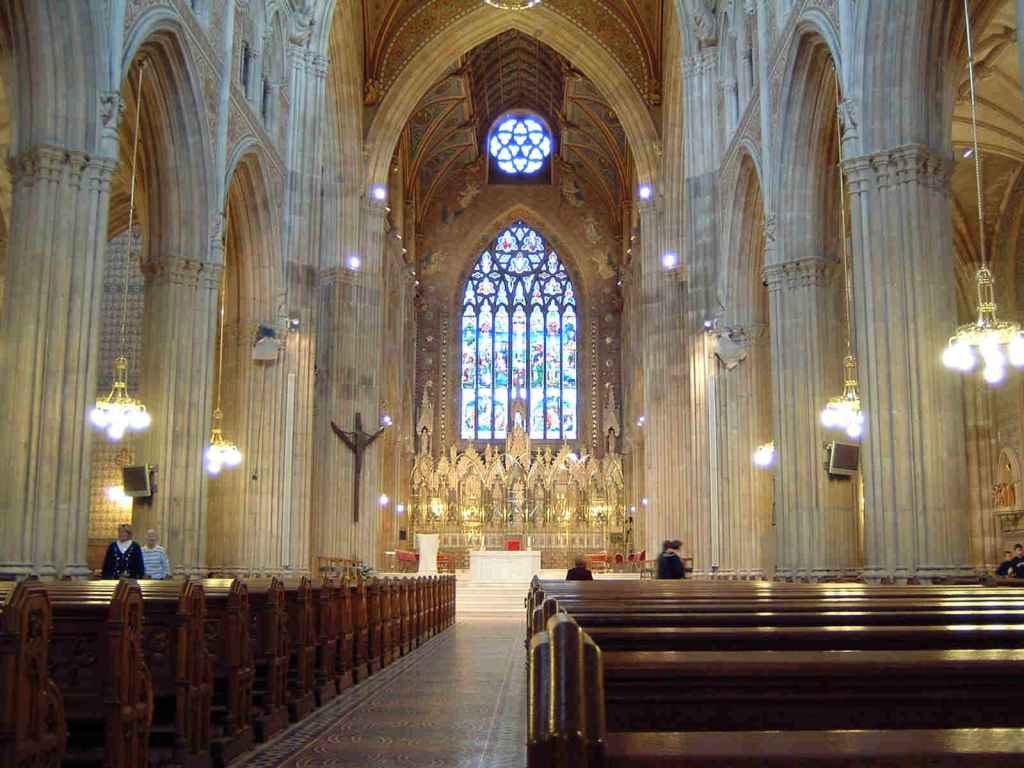
Despite all the horrendous things the Church may have done throughout the centuries, the cathedrals they built to immortalize our King make sense. I know they were not built in a righteous way, the poor were taxed and unholy deals were made with the rich, but there is a breath of God that remains in these places even today.

Whenever I visit a city that has a cathedral, I want to go. I want to walk through and sit and be silent there. I am awed in these places.

Of course, there are nature locations that give the same feeling: water falls, canyons, hot springs, lakes, oceans, forests, mountains… just to name a few.

As much as I enjoy contemporary Christian worship, there is a part of me that misses the wonder, the intense quiet, and the Holy Presence that permeates high church worship.

If I could describe that kingdom within me (which is impossible) but perhaps, just a color, a shape, a smell, a sound: what would it be? I don’t know. I just don’t really know.

Read Full Post »

I have already written about seeing the invisible as well as the Invisible God. Hebrews 12 prescribes another piece of the process: Holiness.

Hebrews 12:14
Make every effort to live in peace with everyone and to be holy; without holiness no one will see the Lord.

I think it’s a little like being color blind. The closer I come to holiness, the more expansive my color wheel, my prism. When my eyes are clouded by 3-D things, problem mentality, and “what about me?” syndrome, I’m putting myself into a black and white world.

The movie Pleasantville, or even the Wizard of Oz, dramatically captured this difference. Colors look more vivid when they are juxtaposed against shades of gray. Don’t get me wrong, artistically, I love black and white, whether its movies or photographs, but I am talking about a different kind of non-color here. I’m referring to a non-holy world that is flat with unrelenting sameness.

To see God through the lens of holiness, we are promised the universe and that is hinted at through the glory. In American Sign Language, the gesture for holiness is a large arch over the head with the fingers fluttering.

But of course, the real challenge is entering the holy place. I’d say there is a type of nakedness this is a prerequisite for entry, not just the shedding of our outer layer of clothing, but also the skin of expectations and labels and the outer muscles of self-determination. We started walking away from the holy place the first time we said, “No, I want to do it myself.”

I cannot touch the holy because it’s not here in this world.

Holiness is wholeness (completeness, synchronization, transparency); it’s the paradox of loving those who should not be loved, living from inside out, choosing peace over violence, forgiving the unforgivable, mirroring Jesus, and echoing the Holy Spirit.

Wholeness is also brokenness. What is broken? the hard heart, the frozen spirit, the rigid memory, the fear of death.

Holy seeing is not for the faint-hearted. It takes courage and imagination to see what we do not recognize, to see and not identify, to see and embrace.

Read Full Post »

Grace is everything. If I could only grasp the full power of grace every day, nothing could cause lasting harm. Grace diffuses anger, despair, disappointments and resentments which all fuel bitterness. And bitterness hurts everyone.

Hebrews 12:15
Exercise foresight and be on the watch to look [after one another], to see that no one falls back from and fails to secure God’s grace (His unmerited favor and spiritual blessing), in order that no root of resentment (rancor, bitterness, or hatred) shoots forth and causes trouble and bitter torment, and the many become contaminated and defiled by it.
[Amplified]

For some years I worked with the Elijah House ministries; I read many of the John and Paula Sandford books, I participated in the Basic School which taught the essentials of prayer for healing and how to recognize and address bitter root judgments. I met with my own counselor for several years.

So many early bitter roots are like persistent weeds in the garden that grow very deeply in the soil. They cannot be merely cut at ground level, they must be pulled out, otherwise, they will tend to grow back, sometimes larger, stronger, and even deeper than before.

Hurtful instances in our past act in the same way and can derail a life. My own life was on a treadmill of resentments about situations that were mostly outside my direct control: my father’s alcoholism and death when I was a child, my mother’s mental illness, our relative poverty, my brilliant brother, just to name a few. I had an internal tirade always playing in my head: why these parents, why this family, why this city, why this school, why this husband, and why this body. And the follow up to “why” became “if only” — if only I had more money, if only I had a different family, etc. The litany was endless. And each verse dug my roots in deeper and deeper.

When I began the healing process of allowing the Spirit to weed my garden heart, I thought I would explode into a million pieces. I had held on to those issues for so long that I didn’t know who I would be without them.

Although I was able to release many of my old hurts and habits, I recognize now that a life picks up other hurts along the way. Not all bitter roots come from childhood or even teen years, they can find yummy soil ten years ago or five or even yesterday. How deeply they are planted and how much I water my bitter roots will determine how easily they can be removed.

This is where grace comes in, through the love and power of the Holy Spirit, the work of the Messiah, and the intention of God to make all things well.

Read Full Post »

Cloud of Witnesses by Jean Moore

Is it really Abraham and Isaac and Jacob? What about the disciples or maybe a few of the women who managed to get their names in the book? Or what about all the unnamed saints? Is it one cloud for all of us? Maybe they’re color coordinated.

Hebrews 12:1
Therefore, since we are surrounded by such a great cloud of witnesses, let us throw off everything that hinders and the sin that so easily entangles, and let us run with perseverance the race marked out for us.

Honestly, there are a lot of dead souls between the Old or New Testament times and now. Who are these people? And what do they see?

I would assume that most traditional Christians believe these cloud formations are all the folks in heaven, especially the long-gone relatives and extended family who are cheering them on. Big family: big cloud.

But I’m not from a big family nor have I done much in the genealogy department to scout out family members I never knew I had. I suppose the cloud could be my “church” family but then, let’s be honest, do I believe they would keep checking on me if I’m not connected to that “building” where they met me in the first place?

I know I’m being flip, but I want to challenge the concept in my own head. What have I speculated over the years? I’ve read this scripture hundreds of times. It always sounded nice, the uncountable numbers celebrating when a “lost one is found” like the lost coin of the old wife [Luke 15:8-10] or the shepherd who searched until he found his lost sheep [Luke 15:4-6].

But I’m not lost (at least I hope I’m not). Instead, I’ve been treading Christian waters for thirty years: is the cloud still around? Are they applauding or are they waiting for me to get on with it? Is the cloud “individual” or corporate (like the “hive mind” of the Borg in Star Trek)?

Or is it time to let go of the literal image and consider the essence of this verse?

Didn’t Solomon capture it: “What has been will be again, what has been done will be done again; there is nothing new under the sun.” [Ecclesiastes 1:9] Our cloud of witnesses faced similar challenges to the ones we face today: they grieved and laughed, they grew families and lost them, they saw success and failure, they laughed and cried. Life goes on. They did it, we can do it. They lived by faith, we can live by faith. They trusted God, we can trust God.

It’s a cloud of love, a cloud of hope, a cloud of humanity that made it through and learned the deep lessons. They are part of the realm that the Holy Spirit embodies. And just as we have access to the Holy Spirit; through that same Holy Spirit, we have access to the cloud who lived and live still outside our understanding.

So, I thank you “cloud of witnesses” and I thank you Holy Spirit. Keep me running and mindful of your presence. Keep me in the race.

Read Full Post »

Paradox or miracle? How can anyone see the invisible? I looked it up: not perceptible by the eye. But of course, we’re not talking about the eyes, are we? It’s about “seeing” differently — probably the key to everything.

Hebrews 11:27
By faith he [Moses] left Egypt, not fearing the king’s anger; he persevered because he saw him who is invisible.

This kind of seeing is somewhere between the understanding that comes with “oh, I see!” to envisioning what is unknown. It takes both imagination and understanding to embrace the faith of a true Messiah, to relate with God, to engage outside the 3-D matrix in which we tend to live mindlessly.

In Hebrews 11, the author is reviewing a long litany of men (mostly) and women who stood out in history as people of faith. A short “typifying” moment or two is written about each one. For Moses, it meant going upstream (like most people of faith), but the costs were huge. Think about it: Moses lived in the household of one of the most powerful men of the known world. And long before Moses’s “burning bush” epiphany, he walked away from Pharaoh’s house to follow what he saw in the Invisible.

I wouldn’t say he used the best way of “walking away.” He operated as so many young people do when they are caught by the wonder of a sovereign God. They are bulls in a china shop, causing residual damage as they plow through their world to get through the door. For Moses, it was killing a man; for a friend of mine, it was becoming a missionary, determined to live by faith financially, along with a wife and three young children who were not in step with him: the family broke.

To see, feel, hear, smell or taste the invisible is mind-altering. I have had such glimpses, only a few, and they were exhilarating. It was easier when I was younger. But now, no matter how close I get to the invisible, my 3-D responsibilities pull me back. My feet are quite entrenched in the pragmatic. I am like an amusement ride that swings back and forth, my equilibrium challenged continually.

I believe we are called to engage in a harmony of both of these worlds: the visible and the invisible. Like the energy that flows within the body, there is energy that flows between us and others, us and things, us and nature. This is Holy Spirit teaching working within but also without.

Balance me out today Lord. Keep me mindful of your presence. Open my eyes to see the invisible.

Read Full Post »

« Newer Posts - Older Posts »