Feeds:
Posts
Comments

Posts Tagged ‘love’

another-way“This is what the Lord says—he who made a way through the sea, a path through the mighty waters, who drew out the chariots and horses, the army and reinforcements together, and they lay there, never to rise again, extinguished, snuffed out like a wick . . . “ [Isaiah 43:16-17.

Whether you believe or not that God actually divided the Red Sea to allow the Israelites to walk through unharmed while destroying the Egyptian army that followed after them [Exodus 14], there is a message here for all of us.

It is God who makes the way in the midst of trials or darkness. It may not be the path we want to take; it may not be the most obvious path; it may feel dangerous. But God’s way is still the best way.

Of course, we can always argue with God if we disagree with the direction. But then, there are repercussions, a chain reaction if you will, when we choose another way. And, for a season, circumstances may seem dire. It’s important to see the situation for what it is. Change cannot happen without truth.

I wish I could figure these things out while they are happening instead of in hindsight. I look back, and say, “Oh, you meant for me to go that way!” Like Homer Simpson: “Doh!”

You see, because I am so friggin’ capable, I am quick to analyze the paths ahead and I often take the one that seems best to me (not necessarily best FOR me). And as I’m going along, I suddenly get this feeling,  this overwhelming sense that I have blown it, again. It is in this moment of recognition that I must stay for a season. In order to see clearly, I must live in it (not deny it). And then, God shows up. More than likely, I will never find my way back to the original way God intended, but another way is revealed. God is full of back doors. And I am grateful.

So, I just want to encourage others: even when we blow it, God doesn’t give up on us. There is no mistake or sin that God cannot rectify or redeem. I believe this wholeheartedly. I have to. Otherwise, life would indeed overwhelm me.

Read Full Post »

Fasting

soul connectionIs not this the kind of fasting I have chosen: to loose the chains of injustice and untie the cords of the yoke, to set the oppressed free and break every yoke? [Isaiah 58:6]

Fasting has been narrowed in recent years to being about the food and beverage consumption: no lunch or no sugar or no alcohol or no carbs (oops, that’s a diet option). And that’s the problem, we live in a dieting world where the giving up of one element or another is this short term option that will give us some relatively immediate results. But I am pretty sure that fasting for God is a different mindset. It’s not even intended that this “giving up” be over the long haul. Not really.

Just because Jesus fasted for forty days doesn’t mean we need to fast from food and drink for the same amount of time. Besides, unless we have the the other disciplines going hand in hand with the fasting, it will be a futile effort. Fasting, in and of itself, is not the point.

It’s the change-up. It’s doing life differently. It’s making room for something else. It’s intentionally making a sacrifice in order to intentionally choose time and energy for God.

I remember trying to explain this process to my kids when they were younger and it never really quite took hold. Generally, they concentrated on those food items they could tolerate being without: ice cream, soda, desserts, pizza (well, no, I don’t think they ever did give up eating pizza for Lent or any other time).

This year, I am tossing in a few sacrificial lambs like sodas and lattes and even Words with Friends, but my sense of them is different. These acts feel inconsequential in the face of what I want this time to be about: a centering inside time, a time to know prayer in a deeper way, an unearthing of my soul from the tangles of my busy life (this is my yoke referenced in Isaiah). Can I slow down enough to do it? Can I open the clock for meditation and silence?

When Jesus met the woman at the well, his disciples were out getting carry out. When they got back, they offered him his share but he didn’t need it. He was full from the discourse and connection of two souls.

Read Full Post »

Art by Luba Lukova

Art by Luba Lukova

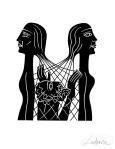
Rachel and Leah, coming from a culture in which the role of women was clearly defined, needed children to show their worth. It was their children that gave them place in their small world. And yet, Leah wanted that one other thing, that intangible thing called love.

Genesis 30:19-20
Leah conceived again and bore Jacob a sixth son. Then Leah said, “God has presented me with a precious gift. This time my husband will treat me with honor, because I have borne him six sons.”

Leah’s resources were few: she was not the beauty like her sister, she was the oldest and she was married by her father’s trickery. She was, if anything, an embarrassment. She had already born four sons and still, her husband favored Rachel. How could that be? Rachel was barren and yet Jacob loved her.

When Leah’s womb stopped bearing children, she must have been devastated. More than likely, Jacob limited his time wither her sexually as well. She had been more of a production machine. He appreciated the growth in his family and community, no doubt, but not for love. Even when the sisters gave him their maidservants, these arrangements were all about fruitfulness, not love. Jacob had been entranced by Rachel from the beginning. He was fixed on her and nothing Leah could do to change that. And yet she kept trying.

Leah is like so many young women today who mold themselves by the reflection they see in the eyes of men. Women often go to great extremes to create a picture of beauty they imagine men want to see. They craft their public personas to be appealing. They read magazines and books, take surveys and spend great amounts of money on surface improvements, to attract the male. Women do all they can to appear younger as long as possible since society has nurtured the idea that older women are no longer sexy or appealing. In the eyes of many men, women have two stages: young and seductive or motherly and caregiving.

How often are marriages destroyed by a man’s lust for someone younger, suppler, and carefree?

But I say only this. We cannot make any of them love us.

God commands us to love unconditionally. There is no promise of reciprocity. There is no promise of reward.

Some claim that it is most difficult to love our enemies. But I say, it is most difficult to love someone who has stopped loving us.

In this place, resentments are always at the edges of every conversation; disappointment waves like a flag for attention; togetherness feels like aloneness.

Love is patient, love is kind. It does not envy, it does not boast, it is not proud.It does not dishonor others, it is not self-seeking, it is not easily angered, it keeps no record of wrongs. Love does not delight in evil but rejoices with the truth. It always protects, always trusts, always hopes, always perseveres.Love never fails. [I Corinthians 13:4-8a]

God loved me in this way. God loved me before I loved back. God would not “make me” love. God loved. And over time, consistency and faithfulness won. Only, through the indwelling power of the Holy Spirit, can I love in this way. Only the Christ within can love like that.

Read Full Post »

orphan babyI can certainly relate to little Prissy in Gone with the Wind who says, “”I don’t know nothin’ ’bout birthin’ babies!” I don’t either, not really. Having built our family through adoption, this aspect of womanhood has eluded me. And yet I know, there is potential for great mystery and anguish; joy and sorrow.

Genesis 29:31, 33a, 34a, 35a
When the Lord saw that Leah was not loved, he enabled her to conceive, but Rachel remained childless. . . . She [Leah] conceived again . . . Again she conceived . . . She conceived again . . .

In the example of Rachel and Leah, it is the unlovely and cast-off sister whose womb is opened from the beginning and she bears four boys in a row while her sister remains barren. Each child’s name is a message to Jacob (who isn’t listening):

  • Reuben could be translated to mean, “see my misery” or “see, a son!” (as in look, pay attention)
  • Simeon means “one who hears” referring to God who heard her prayers, perhaps Jacob would too?
  • Levi could be translated to mean “attached,” in a way that Leah had hoped Jacob would finally attach to her as the mother of his sons.
  • Judah could be translated as “praise” which appears to be her final understanding, that children are about God, not man.

I discovered, after many years of tears, that my inability to bear children had to be accepted as a reality before reality could change. Once I could thank God for who I was and our circumstances, we could move on to adoption and discover the family God intended.

You would think, after the debacle of Sarah and Hagar (surely that story was told through the generations), the women would know that God’s timing was God’s alone and could not niggled with. But they did not. One sister thought the births would change Jacob’s heart and he would finally “love” her while the other wife resented her sister’s fruitfulness. But nothing good comes from resentment or jealousy or envy. . . ever.

Women have not learned much through the ages, I’m afraid. There are still women who intentionally invite pregnancy as a solution to  their problems (perhaps that boyfriend will marry her or that husband will stay closer to home). There are women who see pregnancy as a curse and continually interrupt that cycle through abortion and morning after pills. There are women who have babies without thought to the impact of that child on their finances and futures; there are women who bring children into the world in hopes the grown child will for the mother in her old age. And now, there are even surrogate mothers, who carry a child for someone else or women who defy nature somewhat by artificially inseminating a child or taking hormones to increase their chances of birth and unwittingly produce litters of babies.

I am not casting judgment, not really, but it’s all a bit out of hand. Just as there are pets languishing in shelters, there are unwanted children in foster care and orphanages all over the world.

They are the responsibility of us all.

Yesterday, the Russian government, once again (for this is not the first time) has placed into law a ban on Americans adopting Russian children. This was a strictly political move and shows little concern for the children themselves. When we adopted our daughter from St. Petersburg in 2006, her orphanage alone had over 150 children and it is only one of thousands of orphanages in the country. In the United States, in 2011, there were over 401,000 children in foster care, many of whom could be adopted.

Babies are amazing, no doubt. Making babies can be an act of true love. But we must remember, there is a future to every child born that must be embraced by all of society, no matter their color or race, their health or disability. A child born is part of the family of God.

Read Full Post »

RebekahAbraham is old, really old, and decides to once again, take matters into his hands to find a wife for Isaac, who must be around forty by then. Abraham sends his highest ranking servant (unnamed throughout the story) to the land of his ancestors to find a wife. The servant puts out a kind of “fleece” to determine which maiden is the one. Rebekah, daughter of Bethuel, passes the test. And off she rides, maids & nurse in tow.

Genesis 24:67
Isaac brought her into the tent of his mother Sarah, and he married Rebekah. So she became his wife, and he loved her; and Isaac was comforted after his mother’s death.

I’m sure there are a number of wedding rituals that were still in place even in those times but unfortunately, these are not shared through this story. Rebekah agrees to travel right away (which smacks of “get me out of this family,” an escape route that many young women take) and takes on the adventure of a lifetime.

Rebekah is going to an unknown land just like Abraham did those many years earlier. She only has the promise from a servant, an array of fine gifts and gold, and the hope of a future. She had tremendous courage, I think, as well as curiosity. Rebekah embraced change.

I wish I knew more of what must have happened within the summary text, “Isaac brought her into the tent of his mother.” Was there a ceremony? Or was it merely a matter of having relations with the woman to secure their marriage bond? Is there significance to it being his mother’s tent, or did that simply signify the tent for women? Was it a harem like situation where all the women of the household lived together?

And more interesting still is that Rebekah became the woman who brought comfort to Isaac at the loss of his mother. I cannot help but think that Isaac was estranged from his father Abraham after the great testing on the mountain. At least, I don’t believe they were close. Instead, Isaac gave his heart to his mother. And when she passed, he felt alone and engaged in the building of his own herds and belongings. And although he did not take a wife, I’m pretty sure he was no “40 year old virgin.” There were slaves and concubines undoubtedly and maybe even children, but these would not inherit the promises of God. They were of such insignificance, they are not named or identified. Even Rebekah came from some wealth, since she traveled with her own entourage of nurse and maids.

And so it is, that the progression of God’s plan for building a nation is finally moving again. The entire process had stopped at Isaac’s apparent reluctance to take a wife.

But once Rebekah arrives, he accepts her, he marries her, and more importantly, he loves her. This love statement could have been excluded but it is here for a reason. At this point in the story, Isaac loves, that is, he cares about his new wife more than himself. He is sensitized to her needs and her desires. He wants to please her. He wants to nurture her. He wants her to thrive and be happy. He loves her.

How often does the story begin this way? My story did too. What happens? How do we lose that adventure and love? Did God change his mind? It was a match made in heaven. So was mine. How do we lose sight of God’s gift to one another? Why do so many life events cool our ardor, our belief, our joy?

Read Full Post »

ancient tomb    The whole point of buying the field and the cave from Ephron was to avoid burying Sarah on or in foreign soil. Once purchased, the land became an oasis of Abrahamic land, a place and purchase that took him and his household out of “stranger” status (vs. 4). And although he might continue to lead a somewhat nomadic life, this place would root him to that area by the very same laws of the Canaanites. It was a serious transaction.

Genesis 23:12-13Again Abraham bowed down before the people of the landand he said to Ephron in their hearing, “Listen to me, if you will. I will pay the price of the field. Accept it from me so I can bury my dead there.”

Austrian Cemetery

Austrian Cemetery

I am sure other people in Abraham’s household had died in the thirty-plus years that had lived, worked, and traveled the Negev desert. But, when his own Sarah died, she was almost royalty to those who lived in that time period. Abraham was considered a “prince” because of his great wealth and tribe and herds. To stop and lay down his wife in that place was huge to his household as well as the Canaanites. What Abraham created here was the family burial ground. This would be sacred ground from that time forward and their direct descendants would be expected to be buried there.

german-cemetary

German Cemetary

In modern times, we have lost some of this respect for the burial ground. In Ancient Israel, burning of the body was forbidden (this form of burial was considered to be a punishment for idols and enemies. I am not saying we should not do this in our world, but I do think it’s interesting, this difference in cultural norms.

But in the United States, even those who are buried are not respected. While in many German and Eastern European cemeteries, it is the family joy and obligation to care for the family burial plot, to beautify it, to make it a place one would desire to go and spend time. They are like a series of mini-parks, each plotted area touched by the uniqueness of the family. The burial ground is part of the cycle of life and death. But not here.

New York cemetery

New York Cemetery

In our world, we have relegated the dead to sweeping greens where  paid workers run lawn mowers and weed whackers. In some cases, we we might see  long-lasting plastic flowers jammed into the ground or perhaps an artificial wreath. What is the point? Who is blessed by these? Neither the dead or the living.

Polish cemetery

Polish Cemetary

In my life, I have no burial grounds anywhere. My mother cremated my father and requested the same for herself. They now share an urn which I have in my possession and although it has a small shelf with pictures, I do not think about them much anymore. There are stories that erupt every now and again, but there is no sense of place for them. My husband has asked to be donated to science and then, as far as he is concerned, the body can be cremated and disposed of, like a family pet whose ashes were not saved. For him, it is the soul that continues and has no need for the corporeal flesh. He is probably right.

But I keep thinking about this idea of a selected place, different from today’s norEarthm, but more like ancient times, a place for family to extend itself in memory. Sometimes I think the Japanese and other orientals have it right, their nurture of the ancestors.

And yet, I know, Jesus left the tomb. He was not buried with his family. There was not talk of transferring the body after the Sabbath. Joseph of Arimathea embraced Jesus as family by giving him space in that tomb. Jesus left it and in essence, his departure also said that no single place could embody him. He was of the entire Earth.

Read Full Post »

Photo of Beersheba by Leon Mauldin

Photo of Beersheba by Leon Mauldin

The making of oaths and treaties in ancient times was far more serious than it is today. When anyone swore an oath and broke it, the penalty was severe, even death. I cannot help but wonder how different our world would be if promises and vows had more significance. Not unlike Bonhoeffer’s “cheap grace,” we now have vows made with fingers crossed behind our backs.

Genesis 21:30-31
He replied, “Accept these seven lambs from my hand as a witness that I dug this well.” So that place was called Beersheba,because the two men swore an oath there.

Lack of trust is at pandemic proportions, the real core to our inability to make a vow or promise and keep it. We have all been betrayed so many times, we do not believe the word of others. Either we need lots of evidence or the cost for breaking trust must be so high that everyone is put in a fear position to uphold the agreement (hence, the Cold War).

Of course, those fear-based promises usually have loopholes and everyone is busy trying to find them.

Marriages have become the thing of mistrust and loopholes as well. I find it amusing, the angst over same-sex unions, while cheating, divorce, and secret lusts rage in society. How often are the ones who rail against the sins of others, forget their own?

A covenant is a binding oath, a promise that cannot be broken. An agreement with God, the acceptance of Christ as the Messiah, is on that level.

I forget this sometimes. I dishonor the agreement. I don’t hold up my end of the bargain, the treaty, the contract. In a secular world, if I broke a contract the number of times I have broken covenant with the Christ, I would be sued or forced to pay large sums of money or put in jail. But my contract, thanks be to God, is with Grace. And I get more chances to make it right.

I give “lip service” to my trust in God, but I’m afraid I don’t build my foundation on it. I am swayed and battered by the storms of life and I lose sight of trust I promised to have in God. I know intellectually that God is faithful and trustworthy, but still I stumble.

Sensitize me to Your Presence today Lord and give me courage to speak trust in the face of all circumstances. Help me build a Beersheba today, to remember my promise.

Read Full Post »

« Newer Posts - Older Posts »