Feeds:
Posts
Comments

Posts Tagged ‘sovereignty’

Can I say it? Can I look at my yesterdays, my now, and my tomorrow and say, “Hallelujah!” Can I speak it for my family, both here in the U.S. and elsewhere? Am I at peace with my life and my God? Am I convinced? Or, is there still a part of me a little disappointed, a tad resentful, a bit unyielding? Am I kicking at the goads of seeming unfairness?

Revelation 19:1b-2a
Hallelujah!
Salvation and glory and power belong to our God,for true and just are his judgments.

I have been traveling for the last three weeks. It has been a glorious adventure that included several parts of Estonia, Latvia, and Germany. I was re-connecting with my extended family, the ones who, until 1991, were behind the barriers of the “iron curtain”, cement walls, and miles of barbed wire. It’s hard to believe that was twenty years ago. And yet, the remnants of that desolate time remain, both in the buildings and the hearts of the people, despite the outward signs of robustness: copious McDonalds, modern shopping centers, grocery stores, and, of course, tourists.

Somehow, we all arrive at today. Whether the march went through struggles caused by the power of governments and dictators or the addictions and violence within our immediate circle. Human continues. Often, the way is unclear until we can get a birds eye view, the hindsight look, the review of the paths that led to now in order to see the patterns of God’s making.

It could have been me. Only by the constant movement of my parents’ displaced persons camp did they end up in the American sector of Germany and that, coupled with the stubbornness of my mother who believed they could emigrate to somewhere, anywhere, but there. She would never speak of the divine during those years. But I know, serendipity is Spirit led. Chance is channeled.

God is sovereign.

For me, it has been one kind of a journey and for my family, another. For my adopted children, yet another. Each life is amalgamated by the choices and circumstances of “before.”

Justice and truth don’t necessarily manifest on my time table. This is the mystery. And so, it is faith that sustains us until they do. It is faith that believes evil will not overpower good. Not forever.

And for this reason, I must continue to say, “Hallelujah! Glory belongs to God, who is just and true and avenges the blood of his servants, the losses of the poor, and the sorrows of the fragile.”

Read Full Post »

I am not poor. Of course, I’m working on it, what with spiraling debt and fruitless planning. But, in the greater scheme of things and the world at large, I am quite flush and comfortable. So, who am I speak about the promises of God for the poor?

Psalm 69:30, 32
I will praise God’s name in song and glorify him with thanksgiving. . . . The poor will see and be glad — you who seek God, may your hearts live!

And yet, promises and precedents do exist.

In the time of Christ, the poor saw Him first and recognized God in Him. The poor followed. The poor believed. The poor sustained the faith. And the rich worried.

But God’s empowerment is not a change of social status. In all the acts that Jesus did for the poor, he never made anyone richer. He healed, he fed, he taught. He gave hope where no hope had been. He gave strength to the weak. He spoke to the wealth within each and every human being. He loved.

One of the essentials to surviving and perhaps overcoming one’s circumstances is trusting God’s providence in the midst of difficulty. It’s living through this day because the next day is in God’s hands and anything can happen. This is the significance of praise: it’s trust.

Back in 1970, Merlin R. Carothers wrote a book, From Prison to Praise, that is still in print today and continues to change lives. A lot of us tried his formula but it always felt a little forced to me. I felt like I had to manipulate my circumstances to find something I could praise God for in the midst of them, like having a flat tire on the freeway, but “praise God,” a policeman stopped. And so forth. I’m not saying this way of looking for the silver lining in life events doesn’t have value, it does, but today, I’m thinking differently.

Instead, as in the case of the poor whose circumstances may not be dramatically changed from day to day, it’s trusting God in the midst of the worst. God is sovereign whether I can see it, feel it, or touch it.

Perhaps it’s too hard to say, I praise God in this nightmare, then say instead, “I trust God.” They are the same.

It’s not up to me to figure out which part of this crisis can be turned for good or how God will manifest nor do I need to be a Pollyanna . Instead, it is the simplicity of “I am here, God is here, I am here with God” [Brian McLaren, Naked Spirituality: a life with God in 12 simple words].

If it is hard for me to maintain a place of trust in God, how much more for those in crisis every day?

Read Full Post »

Clearly, if we must be told, as a people, to “not” hold grudges or seek revenge, it must be a norm or tendency. My kids call it “paybacks.” Instead, we are to love our neighbor and why? Because the Lord God says so.

Leviticus 19:18
‘Do not seek revenge or bear a grudge against anyone among your people, but love your neighbor as yourself. I am the LORD.

Of all the things I struggle with, I don’t believe seeking revenge is that high on my list. Grudge-keeping on the hand, is pretty good sport in my head. It’s just one more list. I keep lots of lists and the grudge list, whether I want to admit it or not, is hanging out there waiting for additions at a moment’s notice. It’s amazing how quickly I can drag up the list once I’m wronged again. Not good.

The solution, based on this scripture, is to love that neighbor. And not just love them in general, but with the same care that we love ourselves.

There’s a trend out there to turn this command into a kind of self-serving mandate: I must learn to love myself first. I think that’s self-help myth. Whether we want to admit it or not, we all love ourselves enough to keep eating, sleeping, and entertaining ourselves. That’s not to say we don’t abuse our bodies, use terrible self-talk, and procrastinate. My guess is that the best way to stop self-bashing is to stop bashing others. In the meantime, if I could just give the courtesy of basic acceptance, like food, shelter, clothing, and remember that everyone is working the human thing. We all make mistakes.

I think it’s time to erase the grudge lists. Delete, delete.

Anyway, there’s good reason to do so. God says so.

There is no grudge, no revenge, no mistake, no betrayal that is bigger than God. If I can’t figure it out, if I can’t muster up the reasons to let these things go, then I may have to drop back to the common denominator: God says so.

As a parent, how many times have I finally used this reason. Sometimes, it’s just too complicated, too time-consuming, too frustrating to explain the ins and outs of why a particular decision must be made. Kids don’t get it. And so, I drop back and punt: Because I said so. Apparently, in this case, God feels the same way. Stop with the lists and planning for evil and love instead. It doesn’t have to be Valentines Day with hearts and flowers and chocolates, just the basics, just simple courtesy and respect for the core of the other person, the sacred core created by God.

Read Full Post »

Seeking God’s Will

To whom do you go seeking God’s will? The “right” answer is that we go to God, but honestly, how many of us are very good at “hearing” God’s answers to the burning questions of our lives, our hopes, our futures, our decisions?

Exodus 18:15
Moses answered him [Jethro], “Because the people come to me to seek God’s will. . . . “

When Moses led the people out of Egypt, it was understood that he had communion with God, heard God’s voice, and was directed by God. The people believed in Moses and trusted him. Of course, this was before he disappeared up Mt. Sinai for forty days and forty nights. Nonetheless, at that point, they came to him for “judgments” in the midst of their disagreements. It was Jethro, Moses’s father-in-law, who observed the morning to evening ritual of “holding court” that Moses did for the people and it was Jethro who suggested Moses divide these responsibilities to other trusted leaders that Moses could appoint over “thousands, hundreds, fifties, and tens,” saving the more difficult cases for himself.

Here’s the point: As long as we give authority to someone to make a judgment on our behalf, we are accepting that judgment as God’s will.

This is the basis for our modern court system in which we have, as a culture, determined that controversies should be submitted to a judge (and sometimes a jury), to pronounce an answer, a judgment. Of course, in our world, we have now developed a complex appeal system. In essence, saying, “that’s not God’s will, that’s not the answer I wanted or needed or expected; that judgment wasn’t fairly determined, let’s try again, etc.”

To whom do you give the authority to make judgments in your life?

Is God sovereign or not? As a believer, can I make a judgment or take a path that is outside God’s ultimate will? OK, I’ll grant that my road could be shorter/smarter/leaner if my decisions were more in tune with the Holy Spirit. If I could slow down and ask God more often for direction, I’d probably stop wasting so much time and energy on detours. And yet, God does make the Way.

I have no Moses. Instead, I have the presence of the Holy Spirit within, given by God through the Christ. God’s will is not some floating pronouncement out of reach that requires intense prayer and fasting and study. It’s in the little things, the little daily judgments, the little decisions. And then, it’s on me to accept “what is” in order to move on to what can come next.

Today, I am in God’s will. I have given authority to Christ Jesus who dwells within as Spirit.

Read Full Post »

Most exegesis accedes that the “Lion of Judah” represents the Christ. And it is that One who is worthy . . . and able . . . to change the course of civilization in general and more specifically, to change my life.

Revelation 5:4-5a
I wept and wept because no one was found who was worthy to open the scroll or look inside. Then one of the elders said to me, “Do not weep! See, the Lion of the tribe of Judah, the Root of David, has triumphed. He is able . . .

Who is worthy in my sphere of friends, family, and colleagues to impact my life? Who has earned the right to speak into my choices, to redirect my path, to open my eyes?

There are people who took on influential roles and circumstances. My mother, by default, spoke into my life as I was growing up. She was able. My older brother, also, by proximity and sheer force of will, taught me lessons whether I wanted to learn them or not. Boyfriends and husbands carved out sections of my heart, by will or by relentless time. I learned through the silences of loss like my father’s death when I was nine, or the loneliness of being a latchkey kid, or the bitter and repetitive mistakes that led me down roads I regretted again and again. These people and experiences were “able” to bear upon my life. But who actually earned a place?

Here is the role of God, the mission of Christ, the engagement of the indwelling Spirit. God, by sovereignty is worthy; Christ by personal sacrifice is worthy; Spirit by faithful presence is worthy.

If these do not exist in my life, then where is my confidence? Human is fallible. All of us. When we trust people, we must understand that trust is given and received within the limits of human experience and faith. But it is elusive, at best. It is unreliable, no matter how hard we “try.”

The whole point is to trust God, not human, to trust the Christ, not leaders, to trust the Holy Spirit, not tradition. Freedom and forgiveness are possible and more easily extended to others when my expectation is solely on the One who is able and worthy to exist in our midst.

“Now to him who is able to do immeasurably more than all we ask or imagine, according to his power that is at work within us, to him be glory . . . ” [Ephesians 3:20-21a]

Read Full Post »

Album cover: Through the Open Door by Michael Anthony Miller

When formidable times come, it is more difficult to hang on to the truth of God’s sovereignty. Circumstances overwhelm the big picture and pain distorts understanding. Evil plays its hand and mocks the hand of God, claiming apparent victory. But we must look for the open door . . .

Revelation 3:7b-c
. . . These are the words of him who is holy and true, who holds the key of David. What he opens no one can shut, and what he shuts no one can open.

The supreme sovereignty of the Christ is captured in a single phrase about him, that is, the one “who holds the key of David.” The prophecies spoke of long lasting rule to the line of David in Israel. But even this rule was broken by imperfect rulers and inconstant followers.

While Jesus, the son of God, was perfect in plan and execution of God’s will, and now holds the key in perpetuity and rules humankind forever as the Christ.

This idea doesn’t sit well with human. We are a feisty, independent bunch and like our self-determination, despite the rocky outcomes (wars, rumors of wars, famine, uncontrolled disease, gluttony, murder, and conquest, just to name a few). We blissfully select presidents, prime ministers or simply allow dictators and totalitarians to rise up among us, but we (and I speak as “human” here) cringe or shrink away from the possibility of a divine God, a force unequaled on Earth, an entity outside of time but able to enter time at will. Why are we able to reconcile the one and not the other? Is it just too much science fiction?

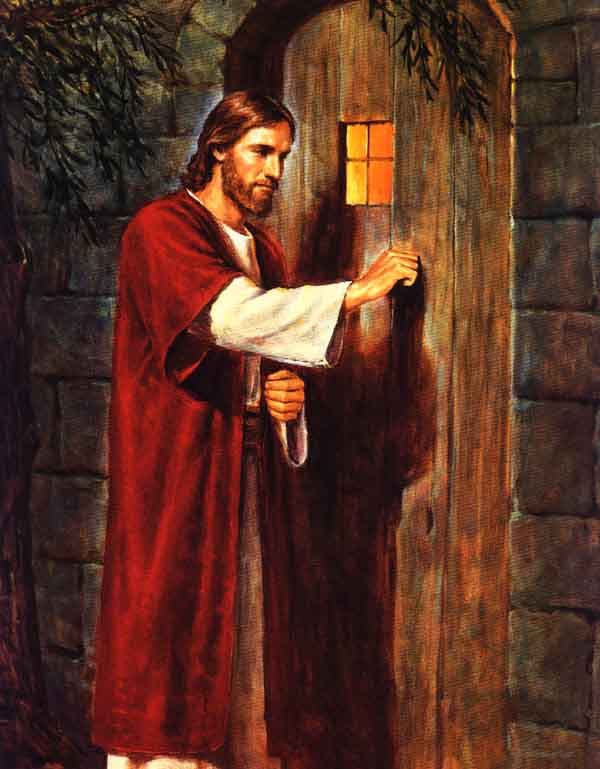
There is an extremely traditional painting of Jesus standing at a door knocking, based on Revelation 3:20a, “Here I am! I stand at the door and knock. . . .” a verse used to indicate that Jesus, like a visitor, is waiting to be invited into our homes, into our hearts. It’s a kind depiction.

But I have a stronger image, that of the open door. This representation is not from Christ’s perspective, waiting to be invited in, this is from my perspective, an invitation to walk through with no strings attached, the invitation implicit in its openness.

It reminds me of a phrase I tell people from out of town, particularly those I like very much and I want to communicate my fondness to them: “Please, come anytime, our door is always open.” I want them to feel free to enter, whether I am at home or not, because I trust them with my home, my sanctuary, my heart.

Jesus trusts me in that way too. And you.

Christ Jesus has the authority to open the door and keep it open until any human can see it, believe it, and walk through it. On the other side is sanctuary.

I remember hearing a story about people who were locked up in cages for a long time but when the door was opened, they did not leave the cage. Outside the cage, all was unknown. Inside the cage, all was familiar. Fear held them inside. Love is patient and kind and waits.

The only bad thing I can see about this open door is the ability of traffic to go both ways. I would love to say I went through the door once and never turned back. Not true. I have stepped back into the old world many times but each time, the open door draws me back, the spirit of God draws me, and I find my way through again.

Come and see, the door is still open. Like the tomb, open. Be set free.

Read Full Post »

How do we lose the bottom line? God is God and that’s the point. God is sovereign. God is above all, within all, beneath all. Acknowledge God and life can be trusted. Engage God and a life can be transformed.

Revelation 1:8
“I am the Alpha and the Omega,” says the Lord God, “who is, and who was, and who is to come, the Almighty.”

Start here. I start here today. Today is my Alpha. . .

Read Full Post »

« Newer Posts - Older Posts »