Feeds:
Posts
Comments

Posts Tagged ‘surrender’

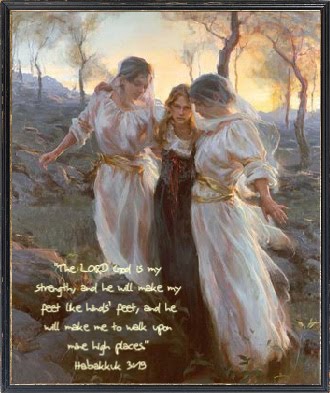
hinds_feetA good part of me is struggling with the word “sacrifice.” Just a quick look at the thesaurus and there’s no wonder I’m hedging, words like lose, endure, renounce, forfeit, and part with. They all resound loss. In our currently turbulent world, can I afford to lose anything more? Can I afford not to?

Therefore, I urge you, brothers and sisters, in view of God’s mercy, to offer your bodies as a living sacrifice, holy and pleasing to God—this is your true and proper worship.Do not conform to the pattern of this world, but be transformed by the renewing of your mind. Then you will be able to test and approve what God’s will is—his good, pleasing and perfect will. [Romans 12:1-2]

It feels like an oxymoron [self-contradictory]. How can I be a “living” sacrifice; won’t I be gone and spent? It’s the most blatant paradox in all of scripture and it’s repeated over and over again: to live is to die; to die is to live. [What you sow does not come to life unless it dies. I Corinthians 15:36]. We see it in nature all the time: the earth replenishing itself.

Too often, I can only see this life, this skin, this body. I try not to be afraid to die. I understand the promises of life after death, I espouse alternate realities and a rich spirit life in which the Presence of Christ is much bigger than this three-dimensional me. But I hold still fast to what I have. Perhaps it is rooted in our family’s poverty when I was young, but how long can I allow that wanting self to rule my life of plenty?

Many years ago, I read Hannah Hurnard’s “Hind’s Feet on High Places,” the allegorical story of Much Afraid whose Chief Shepherd encouraged to take a journey up the mountain with two companions, Sorrow and Suffering. She did not like these companions at first, at all. They seem to be taking her the wrong way, down and not up. But she is convinced to trust the Shepherd, and so she goes, marking that decision with an altar (a benchmark).

And so I am reminded that a living sacrifice is not a one-time, lay it down kind of thing. It’s a another journey. A living sacrifice is ongoing, daily, with understanding, becoming and transforming, letting go of one part, growing another. It is a renewal through pruning. It is communal and by agreement. I must choose.


Read Full Post »

Painting by J.Johansen

“Mourning” by J.Johansen

“Yet even now,” declares the Lord,
“Return to Me with all your heart,
And with fasting, weeping and mourning;
And rend your heart and not your garments.”
Now return to the Lord your God,
For He is gracious and compassionate,
Slow to anger, abounding in lovingkindness
And relenting of evil. [NASB Joel 2:12-13]

Yesterday, I returned from a weekend trip to visit a dying friend and I was humbled at her genuine faith and acceptance of God’s journey for her. She embraces each day. She is present in the moment. She is in the Spirit, having returned with all her heart. She is surrendered to God.

Tonight, at church, Pastor Jess reminded us that surrender means we are “all in.” I believe these forty days will be a true journey of repentance by relenting my willfulness and submitting myself to the Wonder.

I want to give “truth in my inward being” [Ps 51] to others. I want to be known and to know. I want to learn about my “secret heart.” And, I want a clean heart. I confess I have not been focused on these things in the past. But it’s time. Now is the acceptable time [II Corinthians 6:2b].

Read Full Post »

If I am supposed to have more confidence in the Christ, who acts in the role of high priest for me (whatever that means), and who supposedly has bona fide empathy with my temptations, then I’d better be clear on what they are.

Hebrews 4:15
For we do not have a high priest who is unable to sympathize with our weaknesses, but we have one who has been tempted in every way, just as we are—yet was without sin.

Secretly, I’m pretty sure I don’t really believe Jesus experienced all of my temptations and I’m guessing I’m not alone in that deep, dark truth.

Do I really believe that Jesus was tempted by anything like a Dunkin’ Donut or Creme Brulee? Did he worry about the number of calories consumed in a day or the sense of body betrayal when my favorite clothes no longer fit? Was Jesus ever tempted to give up and become a beached whale on the couch because nothing seemed to work?

Was Jesus tempted to run away from all of his responsibilities? Did he consider suicide? Was he tempted to get drunk and stay drunk because life was too overwhelming? And what about all the plights and dangers of love relationships, broken relationships, or marriages built on lies and convenience?

Or what about getting old? Did he look in the mirror and pull up on the crows’ feet around his eyes or stretch the skin around his mouth and consider plastic surgery? Did he stare at old people being helped out of cars with walkers and wheelchairs and contemplate such a future for himself?

I know I’m being ridiculous and yet, am I the only one who chafes, even just a little, at the idea that Jesus, Human for 33 years, could sympathize or empathize with the details of my life’s temptations?

The answer is right there of course. It’s not in the detailed temptations at all, but in the one big temptation that encapsulates them all: being in charge. The temptation is to do it “all myself” and to solve all my problems alone. It’s “kicking against the goads” [Acts 26:14]. It’s following the Eve and Adam story line.

How am I tempted? I am tempted to be a god and manipulate my environment and I am regularly disappointed in the results. And so, yes, it is this person who is asked to come to the Throne of Grace and ask for mercy and help. And the courage to surrender.

Each day.

Read Full Post »

Artwork by Jo Smith

My mother used to tell me that my name, Irmgarde, meant “guardian of the hearth,” which didn’t do much for me as I didn’t imagine myself a homemaker. In later years, I discovered, my name actually means “guardian of a small enclosure.” This is what God does for my heart too.

II Timothy 1:12b
. . . because I know whom I have believed, and am convinced that he is able to guard what I have entrusted to him until that day.

Truthfully, I always think of that small enclosure around my set of close friends and family. I imagine a corral and I am standing at the gate, protecting them from harm, from predators. I am grateful that the Holy Spirit is standing just so at the entrance to my deepest places. This is my warrior King.

It’s part of our agreement. As I turn over my stuff and give God access to my closed places within, I am promised Presence.

We have a triune God (at minimum) to help us get a handle on the work that each entity might play: God, omnipotent and sovereign, manages the big picture (the life maps) while Jesus, the Redeemer, became human to empathize and experience life within the context of time and space and to create a Way to unite us with God by endowing us with the Holy Spirit who indwells any who will accept this arrangement, this gift, this promise, this mystery.

We are understood in all those arenas. . . . and probably more.

God embraces the surrendered soul. Jesus modeled surrender.

My challenge? To accept the paradox that surrender is security; surrender is strength; surrender is safety.

Read Full Post »

Odd passages about Paul “struggling” with the energy that Christ has given him for the sake of others. And that energy is for them to experience the two-fold mystery of God: Christ within (where our unique relationship is built with the Holy Spirit) and without, in our relationships with others.

Colossians 2:2
My purpose is that they may be encouraged in heart and united in love, so that they may have the full riches of complete understanding, in order that they may know the mystery of God, namely, Christ . . .

This idea of Christ within and Christ without reminds me of the various ways people get caught up in their own brand of Christianity. Some put all of their energy into good works and service, reaching out to the poor, developing community and building fellowship (all good stuff), while others put everything into those private places where contemplation, prayer, study, and various other personal disciplines expand their inner domains.

Paul’s work is on both fronts for his people that they might be “encouraged in heart” (interior work) as well as “united in love” (exterior work). The complete understanding comes from both sides of the equation. This reminds me of that well worn passage in James 2:14, “What does it profit, my brethren, if someone says he has faith but does not have works?”

I don’t do well in this dual role. And yet, intellectually I know that both feed each other. I know that my interior life endows my walk on the outside with better choices, if I allow it to do so. And really, good works can draw a person into a deeper inner life, if permitted.

I am intentionally adding the proviso of permission here because I don’t believe I do it. I don’t give way to the power of the Spirit within. If I did, I’d be doing better (the fruits of that relationship with the Christ Spirit would be more evident). This is part of that “free will” concept. I can limit my relationship with God. I can have surface-only interactions. I can pick and choose. It doesn’t really serve me to do it, but I can. And unfortunately, I do become frightened and put on the brakes.

When the Toronto Blessing was in full swing, one of their most popular phrases was “More Lord, more.” I understand now it was a way to “allow” God in more. It was teaching self to let go and receive. It was not about God giving more, it was about the person opening the door wider to the flow of grace.

The mystery of Christ needs both arenas for full understanding. There is a “battlefield” both within and without. But the interesting aspect of these skirmishes is that I would do better through surrender–that is, surrender to the One who reigns over both and all.

Read Full Post »

The idea of fullness always brings up Thanksgiving dinner for me. I see us all, draped on various couches, sated and more, loosening belt buckles and trying to lie as flat as possible to give more room for all the plenty just consumed. Supposedly, this is what is available from Christ.

Ephesians 1:22-23
And God placed all things under his feet and appointed him to be head over everything for the church, which is his body, the fullness of him who fills everything in every way.

But we’re not full. At least I know I’m not.

Some years ago when everyone was on the Toronto Blessing bandwagon and everyone was “soaking” on the floor and asking God for more, more, more. Now, I can’t help but think God was shaking his head, “How much more do you want? I’ve given you everything!”

It’s not that God is stingy with the stuff, with the power, with the blessings, with the anointings, it is our cap. In order to fill up with all of goods, we gotta make room. Goes back to the hoarding issue: keeping things we don’t need: thoughts, blame, anger, old scripts, pain, shame, ambition, judgments, and so on.

A sponge full of dirty water can’t take on more water no matter how tasty and abundant the spring.

Empty first, then fullness…

Read Full Post »

Interesting concept really, to be mutually dependent. Think about it: we assume a dependent person needs or relies on someone else for protection or caregiving, or knowledge even. But mutual vulnerability implies that each person has his/her own set of weaknesses and strengths, both needed and provided by one another.

Romans 12:4-5
For as in one physical body we have many parts (organs, members) and all of these parts do not have the same function or use, so we, numerous as we are, are one body in Christ (the Messiah) and individually we are parts one of another [mutually dependent on one another].
[Amplified]

This basic idea is the foundation of teams in the workplace. The combination of skills and strengths leads to higher levels of understanding and success. God is asking no less of the body of Christ. Unfortunately, many of us tend to sit back and allow others to do their thing while we absorb all their good stuff, giving little of what we are good at doing back.

Churches are filled with folks who show up regularly on Sunday mornings but rarely extend themselves beyond the pew. So many of us make excuses as we watch talented folks sing, preach, play instruments, run committees, and lead classes. We tell ourselves we have no abilities in those areas and therefore, nothing more can be demanded. But what are we good at doing?

I know there is an entire teaching on those verses about being strong in weakness [II Corinthians 12:10] and how God will give us what we need if we step up to the plate. And I don’t really disagree. However, I also think we may be missing something valuable in the church: taking advantage of the gifts people do have, gifts that may not seem useful at first blush but could be used creatively for the body of Christ.

Church life is so locked up in tradition; sometimes there’s little room for innovation and creativity. More than likely, where I am weak, there is someone else who is strong. And where I am strong, it is up to me to offer those strengths for the edifying of those who are weak.

People think of me as strong, but truthfully, I am not “all that.” There are many places and times where I am foolish and insecure, just like anyone else. I am lonely and do not have many close friends. I am a spendthrift and spend money on the wrong things. I make quick judgments. I fill my schedule to overflowing, doing too many things acceptably well, but not really well. I am performance-oriented and put high expectations on those around me. But I am also funny and energetic. I like to draw people together. I like to be the hostess. I like to plan events and watch others enjoy the fruits of those labors. I am smart enough to enjoy reading, studying, and observing others. I love change and new things. I enjoy being with people. I enjoy teaching what I know and writing. I enjoy discovery. But I am not particularly spontaneous because I am also fearful of making mistakes. I can be a control freak. But I can also create something out of nothing.

These are my “I am’s” today.

But, there are people around me who are strong in my weak areas. I want to reach out to them and allow myself to be weak with them. I want to be part of the balance in the body of Christ.

I surrender that part of myself today that has been hiding. It’s time.

Read Full Post »

« Newer Posts - Older Posts »