Feeds:
Posts
Comments

Posts Tagged ‘trust’

It’s one of my struggles in the church as I go through this period of change in viewpoint. I’m in process. So I edit what I say around certain people who I assume will be offended. I don’t want a confrontation, or the backing away, or the widened eyes. And yet, how else does the “conversation” begin?

Galatians 2:12
Before certain men came from James, he [Peter] used to eat with the Gentiles. But when they arrived, he began to draw back and separate himself from the Gentiles because he was afraid of those who belonged to the circumcision group.

Actually, the key problem may be my assumptions about the “other.” Isn’t it these presumptions that keep me quiet? How can I really know what others think unless we talk about it.

But then, I hear my inner voice remind me that I’m not quite sure where I’m going with all this new information about Emergents and Missional Churches and Hipster Christianity. There is so much excitement in these frameworks as believers become more inclusive, more committed to the needs of others, more relational. A part of me enjoys confronting the “sacred cows” of the institutional church but I also don’t want to “throw the baby out with the bath water.”

Peter got a taste of the “new way” when Cornelius [Acts 10] called Peter to his house just after the Lord had given Peter those three visions of the sheet coming down from heaven filled with foods that Jewish law had always prevented him from eating. He was shocked. And yet, when Cornelius’s men appeared, he understood the vision and he went to the house, entered and even ate there. But that was before the gentile explosion. It was one thing to “let in” a few gentiles here and there but Paul was starting to bring them in my hundred and thousands. Maybe it was all happening too fast. I don’t really know.

Perhaps we all suffer from these fears now. The new stuff sounds good, but what about the traditions and the old ways? Haven’t those ways always worked before? Hasn’t the church always survived?

I’m not so sure. Has the church survived or has it merely continued to splinter off into a variety of cells (denominations) because of disagreements and revelations. The proliferation of denominations got so bad at one point that people thought they could solve the problem by having “non-denominational” churches. But soon, even those groups splintered and they created churches by affiliation (Vineyard, Calvary Chapel, Community Churches) and then a single church would develop “campuses” with closed circuit video of the pastor. Big was better, Megabig was best.

But that trend is now being confronted with smaller is better and may tiny (like house churches) is best.

Who knows? What is the church? What is the Body of Christ?

There cannot be only one affiliation or denomination or cell group that has the inside track of what it means to be the Body of Christ. There is but one litmus test: Christ crucified and risen, accepted by the believer as the propitiation of sin. The rest is interpretation.

I think it’s time for me to stop worrying about what people will think and just talk to them. The conversation must trust that Christ is the glue that holds us all together. The conversation opens the doors to our hearts and minds. It doesn’t have to be about “changing” someone’s mind, just connecting.

I have written before about the “sacred other;” if we entered every conversation with this in mind, our differences of opinion would not separate us. We would be free to enjoy the many colors of Christ.

Read Full Post »

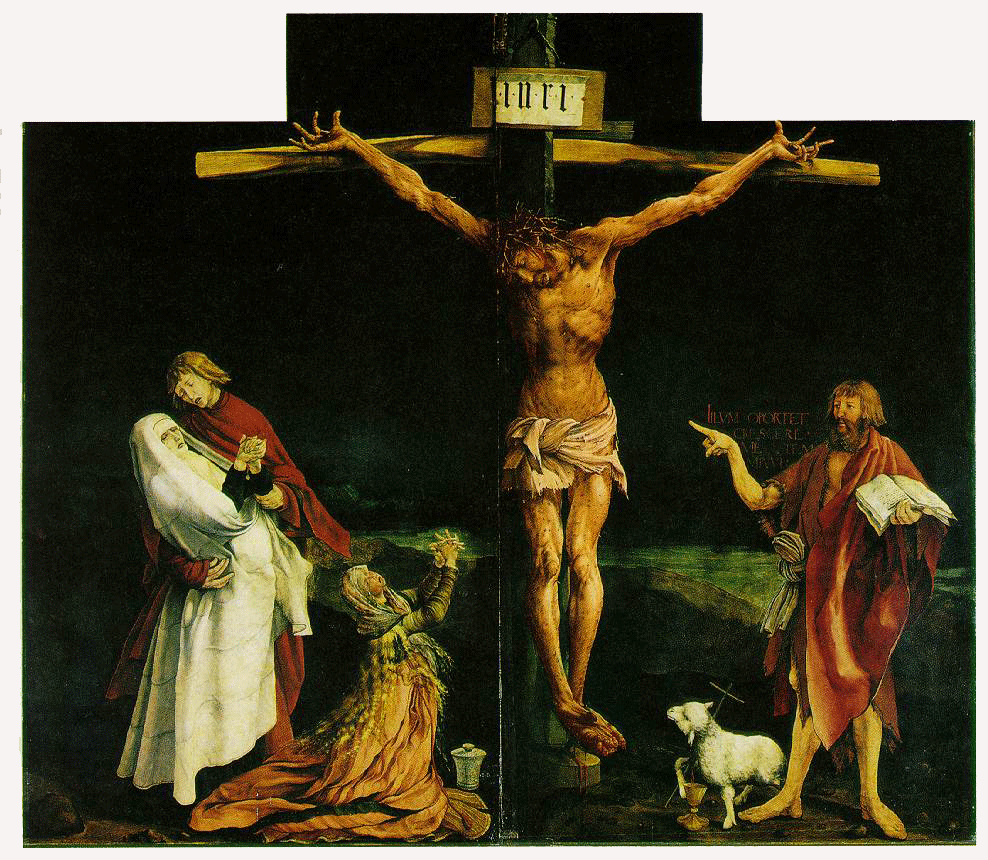
Did the ones who stood vigil at the cross really believe Jesus would die? I don’t think so. They expected a reprieve or a last minute miracle. After all, this was the man who stilled a storm, gave sight to the blind and raised a dead man. Was this his final display of strength in weakness?

II Corinthians 13:4
For to be sure, he was crucified in weakness, yet he lives by God’s power. Likewise, we are weak in him, yet by God’s power we will live with him to serve you.

It’s all there in the crucifixion story: die to live, weaken to strengthen, submit to rule, forgive to trust, suffer to heal, and so forth. These opposites trail after me. When am I going to get it?

Last night I had a dream about a very large black dog that charged toward me and instead of running away or standing stock still, I squatted down, held out my arms to hug him and nuzzle him. I seriously doubt this technique would work in real life. But in the dream, the dog responded and simply rubbed my face and neck the same way my big Snooki dog (a black lab mix) does. It’s a start.

Weakness can be a choice for the good of the moment.

For me, this means saying, “You’re right,” more often or “I take full responsibility for that mistake,” or “I was wrong.” It means listening even when I disagree. It means giving opportunities to others that I would like to have. It can mean serving without recognition or diligence without admiration. It can mean accepting surprises and unintended consequences with grace. It can mean a certain lack of control.

My big joke about myself has always been that I prefer “planned spontaneity.” When an old friend who was a 5th grade science teacher told me she would run experiments in class without knowing the outcome, I paled. How often have I told people, “I’ll do it!” not because I wanted to help but because I didn’t trust anyone else to “do it right.”

That’s a shame to me now. It’s time to respond differently. It’s time to let go of my controlling nature. It’s time to stop previewing the future, planning every step, and manipulating outcomes.

I’m not so sure that even Jesus knew how things would play out. But his trust in God was rooted deeply and in the end, even in fear and doubt, he died with hope. Was he surprised when he found himself back in the world? We’ll never know. But he certainly walked about in new understanding.

This is what can happen to us as well. Once we let go of “our way,” we are able to discover another way that is God-breathed.

Read Full Post »

For those who read my meditations regularly, you know I am intrigued by the sweep of paradox in scripture. Strength in weakness is one of the most difficult concepts to put my head around since the display of strength is my security blanket.

II Corinthians 11:30-31
If I must boast, I will boast of the things that show my weakness. The God and Father of the Lord Jesus, who is to be praised forever, knows that I am not lying.

Back in the day, I worked with a small group of friends to build an avant garde dance theatre company in New York City. These types of projects are always a bit “hand to mouth” and poorly funded. It can be very stressful. I was in charge of the finances (using mostly my personal funds) and the administration of the company in addition to working full time and going to school. After a year of this, I was at the breaking point. At one of our meetings, I confessed, I was falling apart inside and I couldn’t continue to be the rock anymore. They would not allow it. “You have to be strong. We depend on you to be strong.”

And then I knew we had, all of us, put our confidence in the wrong thing: my strength and confidence That kind of strength is an illusion.

It is God who arms me with strength and makes my way perfect. [Psalm 18:32]
God is our refuge and strength, an ever-present help in trouble. [Psalm 46:1]

But God cannot arm me with strength or “be” my strength as long as I continue in the “world’s strongest woman competition.” I have to believe in the promise. I have to be willing to reveal my weakness and only then will God’s strength be visible. My strength is a mere veil to the real thing.

Some of the tools:

  • Be willing to say, “I don’t know.”
  • Choose silence.
  • Acknowledge the successes of others.
  • Accept mistakes.
  • Forgo the praise of others.
  • Relinquish control.
  • Embrace the feelings.
  • Open the heart.
  • Submit to outside circumstances.
  • Build trust.
  • Pray.
  • Respond to the Holy Spirit.

It is one thing to talk about paradox but it’s another to actually live it. This takes a great leap of faith. It’s time to jump.

Read Full Post »

There is a dramatic difference between the one who has been beguiled and the one doing the beguiling. Historically, I have used this word for its second meaning (to pass time pleasantly) and assumed its first meaning had a lighthearted coyness to it. Not so. It’s betrayal . . . and it’s intentional.

II Corinthians 11:3
But I am afraid that just as Eve was deceived [beguiled in Amplified] by the serpent’s cunning, your minds may somehow be led astray from your sincere and pure devotion to Christ.

I don’t believe our children (whether they are sixteen or twenty-six) know they are being beguiled away from the faith. I see the world ensnaring them (and others) into believing they need all the “stuff.” They are bombarded with extremely convincing advertising that insists they are less because they need more: electronics, apps, screens, gadgets, clothing that advertises the store where it was purchased, ever-changing styles that make last year’s apparel uncool, high-powered jobs and income, and so on.

In order to compete, the “church” tries to lure these generations by using the same tools and tricks of the culture. Is that a good thing? I don’t know. Maybe. If young people begin to examine within and look for greater meaning, that has merit. Can it still be a bad thing? Does the end justify the means? I really don’t have an answer, I just have questions. It’s only the individual’s heart and soul that matter. The inner life, that inner discovery happens alone. No accoutrement is needed.

Betrayal is one of the deepest hurts of all. I have been hurt by people of the church.

We must be careful how we “woo” people to the Lord. A person should not be beguiled into the faith, as though following Christ is like taking a happy pill. It’s not.

The journey with Christ is not easier, it’s different, under girded with hope, assurance, and traditionally, with fellowship (other people who care and love). The end of the journey is known, but the path itself is still laden with challenges.

Read Full Post »

The metaphors of war and weapons are not my favorites and yet I do believe I have access to tools within, where the Christ Spirit dwells, to help me resist my ongoing bad habits and harsh judgments I make against others. The power is all there. I just don’t tap into it.

II Corinthians 10:3-4a
For though we live in the world, we do not wage war as the world does. The weapons we fight with are not the weapons of the world.

The 3-D world in which I walk and live has its own rules and recommendations for change. There’s a lot about “doing” and “pulling up of boot straps” and “taking charge.” But the way of Christ is different. It’s the opposite of what we think. It’s the rule of paradox. It’s “being” and not always doing. It’s letting go of “my way” and going the way of Jesus. It’s mindfulness about others.

The divine weapons don’t manifest while I’m using my own weapons. Divine power waits until I have expended all of my “personal power” and efforts.

This truth is one of the reasons why Alcoholics Anonymous and similar 12-step programs are so successful. The person must come to the end of self. There is a step, even a leap, across the threshold into the arms of a higher power. God never misses.

I cannot wield divine weapons. I can only submit to them. This is the essence of faith.

Read Full Post »

Generosity is an expression of thanks to God. When I give to someone in need, that act of giving, in itself, is thanking God — for my having enough to give. And if this is true, what I am I saying when I don’t give?

II Corinthians 9:12
This service that you perform is not only supplying the needs of God’s people but is also overflowing in many expressions of thanks to God.

I have put too much focus on the traditional acts of thanksgiving: saying prayers at meals, lifting my hands in church, saying the Lord’s prayer each day, giving thanks when I have a close call in a car. But I haven’t considered my actions as a form of thanks. I haven’t thought of loving others as a form of thanks.

There is a description of our relationships being like a cross, the vertical is our relationship with God and the horizontal is our relationship with others. And although I have seen and know that my vertical relationship with God enhances my ability to love others. But I had never considered the opposite. My outpouring of self into others touches God by confirming my trust and faith in His ability to keep me full.

That’s the idea of it anyway.

Instead, I see my fears block my giving. I’m not just talking about money either. Of course, this is included. And I do fear the loss of security that money provides. But I am placing my hope for security in the wrong place. It’s a habit from my own poverty growing up in the inner city.

I am grateful for my comforts. I do thank God verbally each day for the abundance in which we live. And yet, today, I am confronted with a greater truth: give thanks by letting go. Build faith. Build trust. Give out of the abundance.

And, in the circle of generosity, it all comes back again.

Read Full Post »

Godly sorrow is different from the mouth saying “I’m sorry;” it’s from the heart. How can we tell which is which? We can’t tell by words alone. Only actions express sincere contrition.

II Corinthians 7:10
Godly sorrow brings repentance that leads to salvation and leaves no regret, but worldly sorrow brings death.

I remember a friend of mine who had been devastated by her husband’s infidelity. He had expressed sorrow for his poor judgment and betrayal. She never believed him. He asked for total forgiveness. She could not give it. She confessed to me that she wanted him to suffer (as she had suffered). But what was she really saying? I believe she never saw “Godly sorrow.”

But I wonder, would she have recognized Godly sorrow in his behavior? If actions are the reflection of authentic regret, it’s important to know which actions would speak that truth. What does repentance look like after someone has hurt you?

Read Full Post »

« Newer Posts - Older Posts »