Feeds:
Posts
Comments

Posts Tagged ‘words of advent’

Once Johnson & Johnson took over the word Pledge, it’s lost some of its power. Despite the fact that children and adults “pledge” allegiance to our flag, sometimes as often as daily, its meaning has been lost. The word is actually in the “vow” family, but that too has lost much of its significance, in an age of quick no-contest divorces. Most folks think of a pledge (perhaps it’s all those non-profits and churches) as a good-natured “I will if I can” kind of thing. But honestly, the definition is much more binding, a legal relationship, a solemn promise. I’m thinking that when we break a pledge, it sets all kinds of sowing/reaping and karma into motion.

This is how the birth of Jesus the Messiah came about: His mother Mary was pledged to be married to Joseph, but before they came together, she was found to be pregnant through the Holy Spirit. [Matthew 1:18, NIV]

pledged to marryThe word pledged in this passage is the NIV version of course, most standard translations render mnēsteuō  as “betrothed” and more reader friendly versions translate the Greek word to “engaged.” In our day and age, we treat this relationship equally lightly. Give back the ring, shed many tears, post it on Facebook, remove one’s relationship status, and we’re done.

But in the day of Mary and Joseph, the betrothal was virtually equal to the marriage vow itself. To break a pledge of this type required a formal divorce. And the only way a man could divorce a woman in those times was for the cause of infidelity (a one-sided benefit by the way, since a woman could not divorce a man). Joseph was within his rights to have Mary stoned.

It has been said that the church is the bride of Christ (see Revelation 19-7-9) and upon Christ’s return (whatever that might really mean), a great wedding will take place. So, if the wedding is yet to come, we, who have accepted Christ are actually betrothed or pledged to Christ. Will we take this role lightly then or consider it in its most serious form: a vow, a sacred promise to be faithful?
Read Full Post »

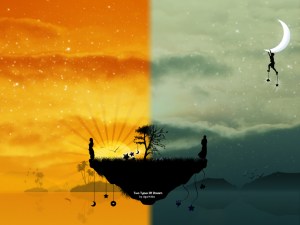
Art by Desexign

What is a dream? Night time dreams and daydreams are what I think of first, but other symbolic uses come up as well. I suppose the most prevalent one is the speech by Martin Luther King, Jr., who said “He had a dream . . . ” as he looked to a brighter future. He was a visionary. And I think of Don Quixote who “Dreamed the Impossible Dream.” Quotes aplenty sprinkle the web. Check them out for encouragement.

But after he [Joseph] had considered this [divorcing Mary quietly], an angel of the Lord appeared to him in a dream and said, ‘Joseph son of David, do not be afraid to take Mary home as your wife’ . . .  When Joseph woke up, he did what the angel of the Lord had commanded him . . . ” [Matthew 1:20a; 24a, NIV]

But I am looking at a specific kind of night dream that a humble carpenter had when his fiancee became pregnant. Being a nice guy of sorts, he decided to divorce her quietly, although I find that amusing since her pregnancy, without his protection, would have ended her stoning. I think he was rather more interested in a) not participating in the punishment, and/or b) disassociating with her and her family. Also, he was a fearful man who could not imagine dealing with the fall-out.

And yet, he had a dream.

How do we know when a dream is from God? I’d say, in general, that the dream contradicts our normal thinking about an event. A dream brings in new information that we would normally suppress. And I believe it’s straightforward.

When I was still struggling with my decision about accepting the Christ, I had a vivid dream of standing on rope bridge. Below me, what initially looked like roiling water and waves, was human bodies. At one end of the bridge was a woman who was interested in enticing me into her lifestyle, both decadent and exciting. At the other end, was a man who had introduced to the stories of Jesus and prophecy in the Old Testament, a “holy” life I could not fathom for myself at the time. I was torn between the two but knew I had to choose one way or another or I would be pulled into the maelstrom below, lost to both. This was a dream from God, still distinct in my mind after more than thirty years.

I am without doubt that Joseph’s dream stayed with him until he died. We don’t have a record of Joseph’s later life, how he died or when. He and Mary bore other children after Jesus, so we know he didn’t disappear and he was still on the scene when Jesus was twelve. But after that? We’ll never know. But we have a dream and savior because one man submitted to a dream.

To accomplish great things, we must not only act, but also dream; not only plan, but also believe. Anatole France.

Read Full Post »

It’s a baby, a little, little baby. How sweet. How cute. What potential!

This will be a sign to you: You will find a baby wrapped in cloths and lying in a manger. [Luke 2:12, NIV]

babyIn Greek, the word is brephos, which can either mean an unborn child or a newborn child, but interestingly enough, this word is gender neutral. As a result, this is the same word that is used for the baby that Elizabeth carries in her womb and “leaps for joy” when Mary came to visit [Luke 1:41], along with six other references. And my favorite reference is in I Peter 2:2, where brethos is used to describe young believers who should crave “spiritual milk,” and cast off the food of the world.

But I’m getting off track. I wanted instead to talk about a baby’s potential. You see, from the outside in, we do not know what is in store for every baby we see. Facebook is filled with pictures of babies, taken by proud parents, who are full of hope and expectations for their baby. They want to give this baby the best of everything, the opportunities, the nourishment, the foundation. They love this baby so much.

And yet, how many mothers collapse in grief when their child becomes a murderer or a drug addict or an abuser? How did this happen? What happened to all that potential?

We know that prophecies abounded about the Christ child who would come into the world innocently enough, but who knew his life would only last 33 years? Who knew he would be mostly rejected? Who knew, really, that it would all happen to this particular baby? Not even the mother knew for sure, despite the miraculous circumstances of his birth. She continued to ponder all those things in her heart [Luke 2:19]

A baby depends on the “village” around him/her to grow and become. If we succeed, if God’s intent is encouraged and prevails, we have a saint. But if we fail that child, what then?

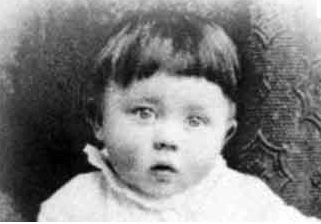
Hitler’s First Photograph
——-Wislawa Szymborska

And who’s this little fellow in his itty-bitty robe?
That’s tiny baby Adolf, the Hitlers little boy!
Will he grow up to be an LL.D.?
Or a tenor in Vienna’s Opera House?
Whose teensy hand is this, whose little ear and eye and nose?
Whose tummy full of milk, we just don’t know:
printer’s, doctor’s, merchant’s, priest’s?
Where will those tootsy-wootsies finally wander?
To garden, to school, to an office, to a bride,
maybe to the Burgermeister’s daughter?

Precious little angel, mommy’s sunshine, honeybun,
while he was being born a year ago,
there was no dearth of signs on the earth and in the sky:
spring sun, geraniums in windows,
the organ-grinder’s music in the yard,
a lucky fortune wrapped in rosy paper,
then just before the labor his mother’s fateful dream:
a dove seen in dream means joyful news,
if it is caught, a long-awaited guest will come.
Knock knock, who’s there, it’s Adolf’s heartchen knocking.

A little pacifier, diaper, rattle, bib,
our bouncing boy, thank God and knock on wood, is well,
looks just like his folks, like a kitten in a basket,
like the tots in every other family album.
Shush, let’s not start crying, sugar,
the camera will click from under that black hood.

The Klinger Atelier, Grabenstrasse, Braunau,
and Braunau is small but worthy town,
honest businesses, obliging neighbors,
smell of yeast dough, of gray soap.
No one hears howling dogs, or fate’s footsteps.
A history teacher loosens his collar
and yawns over homework.

— Stanislaw Baranczak and Clare Cavenagh, translators
from The People on the Bridge


Read Full Post »

There’s a word that conjures an immediate response I’m sure. From billboards, “Virgin : Teach Your Kid it’s Not a Dirty Word,” to Virgin America Airlines to put-down, “You’re still a virgin?” What does this hot word mean in your world? Or mine?

Our Lady of Guadalupe by Pristine Cartera-Turkus

Then Isaiah said, “Hear now, you house of David! Is it not enough to try the patience of humans? Will you try the patience of my God also? Therefore the Lord himself will give youa sign: The virgin will conceive and give birth to a son, andwill call him Immanuel. [Isaiah 7:13-14, NIV]

Of course,  theologians have since uncovered a less than miraculous explanation of Isaiah’s prophecy since Jewish culture assumed that all young women were virgins. They had a good reason for this assertion since sex outside of wedlock was punishable by death. The Hebrew word for virgin as it is used in Isaiah is Alma, or young woman. When the these verses were translated into the Greek, the word Parthenos was selected which had only one meaning, virgin. (By the way, small piece of trivia, the Parthenon’s name came from this same word and one of the reasons was that this temple was filled with temple prostitutes that were virgins – and apparently disposable after a single use.)

The point in the nativity story, I suppose, is not that Mary was a virgin, since that was the norm, the point was that she was impregnated supernaturally. In fact, scripture articulates that Joseph, her fiancee did not have sex with her until after the birth of Jesus [Matthew 1:25]. And for many people, this miracle stops them in their tracks. And some denominations take Mary’s virginity to the next level, saying she was made sinless as well, creating an immaculate conception. [For more on this topic, see Let Us Reason Ministries online.]

We’re living in a time of science and reason and miracles of any kind are always suspect. In my mind, the entire concept of God providing a propitiation or atonement for the choices that created a state of human separation from God is a gigantic miracle in and of itself. The methodology would have to be out of our ken in order to make it work.

Ancient humans seemed to naturally understand the idea of atonement, sacrificing all kinds of animals and daughters to appease the gods, the sun, the weather, or whatever else they could not understand. They seemed quite clear about the basic idea of sowing and reaping. Even Karma, an Eastern idea of cycles, supports the supposition that there are repercussions to our choices (both good and bad).

The virgin birth is actually somewhat inconsequential to me. The idea that God became fully human is much more intriguing. The idea that fully human God (as Jesus), came as an atonement is even more absorbing.

I just want to think about that today.

Read Full Post »

« Newer Posts