Feeds:
Posts
Comments

Archive for the ‘Ordinary Time’ Category

adviceIf you ask for advice, you still have to decide whose advice you will take. And if the advice is contrary, you are no better off than you were in the first place. Choose our counselors wisely.

[Israelites spoke to Rehoboam, Solomon’s son] Your father put a heavy yoke on us, but now lighten the harsh labor and the heavy yoke he put on us, and we will serve you.” . . . Then King Rehoboam consulted the elders who had served his father Solomon  . . . They replied, “If you will be kind to these people and please them and give them a favorable answer, they will always be your servants.”  But Rehoboam rejected the advice the elders gave him and consulted the young men who had grown up with him and were serving him. [I Chronicles 10:4, 6a, 7-8]

I can be terrible about making decisions, particularly decisions that affect others and not just me. I ask lots and lots of questions of people I know, supervisors and neighbors and friends and family, and often, every answer is different. I end up with information overload. And yet, Proverbs 15:22 states, “Plans fail for lack of counsel, but with many advisers they succeed.” So, it’s not the amount of advice that is the problem, but the counselors themselves.

Who do I trust and why? My tendency might be to get frustrated and cast off all the advice and all the counselors and simply go my own way. Or, perhaps I’m kidding myself and I know which way I want to go and I’m simply asking enough people to get the one advice that matches my own private decision.

But there are some hints in the story of Rehoboam and his advisers. First of all, the first advisers were older and had already spent many years advising King Solomon. He was, overall, a very successful king. And secondly, the key to their advice was that responding their way would create loyalty and good will. Rehoboam was too young to realize how powerful loyalty can be. He wanted to appear strong and believed in the power of fear over the power of love and grace.

Leadership by fear is probably the worst kind.

So, the best advice in the face of a difficult decision? The paradoxical – what is best for the people the decision is affecting. That is the key. And of course, seek God’s counsel first. But I know too well, how hard it is to “hear God’s voice.” But if we pray before we ask a human counselor, we may discover the wisdom of God is speaking.

And I have to smile, just this week, my pastor said, “Two patients don’t equal a doctor.” Be sure that the advisor you seek has some counseling cred (experience).

Read Full Post »

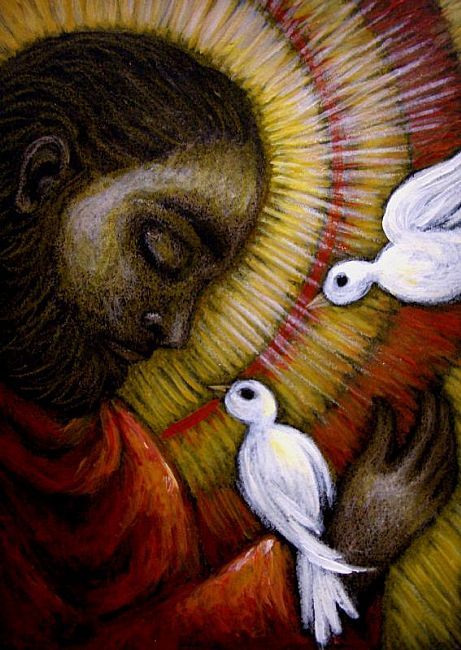
Art by Laurie Justus Pace

Art by Laurie Justus Pace

And this is the point, whether one believes or does not believe: God knows our hearts. God knows my heart. There is no sin I can craft in my head that is unknown, there is no good deed seed not watered. God is sovereign over the heart — the soul of humankind.

Forgive and act; deal with everyone according to all they do, since you know their hearts (for you alone know every human heart) . . . [I Kings 8:39b, NIV]

For this reason, when life circumstances challenge my way, there is only One who can truly help me or actually altar the course of my steps, transform the crushing press of deadlines and drama and duty, rally the troops of heaven on my behalf and, ultimately, on behalf of my loved ones.

Forgive me Spirit Father, Adonai. Forgive my stealthy forays into the world. Forgive my selfish ambition. Forgive my judgments of others. Forgive my callous eye. Relieve my fears. Strengthen my trust and resolve in You. Sustain my mindfulness that I might pray without ceasing.

Read Full Post »

trustThe truth about trust is tricky. I mean, I have struggled with trust all my life. Sure, betrayal is a stumbling block to trust. But personal strength and intelligence can get in the way too. My mother taught me all the ways to combat trust: self-sufficiency, stick-to-it-tiveness, if you want it done right do it yourself, and so on. Trust requires a perpetual surrender.

Trust in the Lord with all your heart; don’t rely on your own intelligence.” [Proverbs 3:5, CEB]

On Sunday, Pastor Jess Bousa, taught the message this way: to recognize the sovereignty of God, we must acknowledge God’s control of situations when things are “bad” and not just when things are going swell. After all, it’s easy to trust God when life is moving along sweetly and securely. It’s the tough times that call on the truth of our trust and faith in this One God.

One of his examples was II Kings 6:15 – 17, when Elisha’s servant feared the encampment of the vast army of the Arameans out to destroy the prophet. But Elisha could see what his servant could not, God’s army that encircled them all: the “second circle” that is God’s domain. This is the circle where trust is engaged. This is the circle where God operates, the bigger arena where our human strengths are worthless, where our intelligence can no longer figure things out, where our manipulations no longer have impact. Trust happens there.

Elisha prayed that God would open his servant’s eyes to see that second circle.

I pray the same. For me.

And yet, I must remember this, unless I go through the chaos and clatter of life’s challenges, I will never get to see God’s power in my life. It’s a paradox of faith. I surrender this day. I must. I will to do it.

Read Full Post »

Art by Lilis Boyer

Art by Lilis Boyer

The Song of Solomon (or Song of Songs) found its place in the Jewish canon by its sheer beauty and poetry. It is not really a complete piece at all, no matter how artfully publishers identify the man speaking or the woman speaking, it’s still just a series of fragments. We will never know the whole of it. And so it is about a fragment that I will respond.

Set me as a seal over your heart,
        as a seal upon your arm,
for love is as strong as death,
        passionate love unrelenting as the grave.
Its darts are darts of fire—
        divine flame!
[Song of Songs 8:6, CEB]

And another, repeated twice in the book:
Make a solemn pledge,
        daughters of Jerusalem,
        never to rouse, never to arouse love
        until it desires. [Song of Solomon 2:7; 8:4, CEB]

Love is powerful force that has gotten washed out by dime store romances and flimsy chick flicks. It’s been downgraded by pornography and trivialized by teen angst. Even Valentine’s Day has played a part in corrupting its message. Purveyors of cheap love are laughing all the way to the bank.

When love is roused at the wrong time or at the wrong place, the power of it and the joy are sucked out of it. It is sex without love, masking the truth of it, manufacturing a feeling but it is not transformative love. But when the moment is right, when there is a mutual selflessness, when it is about the giving away of it moreso than the absorption of it, then the power of God can be unleashed. This I believe.

I know, there are different words for love in Greek, but in the Hebrew, both verses use the same feminine noun, ‘ahabah אַהֲבָה which can be translated as love: human love for a human object (man to man, man to himself, man to woman, sexual desire, and incidentally, God to man too).

And so I ask myself and all of us, is my love toward others with the same intent as God’s love?

God shows love to people over and over again whether its through grace or miracles or the sacrifice of the One Son, Jesus. God’s love is pours out without measure. Jesus taught, “Give, and it will be given to you. A good portion—packed down, firmly shaken, and overflowing—will fall into your lap. The portion you give will determine the portion you receive in return.” [Luke 6:38, NIV]

But no, not me. I confess, I am hungry to be loved more than to love. Lonely. Overwhelmed. Shaken by circumstances. Distanced by disappointment still. Hardened by losses, speaking into the wind.

I am no stronger than the one beside me. My years in Christ clear my vision and for this reason, I understand why the saints and desert fathers of old cried out, “Lord Jesus Christ, Son of God, have mercy on me, a sinner.”

Art by Cyra R. Cancel

Art by Cyra R. Cancel

Or why St. Francis wrote:

Lord, make me an instrument of Your peace. Where there is hatred, let me sow love; where there is injury, pardon; where there is doubt, faith; where there is despair, hope; where there is darkness, light; where there is sadness, joy.

O, Divine Master, grant that I may not so much seek to be consoled as to console; to be understood as to understand; to be loved as to love; For it is in giving that we receive; it is in pardoning that we are pardoned; it is in dying that we are born again to eternal life.

Let me know and give love as strong as death.

Read Full Post »

stillbornI just finished reading An Exact Replica of a Figment of my Imagination by Elizabeth McCracken at the same time I read David and Bathsheba’s story of their own first child, who only lived seven days before dying as foretold by the prophet Nathan for David’s illicit with relationship with Bathsheba and ordering the death of her husband in battle. Both stories capture a view of grief we rarely see.

He [David] answered, “While the child was still alive, I fasted and wept. I thought, ‘Who knows? The Lord may be gracious to me and let the child live.’  [II Samuel 12:22, NIV]

For McCracken, the newborn infant, nicknamed Pudding, was their first and neither she nor her husband broke any laws or treated Pudding with anything but ultra care: the right foods, the right rest, the right attitude. It was a pregnancy made in heaven. But then, near the end of her last trimester, Pudding stopped moving, at least it seemed so to her. Many thought she might be overreacting (they were living in France at the time), and she was sent home. However, by the next day, her own concern pressed the issue and she sidestepped her midwife and went to the doctor’s office where it was discovered that the child was, indeed, dead but McCracken would still have to bear this lifeless child into the world. The depth of her pain and anguish are laced throughout this slim volume.

Back in the day, when I was still performing my one woman show, Pente, one of the women in that quintet was Bathsheba because her story is minimized in scripture; her grief and loss are summarized in the single line, “Then David comforted his wife Bathsheba, and he went to her and made love to her . . . ” [vs 24a] but I believe McCracken’s tale captures a more realistic picture of a mother’s heart and the depth of her pain.

But getting back to my selected scripture, it is intriguing to me that David, who knew that he had sinned and who knew that Nathan was a formidable prophet whose words always came true, pressed into the 7-day period of prayer and fasting and, undoubtedly, deep confession. As long as the child lived, David did not give up even the slightest sliver of hope. David could not change what he had done but he could surrender his helplessness to God, who could still change the outcome. God’s outcome is never fixed in time. And yet . . .

The child died.

And David could do nothing more than surrender again.

We have choices beforehand, before the inevitable happens. But once tragedy strikes, whether deserved or undeserved, we only have our response to God. The pain is still there but can be muted if we wrap it into the embrace of God. Grace lives.

Read Full Post »

I don’t have any trouble singing in church. In fact, in general I love choral singing as well. I’m not the best singer by far, but in a group setting, I feel bolstered by the voices around me and feel I can sing with the best of them. I am always a little sad when people around me don’t sing at all. My daughter rarely sings in church but she will sing along with the radio all the time. She says it’s the music she doesn’t particularly like, not her style and all that. But my real question is to God: why are we told to sing or even commanded? What is it about singing that is different from speaking?

Give thanks to the Lord with the lyre!
    Sing praises to him with the ten-stringed harp!
Sing to him a new song!
    Play your best with joyful shouts! [Psalm 33:2-3; CEB]

Some results from a cursory Internet search include:

  • Singing is the act of producing musical sounds with the voice, and augments regular speech by the use of both tonality and rhythm. Singing expresses emotion and united communities.
  • Back in 1588, William Byrd wrote that singing is delightful to Nature and preserves our health.
  • In a book entitled Music and the the Brain, there is evidence that singing is therapeutic.
  • There are even studies out there that claim people who sing live longer.
  • People who stutter often lose their stutter completely while singing the words (Anyone remember the film, The King’s Speech?)
  • A song can also help people to learn something or remember concepts.
  • Singing is a part of cultural identity.
  • Singing helps people understand who they are.
  • Singing helps people experience worship.
  • But it is also a way to bring people together for a cause, for a right, a touchpoint.

There are songs in the church that have the same power but it’s rarely embraced with the furor of social change, which is too bad. If our passion for God could be as rich as our passion for justice, lives would be changed.

And so I say: sing. Sing unto God. Sing together. Sing alone. Sing.

Read Full Post »

Art by Kelly Watts

Art by Kelly Watts

Apparently, there were several concentric circles of influence, courage, and power around King David. In I Chronicles 11, there are several references to both the three and the thirty. Unfortunately, they don’t exactly match up with sister references in II Samuel 23. (See Wikipedia article for details.) And yet, they are provocative in their specificity:

Jashobeam, a Hacmonite, was commander of the Thirty . . . Next in command came Eleazar, Dodo’s son the Ahohite, who was one of the three warriors. . . . Abishai, Joab’s brother, was chief of the Thirty. He raised his spear against the three hundred men he had slain, but he wasn’t considered one of the Three. He was the most famous of the Thirty. He became their commander, but he wasn’t among the Three. . . .  He [Benaiah] was famous among the Thirty, but didn’t become one of the Three. [I Chronicles 10b; 12; 20-21; 25]

These groups represent spheres of influence as well as strategies of leadership.They were predominately known to be mighty warriors.

Jesus also had spheres: the three closest disciples [Peter, James & John, so referenced in Mark 9:2] and of course, the twelve who became the core group, “first, Simon (who is called Peter) and his brother Andrew; James son of Zebedee, and his brother John;Philip and Bartholomew; Thomas and Matthew the tax collector; James son of Alphaeus, and Thaddaeus; Simon the Zealot and Judas Iscariot, who betrayed him” [Matthew 10:2-4] and lastly, the seventy or seventy-two, “After this the Lord appointed seventy-two others and sent them two by two ahead of him to every town and place where he was about to go [Luke 10:1].

In each case, these groups had particular assignments. In David’s case, they were warriors and commanders, built for strength, battle, and protection. They displayed courage and often risked their lives for their beloved King. They came to David gifted in these areas.

On the other hand, the disciples that Jesus selected seemed less than qualified. They came from different walks of life except for a sub-group of them who were identified as fisherman and one a tax collector. We don’t know much about the rest, but we do know they were not the normal supplicants who would follow a rabbi. Many stories, in fact, show some frustration on Jesus’s part at their ability to grasp his teachings and what his teachings meant. Essentially, the disciples did not really come into their own until Jesus commissioned them upon his resurrection.

In recent years, the phrase, “God doesn’t call the qualified, but qualifies the called” has become quite popular. And although that is true in some cases, like the New Testament disciples who learned by doing and following their Teacher, we also have the example of the Three and the Thirty who were already gifted and committed their gifts to the King. They gave what they had.

Both are needed: those who have talents can surrender them to God and those who don’t know what their talents might be can surrender their will to God and their use will evolve.

Read Full Post »

« Newer Posts - Older Posts »