Feeds:
Posts
Comments

Archive for the ‘Ordinary Time’ Category

I amSo many times I have read about the great “I AM,” the God of all Gods, the one God who cannot really be named or explained. When Moses asked who should I tell the Israelites in Egypt sent me to them, and he was told:

God said to Moses, “I am who I am. This is what you are to say to the Israelites: ‘I am has sent me to you.’”God also said to Moses, “Say to the Israelites, ‘The Lord [I AM], the God of your fathers—the God of Abraham, the God of Isaac and the God of Jacob—has sent me to you.’ [Exodus 3:14-15]

But in the notes, this I AM phrase has alternative meaning: I will be what I will be. And decidedly, in English at least, this brings up a whole new array of possibilities.

I am still working on a full engagement with the present. This idea crosses over into a variety of disciplines both Eastern and Western. It is accepting the now, being full in the now, and living it without remorse for what is past or fear of the future.

But now I am challenged to consider as well this more open-ended God who is and will be. Not that I didn’t know that of course, but I find it intriguing to ponder God, perhaps as a point within me for the now and then stretching outward my center self in an ever growing, ever widening funnel of “God Self.” God is now but also God is potential, forever.

God is telling Moses, “No worries: here now and here tomorrow.” All of time is God’s now.

How can we not be grateful for the invitation to be in relationship with this God of today and forever? There are not enough songs to sing, poems to recite, or words to say that can capture the wonder of God in me and in the universe, a personal God and a cosmic One. This is the reason we glorify God. This is the reason we praise. This is the reason we surrender.

Who sends you?

Read Full Post »

make a wayWe all were. Sent ahead. In some cases, that is more obvious than in others, but if you think about it, we can each lay a path or new ground for our descendants and loved ones.

But God sent me [Joseph] ahead of you to preserve for you a remnant on earth and to save your lives by a great deliverance. [Genesis 45:7, NIV]

My mother and father left Europe and came to America and worked hard for the sake of their children and a new life. My mother’s mother left her village in Lithuania to go to Riga to experience city life. In my own life, bouncing from city to city, I eventually landed with a husband and a home here in Maryland and drew three orphaned children to us from Latvia and St. Petersburg, Russia, their lives forever changed.

We can each make a way. We can cut the brambles to the best of our ability so that others can walk behind.

But of course, some people refuse. The road ahead seems too difficult, too overwhelming. And so they sit in what small space they can carve out and wait. Reminds me of the parable of the “talents.” Three servants were entrusted with wealth to invest for the Master while he journeyed away. Two took risks and plunged ahead. But the one merely buried what he was given and although he returned it all, he had made not change or increase.

Humans are given gifts as well as challenges that make us who we are but also help make us what God intends. It is not about the money but about the attitude, the response to life’s events, accepting the truth of what is and making the very best of what that truth can contribute.

This process is true for organizations as well as individuals. Churches, in particular, have a mission to reach out to those stagnant souls who have lost their will or hope toward the next step. The Church, the Body of Christ, can do corporately what cannot always be done by the one. But it must be done in unity and love.

Look back: who is following you? Whose steps are landing in your footprints?

Read Full Post »

dream and forgivenessIt’s not like Joseph had one God dream after another. He had a couple of foretelling dreams as a teen and no other dreams of his are shared through his time in Egypt. Instead, he turned to dream interpretation, but again, only a few. He known for being an honorable man, but not necessarily a diviner. Yet, God used him in this way at a point of need.

[Joseph said:] And now let Pharaoh look for a discerning and wise man and put him in charge of the land of Egypt . . . Then Pharaoh said to Joseph, “Since God has made all this known to you, there is no one so discerning and wise as you. You shall be in charge of my palace, and all my people are to submit to your orders. Only with respect to the throne will I be greater than you.” . . .  Joseph was thirty years old when he entered the service of Pharaoh king of Egypt.  [Genesis 41:33, 39-40, 46a; NIV]

After twelve years of servitude, Joseph is raised up to one of the highest positions in that world, second only to Pharaoh at the age of thirty, all because of a dream, an interpretation, a vision, and twelve years of leading in lower positions. Every year of his captivity was actually a year of practice and preparation for the big leap. He had no way of knowing that such a day would come.

What we don’t see is any record of built up resentments toward his half-brothers. The only hint that memories cause him pain comes in the naming of his sons: Manasseh (which appears to mean “forget” and Joseph writes that his son has been born to help him forget his father’s household) and Ephraim (which seems to mean “twice fruitful,” and Joseph writes that this birth symbolizes a new life of fruitfulness in the place of suffering). Suffering? Interesting.

By the time the brothers finally come from Canaan to ask Egypt for grain, Joseph has been away at least twenty years. He has a new name, a new life, and his own family. And yet, the moment of reckoning arrives–the moment of payback, the moment when he could, at a word, destroy all ten of his brothers for their betrayal. During this first visit, he is tempted but there is also his integrity fighting against it.

Resentments build fast in my world. I know it. I see it. I feel it. People will say, “oh, I forgave, but I will never forget.” I think it was my old friend, Mma Precious Ramotswe, from the mystery series The No. 1 Ladies Detective Agency, who said (more or less), “If we don’t choose to forget as well, the memory may very well erase the forgiveness.”

I can choose drama or I can choose dream. I can choose to forgive and forget. I can allow God’s dream to build a life or I can fight the way. I can complain of the time and the disappointments or I can trust in the preparation.

Read Full Post »

prisonThe story of Joseph and how he was sold into slavery by his brothers is a popular Sunday School tale. This, along with his “technicolor dreamcoat,” have been repeated over and over again. Joseph was wonderful; his brother were not so wonderful, but God blessed Joseph and the paybacks were sweet. But is that all of the story?

But when all goes well with you, remember me and show me kindness; mention me to Pharaoh and get me out of this prison. [Genesis 40:14, NIV]

Despite Joseph’s favor with God and being the favorite of his own birth father, he was sold, enslaved, raised up, imprisoned, and raised up with the prison walls, and forgotten (again and again). Yes, Joseph received favor in his circumstances and yes, apparently Joseph had a great work ethic, but Joseph also knew he was captive to the whims and control of others.

He was not his own man. He was dependent and I believe this is the lesson he needed to learn.

Joseph may have been a man of integrity and all of that, but until he walked the challenges of being in the lowest place could he be elevated to the highest.

Jesus tells a parable with a similar message in Luke 14:7-11.
“When someone invites you to a wedding feast, do not take the place of honor, for a person more distinguished than you may have been invited. If so, the host who invited both of you will come and say to you, ‘Give this person your seat.’ Then, humiliated, you will have to take the least important place. But when you are invited, take the lowest place, so that when your host comes, he will say to you, ‘Friend, move up to a better place.’ Then you will be honored in the presence of all the other guests. For all those who exalt themselves will be humbled, and those who humble themselves will be exalted.”Minolta DSC

This is the message of the old Joseph story for me today. Joseph was proud of his many dreams that showed his family bowing down to him. He inadvertently, through a bit of gloating, set a major set of circumstances into motion.

Beware, I say to myself, beware of pride and judgment. God will teach in a variety of ways. In God’s time, there is no time, only the lesson that must be learned.

Read Full Post »

Art by Little-LadyBee

Art by Little-LadyBee

Reuben, eldest son of Jacob and Leah, has quite a sin in his past. There may be scholarly argument about it, but the NIV clearly states that Reuben slept with Bilhah, who was Rachel’s handmaid and concubine to Jacob and who bore two of the twelve tribal leaders of Israel (Jacob). What Reuben did was a slap in the face to his own father, and somehow, I think he intended it. For it was Reuben who also found the mandrakes for his mother (Leah) in hopes of helping her carve a more loving relationship with Jacob. It never happened. Reuben had some issues with his father.

And yet, it was also Reuben who tried to save his brother Joseph and his many-colored coat, despite his father’s favoritism.

When Reuben heard the plan, he tried to help Joseph.
Reuben: Let’s not kill him. We don’t need to shed any blood to be free of him. Let’s just toss him into some pit here in the wilderness. We don’t need to lay a hand on him.
Reuben thought perhaps he could secretly come back later and get Joseph out of the pit and take him home to their father before any more harm came to him.  The brothers agreed. [Genesis 32:21-22, The Voice]

Reuben had a bit of righteous indignation, whether toward his father, for the way he treated Leah or, in this case, about the impulsive decision of his brothers to kill Joseph. And yet, whether for good or for ill, Reuben was blinded by his own point of view.

This is a good warning for me. It’s a good warning for us all.

hero or villainWe have all sinned or made bad judgments/decisions along the way. That doesn’t mean we can’t choose rightly today or do a courageous and honorable thing. That thing in our past does work to keep us humble. And that’s not a bad thing really.

The hero act does not erase the past but it does give hope that we can change. All have a potential for good. But we must also take care how we view others: villain or hero?

Read Full Post »

Painting by Chris Easley

Painting by Chris Easley

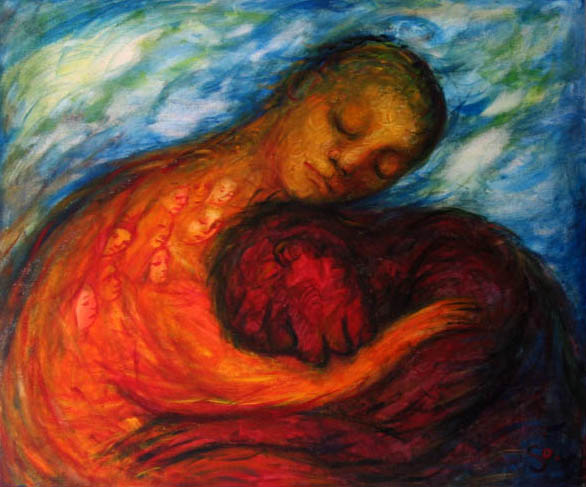
Although I know this story well of Jacob wrestling with an unknown man (an angel? who knows?), I had not paid attention to the meaning of the name, Israel (“struggles with God”). And for me, a new scenario emerges of Jacob actually struggling with himself, that part of himself who was named usurper or supplanter. His history was full of deception and trickery and this night, I believe he struggled with that self in order to emerge new.

So Jacob was left alone, and a man wrestled with him till daybreak. . . . Then the man said, “Let me go, for it is daybreak.” But Jacob replied, “I will not let you go unless you bless me.”The man asked him, “What is your name?” “Jacob,” he answered.Then the man said, “Your name will no longer be Jacob, but Israel,because you have struggled with God and with humans and have overcome.” [Genesis 32:24, 26-28, NIV]

I am a bit of a Doctor Who fan (not a serious fan, but I do enjoy watching the show on occasion). It just so happens I watched an episode reminiscent of this Jacob story in which the Doctor and his companions are challenged by a foe called the Dream Doctor who tells them they must choose between two dreams, which is real and which is a true dream? If they choose the correct plot, they will all live, but if they choose incorrectly, they will all die. It’s a mystery of course. But in the end, the Doctor figures it out and realizes that both scenarios are dreams and he destroys them both in order to live in reality (a paradox, of course). But the key to the story is the identity of the Dream Doctor who the companions don’t recognize, but who the Doctor says he knows very well, his very own dark side.

We all have this dark side and it is through our journey in faith, in Christ, that we are gradually able to bring that side forward in order to wrestle with it. Most of us tend to hide the dark side as long as possible, but truthfully, only when the dark side is brought to the light, can we be healed. As long as the dark side stays in the dark, it is safe to live on. (Oh, how Star Wars that all sounds. Sorry.)

These are my late night ramblings as I consider the meaning of Israel as a word. And if I was a true historian, there is probably more depth in it when it’s applied to the nation Israel. But I won’t go there in print. 🙂

I give thanks, instead, to the Christ who does battle for me and with me in the name of God, the Light of the World.


Read Full Post »

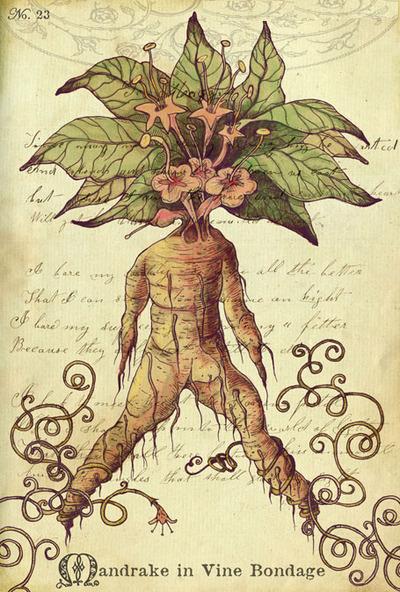
mandrakeIn case you don’t know the story, mandrakes supposedly have fertility enhancing properties (along with possible euphoria and hallucinations). All the same, Reuben, oldest son of Leah (the wife Jacob didn’t want), finds some in a field and he gives them to Mama Leah to use on Jacob (knowing of her longing to be loved by the man who wouldn’t or couldn’t care less). Rachel (the sister that Jacob did love but who was barren) makes a deal with sister Leah: give me the mandrakes and I’ll “let” you have another go at the man. Great story for “sister-wives;” they should be on TV.

So when Jacob came in from the fields that evening, Leah went out to meet him. “You must sleep with me,” she said. “I have hired you with my son’s mandrakes.” So he slept with her that night.God listened to Leah, and she became pregnant and bore Jacob a fifth son.Leah conceived again and bore Jacob a sixth son. Then Leah said, “God has presented me with a precious gift. This time my husband will treat me with honor, because I have borne him six sons.” [Genesis 30:16-20, NIV]

Of course, it didn’t work. Despite Leah having her own babies again, those two more sons (and a daughter – Dinah – barely worth mentioning), only later that did Rachel have a child and apparently, not from the power of the mandrake root.

These women were operating in a world of baby competition. Children were essential to the future of the family, and in particular, to the woman in a household. And, with the promises of God doled out to the line of Jacob, these women were the brokers of their husband’s descendants. In the end, Rachel only produced two of the patriarchs of the twelve tribes, her maidservant Bilhah birthed two sons, Leah birthed six sons, and Leah’s maidservant Zilpah also birthed two sons. And yet, despite the numbers being on Leah’s side, Jacob never did come around, and loved Rachel’s boys (Joseph – famed for the multi-colored dreamcoat and Benjamin) the most, playing favorites throughout their lives.

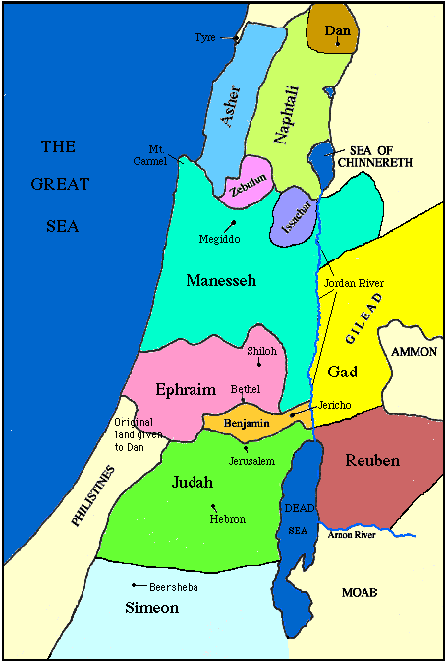
tribemapIt’s not like Leah’s boys weren’t important in their own right: Judah’s birthright, for instance, was foundational to the Jewish nation or Levi, whose descendants ruled the Temple and interceded with God as priests. They were all on the map.

Each son had his own future and each child born had a destiny.

The mandrakes were a tool that two women tried to use to manipulate their futures, their love lives, and their progeny. It didn’t work; it doesn’t work today either.

As the mother of three adopted children and no biological children, I know the mandrake game. I tried the same thing. I could not fathom that God would actually put two Christian people together and not create offspring from them. I became a sort of Rachel, trying all kinds of tests and suggestions to make babies happen. But God doesn’t act from my mandrakes or my plans. God is sovereign.

in this houseEven when our story changed and we adopted children, I tried to control their outcomes. Oh, I know, it was all in the name of giving them the best, giving them opportunities I never had, building arenas of success, layering on the expectations. I am ashamed to confess these things for my plans created many disappointments. But, my disappointments were self-inflicted. My plans were not God’s plans [Isaiah 55:8].

My children are still God’s masterpieces [Ephesians 2:10, NLT]. And my job should have been to plow the ground and provide nutrients, but allow them to grow into themselves, into the people God intended.

Forgive me for the mandrakes in my life, Lord. And do what you will with our children, now young adults, looking for a way. Perhaps the road could have been easier if I hadn’t littered it with so many calculations.

But, just like Rachel & Leah, the one thing I gave without mitigation was my love. And I am thankful that love covers a multitude of sins [I Peter 4:8].

Read Full Post »

« Newer Posts - Older Posts »