Feeds:
Posts
Comments

Archive for the ‘Ordinary Time’ Category

ifJob finally stops his long recitation of sorrow and lays out a series of If/Then statements. In chapter 31, he makes at least sixteen if statements, all articulating what he has been accused of by his friends and family (as a reason for his current sufferings) and Job basically says, if it’s true that he did any of these things, then may others benefit from his mistakes, may people change their paths, may more harm come to him, and so on. It’s a fascinating end to his arguments, and the chapter concludes with “The words of Job are ended.”

Scripture example:
If ever people in such conditions did not physically bless and thank me
        for warming them up with the fleeces of my own sheep,
If I ever used my civic strength to condemn the fatherless
        simply because I knew I had allies in the courts;
Then let my arm be pulled from its socket!
        Let my forearm be snapped off at the elbow for raising it against the orphan! [Job 31:20-22, The Voice]

It’s a strong presentation. But it’s also a bit of a prideful one. He’s so sure. Job is just so sure that nothing in his life would warrant his current circumstances.

And of course, for those of us reading, we already know how the story began and ends. Ultimately, he was right. Job had not sinned or lied or cheated. He had feared the Lord and acted accordingly.

But the one thing he did not consider was that God is sovereign and ultimately, can choose or not choose, do or not do as God wills. God cannot be held to logic or democracy. It is not for us, human, to necessarily figure it out. Most people don’t particularly like that concept, but I think it’s quite true.

There is, of course, if/then in our own lives as well as sowing and reaping. We don’t have God’s latitude, except for the divine intervention of the Christ, the Messiah, whose mission was to break the ongoing if/then of our cultures and our races.

ifthenThere is good power too in if/then. We don’t have to throw out the baby with the proverbial bath water. It’s a core theme to a type of goal planning and success. It’s a way of talking to oneself or scheduling one’s day and the reason it has power, the “if” statement presents an accomplishment or finished task that then frees the mind to move on to the next thing, the “then.” For instance, “If I have finished writing this blog post, then I can read those articles on Journaling” or “If it is 7:30 pm, then I can spend an hour on Facebook.” (For more on this concept, How To Use If-Then Planning To Achieve Any Goal.)

Interestingly enough, there is currently a Broadway Musical about to be launched in March 2014 called, of all things, If/Then. The story seems to revolve around different paths in a life. Most of us have played that game in our heads, what if I hadn’t married this particular person and gone to college out of state instead. Then, who would I have become?

I really didn’t get any deep insights here, but I am aware of the power of “If.” It carries with it an assumption or set of conditions and I think, perhaps, I have been building the wrong if statements in my life. I just want to think about it. You?


Read Full Post »

DelusionHow often have you heard this? It’s a catch-all phrase people say who bristle at the more impugning Christian-eze about everyone being a sinner, needing to be saved, and so on. Honestly, they think to themselves, why do I need a Savior? I’m a good person, I’ve never killed anyone or abused a cat or intentionally done harm to someone else. Job had a little of this attitude going too.

God forbid that I should justify you—saying you [Bildad, Eliphaz, and Zophar] are right [in your accusations against me]; till I die, I will not put away my integrity from me.  My uprightness and my right standing with God I hold fast and will not let them go; my heart does not reproach me for any of my days and it shall not reproach me as long as I live. [Job 27:5-6, Amplified]

What is the appropriate reply? I’m not sure. Is it for me to try and convince the other person of his/her shortcomings, immoralities, or misdeeds? Is it for me to point out their personal abuses like overeating, smoking, or other chemical intake? Is it for me to mention their self-absorption, their miserliness, or their pride? Am I to be the one to point out their luxuries while others starve, their health while others die, their contentment while others suffer? Should I mention their debt or over-spending? Should I mention a lack of empathy or compassion for others not like them? Should I mention words of judgment or lies or flattery?

For these things, I stand charged each day. I don’t need anyone to tell me because I know. And I ask forgiveness. I am no better than you. And maybe no worse. But I see the truth of me in the mirror of Christ while also seeing a potential for true “good.”

This is the beginning wisdom.

Read Full Post »

notre dameHow did this get past me after all these years? Honestly, I was so sure that this phrase, “I know that my Redeemer liveth,” made most popular in Handel’s Messiah, was from Isaiah, like so much of that great oratorio. Instead, I’m reading along in Job, and there it is jumping out at me.

“But as for me, I know that my Redeemer lives,
and he will stand upon the earth at last.” [Job 19:25, NIV]

Remember now, this is Job, one of the oldest texts and yet the Redeemer appears, the vindicator, the deliverer, the rescuer: only the Messiah, who Job proclaims despite his exhaustive litany of sorrows, losses, betrayals, and sickness. His redeemer lives. And mine.

Read Full Post »

smhNot as popular as the ubiquitous LOL, but SMH is appearing more and more in text messages and Facebook comments. And here, in one of the oldest books of the Bible, Job says it too:

I also could speak like you,
    if you were in my place;
I could make fine speeches against you
    and shake my head at you. [Job 16:4, NIV]

The Voice translation gives the verse a little more clarity:

If we were to trade places,
        I could rattle on as you do.
    I could compose eloquent speeches as you do
        and shake my head smugly at you and your problems. [Job 16:4, The Voice]

And there it is: shake my head smugly at you. Job is calling out his friends for what they are really doing, which is judging him. And quite honestly, so is every SMH. It’s a subtle put-down but a put-down all the same.

I have never liked the book of Job much with its speech after speech after speech, pretty much saying the same thing over and over again. It reminds me of a one of my colleagues long ago with whom I completely disagreed, and yet despite my authority to say “no” and my opinion (shared by others), she would continue to state her case, first in one way and then in another, as though, the wording alone would finally break through my dense skull. I kept saying, “I understand what you are saying but I disagree with you all the same.” She could not fathom how I could possibly disagree, surely I wasn’t understanding the “truth” she was imparting. And she would begin again.

But perhaps this story sticks in my mind because I am guilty of it myself. Perhaps I am SMH, if not physically, then emotionally or privately. Whether overt or secret, I am still holding court in my mind.

I am not Job in this story, I am one of the friends. And I’m not liking it much, this realization.

Solution? None. At least, not at this point, except for awareness and I suppose that’s worth something. And certainly, the next time I am tempted to SMH, I will think twice and look back into the root of it.

Read Full Post »

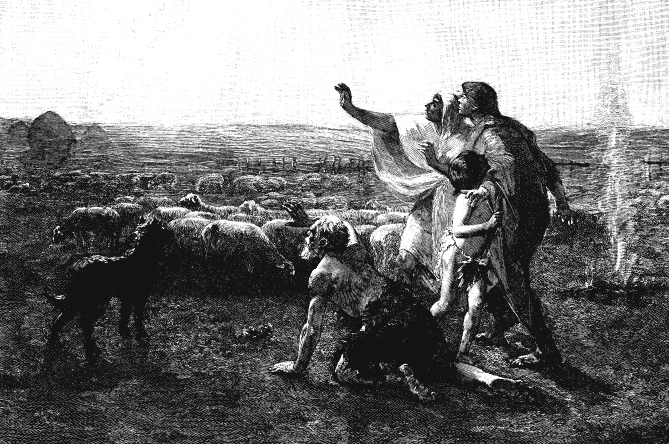
shepherdsHow many of us know a shepherd. Honestly? At best I may have met a 4-H person at the Farm Fair. Oh, and one of my library colleagues used to raise a few sheep for the wool which she sheared and spun and created beautiful things. But she wasn’t exactly Little Bo Peep. And although nativity story shepherds have been romanticized, the truth is they were on some of the lowest rungs of the ladder. They were a necessity for the economy, the protection of the sheep, but their jobs were B-O-R-I-N-G. In modern day, I might compare them to a rent-a-cop on the graveyard shift of a storage unit.

And there were shepherds living out in the fields nearby, keeping watch over their flocks at night. An angel of the Lord appeared to them, and the glory of the Lord shone around them, and they were terrified. . . . When the angels had left them and gone into heaven, the shepherds said to one another, “Let’s go to Bethlehem and see this thing that has happened, which the Lord has told us about.” So they hurried off and found Mary and Joseph, and the baby, who was lying in the manger. [Luke 2:8-9, 15-16, NIV]

I’ll look into angels tomorrow but for now, let’s look at shepherds. Back in the day, the shepherd metaphor was a good one. The Greek word poimēn word means herdsman or shepherd, but even then, it was seen metaphorically, the one who watches over the flock, the one who protects the herd from outside danger, the one who seeks for lost ones, the one who heals the sick. For these reasons, many have compared shepherds to pastors in a church. And certainly, even Jesus himself, allowed this comparison [John 10:14-16].

What’s funny about shepherds to me is that despite their humble station, the critters they guarded appeared to be quite stupid and over the years, and this has stuck. Despite some contrary information in recent years about sheep being able to recognize faces of other sheep and human caretakers, build relationships, and possibly know how to eat certain plants to make themselves feel better. But mostly, we find sheep to have such a strong flocking instinct and “follower” genes that they will do themselves harm based on who they follow. That metaphor has never been complimentary to the church or people who follow leaders blindly.

But no matter how much we imagine this shepherd/flock relationship, it’s not really in our modern ken or culture. We don’t have a modern counterpart to the stinky, smelly sheep workers who were more comfortable alone with their animals than they were with other people. They were undoubtedly loners and nomadic by nature. They often endured taunts for unappealing acts with their ewes. Was it true? I really don’t know. And yet, these most lowly of men were, according to the story, visited by angels in such a large number that many shepherds (scattered over the fields) saw the spectacle and responded.

It is so often the case that the poor and “least of these” type folks get the message. They have nothing to lose, having little to begin with. The grassroots campaign for the Christ began with them. Come see–go tell. The Messiah has come.

Read Full Post »

There’s a word that conjures an immediate response I’m sure. From billboards, “Virgin : Teach Your Kid it’s Not a Dirty Word,” to Virgin America Airlines to put-down, “You’re still a virgin?” What does this hot word mean in your world? Or mine?

Our Lady of Guadalupe by Pristine Cartera-Turkus

Then Isaiah said, “Hear now, you house of David! Is it not enough to try the patience of humans? Will you try the patience of my God also? Therefore the Lord himself will give youa sign: The virgin will conceive and give birth to a son, andwill call him Immanuel. [Isaiah 7:13-14, NIV]

Of course,  theologians have since uncovered a less than miraculous explanation of Isaiah’s prophecy since Jewish culture assumed that all young women were virgins. They had a good reason for this assertion since sex outside of wedlock was punishable by death. The Hebrew word for virgin as it is used in Isaiah is Alma, or young woman. When the these verses were translated into the Greek, the word Parthenos was selected which had only one meaning, virgin. (By the way, small piece of trivia, the Parthenon’s name came from this same word and one of the reasons was that this temple was filled with temple prostitutes that were virgins – and apparently disposable after a single use.)

The point in the nativity story, I suppose, is not that Mary was a virgin, since that was the norm, the point was that she was impregnated supernaturally. In fact, scripture articulates that Joseph, her fiancee did not have sex with her until after the birth of Jesus [Matthew 1:25]. And for many people, this miracle stops them in their tracks. And some denominations take Mary’s virginity to the next level, saying she was made sinless as well, creating an immaculate conception. [For more on this topic, see Let Us Reason Ministries online.]

We’re living in a time of science and reason and miracles of any kind are always suspect. In my mind, the entire concept of God providing a propitiation or atonement for the choices that created a state of human separation from God is a gigantic miracle in and of itself. The methodology would have to be out of our ken in order to make it work.

Ancient humans seemed to naturally understand the idea of atonement, sacrificing all kinds of animals and daughters to appease the gods, the sun, the weather, or whatever else they could not understand. They seemed quite clear about the basic idea of sowing and reaping. Even Karma, an Eastern idea of cycles, supports the supposition that there are repercussions to our choices (both good and bad).

The virgin birth is actually somewhat inconsequential to me. The idea that God became fully human is much more intriguing. The idea that fully human God (as Jesus), came as an atonement is even more absorbing.

I just want to think about that today.

Read Full Post »

I was thinking today about the feelings and thoughts of someone on death row. And I wondered how I missed the similarities between myself, while I was still isolated away from God/Spirit/Yahweh, while swimming in a sea of self-manufactured detritus. The sentence is the same. The mega-tube slide relentlessly taking me downhill.

break freeI sought the Lord, and he answered me;
    he delivered me from all my fears.
Those who look to him are radiant;
    their faces are never covered with shame.
This poor man called, and the Lord heard him;
    he saved him out of all his troubles.
The angel of the Lord encamps around those who fear him,
    and he delivers them.  [Psalm 34-4-7, NIV]

Once an inmate is on death row, there is no action that can be done on one’s own to stay the sentence. The “help” must come from the outside, others who plead one’s case, a judge who might rule in the inmate’s case, a government official who might vacate the sentence. Salvation is offered. The inmate must choose to accept.

I just say “choose” because it’s not always the case that a person wants to live and it could be that the restraints on that “life” may not be acceptable. You see, despite the reprieve, a convicted criminal who somehow receives clemency will still be bound by a system of checks and balances. Each day and each morning, calls for a choice, to live.

There is a good reason that Moses writes, “This day I call the heavens and the earth as witnesses against you that I have set before you life and death, blessings and curses. Now choose life, so that you and your children may live and that you may love the Lord your God, listen to his voice, and hold fast to him.” [Deuteronomy 30:19-20a]

This morning, I attended a prayer breakfast sponsored by our city’s Chamber of Commerce. I find this event so very puzzling as many people attend out of some kind of civic obligation or opportunity for networking and not necessarily for prayer or religious instruction. And yet, the speaker is always clear on the message: God in Christ, the Way, the answer, the hope. It is not watered down. The speaker today was no different from years past. In fact, he called his chance to speak for what it was, “crossover evangelism.” I had never heard the term, but it reminded me of Christian artists who had crossed over into the secular market or country singers who achieved crossover into rock ‘n roll. He was reaching a group that may not have heard a message of reprieve from a life in emotional, relational, or financial chains in such a way.

The speaker, Robert Kossack, is the founder of an organization called Project Crossroad, an organization whose sole mission is to aid youth as they come to one of those many crossroads in life. (Of course, these crossroads happen all along our lives and not just in our teens or twenties.) Kossack spoke passionately and from the heart about his own crossroads and how his choices put him in prison. He, too, was on one of those rapid rides downhill. But through circumstances and epiphany, he chose life in the Spirit of Christ Jesus. And in this place, stopped the spiral downward. My favorite part of his story was when he told of the “walk” he took with a guard in the last minutes of incarceration, a long walk designed for him to remember that place and all that it held (chains and cells and barbed wire and strip searches). The guard insured that Kossack saw these things one more time and told him to “never forget.” And finally, when he had reached the area called R&D (Receiving and Discharge), his family waited for him on the other side. He could see them through the doors. Kossack wanted the guard to remove his chains before he stepped through the door, but the guard commanded him to step aside. And the revelation occurred to him, that the door to the outside would not open until the door to the inside was closed. The only thing that stood in the way was he, himself.

This is so for all of us. Reprieve is offered and we tend to stand in the way of it. We say we want help but then stand in the way of its offer. I am guilty of the same.

The promise is that God will deliver us from our fears and from our prisons. That promise is faithful and true but it is we ourselves who may be missing it. Stand aside for the power of God. Accept reprieve, immunity, and forgiveness.

Choose life.

Read Full Post »

« Newer Posts - Older Posts »