
Feeds:
Posts
Comments

smhNot as popular as the ubiquitous LOL, but SMH is appearing more and more in text messages and Facebook comments. And here, in one of the oldest books of the Bible, Job says it too:

I also could speak like you,
    if you were in my place;
I could make fine speeches against you
    and shake my head at you. [Job 16:4, NIV]

The Voice translation gives the verse a little more clarity:

If we were to trade places,
        I could rattle on as you do.
    I could compose eloquent speeches as you do
        and shake my head smugly at you and your problems. [Job 16:4, The Voice]

And there it is: shake my head smugly at you. Job is calling out his friends for what they are really doing, which is judging him. And quite honestly, so is every SMH. It’s a subtle put-down but a put-down all the same.

I have never liked the book of Job much with its speech after speech after speech, pretty much saying the same thing over and over again. It reminds me of a one of my colleagues long ago with whom I completely disagreed, and yet despite my authority to say “no” and my opinion (shared by others), she would continue to state her case, first in one way and then in another, as though, the wording alone would finally break through my dense skull. I kept saying, “I understand what you are saying but I disagree with you all the same.” She could not fathom how I could possibly disagree, surely I wasn’t understanding the “truth” she was imparting. And she would begin again.

But perhaps this story sticks in my mind because I am guilty of it myself. Perhaps I am SMH, if not physically, then emotionally or privately. Whether overt or secret, I am still holding court in my mind.

I am not Job in this story, I am one of the friends. And I’m not liking it much, this realization.

Solution? None. At least, not at this point, except for awareness and I suppose that’s worth something. And certainly, the next time I am tempted to SMH, I will think twice and look back into the root of it.
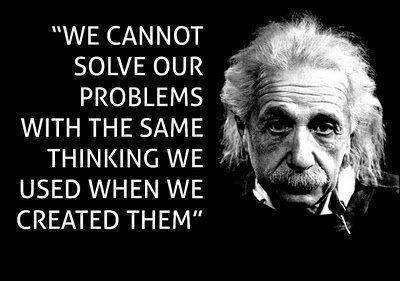

Albert Einstein

Albert Einstein

It’s a mysterious statement and how interesting, that it comes from the mouth of Zophar, the least likely of the three “friends” of Job. After all, his next breath his full of chastisement and nastiness toward Job. And yet, he does have this one right.

Oh, how I wish that God would speak,
    that he would open his lips against you
and disclose to you the secrets of wisdom,

    for true wisdom has two sides. . . . [Job 11:5-6a, NIV]

In a wonderful online homily, this topic is explored more fully, but it fits in with my own view of the many paradoxes that exist in scripture and faith. An old friend used to call it the both/and of truth. In God, two seemingly opposed truths can actually co-exist. How is that possible? I don’t begin to understand it. But I believe it because it allows for the conundrums that an “all-knowing God” and the “free-will of Human” can be true as well. It is wisdom to accept the possibility of their concurrence.

Another view of the two sides of wisdom might be the simple explanation that everything is not revealed to us, like the iceberg that only shows a tip of itself while the greater story is beneath the water.

both-andAs I see it, God himself declared that Job was a righteous man whose love for God was pure and above all other living men. Job committed no sin that we could see to warrant his suffering. God allowed it to happen at the hand of the enemy. Somehow, God knew it would take Job to the “next level” of understanding and wisdom and faith. At great cost.

A deeper truth had to be examined, a more difficult investigation into human.

I must remember this basic truth as well: all stories have two sides, all of suffering is an iceberg, all sin has a path leading up to it. So often, I hear people condemn those who adhere to looking at the world as black or white, good or bad, etc. But I think it may be a mistake to assume that the only alternative is to say that the world is grey, as though the contrary forces would meld into something new. Instead, it may just be possible, from a God view, that both black and white can live together and still retain their identities.

Drawing by Oldřich Kulhánek

Drawing by Oldřich Kulhánek

Job did. At least, that’s what is written about him in Job 7:16 and then again in chapter 10, verse one.

I despise [loathe, hate] my life; I would not live forever.
    Let me alone; my days have no meaning. [Job 7:16, NIV]
and . . .
I loathe [hate] my very life;
    therefore I will give free rein to my complaint
    and speak out in the bitterness of my soul. [Job 10:1, NIV]

The dictionary defines “despise” as loathing and “loathing” as a feeling of disgust or intense aversion for something. If we switch over to the word “hate,” it is defined as an intense or passionate dislike, an extreme hostility toward something.

In the early weeks or months of Job’s suffering (no one knows for sure how long he suffered, but most scholars count his time in months and weeks and not years), he hated his life. His suffering was so intense, his dismay at the losses, his “why me” lament, caused him such intense feelings, that he abhorred his very existence.

And yet, he did not kill himself. He was, despite it all, somehow surrendered to God’s will.

There is so much I do not understand about Job, but I do see this: he was in terrible pain. He was distraught and hated his circumstances. He wanted it all to end. He wanted to forget, to stop feeling, to stop experiencing all that was horrible in his life. He was attacked by his own friends and he was misunderstood. Nothing new there. Job was fully human. He was no angel in his torture and so he cried out with intensity and even venom. But he remained.

Even his wife said he should “curse god and die!” She too suffered, but ultimately placed the blame fully on Job’s own shoulders. As did his friends.

Apparently, someone has to be to blame. We do it in our modern times too, don’t we? It’s the boss or the President or the Congress or the neighbor. It’s the parents or the children or the Pastor or the car in front of us. It’s the farmer or the industrialist or the millionaires on Wall Street. It’s the Muslims or the Gays or the Polygamists. It’s the Jews or the Christians or the liberals or the conservatives. They did something! Things are bad. Someone did or said something to bring this on. Right?

Or, maybe, just maybe, it’s up to us to simply stand in the midst of the storm.

Therefore put on the full armor of God, so that when the day of evil comes, you may be able to stand your ground, and after you have done everything, to stand.” [Ephesians 6:13, NIV]

When my friend, Mary, died on Mother’s Day, 2013, she endured several months of the ravages of pancreatic cancer. Her disease was inoperable and therefore, nothing could be done but to ride it out. When I visited her early in her death pilgrimmage, I will never forget her words: “I did nothing to cause this. I have been healthy all of my life; I ate well, I exercised, I took care of my body and my spirit. This is simply part of my journey and I will to experience it fully, without blame toward anyone, including Spirit.” And so she touched hundreds of lives in her final months and died with no miraculous healing or recuperation.

She did not despise her life or her God.

Hate and disdain, name-calling and blame-shifting, take up a lot of energy. They suck up valuable human resources.

No more. No more.

Genealogy of Noah

Art by Gil Bruvel

Art by Gil Bruvel

I tried to do a cursory read of some of the commentaries on the three sons of Noah (Shem, Ham, & Japheth) and immediately realized I could never cover all of this controversy in a single post. It’s a big deal, the descendants of these three and the curse that Noah placed on Ham’s son Canaan (specifically) due to some kind of drunken episode (verses 20-27). The theories are many, the results undeniable, if genealogy is indeed the culprit, that, and a popular term of today: “generational sin.”

The sons of Noah who came out of the ark were Shem, Ham and Japheth. (Ham was the father of Canaan.) These were the three sons of Noah, and from them came the people who were scattered over the whole earth. (Genesis 9:18-19, NIV)

The oldest is actually Japheth and his name means opened. And a quick look in chapter ten shows that his descendents appear to be the great travelers who spread humanity the furthest. And then, the middle son, is Shem and to him is attributed the line of Abraham, David, and the Christ through Mary (Luke 3). And so, they were known as Semites, which became another way to refer to the Israelites and Jews of later days. And lastly, there is Ham, whose son was Canaan (among others) and who received the curse which many attribute to the seemingly endless animosities between those generations and all other peoples. Is it so? I really don’t know. There are even scholars who have credited the various races and skin color to those three family lines (which seems a little ridiculous to me).

But then, is it really necessary to “explain away” our current world tensions by marching back in time through scripture to put the whole thing down to a younger brother seeing or possibly engaging his naked father in some way? Really? I think generations of transgressions and the human tendency toward self-preservation and righteous indignation have done enough damage along the way, with or without the curse.

Genealogies are good for hindsight I suppose. It’s fun to go back, using a 20-20 lens to see what happened and how each person/choice turned the wheel of time. And one day, I suppose, our own descendants will look back on our now as well. “What were they thinking?” They’ll never understand our choices anymore than we understand the choices of our own ancestors. Lessons could be learned, since it is said, again and again, (thank you George Santayana), “Those who cannot remember the past are condemned to repeat it.” But do we?

In reality, we change history all the time. In fact, our individual histories are more fiction than truth. We remember what we want to remember and fill in the rest. “Memory is fiction. We select the brightest and the darkest, ignoring what we are ashamed of, and so embroider the broad tapestry of our lives.” (Isable Allende.) [For more on this topic, read Luc Sante in the New York Times Sunday Book Review, March 12, 2010.]

So many people are on the genealogical bandwagon. Even celebrities have joined in the foray, looking for lines of descent as though this might explain who they have become outside of mere circumstances or serendipity, or simply God’s will and hand moving through Spirit.

We can study and we can ponder what has been or could have been, but the moment of greatest concern should be now, for it is our response to the events and knowledge of today that will turn the world (both the microcosm and the macrocosm).

Cain and Abel

Photo by Bjorn Andron

I had a new thought about these two. It’s nothing earth shattering and my guess is as good as another’s when it comes down to the story of Cain and Abel and how the younger brother died. I have been greatly influenced by all the bad Sunday School art and for some reason, we have been led to believe that Cain came upon Abel from behind and whacked him over the head. The end of Abel.

“Now Cain said to his brother Abel, “Let’s go out to the field.” While they were in the field, Cain attacked his brother Abel and killed him.” [Genesis 4:8, NIV]

But I have a new thought. Wouldn’t it be far more interesting if they actually had an argument in that field? Isn’t it possible that Cain decided to confront Abel about the differences between them? And isn’t it possible that instead, they fought to the death? In the scheme of human frailty, it makes more sense. It was a fight that could have ended differently, but instead, ended in Abel’s death. There is no reason to believe that Cain hid the body or buried it either. Things moved quickly after that and Cain, not killed by God (as he would have been in later years under the law), but simply banished. There was something of value in Cain that God decided to preserve. And so he went off and built another life.

I’m not sure what that really means for me today. Perhaps it’s just a reminder again that everyone has something inside them worth nurturing and that second chances are possible if we give just a little.

MicahEach year brings its challenges and dreams, its disappointments and surprises. I am alive, blessed with work and shelter, and healthy for the most part: for these things I give thanks. I want to keep my focus this year on the Christ within, the story that God has given us in scriptures to mark my way, and the people  around me to share the journey. I want to lead and I want to be led. I want to be a light and pierce the darkness. I want to count to ten before I speak ill of anyone. I want to practice contentment. I want to be a champion for joy.

My verse for this year is Micah 6:8

He has shown you, O mortal [human], what is good.
    And what does the Lord require of you?
To act justly and to love mercy
    and to walk humblywith your God.

My long term resolve for this year in God is to

  • st patrick prayerTo read the Bible through again (daily), this time using one of the chronological plans where the poetic and prophetic chapters are interlaced with the historical. I found this particular plan at the website: Blue Letter Bible, if anyone cares to join me. It can start on any day of the year.
  • To re-imagine prayer and pursue an interior life, daily.
  • To celebrate what is good by dropping small notes into a jar and then reading them on 12/31/14, daily.
  • To respond to God’s will and submit to the Holy Spirit, daily.
  • To write. Daily.
  • To honor the gift of health by engaging my body in exercise, wellness, and nutritious eating, daily.
  • To order my spaces, not with guilt but with respect for the endowment God has provided.

Let it be so, dear Christ, dear Spirit within and without.

I invoke the Lorica Prayer of St. Patrick (in which lorica means body armor or protection), I enter this year with Christ.


ImpossibleIt’s been the word of the season at Restore Church this year: impossible. And it’s a word that all believers must hear, should hear, need to hear and understand. This word is about us today and our faith. This word is about the extent to which God will do something from nothing. Thanks Pastor Jess Bousa for this word, now illuminated.

It sounds impossible, but listen—you know your relative Elizabeth has been unable to bear children and is now far too old to be a mother. Yet she has become pregnant, as God willed it. Yes, in three months, she will have a son. So the impossible is possible with God. [Luke 1:36-37, The Voice]

The concept is a simple one, that the impossible cannot be expected: it is a miracle after all. And yet these miracles are among us every day but we fail to give them their due. Isn’t it a miracle that a man, like Jess, could be transformed from full-blown drug addict to pastor of a thriving church? Or that I, a self-indulgent, pot-smoking, foul-mouthed actress wannabe could become a follower of the Christ? Or that my children, all adopted, would be “the ones” out of a million orphans to come into our family? All of our lives are filled with the miracles of impossible when God takes the raw material of “nothing” and makes something. Whether one sees the Genesis story as word for word real or symbolic, the message is the same: Creator God is a Maker God, who uses building blocks that none of us can really fathom. Something from nothing. Possible from impossible.

In Greek, impossible is adynateō with meanings that bridge the distance between weakness, inability, and powerlessness to the bottom line: it cannot be done. And God asks me, when will I see and understand the adynateō in myself? Not weakness in what I want to do, my dreams and ambitions. No. This is the weakness in the face of what God wants to do. In Corinthians 12:9, God speaks through Paul saying, “My grace is sufficient for you, for my power is made perfect in weakness.” God is talking about the God Plan in Paul’s life and ultimately, in my life too.

God’s power manifests in doing God’s plan. 

impossible triangleOh, silly me. I have missed this obvious all along. I keep trying to get the blessing (and success) for my ideas, my plans, my ambitions, my projects. But there has been little room in my masterminding for the impossible, the unexpected, the miracles of God.

How many sermons and teachings have we heard about knowing God’s will for our lives, as though we might be able to figure out the impossible?

This is the only time I can truly say that the cliche, “whatever,” used by teens for the last decade or so, is truly the correct word in this situation. Our surrender to God is a “whatever.” That is, whatever God wants to do, whatever the Holy Spirit wants to manifest, whatever is possible in God’s cosmos, I choose to embrace today.

Don’t misunderstand me. I am sure this is not a passivity where we simply lie down on a bed and wait for a miracle. If anything, it’s a reckless abandonment of my narrow views in favor of the expansive potentialities of God.