
Feeds:
Posts
Comments

Posts Tagged ‘Christ’

The second appearance of the Christ is critical to the faith. But I must say, it’s been an event a long time coming. No one can really imagine what the Second Coming might look like. Scriptures are fairly vague at best.

Hebrews 9:28
. . . so Christ was sacrificed once to take away the sins of many; and he will appear a second time, not to bear sin, but to bring salvation to those who are waiting for him.

There’s Revelation 1:7 — “Look, he is coming with the clouds, and every eye will see him. . . ” and Matthew 24:30 — “Then will appear the sign of the Son of Man in heaven. And then all the peoples of the earth will mourn when they see the Son of Man coming on the clouds of heaven, with power and great glory.” and II Thessalonians 1:7b — “This will happen when the Lord Jesus is revealed from heaven in blazing fire with his powerful angels.”
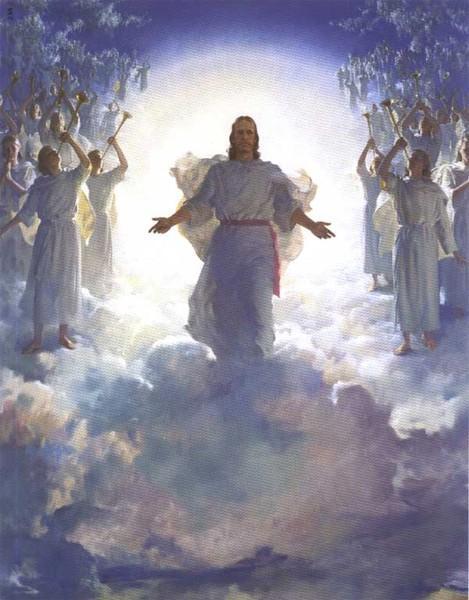
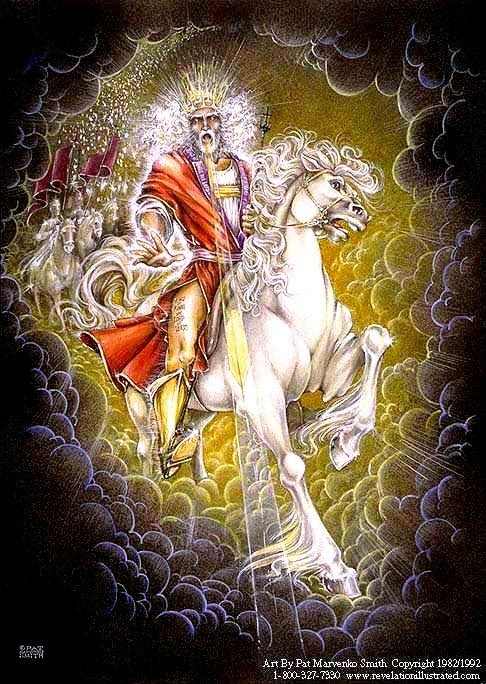
So what do we have here: clouds, flames, and signs with the Son of Man manifesting in the midst of it all. Artists have rendered this idea/image as either the Bible School Jesus all in white, robes flowing, or some kind of King image, all in gold, often times on a horse, and full of majesty (whatever that means). In either case, he is recognizable. Me? I don’t think so. I don’t think we’ll understand the Second Coming any more than we understand the ways of nature. We may be able to describe its properties, but not its essence.
Some people talk about the Second Coming of Christ as their chance to say to unbelievers, “See, I told you so,” “I warned you!” They act as though they wouldn’t be in the same shock and terror and wonder! Face it. How many times do things appear out of nowhere in the sky? I have to laugh as I consider whether all the spaceship movies are getting us ready for that appearance.

Of course, not everyone believes this can even happen. I remember standing at a bus stop every day to wait for the public bus that would carry me to high school (this is pre-school buses in Indianapolis). On the corner was a church of some type or another and on their sign, it always said, “Jesus is coming soon!” From my limited understanding of Christianity in those years, I thought they were really stupid. How could Jesus come again if he had already come. This was a teaching I never got (or understood) in Vacation Bible School or the more formal Latvian Lutheran church services. I don’t think I was alone.

A Second Coming is not something which we can prepare for in any way. When Harold Camping touted his May 21st forecast of judgment day (now pushed back to October 21st), he made it sound like people could actually do something in time for that day. That’s not the purpose of Christ’s coming. It’s the end of the age. Whatever happens next will be new, different, not recognizable. It may mean death or it may mean transformation. It’s a nexus moment. When the Christ comes, and if indeed, it’s “in the sky,” then the universe has changed dramatically. Both things cannot co-exist and be the same as before.

And why do the scriptures say that people will mourn? Is it because they didn’t believe or is it the loss of what we know. Our children and our children’s children will not know life as we know it. Everything must change. Everything will change. And if we don’t like change now, “Baby, you ain’t seen nothin’ yet.”

Read Full Post »

Wood Engraving by Gwen Raverat

Whenever the word inheritance comes up in scripture, my mind vaults to the story of the prodigal son [Luke 15] who is given and subsequently wastes his birthright share in “wild living.” But an everlasting inheritance can’t be expended, nor can it be given ahead of time, or can it?

Hebrews 9:15a
[Christ, the Messiah] is therefore the Negotiator and Mediator of an [entirely] new agreement (testament, covenant), so that those who are called and offered it may receive the fulfillment of the promised everlasting inheritance. . .
[Amplified]

So many Christian people are quite focused on the heavenly bequest and even use the promise as an appetizer to entice others into becoming followers of Christ. It sounds a little like the lottery, as though they are saying, if nothing else works out down here on Earth, at least we know we’ll have entry through the pearly gates and streets paved with gold; at last, a life of leisure with no pain, no worries, and no kids (only kidding on that last one).

But is that the point? Are we supposed to be toughing it out here because we can count on this inheritance later? This would be like our own children making no efforts now and simply waiting around until the parents kick off and the 401K’s are distributed.

I think the everlasting inheritance supersedes time. Just as there is no time in God’s world, our heritage is not limited to our death and subsequent afterlife. Instead, it was precluded by Christ’s death and the distribution included the Holy Spirit who lives in and among us now.

You want to spice up the Four Spiritual Laws or your personal proselytizing, then start including the wonder of the Holy Spirit who dwells within us now, who partners with us in this life, who draws us into being better Humans, who stimulates our internal compass toward those in need, to pricks our conscience, and teaches us to love others by loving us.

This is the everlasting inheritance that is here today.

Read Full Post »

Art by Catherine Andrews

The implication then is this: if the Christ appeared in a more perfect tabernacle not of “this” creation, there must be other creations. Hmm. The psalmists write, Selah, “pause and calmly think of that.”

Hebrews 9:11
But [that appointed time came] when Christ (the Messiah) appeared as a High Priest of the better things that have come and are to come. [Then] through the greater and more perfect tabernacle not made with [human] hands, that is, not a part of this material creation . . .
[Amplified]

Are there other clear references to another creation? I mean, it isn’t necessarily heaven designated in this passage from Hebrews, it could be anywhere. It seems a bit “woohoo” and “new agey,” right? In fact, I find it totally other-worldly, Star Trekian, multi-dimensional, and clearly, we’re “not in Kansas anymore.” We’re outside our human understanding. We don’t know about this other creation(s).

I understand, some commentators still believe the “perfect tabernacle” is in heaven because the human tabernacle was intended to mirror or replicate some heavenly place. But I think that’s simplifying the Spirit realm of God. It’s anthropomorphizing what we don’t understand and trying to put it into human terms.

It’s a similar situation with all the prophets who were given extraordinary visions of things outside their ken such as animals covered with eyes and wings in Revelation or Ezekial’s animals with four faces.

When my children were little, my husband and I liked to have fun with the various holiday characters such as Santa Claus, the Easter Bunny, etc. We always told them these characters existed in a different dimension. As the kids got older and realized how unbelievable it was that Santa could fly across the world in a single night and deposit gifts in each and every house, we reiterated: different dimension–anything can happen. Of course, our story is not as creative as C. S. Lewis and his world of Narnia, but ultimately, we share the same idea, once anyone goes through a “portal,” things are very different “there” (wherever there is).

The world and words of the Spirit realm are best depicted through the arts I think. Music, visual art, performance art, dance, film, scent, poetry: these are some of the better expressions of God’s kingdom or sphere or neighborhood.

What the Messiah did for Human is not really fathomable in our limited cosmos. One sacrifice for all? One outpouring of blood covers all sins from the beginning to the end of time? Perfection in human form? Covenants, promises, reconciliation, restoration, renewal, all of these possible by the act of one offering? Absurd, right?

Nope. It’s the link between our creation and all the other ones. The ultimate portal. Not science fiction or fantasy, but God business. And the stuff of dreams, imagination, love, resurrection, and transfiguration.

Read Full Post »

What is a useful crop? I’m sure there would be lots of answers to this question depending on one’s point of view. Is my life producing anything useful? Beautiful? Memorable? Helpful? What is ultimately driving me? I am so very busy all the time. Maybe it’s time to rotate the crop?

Hebrews 6:7
Land that drinks in the rain often falling on it and that produces a crop useful to those for whom it is farmed receives the blessing of God.

When I was a younger Christian (back in the day is the latest phrase — of course, the kids who use it crack me up, it’s hard for me to consider their tween lives as “back in the day”), I was taught a similar sounding verse from John 15:8, “This is to my Father’s glory, that you bear much fruit, showing yourselves to be my disciples,” and that fruit meant converts. My fruit was supposed to be notches on my belt, the number of people “brought to Christ.”

But really, is it just about that? Or is fruit like the crops and what is truly important is that they be “useful.” Whatever I produce should have some purpose. Naturally, sharing my faith with others and the story of my transformation as a result of that commitment to the Christ is useful. But, there are other things: providing food and shelter for those who don’t have it or giving a family to an orphan, or guiding someone to resources they need to take the next step. These are all good.

What about beauty? Is art useful? Is music? Is drama or writing?

Too many people lose sight of the power of the arts and nature to feed the soul and to transcend circumstances.

Yesterday, I read in the New York Times Magazine about a young African American who grew up in the projects where deep poverty and casual violence was the mainstay of his life. And somewhere along the way, Ryan Speedo Green found the joy of music and now, he won an “idol” type contest by the Metropolitan Opera. Someone gave him this opportunity and it was more than “useful,” it was life-changing.

We never know who we will touch with our fruit but as long as it is nurtured with love and is an authentic expression of ourselves, there will be someone to eat.

Read Full Post »

Of all the senses, I find it fascinating that the writer of Hebrews uses taste twice in the same sentence to describe the human experience of the things of God, that is the heavenly gift and word of God. That sense we use every day when eating but rarely do modern believers “taste” God.

Hebrews 6:4-6a
It is impossible for those who have once been enlightened, who have tasted the heavenly gift, who have shared in the Holy Spirit, who have tasted the goodness of the word of God and the powers of the coming age, if they fall away, to be brought back to repentance . . .

Even back in Psalms [34:8], we are encouraged to “Taste and see that the LORD is good; blessed is the man who takes refuge in him,” or in verse 119:103, “How sweet are your words to my taste, sweeter than honey to my mouth! ”

There must be something then about the intimacy of eating and tasting that is particular to the Word of God (both Jesus Himself [“eat of my body and drink of my blood” John 6:52] and the words imparted to us through scriptures), as well as the heavenly gift (which could be any number of things, but in my mind, it’s pure grace).

Just a cursory glance through commentaries about these verses shows many have decried and argued and professed to know what they really mean. I can’t begin to make such a claim. I don’t even want to discuss what it might be to taste these things and then, by virtue of “falling away,” losing access to repentance. The whole idea gives me the heeby-geebies. The texts that fall on both sides of the aisle are numerous from the simplified “once saved, always saved,” to the stricter interpretation of “human will” to the more Calvinist interpretation that all human acts fall under the express sovereignty and rule of God. I realize there are issues here.

But what about this taste business? If I just focus on this one piece of information, this one phenomenon, I believe there is something here for me today that can transcend all of the rhetoric and apologetics.

Taste is a matter of detection, discovery and discernment. Everyone responds to foods differently, depending on the sophistication of their palate. Some people have affinities for certain tastes and aversion to others. On average, the human tongue has between 2,000 to 8,000 taste buds. It’s highly personal and individualistic.

And so, here’s my small point: when we taste the things of God, we all have a different experience. For some, it is a rich, sweet taste and suffuses the mind. For others, something else, like savory [or to use the latest word, umami] and maybe, depending on the circumstances, even bitter or sour or salty.

But in any case, the taste is strong and unique. Like the spelled “turkish delight” that drove Edmund in the Lion, Witch & the Wardrobe to make all kinds of poor choices, the taste of heavenly things is intimately memorable. I’m guessing or supposing that the taste sense somehow brings into sharp focus the other senses so that what is seen or heard or touched suddenly has a much needed added dimension.

Perhaps the next time I sit at a meal and pray a blessing on the food, I might add a silent prayer to expand my understanding of tasting the things of God.

Read Full Post »

Artwork by Gretchen Smith

Most of us know the short verse, “Jesus wept” [John 11:35]. We might even get a warm and fuzzy feeling at the picture of a sympathetic Christ, weeping for his friend. But how often does anyone quote this verse in Hebrews, where Jesus cries out loud and sheds tears before God?

Hebrews 5:7
During the days of Jesus’ life on earth, he offered up prayers and petitions with loud cries and tears to the one who could save him from death, and he was heard because of his reverent submission.

After a quick look at some of the commentaries, it’s interesting to me that most writers place all this “weeping and wailing” right before his death in the Garden of Gethsemane, as though this is the one time Jesus encountered his destiny and travailed before the Father. But I propose that the prayers and supplications of Jesus were ongoing. Think about it: how many times did Jesus miraculously escape the authorities? How many times did he suspect danger in his life, anticipate a shortened ministry, protect himself and his work by discouraging loose talk or gossip among his followers?

Jesus knew his life was forfeit but I can imagine him praying regularly, “Not yet . . . not yet. Give me a little more time.”

Jesus needed help and protection from God continually, not just in the garden, but throughout his ministry life. And in the same way that he emptied his heart and soul before God at Gethsemane, I believe he did this regularly and undoubtedly during many of those solitary prayers he sought out on the mountainsides, away from the disciples.

Lastly, I am intrigued by the idea of a noisy Christ. I mean, I don’t know about you, but a mental picture of Jesus roaring or wailing before God is difficult to wrap my mind around. And yet, why not? Isn’t it culturally appropriate? Would Jesus be “above” such behavior, such expression of need, desire, or supplication? Not at all.

I have experienced deep crying out to God and weeping but only at those times of deepest despair, betrayal, or fear. When I cried out to God at such times, I confess, it wasn’t that I put all my trust in God, I was merely bereft of hope, overwhelmed, and felt as if there was nowhere else to turn, I was “poor in spirit.” It was my last chance.

I wonder, were there circumstances and situations that Jesus did not expect to happen? Was he ever surprised (or surprised all the time)? Did he expect/hope his follower-disciples would “get it” sooner than they did (or did they get it while he was still alive at all?); was he troubled by the masses of people who easily followed him day after day for “bread and fish” but could not grasp the food of the Spirit; was he frustrated by his own inability to break through thousand-year-old traditions and beliefs? Did he cry out to God the day he called himself the “bread of life” and taught them about eating his flesh and drinking his blood–so many deserted him that day. I can imagine him saying, “Father, how do I reach them?”

And yet, each day, he submitted again and again and again to the role he was given to endure (in the order of Melchizedek); he pressed on. He woke up, he prayed, he taught, he ate, he miracled. And finally, he reached that God-ordained last day, that last supper, and that last prayer. My spirit tells me now: his garden prayers were not the first time he bled in sweat nor flooded the ground with his tears. His life in the Father was full of prayers and supplications every day.

Holy tears for me. Thanks be to God.

Read Full Post »

If I am supposed to have more confidence in the Christ, who acts in the role of high priest for me (whatever that means), and who supposedly has bona fide empathy with my temptations, then I’d better be clear on what they are.

Hebrews 4:15
For we do not have a high priest who is unable to sympathize with our weaknesses, but we have one who has been tempted in every way, just as we are—yet was without sin.

Secretly, I’m pretty sure I don’t really believe Jesus experienced all of my temptations and I’m guessing I’m not alone in that deep, dark truth.

Do I really believe that Jesus was tempted by anything like a Dunkin’ Donut or Creme Brulee? Did he worry about the number of calories consumed in a day or the sense of body betrayal when my favorite clothes no longer fit? Was Jesus ever tempted to give up and become a beached whale on the couch because nothing seemed to work?

Was Jesus tempted to run away from all of his responsibilities? Did he consider suicide? Was he tempted to get drunk and stay drunk because life was too overwhelming? And what about all the plights and dangers of love relationships, broken relationships, or marriages built on lies and convenience?

Or what about getting old? Did he look in the mirror and pull up on the crows’ feet around his eyes or stretch the skin around his mouth and consider plastic surgery? Did he stare at old people being helped out of cars with walkers and wheelchairs and contemplate such a future for himself?

I know I’m being ridiculous and yet, am I the only one who chafes, even just a little, at the idea that Jesus, Human for 33 years, could sympathize or empathize with the details of my life’s temptations?

The answer is right there of course. It’s not in the detailed temptations at all, but in the one big temptation that encapsulates them all: being in charge. The temptation is to do it “all myself” and to solve all my problems alone. It’s “kicking against the goads” [Acts 26:14]. It’s following the Eve and Adam story line.

How am I tempted? I am tempted to be a god and manipulate my environment and I am regularly disappointed in the results. And so, yes, it is this person who is asked to come to the Throne of Grace and ask for mercy and help. And the courage to surrender.

Each day.

Read Full Post »

« Newer Posts - Older Posts »