Feeds:
Posts
Comments

Posts Tagged ‘faith’

Martyr has become a dirty word over the last twenty years as Islamic terrorists and extremists have usurped its meaning through rampant suicidal bombings in the name of their God. And yet, even they fit the basic definition: a willingness to suffer or die for a belief or cause. Would I?

Revelation 6:9, 11
When the Lamb broke open the fifth seal, I saw at the foot of the altar the souls of those whose lives had been sacrificed for [adhering to] the Word of God and for the testimony they had borne. . . . [they were] told to rest and wait patiently a little while longer, until the number should be complete of their fellow servants and their brethren who were to be killed as they themselves had been.
[Amplified]

And there’s yet another negative definition for martyr, that one who seeks attention by feigning or exaggerating pain. Sometimes, it’s just a person who dramatically takes on the weight of any project with great long suffering. It’s a sham.

How has this word and its intended meanings gotten so distorted?

Of course, not every martyr must die to show his or her strength in following the heart of God. Many are persecuted today in various closed or restricted countries for their faith such as China, Zimbabwe, Eastern European countries like Uzbekistan and Turkmenistan, Muslim countries where western faith is scorned, and so on. These men and women are often imprisoned for basic activities such as prayer, bible reading or distribution, and corporate gatherings. Other martyrs are those work with the poor and sick such as Mother Teresa, William Booth (Salvation Army), David Livingstone (Africa), and Corrie Ten Boom [see more]. They are following an inner vision, a knowing that this is the way they must walk.

In John’s time, martyrdom had become a norm for the Christ follower, in fact, persecution and execution continued up through the 4th century until the time of Constantine. These deaths were not the result of a person’s actions, but merely by their affiliation. Other faiths and peoples have experienced this same kind of broad swathe of death, such as the Jews in Russian pogroms and throughout World War II, or the genocide of Rwandan Hutus in 1994 or African-Americans in our country. The list goes on and on.

So, there are two questions in all of this? Would I have the courage to stand for my faith in the face of death? And secondly, why must it be necessary?

In John’s vision, the implication is that more would die. Apparently, that magic number has yet to be reached.

Even in today’s pop culture, there’s this idea that a lover would die for another:

I’d catch a grenade for ya (yeah, yeah, yeah)
Throw my hand on a blade for ya (yeah, yeah, yeah)
I’d jump in front of a train for ya (yeah, yeah , yeah)
You know I’d do anything for ya (yeah, yeah, yeah)
Oh, oh
I would go through all this pain
Take a bullet straight through my brain
Yes, I would die for ya baby
But you won’t do the same . . . [Bruno Mars]

But really, isn’t it all just a type of posturing?

And yet, some men and women do enter the armed forces and put their lives on the line. Perhaps some don’t really believe they will die but others know, the possibility is there and something inside drives them. They are called heroes. It’s an idealism, a sense of sacrifice for the sake of the many, a belief in good and evil. Is my faith so strong?

How many more must die?

Read Full Post »

Album cover: Through the Open Door by Michael Anthony Miller

When formidable times come, it is more difficult to hang on to the truth of God’s sovereignty. Circumstances overwhelm the big picture and pain distorts understanding. Evil plays its hand and mocks the hand of God, claiming apparent victory. But we must look for the open door . . .

Revelation 3:7b-c
. . . These are the words of him who is holy and true, who holds the key of David. What he opens no one can shut, and what he shuts no one can open.

The supreme sovereignty of the Christ is captured in a single phrase about him, that is, the one “who holds the key of David.” The prophecies spoke of long lasting rule to the line of David in Israel. But even this rule was broken by imperfect rulers and inconstant followers.

While Jesus, the son of God, was perfect in plan and execution of God’s will, and now holds the key in perpetuity and rules humankind forever as the Christ.

This idea doesn’t sit well with human. We are a feisty, independent bunch and like our self-determination, despite the rocky outcomes (wars, rumors of wars, famine, uncontrolled disease, gluttony, murder, and conquest, just to name a few). We blissfully select presidents, prime ministers or simply allow dictators and totalitarians to rise up among us, but we (and I speak as “human” here) cringe or shrink away from the possibility of a divine God, a force unequaled on Earth, an entity outside of time but able to enter time at will. Why are we able to reconcile the one and not the other? Is it just too much science fiction?

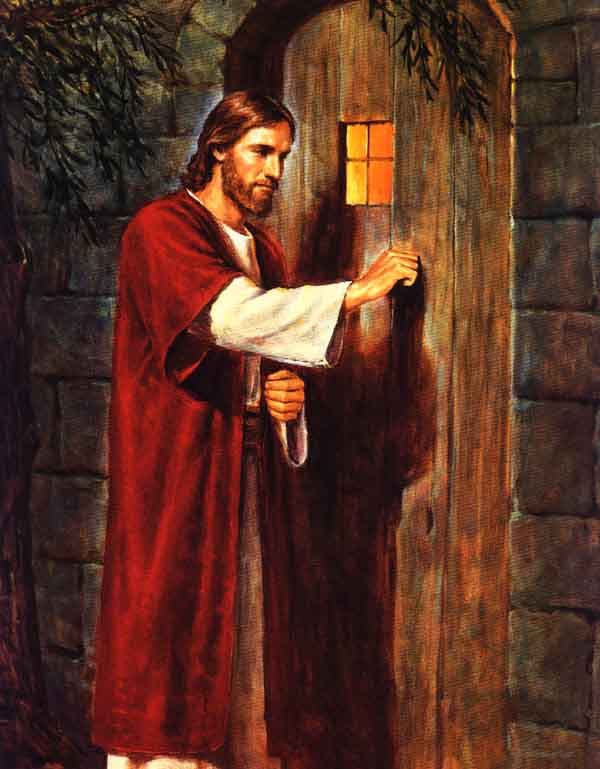
There is an extremely traditional painting of Jesus standing at a door knocking, based on Revelation 3:20a, “Here I am! I stand at the door and knock. . . .” a verse used to indicate that Jesus, like a visitor, is waiting to be invited into our homes, into our hearts. It’s a kind depiction.

But I have a stronger image, that of the open door. This representation is not from Christ’s perspective, waiting to be invited in, this is from my perspective, an invitation to walk through with no strings attached, the invitation implicit in its openness.

It reminds me of a phrase I tell people from out of town, particularly those I like very much and I want to communicate my fondness to them: “Please, come anytime, our door is always open.” I want them to feel free to enter, whether I am at home or not, because I trust them with my home, my sanctuary, my heart.

Jesus trusts me in that way too. And you.

Christ Jesus has the authority to open the door and keep it open until any human can see it, believe it, and walk through it. On the other side is sanctuary.

I remember hearing a story about people who were locked up in cages for a long time but when the door was opened, they did not leave the cage. Outside the cage, all was unknown. Inside the cage, all was familiar. Fear held them inside. Love is patient and kind and waits.

The only bad thing I can see about this open door is the ability of traffic to go both ways. I would love to say I went through the door once and never turned back. Not true. I have stepped back into the old world many times but each time, the open door draws me back, the spirit of God draws me, and I find my way through again.

Come and see, the door is still open. Like the tomb, open. Be set free.

Read Full Post »

A fantasy story line comes to mind: certain characters are entrusted with a secret stone or message or magic phrase and they are called to face numerous odds to protect it, embrace it, and nurture it. With each successful engagement, the power enlarges but so does the evil that opposes it. Each time, engagement becomes more difficult. The opposition is weighty.

Jude 1:3b
. . . I felt compelled to write and urge you to contend for the faith that was once for all entrusted to God’s holy people.

It’s fanciful I know, but I think, as believers, we sometimes lose the wonder of what we have in the Christ: that Holy Spirit, that Truth, that potential for joy and peace within. The experience of eternity is within. It is the spirit, after all, that lives on after the body fades. Part of the message we hold determines the quality of our eternity. We also lose track of the power of the opposition, as well as its inventiveness and ability to dissemble.

Does anyone else wonder why the message was sent in that particular era dominated by the Roman empire? What was it about the plight of the Jewish nation (one of many) that compelled God to send the whole Story. The people cried Hosanna! (save us) and God sent the most unlikely Savior, not a general leading a great army to destroy the Romans but a baby born to a couple of poor folks.

No instant messaging was available, no news feed, no reporters on the scene. In fact, what witnesses there were, few had much credibility: shepherds (one of the most disreputable “professions” of the day) were supposedly informed by a sky full of angels? Right. And what were they smoking? Or, what about those foreign guys: mystics and astronomers that weren’t even of the faith? They probably had an ulterior motive. I mean, the people closest to the event (like the innkeeper, let’s say), don’t seem to have much place in the story or what about all those other people who were stuck in Bethlehem for the census? No, I think it was a pretty hushed affair, just another baby and just another mouth to feed.

But Mary treasured up all these things and pondered them in her heart. [Luke 2:19]

Mary was the first one who was entrusted with a truth, a power, a hint of what was to come. She did not stand on a street corner and declare the message. She didn’t start a blog or expect special treatment. She didn’t go to the governor and display her treasure. She waited. Her role was not truly expanded until after the death and resurrection of Christ.

I am entrusted with faith. I accepted the quest, the mission. But I am not so sure I have been wholly conscious of my role. Or perhaps, that full expression of my understanding as been successfully undermined by the adversaries.

I think my next foray should be covered with a backup. “For where two or three gather in my name, there am I with them.” [Matthew 18:20] I need to find those partners, like the trio from Harry Potter or the Three Musketeers or even, the three disciples who knew Jesus the best.

It’s a journey all right and it’s a journey that is best taken together.

Read Full Post »

I’m sure the intention of the phrase, “chosen sister” is that of a sister in the flesh who is also a believer. And yet, for me, something else resonated which makes me want to take a little mind excursion into the value of friendships.

II John 13
The children of your chosen sister send their greetings.
[NIV, 1984]

The second letter of John did not hold much new for me. I see it as a very concise review of his first letter as he writes on the importance of loving others, obedience to Christ, and protecting the Spirit from within from deceptions and deceptive people.

However, when I read the last phrase about the lady’s “chosen sister,” a deeper chord struck. I suppose it’s because I don’t have any blood sisters and like most women who don’t, wish I did. There is a bond between sisters that is unique.

On occasion, we all encounter a friend who becomes as close as a sister, or maybe even closer. Those friends were chosen: either by one another or, in the case of the Presence, chosen by God. These relationships are singular and should be cherished.

I have had a few such women friends who have marked my life and I am grateful for them. To them I give testimony this day.

Becky & Mary were girlfriends from high school with whom I walked through a complex time, both personally and culturally. It was the time of agitated civil rights, the Vietnam war, and our own search for identity. The times in which we lived branded us and even after forty years, we are still engaged (no matter how frequently or infrequently) and that link makes us genuinely care about each other as well as our children and the lives they are leading. They are chosen sisters.

In college, I met Kathy, another chosen sister with whom I have experienced great losses and gains, marriages and divorces, fertility and infertility, grief and joy. There have been months, even years, when we lost each other, but the cord was stronger than time we lost and we endured. Our big joke now is that we will age together, rocking on a porch somewhere, hopefully near the ocean or the mountains. Our children continue to be part of both of our lives.

In recent years, Janis & Kathleen have been the women who have walked beside me in faith and trials. They adopted my children, in one case, as a Godparent even, and I know their prayers cover me and my kids in a cloud of light as I do for theirs (which takes longer since they both have five children apiece, LOL). These chosen sisters entered my life through the church, our prayers and worship of the same God bind us too.

Of course, there have been other key sisters that God chose for me: women whose lives crossed mine for a season. Each of them were a blessing that cannot be cast off whether it was for ten years or ten weeks or even less. And there are women today who are in my life but we have not quite “chosen” fully. We love, we care, we connect, but we are not laid bare.

Friendships are harder to sustain in this age. We are either too busy to commit the time it takes to bridge our lives or too insecure to open our arms and expose our hearts. I am guilty.

Every friendship is a gift. And just as I need the Presence of God within, I need you, chosen sister or nearly sister or soon to be sister, on the outside. And you need me. Let us choose more freely.

Read Full Post »

Don’t worry, I’m not interested in the “blab it & grab it” prayers or the prosperity gospel, and yet, John’s statements must be addressed on one level or another. Key words here for me are “confidence,” “according to his will,” and “we know we have.”

I John 5:14-15
This is the confidence we have in approaching God: that if we ask anything according to his will, he hears us. And if we know that he hears us—whatever we ask—we know that we have what we asked of him.

Confidence in approaching God implies a consistent and strong faith. It is a wholehearted acceptance that God is God, Christ is Christ, and the Holy Spirit is a gift, a living entity who shares my soul space, by invitation. As our pastor puts it, once we enter this new covenant, we are “under new management” full of grace and mercy.

Therefore, there is now no condemnation for those who are in Christ Jesus, because through Christ Jesus the law of the Spirit who gives life has set you [me] free from the law of sin and death. [Romans 8:1-2]

To ask, however, according to God’s will is a little trickier, at least, in my experience. In some areas, biblical text is clear and identifies God’s will (the ten commandments are a strong example). But, unfortunately, the Bible, glorious and complete, beautiful in both poetry and truth, may not be so easily interpreted when it comes to the questions of post-modern society. Oh, there are lots of folks who believe they have the inside certainty of God’s will, but not me. Just parenting three teenagers has been enough to show me how little I know. There are no assurances about learning issues, mood disorders, private vs. public education, and so forth. Instead, my confidence must rest in the more general promises that God makes about his care and love for the children . . .

All shall be well, and all shall be well, and all manner of things shall be well. [Julian of Norwich]

But for me, the true key to John’s letter about God’s Will and asking (in prayer), is the timelessness of God. For God, there is no yesterday, today, or tomorrow: it’s all now. And it is in this context that all prayers and answers must be understood.

If I am a believer (and I am), then God hears me and if, in confidence, I have sought and believe my requests are within the realm of God’s loving will, then it is done. . . . not it “will” be done, but it is done. The answer has been given.

We, and no, not just we in general, but “me,” … I get caught up in looking for the manifestation of God’s answers. I believe in a healing God, so I am too often crushed by the continued illness of others. I believe in a saving God, and yet I am sorrowed when Christ is rejected by those in need. I believe in a loving God, but I am caught off guard by the cruelties of human to human, or worse, believer to believer.

But today, I am reminded: what I can see with my human eyes and understanding does not change the facts: God is, God hears, and God answers.

Read Full Post »

It’s so much easier to speak of the spirit world in different contexts, fantasy for instance. In those circles, it’s the norm to speak of spirits, magic, miracles, powers, spiritual enemies and spiritual good guys. But we have lost our ability in this age to speak of the Spirit World.

I John 4:4
You, dear children, are from God and have overcome them, because the one who is in you is greater than the one who is in the world.

Despite the fact that numerous references are made to this spirit world in scripture; I am particularly thinking of Ephesians 6:12 as a good example, “For our struggle is not against flesh and blood, but against the rulers, against the authorities, against the powers of this dark world and against the spiritual forces of evil in the heavenly realms,” we hesitate to claim it as our own. It’s all woohoo stuff! And so, most folks shrug off spirit talk.

But I cannot. The epistle of I John speaks at length about spirit relationships: our own spirits, those of the “anti-christ” opposed to all Christ spirit, the spirits of the world, the spirits of believers, and the spirits of God followers. This is the unseen world and yet, more and more, I do believe it is the most important part of our existence.

We are multi-dimensional for a reason. And there are enough people, even in modern times, who have had significant experiences with Spirit that it seems foolish to disregard this aspect of our humanity, our spirituality, our essence.

I guess the big question is in the tension that arises when we refer to “good” and “evil” spirits. And I understand that hesitancy, but there is simply too much evidence to deny them. For me, the truth of evil places human depravity at the feet of its source: the realm within.

Do we really think that the battles we carry on in the flesh will change the spirit? Will our wars block the power of evil’s presence and influence? Will our gun laws prevent their distribution on the streets of our cities? Will our capture of kilos of cocaine prevent the fields of poppies from being grown again?

We are back to the single word that explains the Way of the Spirit realm: paradox. It’s not the very reasonable approaches to problems of our world that will change it, but the opposite. If not, if it’s all Pollyanna, then why did Jesus bother to say any of it? I know things are bad now, but things were bad then too: almost everyone was poor or under the iron fist of a dictator or slave owner, violence was the norm and so was hunger. There was no “upward mobility,” there was no middle class. Back then, it wasn’t just the 99% but 99.9% of the people who suffered under human indignity and loss.

They had good reason to look and wait for a revolution. Instead, Jesus proclaimed a victory for the interior life as the starting point for change. Do we follow? Do we believe?

Read Full Post »

Here’s a picture for you, hate as a knife; hate as a gun; hate as a club; hate as a poison dart. They are all tools that a person can use to unleash a violence on someone else and it does damage, sometimes permanent. Hate is potent. Who am I kidding? It’s always within my grasp.

I John 3:15
Anyone who hates a brother or sister is a murderer, and you know that no murderer has eternal life residing in him.

Over the years, I have engaged many people about my faith. And, in particular, my desperate need for forgiveness, for my own sins as well as a willingness to forgive others. So often, their comeback to me is that they haven’t done anything so bad: they haven’t murdered anyone or stolen anything or taken lethal drugs. They speak as though there is such a thing as an “ordinary” life of niceness, their “good person” syndrome, a whitewash.

But I say they have murdered, at one time or another, with hate. And, unfortunately, in the paradoxical world of God, that hate might have appeared justified, the object being a mean, cruel, even evil-seeming person, or an adulterer, a child abuser, a wife beater, a liar, a betrayer. Do any of these descriptions make your blood boil?

That’s different, you say. They deserve to be hated; they broke the laws of humankind. They are “Cain: who slew Abel” [Genesis 4]. Instead of casting them out of the garden, you cast them out of your life. It’s a way to soften the feelings, to put blanks in the pistol, to dull the edge of hate.

There were years I hated my own mother for the emotional damages she brought into my life. There were times I hated my brother out of sheer jealousy for his abilities, for his “position” in our family, for his successes that perpetually outshone my own. There were intervals I hated my husbands (in certain seasons of our shared lives), for their disdain of me as a woman, for their disregard, for their isolations. There were girls I hated who were prettier than me, smarter than me, “in” while I was “out,” or acknowledged while I was invisible. There were lovers who bruised my heart and cast me aside. There were neighbors who crossed the line of decency. There were . . . there are . . . enemies of the state, terrorists, and many, many, unnamed villains.

Oh yes, plenty of people to hate. And yet, none of my hate effective in relieving my own soul, heart or mind of injury. What has been done to me, I cannot re-write, I cannot change my past with the weapons of hate, nor can I pay them forward. Hate perpetuates hate. It feeds upon itself.

Back to the paradox: there is a reason that Jesus taught us to love our enemies [Matthew 12:44]. I think we have mistakenly relegated this command to an ideal, something nice to work toward. But I have come to believe it’s a weapon in its own right, not just as powerful as hate, but more powerful. It’s a neutralizer, a transformer. If hate is a weapon, love is a bomb that changes the landscape completely.

It’s not a suggestion: it’s a guarantee.

Read Full Post »

« Newer Posts - Older Posts »