Feeds:
Posts
Comments

Posts Tagged ‘faith’

The first step is belief. “I believe you; I believe what you are saying; I believe YOU are speaking truth.” But the next step is critical, when the listener moves belief into the realm of faith. Here is where the content has meaning for the listener. And here belief can grow.

Hebrews 4:2
For we also have had the gospel preached to us, just as they did; but the message they heard was of no value to them, because those who heard did not combine it with faith.

Life in the Spirit is cyclical. With this scripture, I understand it even more than before. Belief prepares the ground of my heart to have faith, that confidence in things not seen or proven. And when faith expands, then I am able to understand more of the “message.” I understand more about the messenger.

As soon as I give room to doubt, the process slows down. It still works, but more methodically. The doubter is looking for more to believe, more information, more facts, more stories, more exposure. And when all goes well, the tipping point is reached and the process begins again.

“Then he [Jesus] said to Thomas, “Put your finger here; see my hands. Reach out your hand and put it into my side. Stop doubting and believe.” [John 20:27]

Read Full Post »

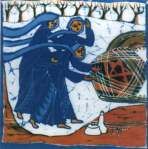
Painting by N.S.G.

It takes a lot of courage, actually, to continue to hope in something or someone, both unseen and yet promised for a time in a future we cannot know. There must be persistence too, but often, it takes plain courage and a type of audacity to believe despite it all.

Hebrews 3:6
But Christ is faithful as a son over God’s house. And we are his house, if we hold on to our courage and the hope of which we boast.
[NIV 1984]

For some people, this tenacity has to have something more substantial to sustain it and so they latch on to a concrete idea still in the future to uphold their courage. Like a date. Apparently, there is a groundswell of believers who are putting their hope and their courage into May 21, 2011 as “judgment day” and the end of the world. These folks are the antithesis of Rob Bell’s stance in Love Wins. Where Bell’s hell is already manifesting here on earth and our battle is in the now for the power of the Kingdom to take hold; these folks are predicting the great rapture for the enlightened and a fiery hell for everyone else; the only winners in their minds are “people like them.”

Of course, this isn’t just in the Christian world; there’s still 2012 to face as well. With the “end” of the Mayan calendar, some people believe and predict, the end of the world as we know it is next year.

To what or in what do these eschatological folks hope? Mostly, it’s “hope nothin’ bad happens to me” and “just in case,” let’s look into some “fire” insurance . . . or assurance, and join this or that bandwagon.

Here’s the rub: hope implies a good end. And it takes courage to hold onto this kind of hope because our world is full of dark things, dark people, dark rulers and “principalities.” [For our struggle is not against flesh and blood, but against the rulers, against the authorities, against the powers of this dark world and against the spiritual forces of evil in the heavenly realms. Ephesians 6:12]

“Do not be afraid of those who kill the body but cannot kill the soul. . . . ” Matthew 10:28a

Courage cannot be built on a 3D world; there are no guarantees here. Courage and hope can only be built on our faith in the truth of a Christ whose Holy Spirit defies logic and protects the Human Spirit from eternal death and separation from the Creator. Nothing more.

To become a believer in the Christ is a statement of hope. For the words of Christ promise that all will turn out for the best. Courage is the ability to face a different world that mocks hope, questions the supernatural, and defies paradox with proofs and logic. To stand. That’s the key. Whether it’s May 21st or 2012, whether it’s sickness or sorrow or disappointment that have been meted out in large doses, we are called to stand on the solid rock of faith.

And if I fall off that rock because my faith was too small or my fears too great? There is still grace.

“But now I urge you to keep up your courage, because not one of you will be lost; only the ship will be destroyed.” [Acts 27:22]

Read Full Post »

Empty Room by Tom Burke

Believing in a future is part of the faith package. We can’t know what that future will actually hold for us, but that does not preclude us from embracing all the possibilities. So much of tomorrow hinges on today.

Philemon 20
And one thing more: Prepare a guest room for me, because I hope to be restored to you in answer to your prayers.

Paul believed he would be cut loose from prison. He asked his friends and his followers to believe the same thing, despite the circumstances.

I can function fairly well in this part of the equation, but I’m not so good when that future I had prayed about, asked for and even envisioned, doesn’t happen. I am disappointed. This is a trap for me.

Intellectually, I understand what it should be. I can preach about it and I can teach about. I can offer all kinds of advice, quotations, and scripture references. Honest, I get it. But the reality of living the other answer is not always my best day.

Instead of disappointment, when the alternate future presents itself, I need to joyfully envelop it and give thanks because God, all sovereign, heard my prayer and took my future onto a different way. When I don’t get “out of prison,” when I don’t get the job, when my kid doesn’t go to college, when my project is not accepted, when . . . when . . . when, it’s no less intentional from the God perspective.

I’m reading a book by Steven Furtick called Sun Stand Still. He’s a young, exuberant pastor from Charlotte, North Carolina, who planted a church that grew into the thousands in a very short time. He’s all about audacious prayers and expecting God to do impossible things. He has seen such prayers answered every day. His faith is infectious. He challenges his church to do the same, like Paul, he says, “do as I do, believe as I believe, trust as I trust.”

Have a I become too jaded in my walk to drum up this kind of enthusiasm? I don’t know. It’s not that I don’t believe God can do great and wondrous acts. God can and does. But I want to be able to walk on through despite the outcomes. I want to have a faith that isn’t wrapped around the answers. Because, quite honestly, my requests are not always in the best interests of the whole picture; I know that instinctively. I can only dream my dream and put my desires out there. But I could be way off.

When I was younger and went through those terrible years of barrenness, I came to a peace when I accepted the reality of my body. It was no less God’s plan and, in the end, we built a family through adoption, three kids who didn’t know that God had prepared a room for them here.

Everything is connected, every dream, every future, every room. Keep me mindful Lord, when I step into the room prepared for me today, that I don’t forsake it just because it’s not painted the color I had imagined or it’s not furnished with the expected furniture or populated by certain people.

Help me dream and even dream big still, but help me engage in today fully as well. Today is part of yesterday’s dream.

Read Full Post »

Batik by Hanna Cheriyan Varghese, Malaysia

Sometimes it’s not worth engaging in discussions that will go nowhere, particularly if people are getting upset and defensive. No one gains. If anything, more is said than should have been said and the controversy escalates. I have seen this happen a hundred times. I’m done.

Titus 3:9
But avoid foolish controversies and genealogies and arguments and quarrels about the law, because these are unprofitable and useless.

We had a controversy in our local community that was extremely divisive. Conversations were misrepresented; newspapers reported incomplete information and often, with only one side of the story or pure hearsay; while social networks were used to accuse and inflame an already unstable situation. And to what end? The people in the center of it all felt no better, just wrenched apart emotionally. The only thing that lessened the impact was the wisdom of a few who said: don’t engage, don’t add, don’t comment. And eventually, this proved the best choice; the furor abated and people moved on with their lives.

When Jesus stood before the different “authorities” on those fateful days before his crucifixion, he, too was silent. What would have been the point? No one would have believed him more that day than any other day. There was nothing more to be said. His great controversy had to be endured and he knew the meaning from the beginning. He may not have known how the whole thing would play out, the passing from one dignitary to another (think about it: he saw three “leaders” in the course of 24 hours who could have changed the world), but he knew the outcome would be the same: torture and death to the body.

But Jesus also knew about the third day. He knew about the results. He trusted God, despite the pain, the desolation, the anger, and the very air of evil that encircled him. Words were nothing.

And so, Jesus, as foretold throughout the histories and prophecies, rose from the dead. That event put all controversies into perspective.

When all is said and done, most stories have an opportunity for resurrection and transformation. With God, there is always hope. There is no irredeemable act. Even in the face of evil, we must hold fast to our belief that “love wins” — God wins!

Read Full Post »

Book by Sheena Iyengar

Here is the duality of living and walking the faith: first there is the inner journey, bringing the life within into the presence and guidance of the Holy Spirit; then, secondly, the outer journey, walking out the behaviors of the Way and choosing to “do good.”

Titus 2:6-7a
Similarly, encourage the young men to be self-controlled. In everything set them an example by doing what is good. . . .

I wish this dual walk was more linear. You know, get the inner life in order and only then, venture out into the world. But it’s not like that. We must live in both worlds at the same time and apply what is learned within along the way. I suppose the ideal is reaching a point when the inner and outer lives are meshed into one and they operate seamlessly. Good is no longer a choice but a state of being. God is good.

Instead, I must remain conscious and aware; I must choose to be good.

The other day, I went to the optician to order new glasses after several years of wearing the same frames. To be honest, the idea of changing my appearance so drastically was a little daunting. I even thought about bringing a friend or one of my teenagers to help me pick out the frames. But then, I knew, if I did that, I would muddy the waters of my decision-making. Fortunately, I had the best optician. He helped me pick a small group of frames, six or so. Then, I sat down and he presented me with two. Between those two, I had to choose one. And so forth, from one pair of choices to the next. It was hard but doable.

And then it occurred to me this morning that “doing good” is very similar. I can’t make a global choice to do good, but as my day unveils, I can handle choosing between two possibilities.

Our culture overwhelms us with the cereal aisle of choices and it’s difficult to know which way and which one. Many in the current generation of teens and twenty-somethings are frozen by the panorama of options. They live in a country where anything is possible, or at least, this is what they have been taught. But they haven’t been taught how to choose along the way.

I am no better. Historically, I have been a “Jill of all trades” and the master of none.

Today, I will bring the array down to a manageable level. And as I look at those choices today, I will ask myself, which one is good.

Read Full Post »

A Pure Heart painted by Jan Oliver

Is it true? Do the pure of heart recognize pure motives in another person? Or, even more mysterious, can the pure find something pure in anyone? Is it another way of thinking about the “sacred other?” How sorrowful, then, to dwell in the opposite world, a type of hell surely, where nothing is pure.

Titus 1:15
To the pure, all things are pure, but to those who are corrupted and do not believe, nothing is pure. In fact, both their minds and consciences are corrupted.

I was quite moved today while listening to the audio book of Cutting for Stone by Abraham Verghese when a minor character, Deepak, a 5th year resident doctor who has been close to completing his residency many times but has, time after time, been cut out by the system, speaks to his young intern, Marion. Finally, circumstances take a turn for Deepak, his first real hope in ten years that things will work out. He shares his long-standing belief that good does triumph over evil, that hard work and honesty and integrity do prevail along with patience and long suffering. He is so clearly a good man, a humble man who loves his work and believes in this “power of good.” He is of the pure heart variety, and I found him remarkably drawn, this character in the book felt real and knowable.

The pure of heart do suffer because of those who do not recognize them. Those pure-hearted ones are taken advantage of; they are often swept aside; they are maligned in their silence.

In our small town, it is a political season in which a mayor will be elected (or re-elected) and a city council re-populated with new or old faces. The rhetoric is flying and I wonder, are there pure hearts among them? Can I still my own heart long enough to recognize them? Can I get past my own judgmentalism and pre-conceived notions? Can I tap into my small spot of purity where the Holy Spirit dwells within and where truth can be uncovered?

I am also in the vortex of another political storm, where integrities are coming into question, where truths are unclear, where memories have become short-sighted. And today, I realized, sorrowfully, that my friends may continue to be maligned because corrupted hearts may not recognize them. And despite the purity I can see; it does not give revelation to others. At least, for now. But like my sweet doctor Deepak, a time will come when purity of heart and motive will emerge. I must believe that too.

Just yesterday, I discussed with new friends how we cannot know the ways of God’s hand. What may appear as defeat on the outside, may be victory within. What plays out in sorrow now, may reveal a greater glory later. I must hold to this understanding.

After all, Jesus modeled this same scenario. He was betrayed, wrongly sentenced, and crucified. Most of his followers were broken and dismayed. Their cause for good appeared broken. They looked at the circumstances in 3-D only, not knowing that other dimensions were turning upside down. They allowed the corrupt to veil their hope.

We must stand fast. The pure of heart must hold to this: Sunday’s coming.

Read Full Post »

In several places Paul tells his followers to trust his message because his very life is a testament to his faith. In today’s world, there are those we know and have known, whether they are friends or family, and because we know them, we trust them. Or do we?

II Timothy 3:14
But as for you, continue in what you have learned and have become convinced of, because you know those from whom you learned it, . . .

Trust is a funny thing. It can be taken for granted or it can be nurtured consciously and strengthened over time. The longer and deeper I know someone, the more likely I am to discern whether he/she is trust “worthy.” Relationships are built on trust because people must be transparent to be trusted. Without transparency, the foundations of a relationship are built on sand. And yet, despite, weeks or months or years of building trust, it can be broken with a single word, a single act, a single observation.

As soon as mistrust raises its unholy head, there’s hell to pay. Rebuilding trust after a betrayal (whether perceived or real) takes longer than the first time around. We place the other under the microscope and we find additional reasons to “not” trust. We look for the lie. We look for the secrets. We expect the worst.

I believe this “breaking of trust” moment must be examined carefully and weighed against knowledge and familiarity and love.

In the past week, I have seen three relationships within my immediate family ripped apart (possibly in a permanent way) because of broken trust. Somehow, whatever was known about each other before that moment came, was not enough to stay the doubt and suspicion, to balance the scale of possibilities, to hold the cracks together. Whether it’s teenagers falling in and out love or mature adults running from the possibility of being hurt yet again, the process is the same and one or the other says, “I don’t believe you.”

And then, on top of that, in a public forum, I witnessed palpable abusiveness and accusations because of a perceived certainty that trust was broken. I wanted to stand up and yell, “Stop! You’re talking about my friend, you’re calling into question the integrity of someone I have known for twenty years.” I trust my friend. I trust my friend’s intentions. And it hurt me to watch the bubbling cauldron of bitterness and rejection. The words were different, but it sounded the same, “I don’t believe you.”

And that’s when I saw it, this moment of decision, to stand by what has been shared and spoken before, to remember the conviviality and the good intentions, to hold fast to the history. . . or not.

Paul tells Timothy to trust in the truth of what he has learned from his mentor, from his friends, and from his family. This is Paul’s last letter to his protege. Many, many people attacked Paul in the same way that the authorities attacked Jesus. They called them liars, fakes, and charlatans. They called them destroyers and divisive elements in the faith.

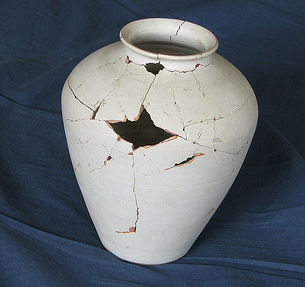
Who will we choose to trust in that moment when the vase is about to shatter? Who will we believe?

Read Full Post »

« Newer Posts - Older Posts »