Feeds:
Posts
Comments

Posts Tagged ‘God’

A Pure Heart painted by Jan Oliver

Is it true? Do the pure of heart recognize pure motives in another person? Or, even more mysterious, can the pure find something pure in anyone? Is it another way of thinking about the “sacred other?” How sorrowful, then, to dwell in the opposite world, a type of hell surely, where nothing is pure.

Titus 1:15
To the pure, all things are pure, but to those who are corrupted and do not believe, nothing is pure. In fact, both their minds and consciences are corrupted.

I was quite moved today while listening to the audio book of Cutting for Stone by Abraham Verghese when a minor character, Deepak, a 5th year resident doctor who has been close to completing his residency many times but has, time after time, been cut out by the system, speaks to his young intern, Marion. Finally, circumstances take a turn for Deepak, his first real hope in ten years that things will work out. He shares his long-standing belief that good does triumph over evil, that hard work and honesty and integrity do prevail along with patience and long suffering. He is so clearly a good man, a humble man who loves his work and believes in this “power of good.” He is of the pure heart variety, and I found him remarkably drawn, this character in the book felt real and knowable.

The pure of heart do suffer because of those who do not recognize them. Those pure-hearted ones are taken advantage of; they are often swept aside; they are maligned in their silence.

In our small town, it is a political season in which a mayor will be elected (or re-elected) and a city council re-populated with new or old faces. The rhetoric is flying and I wonder, are there pure hearts among them? Can I still my own heart long enough to recognize them? Can I get past my own judgmentalism and pre-conceived notions? Can I tap into my small spot of purity where the Holy Spirit dwells within and where truth can be uncovered?

I am also in the vortex of another political storm, where integrities are coming into question, where truths are unclear, where memories have become short-sighted. And today, I realized, sorrowfully, that my friends may continue to be maligned because corrupted hearts may not recognize them. And despite the purity I can see; it does not give revelation to others. At least, for now. But like my sweet doctor Deepak, a time will come when purity of heart and motive will emerge. I must believe that too.

Just yesterday, I discussed with new friends how we cannot know the ways of God’s hand. What may appear as defeat on the outside, may be victory within. What plays out in sorrow now, may reveal a greater glory later. I must hold to this understanding.

After all, Jesus modeled this same scenario. He was betrayed, wrongly sentenced, and crucified. Most of his followers were broken and dismayed. Their cause for good appeared broken. They looked at the circumstances in 3-D only, not knowing that other dimensions were turning upside down. They allowed the corrupt to veil their hope.

We must stand fast. The pure of heart must hold to this: Sunday’s coming.

Read Full Post »

Another translation has “bond-servant of God,” or one who is bound to service without a promise of recompense or compensation. Too often, people serve their gods with an expectation of a result, an ROI (return on investment). Doesn’t work that way.

Titus 1:1
Paul, a servant of God and an apostle of Jesus Christ to further the faith of God’s elect and their knowledge of the truth that leads to godliness—

There are promises from God for the elect (those who follow and serve), but those promises are on God’s terms, not ours. All things come through grace, therefore, whatever is given is a gift and not deserved in some way, no matter how “good” we are, how righteously we behave, how pious.

In Paul’s case, he defines himself as one of these bond-servants but also as an apostle, a messenger, expected to share the knowledge of the Christ imparted to him or her. Not everyone is an apostle. And yet, if we believe, as I do, that Christ is the long-awaited Messiah, then I am to tell my story (to testify). This is not about insisting that my story is better than your story. I tell because my life changed and the course I was on in my late twenties developed an unexpected fork in the road and I was able to choose a different way.

Some people, particularly Christians, forget that they have dual responsibilities. They might jump in with both feet into the messenger business, in the name of Christ, but often they forget their agreement to bonded service to God. There are some who serve God but have not recognized the Messiah part of their journey.

We have both identities and both roles, like in a family, I am a mother and a wife; in my job, I am both a librarian and a manager; in the Church, I am both a penitent and a teacher. Each role is served by the other, each task made richer by the other.

Let me be mindful of all of my dual roles today and in particular, by service to God and my message on behalf of the Christ.

Read Full Post »

It’s the verbs and they all say the same thing: persist, persevere, adhere, apply oneself, carry on, conduct, continue, cultivate, engage in, hold to, keep on, maintain, perform, ply, practice, proceed, prosecute, see through, tackle, work at . . . This is Christ-based engagement.

II Timothy 2:22b
. . . pursue righteousness, faith, love and peace, along with those who call on the Lord out of a pure heart.

Righteousness, faith, love and peace are the foundations of our faith walk (and if we were honest about it, these are roots to most faiths in the matter of behaviors). They are essential to “human.” If I could live out righteousness (and I love how the Amplified defines this: “all that is virtuous and good, right living, conformity to the will of God in thought, word, and deed”), build my faith (and trust) in a truly sovereign God, love others as the sacred souls they are, and promote peace in my circle of influence, my world would be different. I would be a change agent and like a pebble thrown into a pond, the circle would expand.

Influence comes out of authentic living in the Christ.

But all of this kind of talk is so general, it’s a concept, it’s knowledge, but what will it look like today? When I enter the “prayer of examen” (as Richard Foster writes in his book, Prayer), will I recognize the words and actions of any of these four pillars? Can I be more mindful today that I was yesterday or the day before? Can I be conscious in my choices?

Each day, I spend time in confession, asking God to forgive me my missteps, my harsh words, my judgmental thoughts. But, can I as well, give thanks for those other times, those times I actually connected with the Holy Spirit in a viable and observable way? That would be a good thing.

Read Full Post »

Separating myself from “corrupting influences” is not so easy. It’s a matter of degree, that difference between good, better & best. In some areas, I have been successful and on occasion, I have been blessed and used in a powerful way but it’s an erratic arrangement.

II Timothy 2:21
So whoever cleanses himself/herself [from what is ignoble and unclean, who separates himself/herself from contact with contaminating and corrupting influences] will [then himself/herself] be a vessel set apart and useful for honorable and noble purposes, consecrated and profitable to the Master, fit and ready for any good work.
[Amplified]

Some of this “separation” feels too strict and legalistic, like those Pharisaical laws that disallowed touching contaminated things without all kinds of ceremonial washings and waiting times. It smacks of the story that Jesus told about the Good Samaritan [Luke 10:25-37] who broke all kinds of laws to minister to an injured and “unclean” man. There are contemporary versions of this, various religious sects that will not allow people of differing beliefs to sit at table or to share in communion or other sacred acts.

And so I manage to excuse or validate some of my choices in the name of freedom. But it can be a slippery slope, I know.

I think it’s important to recognize the value of single-minded piety, as long as it is also lived with grace and generosity toward others who do not live in the same way. That kind of life does indeed prepare the mind and soul for greater challenges of faith. There are other hints to this concept like Paul’s references to the athletes who prepare hard for the race, who practice their craft diligently, who commit their energies toward attaining a particular goal.

In earlier years of my faith journey, I have somewhat foolishly asked God to drop gifts and signs on me, to use me as that intermediary for healing or miracles. And yes, it’s true that these are gifts; it’s possible that God, for the sake of the moment, might grant such experiences. But for the long haul? I think it’s the warriors of faith, the ones who don’t necessarily shy away from “corruptions” and “contaminations,” they simply don’t have time or interest there. It’s a non-issue.

If I am in a time of prayer and meditation, I am not watching the unenlightening television show or browsing the Internet for inappropriate content. My “self” is elsewhere engaged.

It all boils down to this for me: to be used for “noble purpose” is part and parcel of my daily life, how I manage the little things [Luke 16:10a]. Thanks be to God.

Read Full Post »

Shared with Irenic Thoughts Blog

If this “in Christ” and “in me” business is not a mystery, then I don’t know what is. To accept the truth of a Messiah is not a casual decision nor is it just “fire insurance.” It’s a relationship that opens a supernatural door to a unique and forever-lasting access to God.

II Timothy 2:11b-13
If we died with him, we will also live with him; if we endure, we will also reign with him. If we disown him, he will also disown us; if we are faithless, he remains faithful, for he cannot disown himself.

This scripture statement is filled with “if’s” because I have to participate in the alliance. Only if I tear up the internal contract completely and “disown” my agreement will I jeopardize the arrangement. Otherwise, no matter what mistakes I make, what foolishness I exhibit, what disappointments and doubt, my God, through the Holy Spirit remains . . . both “in” me and faithful.

Like my own children, who make terrible choices sometimes and even do the opposite of what I ask or recommend, they are mine and always will be. They are part of me and I am part of them.

This is the human version of the God contract. And that one is much more robust. Thanks be to God.

Read Full Post »

Every endeavor has rules. I hate that. Maybe it’s because I’m a child of the sixties [age-alert] but there’s some part of me that wants to rebel just at the whiff of rules. But why? Why have they become limitations instead of opportunities for excellence?

II Timothy 2:5
Similarly, anyone who competes as an athlete does not receive the victor’s crown except by competing according to the rules.

In reality, it’s the rules or the finiteness of the task and the subsequent precision and commitment to working within that framework that separates the good from the great.

When Paul uses a sports analogy, the first sport that comes to my mind is diving. It’s so terribly precise. All those Olympic dives look wonderful to me until it’s replayed in slow motion and the announcer breaks down the movements and compares them to perfect.

I also think of ice skating, skiing, even ballet. The individual, in order to reach excellence, must ascribe to a certain set of standards. Ultimately, it is only after reaching the highest benchmark that rules can be broken or bent for the sake of creativity or experimentation or invention.

I remember, as a child, watching a clown on a high wire and I thought he was crazy to be on a high wire with so little experience. He always looked like he might fall off the wire at any moment. It was funny and scary at the same time. Only later, as an adult, did I learn that the clown must have the most precise technique and confidence in order to “play” on the wire. In the same vein, the jazz artist (whether dance or music) must know the fundamentals thoroughly or the modern artist classic proficiency before improvising.

So, in a way, it’s true, the rules are to be broken, but only after understanding and mastering the space between the rules. Once we learn to color inside the lines, then we can venture out.

Now, what has this to do with my faith in the Christ or serving God? What are the basics or rules of my faith? Isn’t it Christ crucified, resurrected, and engaged in human life thereafter through the presence and power of the Holy Spirit to reestablish communion with God? And thereby I can walk out in love, light, truth, justice, and faithfulness because God is forever in our midst: Emmanuel. Yes, and so essentially, to live is Christ (the greatest mystery of all).

If Christ is exalted (manifest) in/through me [Philippians 1:20-21], then I am living loved and loving others, I am a light in dark places [Matthew 5;15], I am faith-filled and faithful [Luke 17:5-6], I am a spokesperson for truth [John 17:17], and, best of all, I can know, recognize and collaborate with the Holy Spirit [I Corinthians 6;19].

From here, I can improvise. I can be the clown for Christ. I can be a fool. I can be martyr. I can be a change agent. I can be human as God always intended.

Read Full Post »

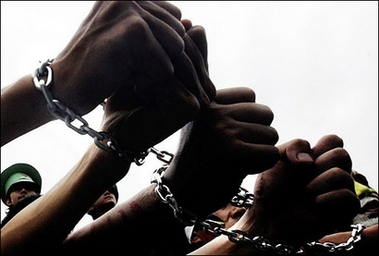
How many of us are ashamed of the chains of another person? Sometimes it’s a looking away or denial of the mistake someone has made and “paying for it” through imprisonment. But there are other chains, like mental illness, grief, illness, divorce, unemployment, and poverty.

II Timothy 1:16
May the Lord show mercy to the household of Onesiphorus, because he often refreshed me and was not ashamed of my chains.

I was ashamed of myself today as I realized I had lost touch with a woman who lost her husband last year. When he died suddenly, I had every intention of reaching out, of staying in touch, of being present to my friend as she went through the grieving process. But I didn’t. And now it has been a year. What caused this lack of attention? I wasn’t ashamed of her pain, per se, but I was uncomfortable. Grief is palpable.

And then I thought of other women I have left to bear the chains of their sorrow, my dearest friend whose brother died suddenly in a car accident. I didn’t know what to say or do and so I did next to nothing. Another friend lost her husband to lung cancer and it was months before I even sat at table with her. She was bitter at the desertions, not unlike Paul who names Phygelus and Hermogenes [vs 15].

I have colleagues whose teen and twenty-something children have gotten caught up in dangerous and illegal circumstances that have put them in prisons and detention centers. I know these mothers sorrow and I know it is hard for them to talk about it. What am I doing to ease their pain?

Another blogger wrote of the isolation that comes from mental illness and how people fear it, not unlike an infectious disease. The very thing that is needed is an unfailing and understanding presence.

I know, I shy away from so many things I do not understand but I am caught short today by my frozen inaction. Even though I am not gifted in removing the chains of others, I can still give a cup of water and hold a hand. A pastor friend of mine once said that people in grief generally need little but someone sitting beside them. Talk is often unnecessary. But I am all about the talk and the words. Silence in a group is outside my comfort zone.

It’s back to phrases like “life is in the being not in the doing” or, we are human “beings” not human “doings.” Corny but all true. But all that “being” needs to be in a place, needs to be with others who are struggling with their current state of “being” and could use a little support, like Aaron and Hur holding up the arms of Moses [Exodus 8:12].

For all of those whose chains I ignored, I ask you to forgive me. May this day be a reminder and a call to be present in the lives of those around me, chains and all.

Read Full Post »

« Newer Posts - Older Posts »