Feeds:
Posts
Comments

Posts Tagged ‘grief’

Art by Favianna Rodriguez

Art by Favianna Rodriguez

But while he [the prodigal] was still a long way off, his father saw him and was filled with compassion for him; he ran to his son, threw his arms around him and kissed him. [Luke 15:20]

It’s not that I didn’t know what compassion means. And yet, despite reading or hearing the prodigal story hundreds of times, I never put the father in this state: “a feeling of deep sympathy and sorrow for another who is stricken by misfortune, accompanied by a strong desire to alleviate the suffering.” [dictionary.com]

I had always read longing and forgiveness into the father’s response, that he ran to the son out of love and joy. However, I finally see, compassion means that the father was struck by the extent of his son’s calamities and he did the only thing he could do for the young man: show him love and acceptance. The son had punished himself enough already. 

The results of the son’s disastrous choices were all over him. Where he had left the family home as a gallant young “prince” among men; he had returned as a slave. And although he would never again be landed (since the he wasted away his inheritance), he was still a son. Life would not be the same in that household: from that point forward, I am guessing the son would have to serve both his father and his brother. He would have to work. And if he wanted an independent life, he would have to create it for himself, save money and rebuild. The one thing he would have was safety and hopefully, a willingness to be instructed.

When I was so sure I knew my way, I too floundered. I wasn’t given my inheritance (for there was none really, in my family’s poverty), but I knew how to work hard and support myself. But I spent all of my money unwisely. I indulged my fantasies without examining them. I looked at the “good life” and yearned for it. And since I couldn’t have it in reality, I tried to have it in reflection: dress that way, spend that way, play that way, drink that way. But of course, the “way” continued to be a pretend world.

I was on a downward spiral. And although I never hit rock bottom as so many must before they turn back or step out of the maelstrom, the direction I was heading is so clear to me in in hindsight. Drugs, alcohol, and carnality were my daily bread. I was not a slave to them yet, but soon. From this, like the prodigal, I turned and tried on the arms of God. I am one of the lucky ones.

But I still have that personality. I still make impulsive choices, I can still spend recklessly, and I indulge both my whims and my children. I still have an addictive personality and can become somewhat obsessed with an idea or incident or food or whatever. I even catch myself yearning for the mega millions jackpot, as though money alone would solve my woes.

It took me a long time, really, to become a true believer, a Christ follower, a Christian even. I could never quite believe I’d done it, given up that other dream of fame and fortune and notoriety in the Big Apple. For the longest time, I went through the motions of extreme faith from “not quite authentic” manifestations of the charisma to dancing and laughing and anything else that would keep my mind occupied and keep me busy. I just kept adding and adding to my plate.

But today, I see that my plate is being stripped away. And I am getting back to the truth of me. And I know my God has compassion for me now just as He/She did when I came to the Spirit quite raw. I am not that other kind of prodigal anymore. I am shedding the layers of “shoulds” and working toward the inner sanctuary of my heart to a me I have never revealed before or known. She has been lost for a long time.

 

Read Full Post »

grieving angel“For my thoughts are not your thoughts,
    neither are your ways my ways,”
    declares the Lord.
“As the heavens are higher than the earth,
    so are my ways higher than your ways
    and my thoughts than your thoughts.” [Isaiah 55:8-9]

Here’s the difference. When you and I “think,” it’s just an opinion or point of view or perhaps a bit of problem solving. When God thinks, things come into being or mountains move. The answer to the question, “what is God thinking” is incomprehensible to humans. Maybe, “what are You making?” would be better. I get some solace from my faith in a blueprint. Some.

We’ve gotten too casual with God. Perhaps it’s part of the new informal culture where jeans are always acceptable and language has become various letters of the alphabet. YKWIM? We want the “thumbs up” Jesus. We don’t want to be afraid of God so we make God cozy and grandfatherly.

And although a relationship with God can be warm and intimate and full of mercy, there is a point when God basically says, “because I said so.” And this moment needs to be accepted with the same surrender as “cootchy, cootchy, coo.” A creator has the ability and the right to destroy or alter or remake the object. “But who are you, a human being, to talk back to God? “Shall what is formed say to the one who formed it, ‘Why did you make me like this?’”Does not the potter have the right to make out of the same lump of clay some pottery for special purposes and some for common use?”[Romans 9:20]

Lately, some terribly difficult circumstances have dropped into the lives of my colleagues and friends: several people have been diagnosed with cancer or had serious surgeries, a couple of people have been on dialysis for over a year, and now a 3 1/2 year old child died just three days after being diagnosed with T-Cell leukemia.The child’s death has been the most difficult of all.

It’s hard to avoid the gripe, “what is God thinking?” Is there a satisfactory answer in my world? Not really.

I understand intellectually. Each journey is different. And although I have come to a peace about my friend Mary dying from pancreatic cancer and how I admire her as she embraces this new path in her life odyssey, the bottom drops out of my confidence, when it’s a child. The grief is heavy, the weight of a family’s loss is palpable.

It’s not the first time I’ve witnessed the agony. Some years ago, I went to a viewing of a baby who had died of SIDS. The mother was so distraught that she pulled the lifeless, embalmed child from the coffin and carried her around the room of the funeral chapel. She was inconsolable. And there was nothing to say.

Every step of faith in the face of pain and trauma and sorrow, is an excursion into the mind of Christ, a dance with the Holy Spirit, a siege at the entrance of the “holy of holies.” But the answer is always the same, “God’s thoughts are not my thoughts, God’s ways are not my ways.”

Read Full Post »

We have three foundations to belief in God: faith, hope and love. And although love is the greatest of these (I Corinthians 13), Peter exalts faith. Much like the challenge of loving an enemy, faith too must do battle, but with doubt.

I Peter 1:7a
So that [the genuineness] of your faith may be tested, [your faith] which is infinitely more precious than the perishable gold which is tested and purified by fire. [This proving of your faith is intended] . . .
[Amplified]

No one wants to go through trials and grief, but there is no question that difficulties make human stronger. Whether those situations give more experience or wisdom, they also build faith. This is nothing new.

Today, however, I pondered the idea of faith being precious though challenged. What would make faith so dear, so prized, so valuable that it must also “suffer slings and arrows?” At its root then, faith must be protected, or at the least, treated with great care.

I think about the absurdity of the treatments often used to fight cancer, chemicals that kill all fast growing cells and ultimately, a few others along the way. The body is threatened with death with each and every treatment. And yet, if the body can survive, can withstand the treatments, there is a chance for remission. Core cells are needed to sustain life: they are precious.

There are core cells to faith as well. It is the pulsing center of faith, the heart. Where is this heart? I don’t know. I think it’s different for each person, but I believe it’s the “Keep” of faith and must be revered.

I believe each person has a faith-planting moment. Perhaps it’s the point of accepting the Christ leadership or the indwelling of the Holy Spirit or perhaps it was a miracle like healing or escape from danger. For me, it was the day I stepped into my apartment in New York and I had a “whoosh” feeling, dropped everything from my arms onto the floor and wandered around my apartment singing the only Christian song I knew: “Jesus Loves me, this I know” for about forty minutes, over and over again. I knew that I knew that God was real and I would follow and believe. My precious faith was born that day.

Read Full Post »

In our 3-D world, the Devil (I know, I know, that label is “oh so old-fashioned”) has the power of death and as a result, the ability to cultivate a fear of death. If I succumb to that fear, I am enslaved by it. The Christ mission broke death-power and its sidekick, fear.

Hebrews 2:14-15
Since the children have flesh and blood, he [Christ] too shared in their humanity so that by his death he might break the power of him who holds the power of death—that is, the devil—and free those who all their lives were held in slavery by their fear of death.

As long as we fear death, audacious faith is more difficult to grasp and hold and act upon.

Supposedly, the Christian norm has been to look forward to heaven, that eternal reward promised when we die. And yet, there are few who rejoice when a loved one perishes, few who can face their own end without navigating the stages of dying and grief: denial, anger, bargaining, depression, and only, at the last, acceptance. Christian or no, most of us still fear the unknown of body death.

I think it has to do with a bit of tenuousness in the faith journey. If I put all my faith eggs in a basket and actually pray/expect a miracle, what if . . . what if . . . it doesn’t happen? If I put my faith on the line like that, won’t it break? If I am disappointed again and again, won’t my faith suffer? Better to be safe and secure and lukewarm. Not.

No surprise here . . . I don’t exercise my faith in the majors much: you know what I mean, things like raising the dead, healing the terminally ill, bringing sight to the blind, hearing to the deaf, and so forth. I fear the death of my faith. And so, the “Devil” wins again.

The Devil is not a man but an entity. We can no more understand what/who the Devil is than we can understand the transfigured Christ. To say the Devil is an “angel of light” [II Corinthians 11:14] on one hand and a fallen angel [Isaiah 14:12, Luke 10:18] on the other isn’t much help either.

We live in a world of balancing opposites like night and day, darkness and light, yin and yang etc. But the most potent set of opposites are love and fear. That’s right, the opposite of love is fear, not hate (which is merely a subset of fear). If I want to do battle against fear, that includes the fear of anything–including death, I must enfold, exude, swell, manifest, embrace, share, and trust the power of love. I’m thinking that miracles, birthed by the Holy Spirit, must be an outgrowth of this powerful and singular energy.

“[That you may really come] to know [practically, through experience for yourselves] the love of Christ, which far surpasses mere knowledge [without experience]; that you may be filled [through all your being] unto all the fullness of God [may have the richest measure of the divine Presence, and become a body wholly filled and flooded with God Himself]!” [Ephesians 3:19, Amplified]

“Whoever does not love does not know God, because God is love.” [I John 4:8]

I am no longer a slave to fear by the authority and work of the Christ. Isn’t it time I stopped acting like one?

Read Full Post »

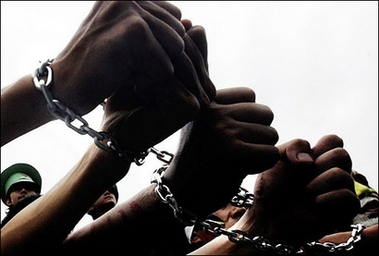
How many of us are ashamed of the chains of another person? Sometimes it’s a looking away or denial of the mistake someone has made and “paying for it” through imprisonment. But there are other chains, like mental illness, grief, illness, divorce, unemployment, and poverty.

II Timothy 1:16
May the Lord show mercy to the household of Onesiphorus, because he often refreshed me and was not ashamed of my chains.

I was ashamed of myself today as I realized I had lost touch with a woman who lost her husband last year. When he died suddenly, I had every intention of reaching out, of staying in touch, of being present to my friend as she went through the grieving process. But I didn’t. And now it has been a year. What caused this lack of attention? I wasn’t ashamed of her pain, per se, but I was uncomfortable. Grief is palpable.

And then I thought of other women I have left to bear the chains of their sorrow, my dearest friend whose brother died suddenly in a car accident. I didn’t know what to say or do and so I did next to nothing. Another friend lost her husband to lung cancer and it was months before I even sat at table with her. She was bitter at the desertions, not unlike Paul who names Phygelus and Hermogenes [vs 15].

I have colleagues whose teen and twenty-something children have gotten caught up in dangerous and illegal circumstances that have put them in prisons and detention centers. I know these mothers sorrow and I know it is hard for them to talk about it. What am I doing to ease their pain?

Another blogger wrote of the isolation that comes from mental illness and how people fear it, not unlike an infectious disease. The very thing that is needed is an unfailing and understanding presence.

I know, I shy away from so many things I do not understand but I am caught short today by my frozen inaction. Even though I am not gifted in removing the chains of others, I can still give a cup of water and hold a hand. A pastor friend of mine once said that people in grief generally need little but someone sitting beside them. Talk is often unnecessary. But I am all about the talk and the words. Silence in a group is outside my comfort zone.

It’s back to phrases like “life is in the being not in the doing” or, we are human “beings” not human “doings.” Corny but all true. But all that “being” needs to be in a place, needs to be with others who are struggling with their current state of “being” and could use a little support, like Aaron and Hur holding up the arms of Moses [Exodus 8:12].

For all of those whose chains I ignored, I ask you to forgive me. May this day be a reminder and a call to be present in the lives of those around me, chains and all.

Read Full Post »

Contentment can turn into complacency if not tempered by the presence of God. While the drive for monetary success can override smaller, gentler ways and cause discontent, sorrow, or grief. Success, fame, renown . . . they are also cut from the same cloth as the love of money.


I Timothy 6:6, 10
But godliness with contentment is great gain. . . . For the love of money is a root of all kinds of evil. Some people, eager for money, have wandered from the faith and pierced themselves with many griefs.

Two sides of a coin are represented in this brief passage.

On one side, I see the importance of adding godliness to the formula for contentment. So many people have taken contentment to mean “door mat” or satisfaction with misrepresentation. Neither of these are correct. True contentment is wrapped up in trust first and sensitized to the Spirit within that trust wrapper. When we cannot change a situation, then we must trust God to know and impact it in God time. And when we can change a situation, then we must move according to the stirrings from the Holy Spirit, moving at a non-human speed. That’s how contentment and godliness work together.

On the other side of my coin is too much action with the wrong motivation. It’s change for the sake of personal gain alone. It’s living a deception and for this reason, it brings grief, for once the money or fame or notoriety are achieved, truth is lost and in many cases, the people who mattered most are cast away while the secret dream that had nothing at all to do with money is forgotten.

Sometimes, acclaim comes without an expectation or specific desire for it. Sometimes, it’s a by-product because a person acted out of pure motive and devotion. It can happen. But not often.

For me, I have known none all and none. Griefs have come and I have felt the piercings. Mostly, because of my fears of not having money. And so, there is a holding or misuse of money, a drive to protect what I do have. It colors my world and I don’t like it, but I am hard-pressed to let go. I am hard-pressed to experience contentment within the confines of what is: this much money and no more; this lifestyle and not another; this security and not that other one; this way for now and not another way.

Grief comes with loss and how interesting to be warned of loss in the midst of “financial gain.” Another scriptural paradox!

Read Full Post »

This phrase about grieving the Holy Spirit has always jumped out at me. Reverend Spurgeon said, back in 1859, that causing grief touches even the hardest hearts. But today, for the first time, I linked the cause directly to my mouth.

Ephesians 4:29-30a
Do not let any unwholesome talk come out of your mouths, but only what is helpful for building others up according to their needs, that it may benefit those who listen. And do not grieve the Holy Spirit of God . . .

This revelation really clenches it for me: I must include “unconscious talking” into my fast.

I can just imagine the Holy Spirit within me, covering ears and thinking, “I can’t believe she really said that!” And then, crying. Doesn’t crying go along with grief?

Sometimes, there is anger too, and disappointment. There is helplessness in grief, because there isn’t much one can do to change the situation. And with grief, there is pain.

When a person is sorrowing, it is because of loss. And in that loss, there is love. But it’s love that is cut off, stopped, quenched, unresolved, blocked. . . for whatever reason.

So, whenever I speak out-of-hand, or gossip, or judge, there is a loss that happens there too. I am inching further away from my center where the Holy Spirit dwells. And the Holy Spirit is calling, reaching out to me, warning me, crying for me, whispering to me, but I am too focused on the outpouring.

Unlike fasting from food, which is relatively easy since the body is pretty good about reminding me about three to four times a day, “Hey, didn’t you forget something? Food! I need food!” But to fast from blabbing is more difficult. There won’t be any help for this one. It will be about mindfulness. It will be about “practicing the presence” of God. It will be about thinking before I speak. It will be about slowing down. It will be about listening.

And maybe, just maybe, if I can submit to this discipline, even for a short while, I will hear the angels singing after all.

Read Full Post »

« Newer Posts - Older Posts »