Feeds:
Posts
Comments

Posts Tagged ‘Hebrews’

What does it mean “to enter?” I guess there has to be a designated portal or opening, a path or direction. Entering implies leaving. Entering also implies that an observation is made from the inside, coming in.

Hebrews 10:19-20a; 22
Therefore, brothers [and sisters], since we have confidence to enter the Most Holy Place by the blood of Jesus, by a new and living way opened for us through the curtain, that is, his body, . . . let us draw near to God with a sincere heart . . .

I remember, back in Indianapolis, I was asked to pledge a high school sorority of some notoriety because it was made up of girls from three separate north side high schools. It had a very long history, apparently as far back as the 1930’s and, based on a cursory Internet search, it was still around in the 90’s. I only mention it because it was the first time I experienced the power of the word, “Enter.” Like most of these types of organizations, there was great hierarchy between the members and the pledges. There were many rules and a lot of “etiquette,” for lack of a better term. And one of the requirements before each pledge could come into a room of members, she had to ask permission to enter. I will never forget that feeling of being made to wait to “enter.”

Another strong memory about entering is from the theatre. There is nothing that can compare with the first entrance onto a stage. There are jitters and nerves, there are fears and expectations, as well as a zillion other feelings. To enter from the sidelines and into the performing area, is literally, like leaving one existence to penetrate another.

The Most Holy Place is not just a place where God hangs out sometimes. This is where God is all the time in a unique and accessible way. This IS God.

In Old Testament times, the “Most Holy Place” was only entered once a year, and then with grave and solemn preparations, including bells on the priest’s robe to insure the people could hear him moving around (some even said a cord was tied to his ankle to drag him out if he died in there – but this is not fully substantiated). That High Priest was the only one who could enter. That was the Law.

Then, a new way comes along and through the single sacrifice of the Christ: all could (and can) enter, all could (and do) have access, all (could and can) engage God in a personal and unique way.

Here’s the sad part: most of us don’t know how to stay there. Legally, through the work of Christ and our faith in the process, we’re in. But we don’t stay in. We act like high school sorority pledges who stand and wait until someone calls us in (perhaps through a Sunday morning worship service or particularly moving sermon or song). We stand like actors and actresses waiting in the wings for our “cue.” We forget about the freedom.

One of our family dogs, a black lab mix, is totally goofy. From the first day we adopted her (at about 4 months), she was afraid of doors and entrances. We had to coax and dangle treats and demonstrate over and over again that no harm would come to her. Finally, she would come in (or go out), and everything was fine. . . until the next time. And we’d have to start all over again.

Humans act the same way; bona fide Christ followers and yet we still stand at the entrance and wait, afraid to enter because it’s not familiar, it’s so unlike “here,” it’s Godspace. We forget the new and living way.
Read Full Post »

The second appearance of the Christ is critical to the faith. But I must say, it’s been an event a long time coming. No one can really imagine what the Second Coming might look like. Scriptures are fairly vague at best.

Hebrews 9:28
. . . so Christ was sacrificed once to take away the sins of many; and he will appear a second time, not to bear sin, but to bring salvation to those who are waiting for him.

There’s Revelation 1:7 — “Look, he is coming with the clouds, and every eye will see him. . . ” and Matthew 24:30 — “Then will appear the sign of the Son of Man in heaven. And then all the peoples of the earth will mourn when they see the Son of Man coming on the clouds of heaven, with power and great glory.” and II Thessalonians 1:7b — “This will happen when the Lord Jesus is revealed from heaven in blazing fire with his powerful angels.”

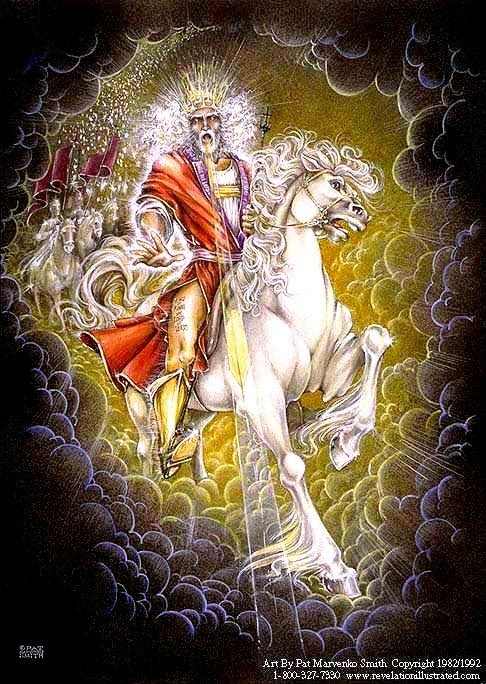
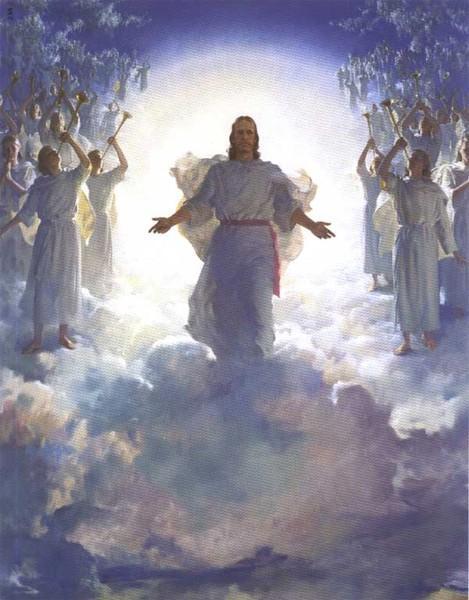
So what do we have here: clouds, flames, and signs with the Son of Man manifesting in the midst of it all. Artists have rendered this idea/image as either the Bible School Jesus all in white, robes flowing, or some kind of King image, all in gold, often times on a horse, and full of majesty (whatever that means). In either case, he is recognizable. Me? I don’t think so. I don’t think we’ll understand the Second Coming any more than we understand the ways of nature. We may be able to describe its properties, but not its essence.

Some people talk about the Second Coming of Christ as their chance to say to unbelievers, “See, I told you so,” “I warned you!” They act as though they wouldn’t be in the same shock and terror and wonder! Face it. How many times do things appear out of nowhere in the sky? I have to laugh as I consider whether all the spaceship movies are getting us ready for that appearance.

Of course, not everyone believes this can even happen. I remember standing at a bus stop every day to wait for the public bus that would carry me to high school (this is pre-school buses in Indianapolis). On the corner was a church of some type or another and on their sign, it always said, “Jesus is coming soon!” From my limited understanding of Christianity in those years, I thought they were really stupid. How could Jesus come again if he had already come. This was a teaching I never got (or understood) in Vacation Bible School or the more formal Latvian Lutheran church services. I don’t think I was alone.

A Second Coming is not something which we can prepare for in any way. When Harold Camping touted his May 21st forecast of judgment day (now pushed back to October 21st), he made it sound like people could actually do something in time for that day. That’s not the purpose of Christ’s coming. It’s the end of the age. Whatever happens next will be new, different, not recognizable. It may mean death or it may mean transformation. It’s a nexus moment. When the Christ comes, and if indeed, it’s “in the sky,” then the universe has changed dramatically. Both things cannot co-exist and be the same as before.

And why do the scriptures say that people will mourn? Is it because they didn’t believe or is it the loss of what we know. Our children and our children’s children will not know life as we know it. Everything must change. Everything will change. And if we don’t like change now, “Baby, you ain’t seen nothin’ yet.”

Read Full Post »

Wood Engraving by Gwen Raverat

Whenever the word inheritance comes up in scripture, my mind vaults to the story of the prodigal son [Luke 15] who is given and subsequently wastes his birthright share in “wild living.” But an everlasting inheritance can’t be expended, nor can it be given ahead of time, or can it?

Hebrews 9:15a
[Christ, the Messiah] is therefore the Negotiator and Mediator of an [entirely] new agreement (testament, covenant), so that those who are called and offered it may receive the fulfillment of the promised everlasting inheritance. . .
[Amplified]

So many Christian people are quite focused on the heavenly bequest and even use the promise as an appetizer to entice others into becoming followers of Christ. It sounds a little like the lottery, as though they are saying, if nothing else works out down here on Earth, at least we know we’ll have entry through the pearly gates and streets paved with gold; at last, a life of leisure with no pain, no worries, and no kids (only kidding on that last one).

But is that the point? Are we supposed to be toughing it out here because we can count on this inheritance later? This would be like our own children making no efforts now and simply waiting around until the parents kick off and the 401K’s are distributed.

I think the everlasting inheritance supersedes time. Just as there is no time in God’s world, our heritage is not limited to our death and subsequent afterlife. Instead, it was precluded by Christ’s death and the distribution included the Holy Spirit who lives in and among us now.

You want to spice up the Four Spiritual Laws or your personal proselytizing, then start including the wonder of the Holy Spirit who dwells within us now, who partners with us in this life, who draws us into being better Humans, who stimulates our internal compass toward those in need, to pricks our conscience, and teaches us to love others by loving us.

This is the everlasting inheritance that is here today.

Read Full Post »

Art by Catherine Andrews

The implication then is this: if the Christ appeared in a more perfect tabernacle not of “this” creation, there must be other creations. Hmm. The psalmists write, Selah, “pause and calmly think of that.”

Hebrews 9:11
But [that appointed time came] when Christ (the Messiah) appeared as a High Priest of the better things that have come and are to come. [Then] through the greater and more perfect tabernacle not made with [human] hands, that is, not a part of this material creation . . .
[Amplified]

Are there other clear references to another creation? I mean, it isn’t necessarily heaven designated in this passage from Hebrews, it could be anywhere. It seems a bit “woohoo” and “new agey,” right? In fact, I find it totally other-worldly, Star Trekian, multi-dimensional, and clearly, we’re “not in Kansas anymore.” We’re outside our human understanding. We don’t know about this other creation(s).

I understand, some commentators still believe the “perfect tabernacle” is in heaven because the human tabernacle was intended to mirror or replicate some heavenly place. But I think that’s simplifying the Spirit realm of God. It’s anthropomorphizing what we don’t understand and trying to put it into human terms.

It’s a similar situation with all the prophets who were given extraordinary visions of things outside their ken such as animals covered with eyes and wings in Revelation or Ezekial’s animals with four faces.

When my children were little, my husband and I liked to have fun with the various holiday characters such as Santa Claus, the Easter Bunny, etc. We always told them these characters existed in a different dimension. As the kids got older and realized how unbelievable it was that Santa could fly across the world in a single night and deposit gifts in each and every house, we reiterated: different dimension–anything can happen. Of course, our story is not as creative as C. S. Lewis and his world of Narnia, but ultimately, we share the same idea, once anyone goes through a “portal,” things are very different “there” (wherever there is).

The world and words of the Spirit realm are best depicted through the arts I think. Music, visual art, performance art, dance, film, scent, poetry: these are some of the better expressions of God’s kingdom or sphere or neighborhood.

What the Messiah did for Human is not really fathomable in our limited cosmos. One sacrifice for all? One outpouring of blood covers all sins from the beginning to the end of time? Perfection in human form? Covenants, promises, reconciliation, restoration, renewal, all of these possible by the act of one offering? Absurd, right?

Nope. It’s the link between our creation and all the other ones. The ultimate portal. Not science fiction or fantasy, but God business. And the stuff of dreams, imagination, love, resurrection, and transfiguration.

Read Full Post »

Just as the early Jews got hung up in the first covenant, today’s believers have created a version of the second covenant that resembles the first: earthly sanctuaries, regulations and time-honored traditions.

Hebrews 8:13 – 9:1
By calling this covenant “new,” he has made the first one obsolete; and what is obsolete and outdated will soon disappear. Now the first covenant had regulations for worship and also an earthly sanctuary.

Of course, it’s even more complex in our religious world of today. There is not just one version of the tabernacle, but many, depending on the sect or denomination. The worship regulations are more rigid if one is affiliated with a high church but even the seemingly “free” new churches have developed mores and practices that eventually become similarly rigid by repetition.

Until I read Pagan Christianity by Frank Viola and George Barna a few years ago, I considered contemporary churches as spontaneous and unrestricted by “ritual.” But truly, haven’t these services become equally predictable and patterned in structure? Isn’t there still a type of “call to worship,” music, prayer, announcements, and sermon structure every week?

Is that necessarily bad? Of course not. But I do wonder if we’re missing something by our focus on buildings and “ministries” and committees of various authority.

Several months ago, my family made a huge leap and ventured away from our church of twenty years just to see “what else is out there.” We visited several other churches, some larger and some smaller. We would attend for several services in a row if we felt attracted to the service. It usually takes longer than a visit or two to get a sense of a place or the priorities. In one case, we were intrigued by a very high-tech, seemingly culture-relevant church. Only to be turned off a few Sundays later when the price tag for this type of savvy “presentation” was revealed as their next “strategic” goal was announced: $14 million!

I don’t have any answers, just a lot of questions. What is important to the Church: the body of Christ? Who really requires weekly “discipleship” with state of the art video and music? Are we competing with the world? Or can we simply stand in within our culture like Jesus among the tax collectors and prostitutes and be agents for change by our steadfast faith and Holy Spirit presence? Does a Christ follower of 10 or 15 or 30 years need to hear sermons every Sunday or should he/she be the one equipping the poor and lost. . . out there?

Shouldn’t prayer and worship be a constant companion? Shouldn’t every gathering of people be a celebration of God with us, Emmanuel?

I have just started reading Brian McLaren’s new book, Naked Spirituality, and I cannot recommend it enough. He uses a single word in each chapter as an exploration into the faith journey. The first word is “here.” And I re-discovered that “here” is about “here I am.” I can choose to be aware of myself in God right now, right where I am: sitting at a computer or taking a shower or getting ready for work. Call to worship isn’t me asking God to show up, it’s me telling God I am present and ready to listen and learn and experience God in the moment.

There are no regulations for “here.”

Read Full Post »

All believers are stepping stones

Apparently I still need a priest. That title is not in my tradition although there has always been the pastor/preacher who was meant to guide or shepherd the church body (and thereby, me too) as well as deliver messages or teach by way of the inspiration of the Holy Spirit. In truth, the human versions are often found wanting. Naturally.

Hebrews 7:26, 28b
Such a high priest truly meets our need—one who is holy, blameless, pure, set apart from sinners, exalted above the heavens. . . . made perfect forever.

On occasion, there are ministers who have crossed my path who have changed my course. In my early days as a Christian in New York, I attended a pentecostal church (much to my own dismay) led by a very old pastor from Norway. I had no personal relationship with him, nor did I find him particularly accessible, but his instruction gave me a hunger for understanding scripture and he was able to explain passages that had stumped me on my own.

Another key pastor in my life was during my early years of marriage while living in Atlanta. He was a brilliant speaker, always intriguing and interesting from the pulpit. He engaged people personally and I am pretty sure everyone who attended that small church had dinner in his home several times a year. It was how his (very southern) family operated. Everyone knew him, warts and all. Through other para-church activities, we became friends and although he was flawed in many ways, his transparency, intelligence, and knowledge of the Bible made a lasting mark. He was our tipping point.

Since then, I have sat under pastors for short periods of time and long. In recent years, I’ve known several pastors of great intelligence who I admired and who gave many words of wisdom and yet, the one thing I longed for was a more personal connection, a sense of camaraderie and kinship. But how could I expect someone who was “ministering” to hundreds or even a thousand of people to guide me? They were simply too busy, too torn by their responsibilities to church and family, too sapped of energy by the truly needy. Oftentimes, I felt like the capable child in a family who everyone assumed was fine, strong, and secure which made it easier to spend time and energy with the struggling one, the emotionally unstable one. It wasn’t anyone’s fault, it’s just how things seemed to evolve.

So, what is my relationship really supposed to be with a pastor now? Having known and followed Christ over 30 years, do I still expect a pastor to be a kind of visionary guide who will come and say, “Jesus told me” that you should do such & such? I would be suspicious of that kind of approach anyway.

All right, all right, I know that Christ is the perfect pastor/priest. Christ is the ultimate shepherd, the ultimate guide, and the one to whom I should be looking for direction. I know that, honestly I do. (I also know that the success of such a relationship depends a great deal on my participation, my willingness to listen, and my time spent in silence. This is not a Sunday morning activity alone, but daily. I get that.)

But what, then, is my relationship to these human pastors? These flawed, but loving men and now women, who have felt called to operate in the role of church leader to “equip the saints.” I believe, at this point, based on experience and a certain amount of self-sufficiency (i.e. self-taught Bible study), that I want to walk beside. I skimmed an interesting online article by Craig Bluemel (who on further browse, appears to be controversial), but I did appreciate his view of the “elders” of the church as co-workers with the pastor. That we are no longer in a time when the church should be a pyramid. We all have something to share and teach by the leading of the Holy Spirit. We are all called to serve. We are indeed that priesthood of all believers [I Peter 2:9]. We need to stop looking elsewhere for “spiritual food” and spend more time looking within and sharing with others what we know.

Christ is our High Priest and will be, forever, yes. But we are the bumbling hands and feet and voice, whether trained or not. We are all imperfect. And so, we should combine our gifts and use them corporately to nurture and celebrate the Holy Spirit on earth.

Read Full Post »

This is another place where modern Human trips up. An indestructible life smacks of Superman and other “super heroes.” Miracles in general are not the food of modernity. We are all about logic and facts and evidence. But, I can only ask those who cannot fathom the miraculous, what if?

Hebrews 7:14-16
For it is clear that our Lord descended from Judah, and in regard to that tribe Moses said nothing about priests. And what we have said is even more clear if another priest like Melchizedek appears, one who has become a priest not on the basis of a regulation as to his ancestry but on the basis of the power of an indestructible life.

What if there was that indestructible one who wielded enough power to sustain life (and that crosses all dimensions of living), forever?

In these mid-range chapters that I am studying in Hebrews, the writer (and personally, I don’t hear the voice of St. Paul at all), the whole point is to examine the believability of Law changing because the priesthood was changed forever with the coming Messiah. That Jesus, as Messiah, was of another tribe (Judah) and like Melchizedek (who is mentioned several times in Hebrews 7), the ancestry does not line up with the law of the time. Melchizedek had an unknown genealogy while Jesus was affiliated by his birth mother to the wrong one and the next leap is Jesus’s true genealogy as divine.

It’s funny really, the ancient peoples struggled with Jesus’s genealogy while modern people struggle with the supernatural. The people of Israel had a history of miracles; this they could accept, but his lineage was a huge problem if he was to be their true priest-king with the authority to change their laws, the foundation of their faith. While today, that’s a more insignificant problem, it’s all the other stuff: virgin birth, bringing dead people to life, sight to the blind, hearing to the deaf, and of course, resurrection.

But, I say again, what if that kind of power did exist? What would we do in the face of an indestructible life, that is, directed, perpetual energy?

Read Full Post »

« Newer Posts - Older Posts »