Feeds:
Posts
Comments

Posts Tagged ‘holiness’

Us. Not just Paul and not just Timothy, us. And just like those two followers of old, we can’t earn a place in the “holy club” either. If God has a purpose and a willingness, then there is also enough grace, because of the work of the Christ, we’re in. And all of this happens “outside of time.”


II Timothy 1:9
He has saved us and called us to a holy life—not because of anything we have done but because of his own purpose and grace. This grace was given us in Christ Jesus before the beginning of time, . . .

I know this verse doesn’t really say “outside” of time, but Paul does write “before the beginning of time,” and I ask, what’s the difference? Because if something is before time, then it’s beyond the control and increments of time. It could be happening “now.” Call is not part of time. That’s amazing!

And if call is not part of time, then service to the Christ is also unhampered by the march of the years of my life. I can be used by God when I am 15 or 90. I can manifest the holy life for a minute, a day, or a lifetime. Those moments are not about me and more than likely, no one will necessarily point at my life’s work or example and say, “oh look, a holy life.” My holy life is in the hands of God’s purpose and grace.

I have skipped the previous verse that articulates the importance of suffering as a portion of the call. This aspect is always a challenge to me. Is suffering a testimony to holiness? I know there are some I can attest it’s true, friends who have walked the suffering pain of cancer and many to their death. Their courage and their abiding love for God during their illnesses humble me still today.

Is that time still to come? I don’t know. Will I choose with courage? If I can just hold on to one truth: suffering in time is finite while the holy life is eternal.

Read Full Post »

Words are compelling. They can change someone’s mind or lock in a point of view; they can soothe or they can motivate to action; they can break a heart or heal. Words create and words destroy. Depending on the wielder of those words and the interpreters, meaning can go either way.

I Timothy 6:4b-5a
“. . . He [one against the message of the Christ] has an unhealthy interest in controversies and quarrels about words that result in envy, strife, malicious talk, evil suspicions and constant friction between men, . . . ”

Currently, there is quite the controversy over the book, Love Wins, by Rob Bell. Perhaps by now, a few of the attackers of this book have actually read it, but I have a feeling that their minds are made up about the author and will read into those words what they believe are true. In response, they have added more words that are even more controversial, like heretic and apostate and “universalist.” These words are highly charged and challenge anyone who might want to agree with Rob Bell’s proposition as being in equal danger. Each day, I google Rob’s name and his book to find additional essays and points of view. Today, I discovered a well crafted essay from Richard J. Mouw, the President of Fuller Theology, who called Bell’s book one of salvific generosity or a generous orthodoxy, a term popularized by Brian McLaren some years ago (also a controversial author).

And so the battles rage about words and more words. Some are determined to “protect the faith” and some are equally determined to take grace to its limits, expanding the faith.

I am not a theologian nor do I have any authority to speak either way really, except by personal experience. I have written about my mother before who died at 91, in full dementia, and after a long life of mental instability, bitterness, and hardness of heart. But, when it came time for the end of her life, love was there and she had a specific experience of seeing the Christ. How could that be? How could God break through that cloud of confusion? Because, love can win. That love came through me, my husband, my children, my church family, my friends, and my neighbors. That love was three-dimensional, yes, but I believe it was also supernatural.

There is potential for recognition of the Way at any point in a life. We will never know.

When I give my own testimony of how God reached into my own soul, I am always reminded that several people who had known me before my revelation would say, “You? You are a Christian? You are LAST person I would think would ever do that.” And so it was, that I was the last person, like the woman who washed Jesus’s hair with her tears. And so, among the terrorists and killers, the child molesters and liars, the idolaters and the prisoners, I am there too. We are all among the last. And what words are there for us?

Read Full Post »

All things foretold will happen in good time. And yet, we still have a role: we cannot stop events from happening that are inevitable, but we can slow down the process. As believers, we are the remnant who stand fast in faith, working paradoxically much like sheep in a wolves’ world.

II Thessalonians 2:6
And now you know what is holding him [“man of lawlessness”] back, so that he may be revealed at the proper time.

The other day, I received an email from a friend who was passing along a David Wilkerson prophecy about great cataclysm and catastrophe coming soon. After a little investigation, I discovered this message was delivered back in 2009 and has been discussed ad nauseum on the Internet (both for and against) as to its validity, etc. My friend asked me “what do you make of this?” And I wondered what kind of reaction he expected.

The people of Earth live in perilous times. Some of the peril comes from our abuse of its natural resources and breaking the balance of nature with greedy commercialism and disregard for the poor. We have had a rash of natural disasters that have swathed countries in destruction and sorrow. We have whole peoples and nations bent on killing one another in the name of their gods, their histories, and their traditions. Some actually believe their perceived evil can be held back with weapons and violence.

When Abraham pleaded on behalf of Sodom (where his nephew Lot lived), he really had nothing with which to negotiate except for the existence of “righteous people.”

“Abraham confronted him [God], “Are you serious? Are you planning on getting rid of the good people right along with the bad? What if there are fifty decent people left in the city; will you lump the good with the bad and get rid of the lot? Wouldn’t you spare the city for the sake of those fifty innocents? I can’t believe you’d do that, kill off the good and the bad alike as if there were no difference between them. Doesn’t the Judge of all the Earth judge with justice?” [Genesis 18:23-25]

This was a prayer. This was a plea for justice. Abraham spoke on behalf of those who could not, who didn’t even know their lives were in danger.

Can I do any less? My response (as well as the response of all who call on the name of Christ) is to pray the mercy. Like the child in the story of the boy who held back the waters by putting his thumb in the dike, we too must be willing to stand, to pray, to cry out to God for the sake of those who cannot. Evil is present, but so is righteousness.

Read Full Post »

In today’s world, unless one participates in a charismatic denomination, the idea of the prophetic smacks of the National Enquirer. So, if most people don’t believe in prophecy, isn’t that already contempt? How does a prophet gain credibility?

I Thessalonians 5:20-22
. . . do not treat prophecies with contempt. Test everything. Hold on to the good. Avoid every kind of evil.

Actually, the scriptures speak of the importance of testing what is said by a prophet. All the way back in the Old Testament, it was written, “If what a prophet proclaims in the name of the LORD does not take place or come true, that is a message the LORD has not spoken.” [Deut 18:22a] This appears to be a straightforward test of a prophecy, if it comes to pass, it’s a true prophecy. Of course, that doesn’t help much in the moment, when a prophecy is uttered.

It’s hard to know, actually. I have experienced a kind of fluttering within my personal spirit upon occasion, a sense of truth being spoken, a type of corroboration or affirmation. But, that’s certainly less than definitive. And so, if the prophecy is important, it’s reasonable to consider putting the words to the test.

But I will say right here, testing a prophecy is about as effective as trusting internal flutterings alone. Oh, I suppose one could compare the prophecy to what is already known and determine if it’s sound and grounded in truth. However, it’s in my mind that a genuine prophecy is outside the normal range of reason. Otherwise, it would just be something the smart folks around us could figure out, they’d be able to predict. You know, those people who love statistics and computers, our weathermen and futurists.

Perhaps the key word here is not the test but the attitude? A prophetic utterance viewed with contempt will rarely find root.

I did check the Greek, as best I am able, and there is a some confusion as to whether the “testing” phrase is about the prophecies or about everything else, that is determining what is good and right vs. what is not. So, perhaps we aren’t supposed to test prophecies alone, but test the world around us.

Others will say that prophecies are not merely predictive, but rather some type of “edification or encouragement.” I think that’s pretty lame. There’s not much danger in doing that, is there? What is there to disregard or disdain?

No, I think it’s all the phrases [20-22] together that have meaning: I cannot hear truth of any kind if I have closed myself off through contempt, either for the speaker or the message. If I have made a decision before the time, then there is no possibility I will hear anything new. In other words, “we hear what we want to hear.”

Also, once we have heard something (anything), we shouldn’t act or react immediately, but let it settle inside. Some testing can be done by comparing the message with what is known, but for what is unknown, it takes a united exploration of those words and ideas with the Holy Spirit. And finally, out of everything spoken, we must hold fast to “good” and truth: once we accept the truth of a prophecy, then we must not let it go. From there comes strength to “avoid evil.”

Read Full Post »

Following all the rules, obeying all the laws, coloring inside the lines, striving for perfection: these are the phrases that come to mind when I ponder the phrase, “legalistic righteousness.”

Philippians 3:4b, 6
If anyone else thinks he has reasons to put confidence in the flesh, I have more: . . . as for zeal, persecuting the church; as for legalistic righteousness, faultless.

Actually, to be honest, just the word righteousness all by itself conjures up all kinds of negative vibes. Well, not completely true. I mean, if I connect the idea with God, then the word smooths out. God can carry righteousness as a banner and that seems perfectly natural. God is righteous and always does the “right” thing, says the “right” words, always has the “right” motives.

Not so, human me.

The synonyms are a lot nicer. I don’t have any problem in my desire to be good or virtuous. I also wouldn’t mind being viewed as holy or godly or devoted. How about benevolent, generous, honorable, or honest? All, quite fine.

But righteous? Blech! I see myself standing there with arms crossed as I look down my nose at the rest of the world. It does not feel loving or friendly or considerate of others.

In the name of the “narrow way,” I see other followers of Christ take this stand. There are Christian sects who go from door to door to proselytize their brand of righteousness and when they are shooed off the property or have a door slammed on them, they consider it a blessing, a confirmation of their way.

And still other faithful, perhaps their God has a different name, and yet, they too act out of a strong sense of righteousness to the point of death for the cause.

Righteousness is elusive. “Why do you call me good?” Jesus answered. “No one is good—except God alone. . . . ” [Luke 18:19] Here is the heart of true righteousness, in God alone and thereby, through the Spirit within. Any righteousness or “right living” that is grounded in my own efforts is, by its very nature, “legalistic righteousness.” It’s a show and a sham.

Keep me mindful, O Lord, of your presence within so that my words and actions are joined by the threads of your Spirit. Selah.

Read Full Post »

We are asked to put on God’s armor in order to stand against spiritual forces from the dark world. Sounds like fantasy but there is a decision to be made here: truth or fiction? I’m leaning toward the truth side. And if true, the real battle has been waging on without me.

Ephesians 6:12
For our struggle is not against flesh and blood, but against the rulers, against the authorities, against the powers of this dark world and against the spiritual forces of evil in the heavenly realms.

I have not been asked to advance against the enemy, merely to stand. And yet, I have not been moving forward or standing, not really. Instead, I have been buffeted about internally. My mind has been captured by the distractions of the world, my spirit veiled by self-absorption, and my heart hardened.

The greater fool, I, for trying so hard to do battle in this 3-D world. I’ve been totally caught up in my ambitions, my weight, my aging, my eyesight, my losses, my children’s successes or lack thereof, and so on. I’m not even on the right playing field.

Currently, I’m reading the Suzanne Collins trilogy, Hunger Games, Catching Fire, and Mockingjay. These stories take place in a futuristic world where our country has been divided into districts, all serving the “Capitol.” Each district has a single industry. Once a year, each district must send two “tributes” (teenagers) to fight to the death, with only one victor. The victor’s district is then blessed with extra food etc. for that year. In the second book, because the lead characters foiled the Capitol in book one, the games take on a cruel turn. I won’t give that away, but a phrase has stayed with me that is relevant to my discussion here: “Remember who your enemy is.”

In our world, we have forgotten who the true enemy is as well. Instead, our countries fight wars, terrorists prevail, our sons and daughters die violently, people starve, and natural resources are despoiled. We continue to struggle with the symptoms instead of the root causes.

Photo by Angelo Juan Ramos

It all comes back to the Light and illuminating from within: living a life of love, submitted and thereby filled with the Holiest Spirit, who works in union with my personal spirit. And out of that life pours forth compassion, forgiveness, and beauty.

I can go about serving others, visiting the sick and dying, feeding the hungry, comforting the homeless, and giving from my livelihood. But if I do these things without the Light, they are band-aids.

It’s time to stop living as though it’s such a great mystery. The mystery has been revealed through the Christ and is a living, powerful presence in me through the Holy Spirit.

I want to stand today. I want to be counted as one standing. I want to shine.

(FD 15)

Read Full Post »

Here was the plan: Jesus would come to Earth and do his best to explain/demonstrate the whole Spirit thing and then sacrifice himself to wrap up and seal the covenant. Promised result: the eyes of our hearts would be opened wide and we could live likewise. Actual result: we’re still discussing it.

Ephesians 5:25b, 27
. . . Christ loved the church and gave himself up for her to make her holy. . . and to present her to himself as a radiant church, without stain or wrinkle or any other blemish, but holy and blameless.

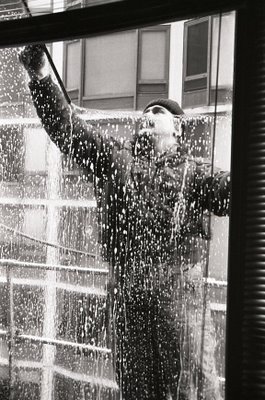
Here’s another word picture for all of this: the high rise window washer who puts himself in great danger to clean the windows so that light can be seen both in and out. But then we shut the drapes.

I have everything I need to enter the story life that God intends. I have the body, the circumstances, the family, the nation, the neighborhood, the friends, the talents, the washed windows . . . (all the layers of my drapes are on the inside of the windows).

The light is there. I made covenant with Christ thirty years ago. I am in the Body. I am loved by God.

During this time of fasting, I am slowly opening my drapes, one by one.

While the light of God might be more like the sun, shining brightly with heat and energy everywhere, the Holy Spirit is radiant and glows, permeating the dark spaces with steady but gentle light.

There is radiance and there is holiness within me. Like the last day of school before summer vacation, I want to open the doors and allow it all to pour out.

(FD 10)

Read Full Post »

« Newer Posts - Older Posts »