Feeds:
Posts
Comments

Posts Tagged ‘resurrection’

The second appearance of the Christ is critical to the faith. But I must say, it’s been an event a long time coming. No one can really imagine what the Second Coming might look like. Scriptures are fairly vague at best.

Hebrews 9:28
. . . so Christ was sacrificed once to take away the sins of many; and he will appear a second time, not to bear sin, but to bring salvation to those who are waiting for him.

There’s Revelation 1:7 — “Look, he is coming with the clouds, and every eye will see him. . . ” and Matthew 24:30 — “Then will appear the sign of the Son of Man in heaven. And then all the peoples of the earth will mourn when they see the Son of Man coming on the clouds of heaven, with power and great glory.” and II Thessalonians 1:7b — “This will happen when the Lord Jesus is revealed from heaven in blazing fire with his powerful angels.”
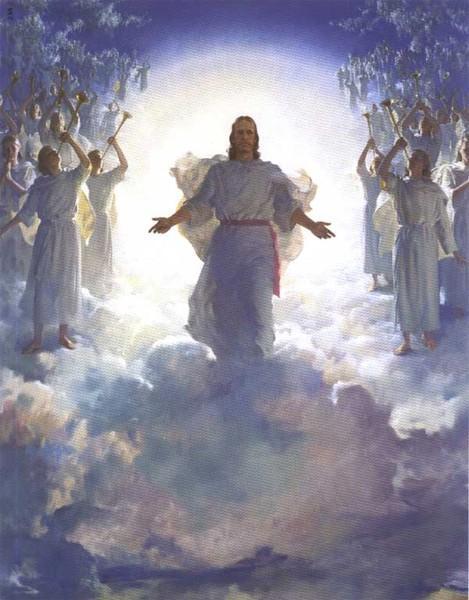
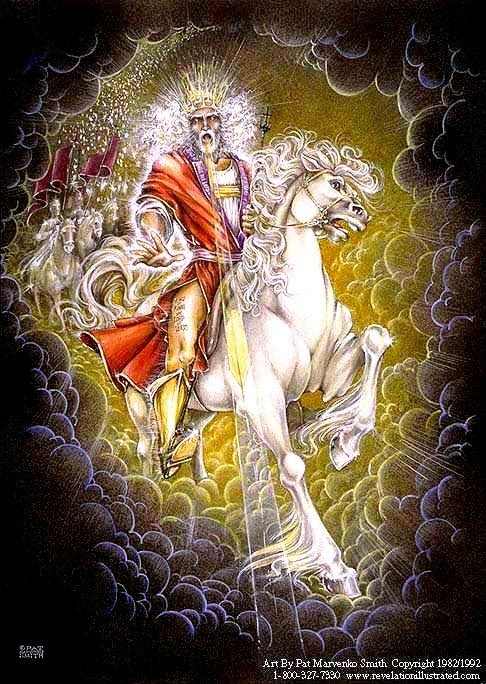
So what do we have here: clouds, flames, and signs with the Son of Man manifesting in the midst of it all. Artists have rendered this idea/image as either the Bible School Jesus all in white, robes flowing, or some kind of King image, all in gold, often times on a horse, and full of majesty (whatever that means). In either case, he is recognizable. Me? I don’t think so. I don’t think we’ll understand the Second Coming any more than we understand the ways of nature. We may be able to describe its properties, but not its essence.
Some people talk about the Second Coming of Christ as their chance to say to unbelievers, “See, I told you so,” “I warned you!” They act as though they wouldn’t be in the same shock and terror and wonder! Face it. How many times do things appear out of nowhere in the sky? I have to laugh as I consider whether all the spaceship movies are getting us ready for that appearance.

Of course, not everyone believes this can even happen. I remember standing at a bus stop every day to wait for the public bus that would carry me to high school (this is pre-school buses in Indianapolis). On the corner was a church of some type or another and on their sign, it always said, “Jesus is coming soon!” From my limited understanding of Christianity in those years, I thought they were really stupid. How could Jesus come again if he had already come. This was a teaching I never got (or understood) in Vacation Bible School or the more formal Latvian Lutheran church services. I don’t think I was alone.

A Second Coming is not something which we can prepare for in any way. When Harold Camping touted his May 21st forecast of judgment day (now pushed back to October 21st), he made it sound like people could actually do something in time for that day. That’s not the purpose of Christ’s coming. It’s the end of the age. Whatever happens next will be new, different, not recognizable. It may mean death or it may mean transformation. It’s a nexus moment. When the Christ comes, and if indeed, it’s “in the sky,” then the universe has changed dramatically. Both things cannot co-exist and be the same as before.

And why do the scriptures say that people will mourn? Is it because they didn’t believe or is it the loss of what we know. Our children and our children’s children will not know life as we know it. Everything must change. Everything will change. And if we don’t like change now, “Baby, you ain’t seen nothin’ yet.”
Read Full Post »

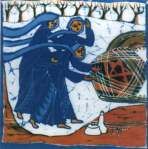
Batik by Hanna Cheriyan Varghese, Malaysia

Sometimes it’s not worth engaging in discussions that will go nowhere, particularly if people are getting upset and defensive. No one gains. If anything, more is said than should have been said and the controversy escalates. I have seen this happen a hundred times. I’m done.

Titus 3:9
But avoid foolish controversies and genealogies and arguments and quarrels about the law, because these are unprofitable and useless.

We had a controversy in our local community that was extremely divisive. Conversations were misrepresented; newspapers reported incomplete information and often, with only one side of the story or pure hearsay; while social networks were used to accuse and inflame an already unstable situation. And to what end? The people in the center of it all felt no better, just wrenched apart emotionally. The only thing that lessened the impact was the wisdom of a few who said: don’t engage, don’t add, don’t comment. And eventually, this proved the best choice; the furor abated and people moved on with their lives.

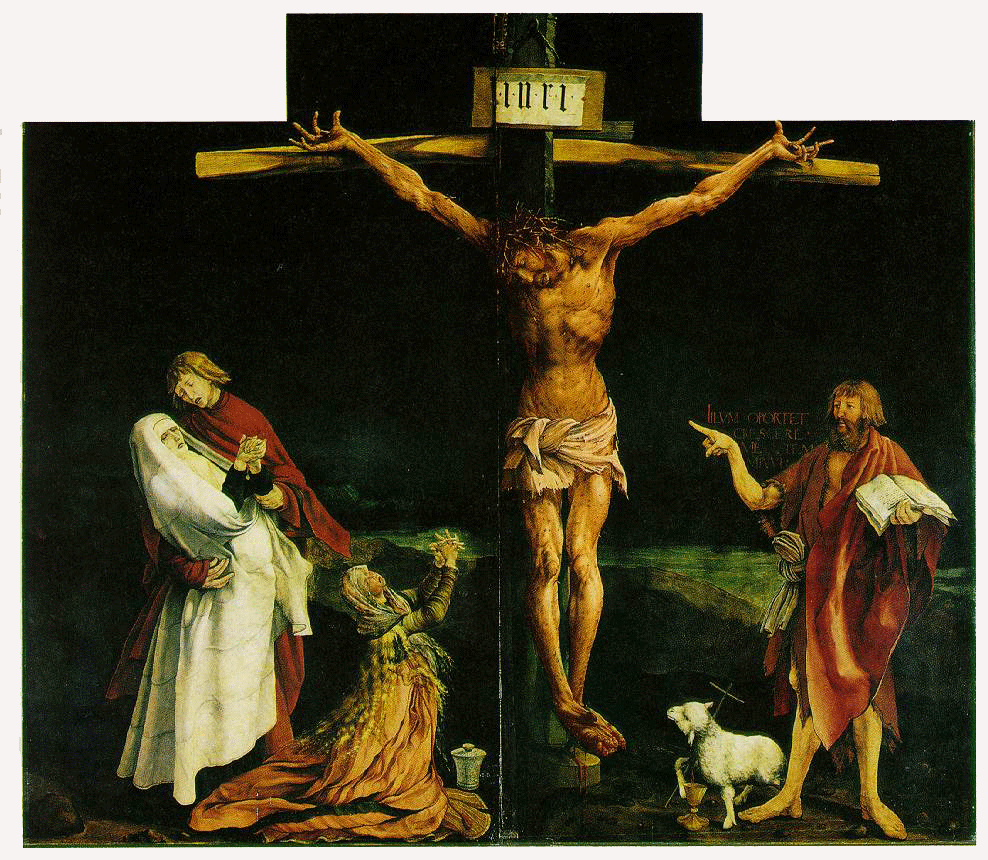
When Jesus stood before the different “authorities” on those fateful days before his crucifixion, he, too was silent. What would have been the point? No one would have believed him more that day than any other day. There was nothing more to be said. His great controversy had to be endured and he knew the meaning from the beginning. He may not have known how the whole thing would play out, the passing from one dignitary to another (think about it: he saw three “leaders” in the course of 24 hours who could have changed the world), but he knew the outcome would be the same: torture and death to the body.

But Jesus also knew about the third day. He knew about the results. He trusted God, despite the pain, the desolation, the anger, and the very air of evil that encircled him. Words were nothing.

And so, Jesus, as foretold throughout the histories and prophecies, rose from the dead. That event put all controversies into perspective.

When all is said and done, most stories have an opportunity for resurrection and transformation. With God, there is always hope. There is no irredeemable act. Even in the face of evil, we must hold fast to our belief that “love wins” — God wins!

Read Full Post »

Becoming is a series of resurrections. In order to optimize the resurrections of the heart, soul & mind, there must be deaths–crucifixions, to be specific. But a number of hindrances to the deaths as well as the awakenings play out in my life. Categorically, the biggest obstacle is idolatry.

Colossians 3:3-5
For you died, and your life is now hidden with Christ in God. When Christ, who is your life, appears, then you also will appear with him in glory. Put to death, therefore, whatever belongs to your earthly nature: sexual immorality, impurity, lust, evil desires and greed, which is idolatry.

This type of idolatry is not just worshiping a statue or foreign god, it’s putting Self up on a pedestal. The earthly nature illustrated in this verse (immorality, impurity, sex, evil desire and greed), is all about self-pleasure and choices made without concern or care for the other. Idolatry is another way of acting out extreme narcissism.

To crucify or “kill” these tendencies, desires, and controlling habits, I must first be willing. Jesus gave us the way to the cross. It didn’t seem very fair at the time. And it was a painful process, a breaking down of everything. His body was stripped of all protections. He was laid bare both physically and mentally.

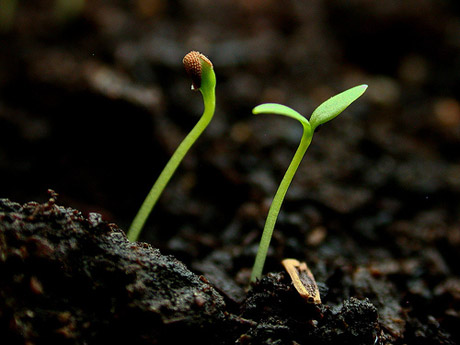
Can I lay bare my own ego that wants to defy the Spirit and doesn’t want to understand or trust the paradox of faith in a Christ? Sexual behaviors and addictive pursuits are not the only features of an earthly nature. I have other consuming thoughts like ambition, notoriety, fame, power, wealth, and control. These too must be crucified before they can become the seed that dies and transforms into a thriving plant or tree. [John 12:24]

This remains unknown territory. I must willingly walk my personal “Via Dolorosa” and encourage my ego to let go of the survival skills I have developed over the years out of pain and fear and abandonment. They push people away. They block the free flowing release of the Spirit within. And what’s on the other side of crucifying the old ways? The old idolatries? I don’t really know. I only have a promise and a faith in the One within.

But I do know this: until that earthly nature loses its grip on my life, I’ll never know the truth of a truly resurrected life. They cannot live together.

Read Full Post »

To know . . . to know . . . to know. What does it mean to know Christ? What does it mean to know the power of his resurrection? And what does it mean to know the fellowship of his sufferings? I mean, really!

Philippians 3:10a
I want to know Christ and the power of his resurrection and the fellowship of sharing in his sufferings . . .

To understand with certainty, that’s one definition. Or, to establish or fix something in the mind (like memorization). Or, to be acquainted with (like a friend). Or, to understand with experience (like baking a cake). And finally, to be able to distinguish one thing from another (like right from wrong).

In some ways, each one of these definitions can be applied to this verse. Like Paul, I want to “know” Christ with certainty. I don’t want a casual acquaintance but a deep knowing that comes from exposure. I want the sunburn of Christ (no sunscreen) inside and out. With that kind of knowing, there is trust, contentment, patience, confidence, and security. To the degree that I don’t have those attributes is the degree to which I don’t really know the Christ. Perhaps “to know” really means “to love” (which is how the more archaic definition for knowing meant a sexual union). There is nothing more beautiful than transparent sex, the give and take of pleasure, the concern for other. Too bad. most sexual unions miss the sacred part.

And how about knowing the “power of his resurrection?” That’s formidable. Can anyone imagine being acquainted with this type of knowledge or certainty? That is supposed to be the case for every Christian, but we don’t walk our lives with that kind of confidence. I know I don’t: I still fear illnesses and teens driving home late at night and violence. Besides, isn’t Paul actually asking for the knowledge of this power to operate in the present and not just for raising his own body. Undoubtedly, this kind of power heals the sick, makes the blind see, the deaf to hear, and the lame to walk. Same power, I’m sure of it.

And lastly, to know and share in the afflictions that Christ suffered: not just physical but emotional, mindful, and spiritual. Can I bear the pain? Can I accept it? Or do I still run away from pain. Sweet paradox again.

I’m thinking they all go together. I cannot “know” one aspect without the other. I cannot be acquainted with healing power without knowledge of pain and hardship. My certainty is strengthened by the operation of all three in my life.

Read Full Post »

I did a quick study of “drink offering” and two things stand out: the drink offering is always given along with something else (usually the meal offering); it is wine and represents the blood. It is often followed by oil which symbolizes the Holy Spirit.

Philippians 2:17-18
But even if I am being poured out like a drink offering on the sacrifice and service coming from your faith, I am glad and rejoice with all of you. So you too should be glad and rejoice with me.

He is saying that his death is poured out over their “sacrifice and service” and as such, will be additionally blessed. And later, Paul asks that his followers rejoice in this, rejoice in his offering, rejoice in the implications of their offerings, both his and theirs. It will be followed by the Holy Spirit who will give back life to their planted seeds. The seed must “die” to bring forth a plant [John 12:24].

But what is in this for me? I am not in the drink offering business. At least, not yet.

Perhaps I need to be aware of the sacrifices that others have made for me though. Do I appreciate the pouring out of my mother, let’s say, who gave everything for her children, even her emigration to the United States for our sakes, to have a better chance. She worked, she saved, she spent, she did the best she could with the resources she had.

I think about David in II Samuel 23:16, when three mighty warriors broke through Philistine lines just to get him a “drink of water” from the well near Bethlehem. Some find it odd that once the warriors brought the water, he would not drink it, but poured it out on the ground. In essence, I believe he was acknowledging it as a type of drink offering. It was holy and symbolized sacrifice for the cause.

To what have I sacrificed? Where is my drink offering? This offering is unlike the offerings described in the early chapters of Leviticus. I believe this offering is not mandated, it’s extra, it’s a choice.

Oh Lord, give me courage and desire to identify and pour out my offering when the time comes.

Read Full Post »

Did the ones who stood vigil at the cross really believe Jesus would die? I don’t think so. They expected a reprieve or a last minute miracle. After all, this was the man who stilled a storm, gave sight to the blind and raised a dead man. Was this his final display of strength in weakness?

II Corinthians 13:4
For to be sure, he was crucified in weakness, yet he lives by God’s power. Likewise, we are weak in him, yet by God’s power we will live with him to serve you.

It’s all there in the crucifixion story: die to live, weaken to strengthen, submit to rule, forgive to trust, suffer to heal, and so forth. These opposites trail after me. When am I going to get it?

Last night I had a dream about a very large black dog that charged toward me and instead of running away or standing stock still, I squatted down, held out my arms to hug him and nuzzle him. I seriously doubt this technique would work in real life. But in the dream, the dog responded and simply rubbed my face and neck the same way my big Snooki dog (a black lab mix) does. It’s a start.

Weakness can be a choice for the good of the moment.

For me, this means saying, “You’re right,” more often or “I take full responsibility for that mistake,” or “I was wrong.” It means listening even when I disagree. It means giving opportunities to others that I would like to have. It can mean serving without recognition or diligence without admiration. It can mean accepting surprises and unintended consequences with grace. It can mean a certain lack of control.

My big joke about myself has always been that I prefer “planned spontaneity.” When an old friend who was a 5th grade science teacher told me she would run experiments in class without knowing the outcome, I paled. How often have I told people, “I’ll do it!” not because I wanted to help but because I didn’t trust anyone else to “do it right.”

That’s a shame to me now. It’s time to respond differently. It’s time to let go of my controlling nature. It’s time to stop previewing the future, planning every step, and manipulating outcomes.

I’m not so sure that even Jesus knew how things would play out. But his trust in God was rooted deeply and in the end, even in fear and doubt, he died with hope. Was he surprised when he found himself back in the world? We’ll never know. But he certainly walked about in new understanding.

This is what can happen to us as well. Once we let go of “our way,” we are able to discover another way that is God-breathed.

Read Full Post »

Had some fun this morning thinking of my body as a seed being prepared for planting. Each seed is different. Each seed has its own characteristics and with each 3-D life event, the seed is affected (both good and bad). Each seed then creates a “plant” — a new entity.

I Corinthians 15:36b-37
What you sow does not come to life unless it dies. When you sow, you do not plant the body that will be, but just a seed, perhaps of wheat or of something else.

It never occurred to me before that a resurrected entity would have as much diversity (or more) than these human bodies we now have.

Really, until Jesus “revealed” himself to the disciples after resurrection, they didn’t really recognize him. He had to manifest something they could understand: the nail-driven hands and feet, the pierced side. But they certainly didn’t recognize his clothes or his features at first.

What else don’t we recognize? They say we “see what we want to see.” We see what we expect to see. For all we know, the resurrected guys are walking around among us. I’m just sayin’…

In the parable of the sower and the seed, the success of the seed had a great deal to do with environment and circumstances. Some of this environment we cannot control initially (caustic families, poverty, etc.) but as we mature, we are presented with more choices. We can actually seek change. We can look for good soil. The human seed does not have to be passive. And apparently, when a bunch of seeds get together they can really transform circumstances.

I know these are just flights of fancy, but word pictures are important because I cannot really fathom anything about this “other” world I have called “heaven” all my life. It’s not just a place . . . it’s a state of being.

Read Full Post »

« Newer Posts - Older Posts »