Feeds:
Posts
Comments

Posts Tagged ‘sacrifice’

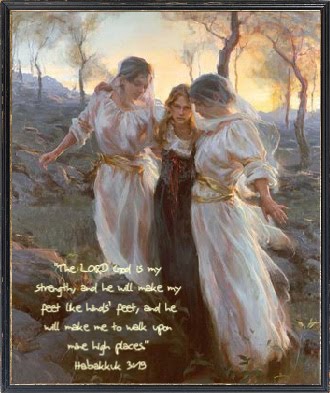
hinds_feetA good part of me is struggling with the word “sacrifice.” Just a quick look at the thesaurus and there’s no wonder I’m hedging, words like lose, endure, renounce, forfeit, and part with. They all resound loss. In our currently turbulent world, can I afford to lose anything more? Can I afford not to?

Therefore, I urge you, brothers and sisters, in view of God’s mercy, to offer your bodies as a living sacrifice, holy and pleasing to God—this is your true and proper worship.Do not conform to the pattern of this world, but be transformed by the renewing of your mind. Then you will be able to test and approve what God’s will is—his good, pleasing and perfect will. [Romans 12:1-2]

It feels like an oxymoron [self-contradictory]. How can I be a “living” sacrifice; won’t I be gone and spent? It’s the most blatant paradox in all of scripture and it’s repeated over and over again: to live is to die; to die is to live. [What you sow does not come to life unless it dies. I Corinthians 15:36]. We see it in nature all the time: the earth replenishing itself.

Too often, I can only see this life, this skin, this body. I try not to be afraid to die. I understand the promises of life after death, I espouse alternate realities and a rich spirit life in which the Presence of Christ is much bigger than this three-dimensional me. But I hold still fast to what I have. Perhaps it is rooted in our family’s poverty when I was young, but how long can I allow that wanting self to rule my life of plenty?

Many years ago, I read Hannah Hurnard’s “Hind’s Feet on High Places,” the allegorical story of Much Afraid whose Chief Shepherd encouraged to take a journey up the mountain with two companions, Sorrow and Suffering. She did not like these companions at first, at all. They seem to be taking her the wrong way, down and not up. But she is convinced to trust the Shepherd, and so she goes, marking that decision with an altar (a benchmark).

And so I am reminded that a living sacrifice is not a one-time, lay it down kind of thing. It’s a another journey. A living sacrifice is ongoing, daily, with understanding, becoming and transforming, letting go of one part, growing another. It is a renewal through pruning. It is communal and by agreement. I must choose.

Read Full Post »

kissandmakeupTherefore, if anyone is in Christ, the new creation has come: The old has gone, the new is here! All this is from God, who reconciled us to himself through Christ and gave us the ministry of reconciliation: that God was reconciling the world to himself in Christ, not counting people’s sins against them. And he has committed to us the message of reconciliation. . . . Be reconciled to God. [II Corinthians 17-19, 20b]
Big word: reconciliation. How often do you use that during the day? And yet, we are doing it every day.
As a parent, we are reconciling our children all the time: settling disputes, making compromises, restoring harmony. At work, we do the same, particularly if we work, as I do, in public service. Sometimes my front desk feels like nothing more than a complaint department.
The key to reconciliation is a willingness to participate in a two-way conversation. Both sides have to agree, both sides have to be in the game.
In the case of God, through the sacrifice of the Christ, the door is open for a permanent relationship with God. Many old rules have been cast aside and a new covenant was forged. But, we still have to go through the door and, as it were, sign our copy of the deal. It’s not that the deal is not a good one or that we need to dicker, we just need to recognize it for what it is, an offer to start over.
Here’s what is amazing to me. It’s never too late to “kiss and make up” with God. This offer is eternal.

Read Full Post »

nose ringThey’re coming back into fashion, nose rings, but not with the same significance they had in ancient Israel. In fact, most circular jewelry spoke of a kind of protection and when Abraham’s servant (never named) gives Rebekah the nose ring and bracelets, she knows this is the beginning of a bridal negotiation.

Genesis 24:21-22
Without saying a word, the man watched her closely to learn whether or not the Lord had made his journey successful.When the camels had finished drinking, the man took out a gold nose ring weighing a beka [5.5 grams] and two gold bracelets weighing ten shekels [110 grams].

I tried to find some additional information about the significance of the nose ring in that era, but did not have much luck in a cursory search. However, I was surprised to find a bridal engagement ring offered on Ebay. Go figure, what goes around comes around.

In general, jewelry had a different significance in that time. It was easily transportable wealth and much like some contemporary tribes of today, women would wear their wealth both symbolically and intentionally. Jewelry is a sign of success.

But then, that still holds true today except that most of us don’t have the kind of wealth that allows us to wear authentic carat-laden diamonds or other precious stones. Instead, we have created imitations. We want the “look” without the reality.

Am I turning this tendency toward my spiritual life as well? Do I want merely the appearance of relationship with God, with Spirit within? Or do I want the more costly genuine version? Am I willing to make the necessary sacrifices to get it?

Unfortunately, I know my answer is still a wimpy “no.” I’d like to believe I am going in the right direction but I also feel myself holding back. God is offering me solid gold nose rings and I’m balking at how I might look. Plus, if I take the ring, doesn’t that indicate I am accepting the terms?

I am the bride of Christ, as a believer, it’s a unique description. But how often do I really walk that out and wear the complete garment, nose ring and all?

Read Full Post »

passover-lambIt’s easier to read the story about God “testing” Abraham when you know how it turns out. As I contemplated this tale, I wondered if Jesus remembered this story as He was being dragged to the cross, knowing full well that He the was Lamb. But that’s another story. In this one, who knew?

Genesis 21:7
Isaac spoke up and said to his father Abraham, “Father?”
“Yes, my son?” Abraham replied.
The fire and wood are here,” Isaac said, “but where is the lamb for the burnt offering?”

As a mother, I cannot do anything but head right for the emotions of the moment. How did it feel to be Abraham preparing the sacrifice of his son at the command of God, who had been all about the promises of descendants as numerous as the stars? Despite departing right away the next day, it was still a three day journey to the mountain where the sacrifice was to take place. Three days of contemplating the loss of his beloved son. Three days of wondering how God would work things out. Three days of surrendering. It could not have been an easy journey.

And how did Isaac feel, once they arrived, tied up and placed on the prepared altar, wood loaded and knife in his own Father’s hand? Did he go calmly? Did he really think, “Wow, my Dad is truly faithful. He’s amazing!” I don’t think so.

In fact, we don’t really hear about the relationship between Isaac and Abraham after this experience at all until Abraham is “very old” and acquires a wife for Isaac who is now forty years old. What was Isaac up to all those years? No telling. We will never know.

But it doesn’t change the story, does it? Whether they feared or not feared, whether they cried or screamed or complained, it didn’t matter. Abraham acted. Abraham took his “here I am” seriously, because “here I am” also means I am willing to do whatever you ask me. No one says, “Here I am” to God and then follow up with, “I’ll think about it.” And because Abraham had already agreed to do whatever God asked him to do, he followed through.

And really, here’s the truth of it for me. When I became a follower of Christ more than thirty years ago, I also said, “Here I Am.” I think I’ve been forgetting what it meant. And, quite honestly, I’ve put my head in the sand about the lamb, figuring Jesus did all that hard work. And that’s basically true, but there are the daily sacrifices and the long-term ones. There are still challenges and obedience.

The lamb is here.

Read Full Post »

Although Abram could believe that God would provide him with descendants as numerous as the stars, he questioned God’s ability to give him the land. Perhaps there were enough loopholes in the promise to make a baby, but land was solid; land was imperishable; land was enduring. And in this case, the land was occupied.

Genesis 15:7-8; 18a
He also said to him, “I am the Lord, who brought you out of Ur of the Chaldeans to give you this land to take possession of it.” But Abram said, “Sovereign Lord, how can I know that I will gain possession of it?” . . . On that day the Lord made a covenant with Abram and said, “To your descendants I give this land . . .

Whereas the baby was a promise, the land became the end result of a contract, a covenant. It was formal and branded with the blood of animals. When blood is spilled over a promise, then it is unbreakable.

In some ways, this sign is still with us today; we hear of it in other cultures like blood oaths and blood rituals. These are done with the same intent, a promise, a loyalty, a trust, are exchanged.

There are a number of blood covenants in scripture and of course, the most important one to believers and Jesus followers, is the blood of the Christ, the Messiah, spilled once for all.

The Israelites gained and lost the land through poor judgment and sin. All through the history, kings fought over the land and by the time of Solomon, it had been taken back and restored to the people of the promise, the people of the covenant. And yet, in not so many generations later, the land was lost again. Today’s Israel is still fighting, for good or not, I do not know, but it is in their DNA to pursue the land that was lost.

The Christ, the very Son of a Holy God, spilled blood as a substitute for our own blood in place of those conscripted animals who annually paid the price in times long past for the sins and bad choices of Human. But just as the Israelites lost their land, despite the promise, Human is loosing everlasting life through distraction, unbelief, division, and tunnel vision.

Too many times, we, Human, we act as though the covenant is failing or no longer powerful. But I know that is not so. I know this deep in my soul.

And so, forgive me Father, when I look elsewhere for the “solutions” to my problems, when I look elsewhere for direction, when I don’t look at all. Forgive me Covenant maker.

Read Full Post »

Tree by Vicky Brago Mitchell

Tree hugger has become, in some circles, a euphemism for left-winger or environmentalist or maybe “commie-fascist-pig.” It’s that bad. Tree huggers are seen to be superfluous and extreme, as though they care more about trees and mice and rivers than they do about oil and energy and pragmatism. Ironic, how many times scripture compares a blessed person to a tree. And one of the most important symbols is the “tree of life.” But of course, that must be different. Or is it?

Psalm 1:3
That person is like a tree planted by streams of water,
which yields its fruit in season
and whose leaf does not wither—
whatever they do prospers.

It’s a good thing, then, to be compared to a tree. Perhaps it came out of the climate where trees were appreciated. I remember my first trip out west by car and how we looked and look for a shady tree to stop for lunch. Another time, I booked a tent site in a camp ground near the beach. It never occurred to me that the site would have no trees. The “gorgeous” weather proved to be monotonous without the blessing of natural shade.

Our current house backs up to the woods. It is the reason we wanted this piece of property (although my big dream is to live near water — river, ocean, lake, etc.); the next best is trees. They are in constant motion really through their partnership with the wind. They are a nesting ground for all kinds of animals. They are part of the cycle of life and clean air. I have never told anyone before, but within days of our move-in, I felt compelled to do something very “new agey” and thank the trees for their sacrifice since hundreds were downed and destroyed in the name of our suburban sprawl. It just seemed right.

One of my favorite nature images is a winter tree silhouetted by the setting sun. I can’t explain that. So, yes, I really am a quiet advocate for trees. And yet, I am also careless as most urban dwellers. I use a lot of paper (it doesn’t look like a tree) and I enjoy the gifts of wood from floor to ceiling. I even live in a wood house.

Maybe that’s the real problem. I like the “idea” of trees; I like them conceptually. It’s not too different from liking the idea of being a follower of Christ. I can romanticize that too. I can sing all the right songs and wear the right jewelry. I can roll out a few scriptures, and I can pray a good prayer. I am a cross hugger about as much as I am a tree hugger.

But just as the rainforests are being systematically destroyed God’s natural world is being polluted, so are children of God starving around the world. . . starving for food as well as spirit. People are dying by violence and neglect. A monthly check to one organization or another is no longer enough.

Save the trees :: Save the people.

Read Full Post »

Martyr has become a dirty word over the last twenty years as Islamic terrorists and extremists have usurped its meaning through rampant suicidal bombings in the name of their God. And yet, even they fit the basic definition: a willingness to suffer or die for a belief or cause. Would I?

Revelation 6:9, 11
When the Lamb broke open the fifth seal, I saw at the foot of the altar the souls of those whose lives had been sacrificed for [adhering to] the Word of God and for the testimony they had borne. . . . [they were] told to rest and wait patiently a little while longer, until the number should be complete of their fellow servants and their brethren who were to be killed as they themselves had been.
[Amplified]

And there’s yet another negative definition for martyr, that one who seeks attention by feigning or exaggerating pain. Sometimes, it’s just a person who dramatically takes on the weight of any project with great long suffering. It’s a sham.

How has this word and its intended meanings gotten so distorted?

Of course, not every martyr must die to show his or her strength in following the heart of God. Many are persecuted today in various closed or restricted countries for their faith such as China, Zimbabwe, Eastern European countries like Uzbekistan and Turkmenistan, Muslim countries where western faith is scorned, and so on. These men and women are often imprisoned for basic activities such as prayer, bible reading or distribution, and corporate gatherings. Other martyrs are those work with the poor and sick such as Mother Teresa, William Booth (Salvation Army), David Livingstone (Africa), and Corrie Ten Boom [see more]. They are following an inner vision, a knowing that this is the way they must walk.

In John’s time, martyrdom had become a norm for the Christ follower, in fact, persecution and execution continued up through the 4th century until the time of Constantine. These deaths were not the result of a person’s actions, but merely by their affiliation. Other faiths and peoples have experienced this same kind of broad swathe of death, such as the Jews in Russian pogroms and throughout World War II, or the genocide of Rwandan Hutus in 1994 or African-Americans in our country. The list goes on and on.

So, there are two questions in all of this? Would I have the courage to stand for my faith in the face of death? And secondly, why must it be necessary?

In John’s vision, the implication is that more would die. Apparently, that magic number has yet to be reached.

Even in today’s pop culture, there’s this idea that a lover would die for another:

I’d catch a grenade for ya (yeah, yeah, yeah)
Throw my hand on a blade for ya (yeah, yeah, yeah)
I’d jump in front of a train for ya (yeah, yeah , yeah)
You know I’d do anything for ya (yeah, yeah, yeah)
Oh, oh
I would go through all this pain
Take a bullet straight through my brain
Yes, I would die for ya baby
But you won’t do the same . . . [Bruno Mars]

But really, isn’t it all just a type of posturing?

And yet, some men and women do enter the armed forces and put their lives on the line. Perhaps some don’t really believe they will die but others know, the possibility is there and something inside drives them. They are called heroes. It’s an idealism, a sense of sacrifice for the sake of the many, a belief in good and evil. Is my faith so strong?

How many more must die?

Read Full Post »

« Newer Posts - Older Posts »