Feeds:
Posts
Comments

Archive for the ‘Ordinary Time’ Category

Most of Hebrews 11 is a cursory overview of some of the great men and women of faith who acted with determination and courage. Their faith was their talisman for relationship with God. And for me?

Hebrews 11:4, 5a, 6a
By faith Abel offered God a better sacrifice than Cain did. . . . By faith Enoch . . . And without faith it is impossible to please God, because anyone who comes to him must believe that he exists. . .

Abel’s stories is one of the first. It’s so interesting that Adam and Eve are bypassed here, more than likely because their faith was wanting. Out of their union, two men were born whose stories have survived through the ages. One son was driven by a pure motive of faith in God and possibly driven by a desire to return their lives to the original purpose and intent of “Eden.” The other son, Cain, seemed to live on the other side of that coin: being more self-sufficient and clearly, my the story’s end, self-absorbed because he couldn’t bear to have his brother’s offering accepted while his was not. I have always believed that motive drove their differences.

In the second story of this chapter, we are given only the second reference to Enoch (now, I am not speaking of the controversial Book of Enoch – which I would like to read one day soon), first in Genesis 5:24 and then again, here in Hebrews 11. And although much is not said of Enoch, there seems to have been knowledge of this one as a prophet, some seven generations before Abraham. The first key for me, based solely on these brief references, is trust. Enoch believed and trusted that God was God and, as a result, anything was possible. Apparently, he transcended the norm, by disappearing without a trace. Although modern times may find this easily explained, there was no need back then for the FBI, pictures on milk cartons, or APB’s. People knew each other and their whereabouts. It was still a small world. His disappearance was supernatural and it occurred out of his faith.

So, what do these stories tell me today? Faith begins out of a decision to believe in the face of all circumstances. Faith begins each day. Faith is rewarded in order to build more faith. Faith is available.

Read Full Post »

Julian of Norwich

I had a personal epiphany this evening about Julian of Norwich’s famous line, “All shall be well, and all shall be well and all manner of thing shall be well.”

Hebrews 11:1
Now faith is confidence in what we hope for and assurance about what we do not see.

It’s faith, simple faith, as written here in Hebrews 11, the famous “faith” chapter. But before the long list of examples begin, there is the basic definition of faith as this confidence in what we hope for coming to pass, no matter what or how things may appear now.

It’s a trajectory that I can begin each morning, before anything has happened in my day, I can speak this Norwich phrase with a deep sense of understanding that I do have this faith, I can have it today, I can enter my day with confidence . . . if I choose.

It’s when I head off the path of faith/wellness, that other prayers are needed. When I stumble be cause the way is hard, I can ask for help and when I err and hurt others because I’m trying to “make things well” on my own, I can ask forgiveness. When my confidence diminishes throughout a day, I can ask for assurance. When I am afraid of what is in my path, I can ask for revelation and wisdom. When I am angry or resentful about my relationships or my situation, I can ask for renewal and Spirit companionship.

This way of faith, this way of confidence in what I hope and believe in, the ever present God who promises that all things in my life will come out well in the end, this is “the” Way.

And for this reason, He can say, “I am the Alpha and the Omega, the First and the Last, the Beginning and the End.” [Revelation 22:13] and I can say, I believe.

Read Full Post »

“Confiscation of property” goes back a long, long time in the guise of political necessity or religious cleansing. Could I let go of my stuff willingly in the face of injustice?


Hebrews 10:34
You suffered along with those in prison and joyfully accepted the confiscation of your property, because you knew that you yourselves had better and lasting possessions.

As a first generation American, stories abounded at the dinner table about the terrible losses our family and their friends suffered at the hands of both the Nazis and Communists during WWII.

When I met my half-sister for the first time in Latvia, 1997, she regaled me with stories about “our” father in his youth and then the terrible time of flight from oncoming forces, first from the West and then from the East. Karlis, in fear of conscription, fled his farmland and hoped his wife and child would be safe enough. Instead, the communists came through and took the land, giving the women only a few days to gather what they could carry and flee to the city of Riga. Once there, they were never united with my father again, who was caught by the Germans and forced into service as a guard.

They lost everything. This is just one family’s story, but of course, just a quick look at a newspaper shows entire villages fleeing for their lives, bundles piled upon their heads. They take what they can carry and no more.

What would I take? What is the most valuable? Would I lug out my laptop or my hard drive? Albums of pictures? My bible? Which clothes? How much can I really carry? Would I get the cat carriers, the dog leashes, the plant I’ve nurtured over 30 years of marriage?

No. Not really. These are the things of the “matrix.” No matter how tender I may feel toward them all, there is really just life itself and faith in the eternal Spirit.

One of my favorite Ann Tyler books is Ladder of Years: the main character walks away from her family and leaves everything, including them, during a beach vacation. Naturally, she causes her family some chaos and pain and concern, but for me, the tantalizing part is her slow discovery of self without the stuff that had come to rule her identity. She walked until she couldn’t walk anymore. She hitched a ride, she ended up in a boarding house room and there she stayed for a long time. She had nothing. And yet, she had everything she needed to live on.

Sometimes it’s a storm, a Tsunami, a tornado, that takes away our possessions. And there is no way to minimize the dreadful sense of loss. And yet, if life remains, then spirit remains, and anything is possible next.

Will that day of challenge come into my life still? Could be. Yes. Could be.

Read Full Post »

What does it mean “to enter?” I guess there has to be a designated portal or opening, a path or direction. Entering implies leaving. Entering also implies that an observation is made from the inside, coming in.

Hebrews 10:19-20a; 22
Therefore, brothers [and sisters], since we have confidence to enter the Most Holy Place by the blood of Jesus, by a new and living way opened for us through the curtain, that is, his body, . . . let us draw near to God with a sincere heart . . .

I remember, back in Indianapolis, I was asked to pledge a high school sorority of some notoriety because it was made up of girls from three separate north side high schools. It had a very long history, apparently as far back as the 1930’s and, based on a cursory Internet search, it was still around in the 90’s. I only mention it because it was the first time I experienced the power of the word, “Enter.” Like most of these types of organizations, there was great hierarchy between the members and the pledges. There were many rules and a lot of “etiquette,” for lack of a better term. And one of the requirements before each pledge could come into a room of members, she had to ask permission to enter. I will never forget that feeling of being made to wait to “enter.”

Another strong memory about entering is from the theatre. There is nothing that can compare with the first entrance onto a stage. There are jitters and nerves, there are fears and expectations, as well as a zillion other feelings. To enter from the sidelines and into the performing area, is literally, like leaving one existence to penetrate another.

The Most Holy Place is not just a place where God hangs out sometimes. This is where God is all the time in a unique and accessible way. This IS God.

In Old Testament times, the “Most Holy Place” was only entered once a year, and then with grave and solemn preparations, including bells on the priest’s robe to insure the people could hear him moving around (some even said a cord was tied to his ankle to drag him out if he died in there – but this is not fully substantiated). That High Priest was the only one who could enter. That was the Law.

Then, a new way comes along and through the single sacrifice of the Christ: all could (and can) enter, all could (and do) have access, all (could and can) engage God in a personal and unique way.

Here’s the sad part: most of us don’t know how to stay there. Legally, through the work of Christ and our faith in the process, we’re in. But we don’t stay in. We act like high school sorority pledges who stand and wait until someone calls us in (perhaps through a Sunday morning worship service or particularly moving sermon or song). We stand like actors and actresses waiting in the wings for our “cue.” We forget about the freedom.

One of our family dogs, a black lab mix, is totally goofy. From the first day we adopted her (at about 4 months), she was afraid of doors and entrances. We had to coax and dangle treats and demonstrate over and over again that no harm would come to her. Finally, she would come in (or go out), and everything was fine. . . until the next time. And we’d have to start all over again.

Humans act the same way; bona fide Christ followers and yet we still stand at the entrance and wait, afraid to enter because it’s not familiar, it’s so unlike “here,” it’s Godspace. We forget the new and living way.

Read Full Post »

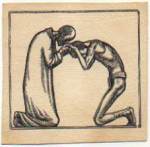
Wood Engraving by Gwen Raverat

Whenever the word inheritance comes up in scripture, my mind vaults to the story of the prodigal son [Luke 15] who is given and subsequently wastes his birthright share in “wild living.” But an everlasting inheritance can’t be expended, nor can it be given ahead of time, or can it?

Hebrews 9:15a
[Christ, the Messiah] is therefore the Negotiator and Mediator of an [entirely] new agreement (testament, covenant), so that those who are called and offered it may receive the fulfillment of the promised everlasting inheritance. . .
[Amplified]

So many Christian people are quite focused on the heavenly bequest and even use the promise as an appetizer to entice others into becoming followers of Christ. It sounds a little like the lottery, as though they are saying, if nothing else works out down here on Earth, at least we know we’ll have entry through the pearly gates and streets paved with gold; at last, a life of leisure with no pain, no worries, and no kids (only kidding on that last one).

But is that the point? Are we supposed to be toughing it out here because we can count on this inheritance later? This would be like our own children making no efforts now and simply waiting around until the parents kick off and the 401K’s are distributed.

I think the everlasting inheritance supersedes time. Just as there is no time in God’s world, our heritage is not limited to our death and subsequent afterlife. Instead, it was precluded by Christ’s death and the distribution included the Holy Spirit who lives in and among us now.

You want to spice up the Four Spiritual Laws or your personal proselytizing, then start including the wonder of the Holy Spirit who dwells within us now, who partners with us in this life, who draws us into being better Humans, who stimulates our internal compass toward those in need, to pricks our conscience, and teaches us to love others by loving us.

This is the everlasting inheritance that is here today.

Read Full Post »

Art by Catherine Andrews

The implication then is this: if the Christ appeared in a more perfect tabernacle not of “this” creation, there must be other creations. Hmm. The psalmists write, Selah, “pause and calmly think of that.”

Hebrews 9:11
But [that appointed time came] when Christ (the Messiah) appeared as a High Priest of the better things that have come and are to come. [Then] through the greater and more perfect tabernacle not made with [human] hands, that is, not a part of this material creation . . .
[Amplified]

Are there other clear references to another creation? I mean, it isn’t necessarily heaven designated in this passage from Hebrews, it could be anywhere. It seems a bit “woohoo” and “new agey,” right? In fact, I find it totally other-worldly, Star Trekian, multi-dimensional, and clearly, we’re “not in Kansas anymore.” We’re outside our human understanding. We don’t know about this other creation(s).

I understand, some commentators still believe the “perfect tabernacle” is in heaven because the human tabernacle was intended to mirror or replicate some heavenly place. But I think that’s simplifying the Spirit realm of God. It’s anthropomorphizing what we don’t understand and trying to put it into human terms.

It’s a similar situation with all the prophets who were given extraordinary visions of things outside their ken such as animals covered with eyes and wings in Revelation or Ezekial’s animals with four faces.

When my children were little, my husband and I liked to have fun with the various holiday characters such as Santa Claus, the Easter Bunny, etc. We always told them these characters existed in a different dimension. As the kids got older and realized how unbelievable it was that Santa could fly across the world in a single night and deposit gifts in each and every house, we reiterated: different dimension–anything can happen. Of course, our story is not as creative as C. S. Lewis and his world of Narnia, but ultimately, we share the same idea, once anyone goes through a “portal,” things are very different “there” (wherever there is).

The world and words of the Spirit realm are best depicted through the arts I think. Music, visual art, performance art, dance, film, scent, poetry: these are some of the better expressions of God’s kingdom or sphere or neighborhood.

What the Messiah did for Human is not really fathomable in our limited cosmos. One sacrifice for all? One outpouring of blood covers all sins from the beginning to the end of time? Perfection in human form? Covenants, promises, reconciliation, restoration, renewal, all of these possible by the act of one offering? Absurd, right?

Nope. It’s the link between our creation and all the other ones. The ultimate portal. Not science fiction or fantasy, but God business. And the stuff of dreams, imagination, love, resurrection, and transfiguration.

Read Full Post »

Just as the early Jews got hung up in the first covenant, today’s believers have created a version of the second covenant that resembles the first: earthly sanctuaries, regulations and time-honored traditions.

Hebrews 8:13 – 9:1
By calling this covenant “new,” he has made the first one obsolete; and what is obsolete and outdated will soon disappear. Now the first covenant had regulations for worship and also an earthly sanctuary.

Of course, it’s even more complex in our religious world of today. There is not just one version of the tabernacle, but many, depending on the sect or denomination. The worship regulations are more rigid if one is affiliated with a high church but even the seemingly “free” new churches have developed mores and practices that eventually become similarly rigid by repetition.

Until I read Pagan Christianity by Frank Viola and George Barna a few years ago, I considered contemporary churches as spontaneous and unrestricted by “ritual.” But truly, haven’t these services become equally predictable and patterned in structure? Isn’t there still a type of “call to worship,” music, prayer, announcements, and sermon structure every week?

Is that necessarily bad? Of course not. But I do wonder if we’re missing something by our focus on buildings and “ministries” and committees of various authority.

Several months ago, my family made a huge leap and ventured away from our church of twenty years just to see “what else is out there.” We visited several other churches, some larger and some smaller. We would attend for several services in a row if we felt attracted to the service. It usually takes longer than a visit or two to get a sense of a place or the priorities. In one case, we were intrigued by a very high-tech, seemingly culture-relevant church. Only to be turned off a few Sundays later when the price tag for this type of savvy “presentation” was revealed as their next “strategic” goal was announced: $14 million!

I don’t have any answers, just a lot of questions. What is important to the Church: the body of Christ? Who really requires weekly “discipleship” with state of the art video and music? Are we competing with the world? Or can we simply stand in within our culture like Jesus among the tax collectors and prostitutes and be agents for change by our steadfast faith and Holy Spirit presence? Does a Christ follower of 10 or 15 or 30 years need to hear sermons every Sunday or should he/she be the one equipping the poor and lost. . . out there?

Shouldn’t prayer and worship be a constant companion? Shouldn’t every gathering of people be a celebration of God with us, Emmanuel?

I have just started reading Brian McLaren’s new book, Naked Spirituality, and I cannot recommend it enough. He uses a single word in each chapter as an exploration into the faith journey. The first word is “here.” And I re-discovered that “here” is about “here I am.” I can choose to be aware of myself in God right now, right where I am: sitting at a computer or taking a shower or getting ready for work. Call to worship isn’t me asking God to show up, it’s me telling God I am present and ready to listen and learn and experience God in the moment.

There are no regulations for “here.”

Read Full Post »

« Newer Posts - Older Posts »