Feeds:
Posts
Comments

Master Your Anger

Sin is crouching at the door . . . and that door is anger. I know this to be true. I have seen the destructive power of angry explosions. I have seen them both against me and through me. Anger is a storm with no boundaries. Anger is unproductive. Anger is an invitation to mistakes; mistakes than cannot be easily corrected. Anger writes in indelible ink.

Genesis 4:6-7
 Then the Lord said to Cain, “Why are you angry? Why is your face downcast? If you do what is right, will you not be accepted? But if you do not do what is right, sin is crouching at your door; it desires to have you, but you must rule over it.”

Anger is a reaction to circumstances and shows the lenses through which a person experiences that moment. Anger usually indicates that there were different expectations. We choose whether we hold on to this anger, this beast, or allow it to be tamed.

My bi-polar mother could not control her anger nor could she it as out of proportion to the actions. It made life very difficult and quite honestly, I found myself lying a great deal to avoid the explosions. I tuned in to the body language of a simmering storm. I became an adept.

But why then, when it was me that exploded toward my children, could I not see it as clearly. How did I recreate that monster?

Some say that anger can be good, that it clears the emotional storage bin. But I don’t have that kind of confidence in anger’s potential for good. It has brought no such cleansing.

My cleaner is tears. They wash my soul. And I am grateful for a God who collects them (Psalm 56:8).

Adam said it was the woman’s fault for giving him the fruit (and maybe a little bit God’s fault for giving the woman in the first place). Eve blamed the Serpent who deceived her. Interesting, though, the Serpent is silent.

Genesis 3:11b-13
Have you eaten from the tree that I commanded you not to eat from?”
The man said, “The woman you put here with me—she gave me some fruit from the tree, and I ate it.”
Then the Lord God said to the woman, “What is this you have done?”
The woman said, “The serpent deceived me, and I ate.”

I’m assuming the Serpent knew what was up from the beginning. He expected retribution. He had counted the cost. So, however he might have looked in the garden, the Serpent was ever changed, and most interesting, for whatever reason, the relationship between the Serpent and woman would be one of enmity. I find that fascinating. The implication is that the relationship could have been something else had everything gone the other way. But what?

What was the Serpent’s true nature? In the same way that Jesus brought Judas Iscariot into his sphere of influence, so did God bring the Serpent into the garden. There was opportunity for them to choose differently, to want something else, to be reached.

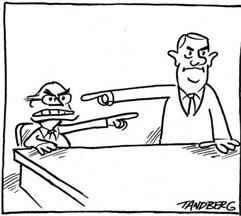
We are quick in this culture to lay blame as well. This week is election week. All media outlets from news programs to Facebook are afire with political mumbo-jumbo. And usually, it’s one side finding fault with the other, somehow thinking if enough aspersions are thrown out there, their own missteps will be ignored.

In reality, we have all eaten the fruit of the knowledge of good and evil and as a result, we spend far too much time looking at “not-God” instead of looking for what is good and right. The ancient aphorism speaks well here: Know Thyself. It’s so important to remember that our eyes are corrupted.

Open my eyes to see like you, to understand with Godly wisdom, to bring grace into every situation and conversation, to clearly bring myself to the situation. As a follower of Christ, I bring God to every table, to every discussion, to every contemplation. That’s part of the covenant I made.

I must accept blame for the part I play in my world.

What They Saw

What do you see?
Woman or a face?

I get a little tired of people treating Eve as though she had a “blonde moment” and impetuously grabbed the fruit from serpent (who was probably a beautiful creature and not some slimy looking snaky thing – I mean really, who would trust a talking snake?). And why is symbolized by an apple? She ate “some of it” … she ate the “fruit thereof,”; it could have been cherries or nuts for all we know.

Genesis 3:6-7a
When the woman saw that the fruit of the tree was good for food and pleasing to the eye, and also desirable for gaining wisdom, she took some and ate it. She also gave some to her husband, who was with her, and he ate it. Then the eyes of both of them were opened . . .

But here’s my point. The interaction between serpent and Eve could have been over time. She may have even pondered what it would mean to “know good and evil” since all they knew up until then was good. They were, after all, made in the image of God who is all good. So, the draw here was the wisdom, I think, not the temptation to disobey. Personally, I’m a big fan of wisdom. We are even encouraged throughout scripture to desire wisdom and to ask for it. And for me, here’s the real loss. If Eve would have asked the Creator for wisdom to solve this conundrum, she would have received all that she needed.

There is some part of human that is still unsure of our place in the universe. Are we truly beloved of the Creator? I’ve made so many mistakes: is it too late for me. No, no one is unreachable. Even eating the fruit of the tree doesn’t kill, but there are consequences.

Adam and Eve experienced consequences. And so do we, every day.

When they ate of the fruit of the tree (whatever it was that the tree produced freely in the garden), they saw everything differently. Before, they were looking with God’s eyes; perhaps they looked within more readily and saw the beauty of all living things; perhaps they were able to communicate freely with God’s creation. But, upon seeking beyond the boundaries of God’s gifts for that time in their lives (who is to say they wouldn’t have received more and more later?), they saw something they had never seen before: Not God.

Now, as a follower of Christ, I am trying to teach myself how to see the old way, with the eyes of God, to bypass the “not God” parts of humans and focus on spirit within.

Painted by Hans Baldung Grien
16th Century

In a previous post, I spent some time thinking about the idea of choices and boundaries for human in the Garden of Eden (a decidedly perfect environment) and yet, within that garden stood a tree with forbidden fruit. Human had to choose whether to honor God’s boundary (“do not eat”) or not. Now, it appears another kind of choice was there as well, whether or not to believe the “crafty serpent.”

Genesis 3:1aNow the serpent was more crafty than any of the wild animals the Lord God had made. He said to the woman . . .

Another thing occurred to me today. Why are so few people concerned with the concept of a serpent that could a) talk and b) interact with human? Some might reason that this was possible because it was really Satan in the guise of a serpent, but still, a talking critter is talking critter. And apparently, human (Adam or Eve) was not particularly surprised by this talking faculty either. Is it possible then that other animals or creatures in the Garden could communicate? I know, that sounds fantastic. (Is that any more fantastic than the idea of a Garden with only two people who named all the animals and walked around naked?) After all, the Garden is not supposed to be Dr. Doolittle’s domain. And yet, isn’t it fun to consider? Perhaps this ability to communicate with other species was lost to us in the “fall.” In some ways, it makes perfect sense that we make up so many stories about talking animals in our children’s stories, fairy tales, and movies. If only, we think, if only my dog could tell me what he really wants. If only my cat would explain why she is so angry with me. And so on.

A few years ago, Carolyn Parkhurst wrote a novel called The Dogs of Babel, in which a man’s wife dies after falling from a tree and the only witness was their dog. The man, a linguistics professor, is so embroiled in grief that his only hope for recovery is to get the truth about his wife’s death from the dog . . .  by teaching him how to talk. To me, that story captured the longing of inter-species relationships.

But, enough about talking animals. What I really wanted to investigate was the logic of the serpent for challenging humans. I believe he really wanted to undermine God’s authority and the best way to do that was by usurping the human role in Eden. The serpent, as a creature of the Garden, had been placed under the authority of human (see Genesis 1:28) just like all the other animals and creatures. To me, this is the reason the serpent was so crafty. He had a bone to pick with Creator and for this reason, he tricked humans, those most beloved of God. Otherwise, why bother?

This breakdown of the chain of command works in today’s world too. What better way to break things up than to hit the “middle manager.” In this way, the organization (or the church) suffers both up and down the ladder. Those below the middle manager begin to distrust that person’s reliability while the administrator above is seen as a poor leader, unworthy of respect. By encouraging human Adam and human Eve to break the boundaries of the Creator, the serpent broke himself free as well. The serpent’s goal was and still is bigger than human.

Evil has an agenda that is beyond mere “search and destroy” missions of human beings. Ephesians 6:12 says “For our struggle is not against flesh and blood, but against the rulers, against the authorities, against the powers of this dark world and against the spiritual forces of evil in the heavenly realms.” Same for them.

What is my role then today? See the big picture. Believe in the boundaries of God. Believe in the reality of a secret agenda of evil. Trust the sovereignty of God.

Lonely Gardener

Two things: from the beginning, it was always God’s intention that humans should work. I never noticed it before, that “Adam” was put in the garden of Eden to tend it, his first real job. The last garden I tried to create showed me how much real work goes into sowing and growing. And secondly, “Adam” (or man … or human) was lonely without someone else of his kind (human) to do this work. That tells me that relationships are important to people. We do better together.

Genesis 2:15; 18a
The Lord God took the man [human] and put him in the Garden of Eden to work it and take care of it. . . The Lord God said, “It is not good for the man [human] to be alone. . .

Just like the Karate Kid, I’m guessing that Adam’s gardening gig held many unexpected byproducts of learning. Gardening teaches the cycle of life, patience, diligence, perceptiveness, creativity, consequences, and so forth. I know just enough about gardening to know how little I know. It’s one of those things I’ve always thought should have an apprentice program for those who really want to learn it. Oh, I suppose I could read a book about it, and over time, I’d learn by trial and error. But to have a master gardener next door who would be able to show and explain along the way, season by season, now that would be awesome.

The alternative, I suppose, would be to have a gardening buddy. Even if we were both novices, we would be tackling it together, discussing possibilities, sharing the workload, being encouraged, celebrating successes or mourning losses. In either case, two can learn, both from the experience as well as from one another.

The way of Christ is the same. Any spiritual way yields more fruit with a partner. I have neglected this aspect of walk for some time. I have tried to go it alone, thinking no one would be interested in cultivating what I wanted to cultivate. But maybe that’s the point, maybe it’s ok for me to want to plant perennials while another plants annuals. Or maybe I want to plant watermelons that spread out everywhere and my garden friend wants to plant potatoes deep in the earth. Isn’t the garden enhanced by both? As long as the dirt is good and nutrition filled, as long as there is water and sunlight, many different things can grow together.

I need to stop being a “spiritual snob.”


Perpetual Teenager

Based on Genesis 2:1-9 and Notes from Zondervan’s Spiritual Renewal Bible (hereinafter called SRB).

My first thoughts today were all about “why.” Why is there a “second” creation story? Why do we have the big overview in chapter 1, only to rewrite the story in chapter 2 (with changes and anomalies). This is probably a huge controversy out there in Bible land or, at the least, fodder for commentators and PhD candidates.

In the SRB notes, it is noted that in 2:4, it is the first time that God is referred to as Yahweh, the Hebrew form for God, the unnameable one, and yet the One that is in relationship with human. And so it occurred to me that this part of the Bible is the relationship story between Yahweh, the creator and his created humans. And, if it’s anything like the creative process I go through (as well as thousands of other writers), the creation part is fun and almost easy, but it’s the re-write that is hard. It’s in the rewrite that the product is transformed and perfected.

We are all in the human rewrite process.

So, how did this happen? I’m guessing that God followed through on his big plan (see Creation Story & Me) and decided to replicate himself. But here’s the hinky part: God is a being of free will of choice. And as a result, created beings have the same DNA.

One of the ways we see immediately this situation is the two trees in the garden (planted together in the center of the garden) where one, from which human could freely eat, was the tree of life (yum!) and the other was the tree of the knowledge of good and evil. We know this story. Don’t eat from the second tree. Choose wisely.

But, here’s where we humans tend to  be perpetual teenagers: when told not to do something, it becomes the very thing we want to do. God is saying, “I made you and you can choose to be like me” by following in my path, eating from the tree of life, etc. Or you can choose to be “not like me” by eating of the other tree. (This is really interesting since we know that the “serpent/Satan” convinced human that eating of the second tree would be the “more like God” choice when, in reality, the opposite was true. Lies, lies, and more lies. But I get ahead of myself.)

As parents, aren’t we doing the same thing: be like me. Learn from my mistakes. Let me warn you about the second tree (or whatever it might be) and yet, they often choose outside of our hope for them. And as a result, a different path is trudged.

We had those choices. We still do.

Will I be a perpetual teenager and keep choosing my own way or will I finally get it?

Choose God’s way.

Creation Story & Me

Based on Genesis 1:1-31

Here’s what I’m thinking: there is a pattern to the creation story that can be replicated in my own spiritual renewal journey. The one I started yesterday. Again. Of course, each day is a new journey and each valley makes for a different trek up the next mountain. I know that. But for the sake of reflection, here’s what I picked up from the 7 day model.

Day One: Light, or discovery. See Renewal and Light post. It’s when a person realizes that something has to change.

Day Two: Separation (like light & darkness, water & sky). It’s really a way to get some order out of chaos. This will be my next challenge and it would be lovely if it would only take a day, but I’m thinking I’ll be at this stage for awhile. Everything got away from me and it’s time to do some sorting: save, toss, or give away. Those are the choices.

Day Three: Growth. Once there’s a little order, then there’s breathing space for growth (vegetation started on this day) and I can see how important it will be to build on what I discover.

Day Four: Time and Milestones. When God placed the sun and the moon and the stars, in my mind, these became a type of measurement. Time was established and the rhythms of life. And so it is in a time of renewal. As there is growth, then there need to be milestones and landmarks along the way. That’s the way I’ll be able to remember. It’s important to mark the time.

Day Five: Multiplication. This is interesting to me that the multiplication part actually starts before the big Kahuna was created (human beings). So, that means, that while I am growing and marking my development, I will also be multiplying “self.” That is, the self that I am becoming, the learnings, the developments, the comprehension, and maybe, if I can sustain this journey, the wisdom.

Day Six: Human (in God’s image). That’s huge. True humanity is true holiness and godliness. I’d love to think I could “arrive” at human one day, but instead, I know, there are only glimpses on this side of heaven (as it were). But there are moments and in those moments, there is love and kindness and generosity and thoughtfulness and patience and transparency and selflessness and yes, even sacrifice. That is Human to which God wants us to aspire.

Day Seven: Rest. Selah (pause and calmly think about that).

And then start all over again. Thanks God for taking me along this way again. Thanks for giving me a “Way” to you. You laid it out even before you sent the Christ.

Glory be to God the Father, God the Son, and God the Holy Spirit. As it was in the beginning, is now and ever shall be, world without end. Amen.