Feeds:
Posts
Comments

Looking for something to consider and meditate upon in the first twenty verses or so of Matthew is not easy. Many years ago, I created a performance piece that illustrated the lives of the five women of this genealogy, but it is only now that I discover that there is controversy over this list. In other places in scripture and Jewish history, the generations are not equally fourteen by fourteen by fourteen. What gives?

Matthew 1:17
Thus there were fourteen generations in all from Abraham to David, fourteen from David to the exile to Babylon, and fourteen from the exile to the Messiah.

If anyone is interested in a discussion of this discrepancy, there is a good (although somewhat dense) article in the Harvard Theological Review by George F. Moore. Most of it appears to be the need for synchronicity in the expectation of the coming Messiah. It’s a case of cycles. In a world where cycles were seen each year and marked with feasts and worshipful sacrifices, they were critical. We experience cycles in our own world, but, perhaps more dependent on one’s lifestyle or geography. After all, not every area of our country or world experiences the four seasons, some only have three (cold, hot, and rain). Others maybe two, warm and snow. Or what about the other cycles we’ve arbitrarily created? How many of us, because of the beginning of school in the fall, start something new at that same time of year? And there are those who follow the church calendar, another kind of cycle. And still others, follow the monthly cycles of their bodies.

Cycles help us give meaning to the changes in our lives. It is a wheel of time, if you will. I believe time is the most critical of all dimensions for human. We can do nothing to change the march of time (although there may be some extraordinary humans who have discovered a way to break the skin of time and have entered another dimension . . . and still others who have traveled space and played tricks with time). But most of us are slaves to cycles of time.

Even now, I keep glancing at the clock in the lower right hand corner of my screen. Time is marching and I must go to work. I’m late.

In recent years, many people have hungered for knowledge of their personal genealogies. They are looking back. They want to count their generations. Where are each one of us in the cycle of our generations? Where is the beginning point? And where might we be heading?

I am the accumulation of my generations past. I am a contributor to the generations of my future, whether biological or not. I am a point in time. Or an exclamation mark. Or a question. I am a breath. I am a color, a sound, a mark.

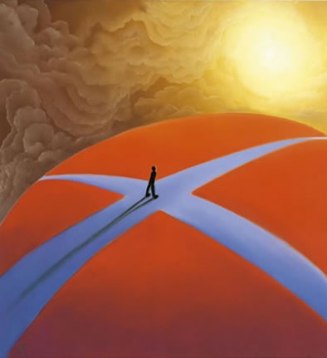
Some people call it writer’s block, but for me,  it’s more like malaise. I looked it up: “a vague or unfocused feeling of mental uneasiness, lethargy, or discomfort.” I’ve had it for the last month (or more) and I have put less than 500 words (or prayers) to page. This is not good. I need to get back on some solid ground.

Psalm 40:2
He lifted me out of the slimy pit, out of the mud and mire; he set my feet on a rock and gave me a firm place to stand.

Here’s a bit of confession: I haven’t felt like writing. It’s a grievous mistake, I know, because writing (like prayer) cannot be done out of feelings alone. It’s a discipline. A persistence. A slogging-on despite the circumstances. My favorite metaphor for endurance and doggedness leaps up: the tortoise of Tortoise & Hare fame. But you see, I have given way to the Hare again, round and round and round I go, no closer to the finish line, and off the path.

Another confession: if I am not writing, you can assume I’m not praying. The two have gone hand in hand for the last several  years and apparently, the Muse has departed, the Spirit hides behind a cloud, and the galloping horse of time has whipped through my apparently delicate balance of personal retreat with both God and Muse and daily life.

It’s not that daily life is a bad thing. I’ve had an amazing number of experiences and involvements over the past six weeks, from travel to Europe to visit extended family to my Navy son visiting for two weeks and second trip out west. Each agenda was full of laughter and joy and healing. I was much blessed. But. . . I took no time alone. Each day I hit the ground running and every minute was loaded. And really, that’s not so bad in itself. I know. But, once I returned to the days and minutes of normalcy and anticipated routine, I had no anchored place or time. I no longer retreated to my favorite chair (or if I did, I woke up an hour later) and I no longer had a plan for study since I just completed my New Testament journey of echoes, prayers, and meditations. Everything has come to a point all at once and, since my way is unclear, I am still standing at a crossroads of sorts. Where do I go from here?

And the worst of it all? When I stop doing something, I tend to forget how to do it. This is most clearly illustrated in a foreign language. Use it or lose it.

To get good at writing, one must write; and to get good at prayer, one must pray. No other way.

I am amazed how easily and quickly I lost my routine of prayer and writing. In the past, I had conquered malaise by keeping track of my time. I know that sounds anal, but it worked! Each time the inner voice of condemnation would attack me because I missed a day or two of prayerful meditation and study, I had facts to shore me up. Sure, I missed a day, but in a year, I’ve gotten it right over 70 or 80 or even 90% of those 365 days. So, “evil voice,” back off! I’m ok.

That pattern  has worked for the last five years.

And in the writing department, I became a great fan of Anne Lamott and her book, Bird by Bird, who encouraged me to start writing, 300 words a day, every day! And I did. I even completed a manuscript that way. But then, the next step was editing and cutting and slashing and changing and re-writing and soon, 300 words could no longer be used as a measure. I faltered. I am once again unsure, beleaguered by another voice or worse, silence. I tried to give myself a little credit, after all, I was still blogging. At least, I was. I did.

Breathe. I gotta breathe here.

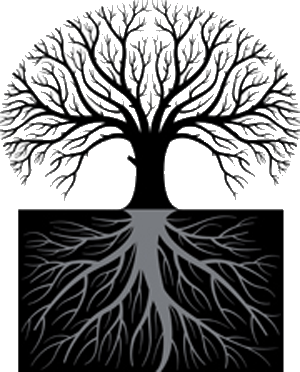
Scratchboard by Michael Halbert

Today, a holiday, I woke with the determination that I would count it a victory day over lassitude and melancholy. I would pray. I would write. I would tend to my inner self. So, how did that go: I slept more than anything else with books on my lap and pen falling to the floor, tea growing cold. I lost four hours of my day to malaise, true malaise. Shortly, I must go to the grocery store for dinner. The day is flying by.

And yet, I do have this to show myself. I am sitting here right now. I made it this far. I crept over the edge. And tomorrow, hopefully, I will make the next step.

It’s time to choose. A way.

Come Along

Come. It’s an invitation. Come see. Come along and be a part. Please come (don’t stay behind). Come with us. But it can also be a command: Come! Come here. Come on. Come away. Move! Why do I resist this word? Why do I want to go the other way? Why retreat?

Revelation 22:17, 20 b
The Spirit and the bride say, “Come!” And let the one who hears say, “Come!” Let the one who is thirsty come; and let the one who wishes take the free gift of the water of life. . . Come Lord Jesus. 

It’s a commitment to come along. It means walking or running forward. Anything else is a decrease or standing still.

When I accepted the truth of Christ as the unique being He is, I did not fully understand the implications, but I did hear the call to participate in the God Presence anyway. It was quite simple, just these words, “Come … and drink.” And these words, “Come Lord Jesus.” And with my willingness to move forward, Christ moved closer to me into a mutual embrace.

Thirty-three years ago, a friend asked me to read the New Testament as an exercise, an acting exercise if you will. In the same way that an actor should read a script for the first time, I was asked to put these words, “if this were true,” at the beginning of the text and suspend all judgments until the end. It was in this way that I heard the invitation as well as the command, to come. Like stepping through a door, I knew I would be entering a different world. For awhile, I tried to straddle the threshold, but in the end, there is only, “come” and then a decision. It’s only after the decision that a person can really know, grow, and change. Even Yoda had it right, “Do… or do not. There is no try.”

I began this particular journaling/blogging walk through the scriptures back in 2009. It’s been a very slow investigation and yet quite revealing. Of course, there have been lost days and lost verses, so I assumed I would just start over again once I finished. But is there a point? Have I lost the momentum? Am I too scattered?

I felt an actual resistance to reaching the end of Revelation. That is, until I read that same call, that allure to drawing closer, the beckoning voice of the Holy Spirit with a promise of more and deeper. Come.

What will that look like? I don’t know. But I must go.

Last week, I went to Hershey Park (amusement park) and in an uncharacteristic and spontaneous moment, I agreed to ride a roller coaster with which I was totally unfamiliar. I did not know how fast it would go or how steep it would climb or drop. I had not been watching it while walking around the park looking for my family. We met up at the entrance of the ride and they said, “Come on Mom,” and I went. It was terrifying. But I survived, as we mostly do. I screamed, I prayed, I closed my eyes, I opened my eyes. I experienced a mini-life.

God does not intend for me to know much about the ride. He just wants me to come along.

Worship God!

Anointing His Feet 2
by Wayne Forte

Worship, in English, can mean to “declare worth.” That’s comfortable. However, in the original Greek, proskynéō means to kiss the ground while falling prostrate to a superior. When was the last time you fell to your knees before someone or something of such awesome worth or value?

Revelation 22:8b-9
I [John] fell down to worship at the feet of the angel who had been showing them [the prophecies] to me. But he said to me, “Don’t do that! I am a fellow servant with you and with your fellow prophets and with all who keep the words of this scroll. Worship God!”

The angel is saying to John, don’t fall down before me, but fall down before the One God, individually and corporately.

In some ways, the Muslim expression of worship is more in keeping with the intent of the word. Other faiths like the Orthodox denominations, Catholics, and some Eastern religions practice deep bowing and submissive movements. In recent years, some charismatic believers have found their deepest experience of prayer when it is coupled with lying prone, face down.

But most of us have lost the physicality of worship. A high church may still have kneelers (to make the submissive act more agreeable) but generally, the most common form of respect is standing up, not kneeling. Some church congretations stand to sing and some stand to pray while still others stand to hear a gospel passage spoken. There are denominations who do lots of standing up and sitting down (with a kneel or two in between) and there are denominations who have made the standing part optional, for those who find standing difficult.

And yet, for little children, the cliche for night time prayers is on the knees at the side of the bed. Perhaps even that has gone a bit out of style, I don’t really know, although figurines still abound with cherub children, hands sweetly folded, and eyes closed. It’s sweet. It’s innocent. But is it worship? Is it prayer? Is it surrender? Why do we encourage children to do this kneeling bit but not we ourselves?

In more contemporary churches, worship has come t mean the singing part of a service: a series of songs, starting with fast praise and then followed by a gradual slow down into devotional melodies and words of adoration. And repetition has become a sign of a deeper experience.

I’m not putting any of these “expressions” down. I faithfully attend a contemporary church. I’m right in there.

But, if I take any time at all to think about it, I do find most forms of Western worship to be very predictable and perhaps, if truth be told, a bit colorless and watered down. We keep boiling down the experience of worship into the most common denominator. Whether the service is a lively 60 minutes or a filibustering three to four hours, we are no closer to kissing the ground before God in adulation and acknowledgment of a divine presence.

After visiting several churches of the Middle Ages up through the Renaissance periods in Europe, I can understand why they designed them that way: they were attempting to remind us of the enormousness of God and smallness of Human. Whether sitting, standing, or kneeling, a person feels the divergence between self and the vaulted representation of all that is above and beyond. What do we have in the U.S.? Mauve chairs, blue carpet and artificial flower arrangements. Comfort, comfort, comfort, to the eye as well as the buttocks.

Everything is so controlled in our churches. Either it’s a repetitive liturgy or it’s an “order of service” that is constrained by the clock. Even those services not confined to time are confined to set rituals.

How many times have I really felt and expressed my absolute surrender to God, Spirit God, Father God, Holy God? When has my body responded spontaneously to my soul’s understanding? When did I ever put my life in danger and touch the hem of the Master’s cloak or wash His feet with tears and dry them with my hair? When did we moderns lose our ability to relinquish self to the Holy Spirit?

Once upon a time, there was a river and on each side, a single tree stood bearing fruit and healing. The only way I can imagine it is as a great giant tree straddling the flowing waters. In a way, it makes a type of cross, the vertical tree whose limbs reach to the sky and roots into the ground, while the river acts as the horizontal uniting creation. Both are needed to heal our land, our souls, our earth.

Revelation 22:1-2
 Then the angel showed me the river of the water of life, as clear as crystal, flowing from the throne of God and of the Lamb down the middle of the great street of the city. On each side of the river stood the tree of life, bearing twelve crops of fruit, yielding its fruit every month. And the leaves of the tree are for the healing of the nations.

A river is dynamic. It is constantly changing as it flows with new waters replacing old. It manipulates the environment, shaping the ground to its own plan. It appears to meander, curving through the landscape, but really, it’s just touching more and more of the earth. It’s in a constant state of flux. It cleanses itself. It is a type for love.

A tree is fixed. It doesn’t really walk about like the trees in the Lord of the Rings. It is solid within the parameters of its designated location. It can grow fatter, taller, and deeper. There is a stubbornness in a tree, quite similar to the stream. It does not give up easily. In my own yard, lightning struck and damaged a very old beech tree. The tree people came and sawed off all of the branches but one that stuck out awkwardly from the top of its mutilated trunk. And yet, it lives on, from season to season. It is a type for life.

Love and the will to live, two of the most powerful forces in the universe. These are both gifts from God and they will not be taken away from those who desire it. The key is to experience them both, for one needs the other, intertwined forever.

Cubes and Cubits

The Bible is rich with measurements, from paces and handbreadths to ephahs and hins. One of the first things described in cubits [generally considered to be the length of a forearm] was Noah’s ark. And here, New Jerusalem is described in stadia [generally considered to be 600 feet, give or take]. But really, who cares?

Revelation 21:15-16
The angel who talked with me had a measuring rod of gold to measure the city, its gates and its walls. The city was laid out like a square, as long as it was wide. He measured the city with the rod and found it to be 12,000 stadia [1,200 miles] in length, and as wide and high as it is long [a cube].

Some people seem to think these measurements confirm, by specificity, the reality of what is being written about. In other words, the ark must be real, why else describe it in such detail? Some people have taken these descriptions and measurements to such “lengths” (pun intended), to recreate the items or places, either in life size or intricate models.

Another set of folks are fascinated by the actual numbers in scripture (a type of numerology if you will), citing the repetition of certain numbers and their implication.

I’m sure all of these studies are fascinating and may even give additional insights to the richness of the text. Of course, there are a number of holy document that have received the same treatment. Numbers, measurements, dates (and dating) are just a few of the ways that humans establish themselves in space and time.

Personally, I’m still trying to come to grips with the relationship between the European kilometer and the mile, or the length of my son’s ship in the Navy in relationship to something I know (it’s about two football fields, he finally said). I can barely figure out if a chair in the store will fit in my living room, much less the size of the ark, the temple, or the New Jerusalem. In the old days, when I felt much more compelled to diligently read every word of scripture (including the begats via the King James), I tried to picture every length, breadth, Old Testament celebration and sacrifice. I was determined to figure out the secret meaning or mystery embedded there.

I confess, today, I’m much more cavalier. I’ve been through the Bible, from front to back, more times than I can accurately count (another falling down, I’ve stopped keeping track), and honestly, I’m no closer to uncovering the ultimate number or truth. If anything, I’m backing off the detail and looking for the big picture. In the same way the Pharisees were chastised by Jesus for trying to tithe on spices used in foods [Matthew 23:23], I’m letting go of it too.

I’m not counting how many people I have “brought to Christ” or with how many people I have shared the gospel. I’m done with measuring my effectiveness as a human being by how many people I speak to or speak to me, or how many agree with me or how many people read my blog. I will not be running for office so I won’t need to count how many people vote for me.

My faith and my ability to love others is not really measurable, so why try? The size of my church doesn’t really tell much of a story either. It’s time to give up the cubits and work the quality of the event, the encounter, the moment.

The Bride

The bride or the “body” of Christ is also the New Jerusalem, a city. Jerusalem of old was selected to be the place of the Temple where God would dwell among the people. It was a place of connection and interaction, devotion and sacrifice, symbolism and authority. And now, we are looking to the New Way.

Revelation 21:9b-10
“Come, I [the angel] will show you the bride, the wife of the Lamb.” And he carried me [John] away in the Spirit to a mountain great and high, and showed me the Holy City, Jerusalem, coming down out of heaven from God.

The New Jerusalem, although described as an object with gates and walls and jewel-like appearance, it is clearly John’s effort to describe the indescribable. It’s still a dwelling place, but different.

I am always reminded of one of the best sermons I ever heard on the resurrected Christ, that He was the same and yet different, in the form of a human, but with traits that exceeded anything observable as human: appearing and disappearing, solid but not solid, not confined to time and space. If the resurrected Jesus would be so different, doesn’t it make sense that the “bride” would be equally different.

In my mind, there is a foolishness to any attempts to truly understand the supernatural relationship between God and human. This binding is unique. And we can choose to be bound or be loosed from God.

Am I a spirit being or not? Is my essence within or not? I cannot convince another person of that reality through words alone because it’s not a “word” kind of thing.

Have you ever tried to remember something and seems to literally dance around the edges of your consciousness? This is how I think about the Spirit self. It’s there and not there. It’s tangible and not tangible. It’s the ultimate paradox.

And perhaps, whether it’s hard to imagine, there is something important to the otherness of Christ uniting with human. I think about the symbolism of Christ as male and the bride as female. There’s something in this oppositeness that changes the equation, that creates something new, that “New Jerusalem.” Marriages of today are experiencing a stretch beyond anything we could have imagined. Sexuality is also reaching past comfort boundaries of the past. But does that change the relationship of the Christ and the bride?

In Galations 3:28, “There is neither Jew nor Gentile, neither slave nor free, nor is there male and female, for you are all one in Christ Jesus.” These human differences do not exist in the Spirit realm, the ultimate relationship. So, despite the fact that it’s nice to have the symbolism of the traditional couple, it doesn’t necessarily mean that it’s necessary for the ultimate union. Just saying.