Feeds:
Posts
Comments

Posts Tagged ‘change’

Abraham pleaded for Sodom and Gomorrah, that God not destroy them if ten righteous people (those doing right), could be found. And God agreed. It only takes a few to save the many.

Genesis 18:32
Then he [Abraham] said, “May the Lord not be angry, but let me speak just once more. What if only ten can be found there?” He [the Lord} answered, “For the sake of ten, I will not destroy it.”

Jesus turned the world upside down with twelve disciples. These twelve were dedicated, who brought with them, their families and their neighbors and their friends. They touched lives and then those people touched lives. And today, we are the fruit of those twelve.

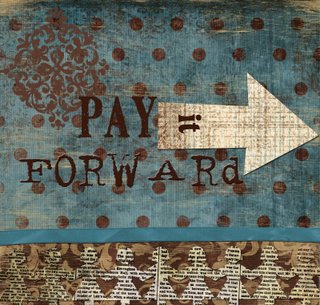
In the movie, Pay It Forward, a young boy, in response to a school assignment of coming up with direct action that could change the world, he devises a simple plan of helping three people with good deeds (things they could not do for themselves) and then challenge them to do the same. Exponentially, the impact would be as great as the disciples’ challenge, a charitable pyramid.

Sometimes, I see myself taking no action at all because I feel so insignificant in the face of our world’s despair. It is hard to remember the value of saving one, of helping one, of changing the course of a single life. It is indeed like the story of the boy throwing starfish back into the ocean one by one. An old man, who sees him, tells him how many will be lost and what difference could he possibly make, the beach was strewn with dying starfish. Yes, but the boy reminded him, he made a difference to that one, the one or few that he was able to throw back into the saving waters.

It is unlikely that I will be the next Billy Graham, speaking to thousands of a hope in the midst of despair, but I could be a friend to one more. I am not comfortable with people whose lives are a shambles. Their troubles are so overwhelming. I want to tell them how to fix it, to do this or that. But I have seen their inability to act. How do I befriend such a one?

It’s a trust issue I think. I have to earn trust and then, perhaps, there would be an opening for more than just a temporary fix. Jesus did not heal everyone, but he was present for them all. He did not feed everyone but he gave an example of how it could be done. He did not change the financial circumstances or status of individuals, but he gave them a better way of handling their situations. Except for the twelve, and the women who followed as well, those lives he changed forever.

Read Full Post »

What is the take away for doing something 40 days? Whether it’s in fasting or in temptation, there’s something here about forty days that should be considered, should be pursued. It’s a whole lot of waiting: more than five weeks of consideration. I wonder what would happen if I waited (prayed, contemplated, meditated) forty days before I initiated a plan or a major decision?

Matthew 4:1; Mark 1:12-13a; Luke 4:1-2a
Then Jesus was led by the Spirit into the wilderness to be tempted by the devil.
At once the Spirit sent him out into the wilderness, and he was in the wilderness forty days, being tempted by Satan.
Jesus, full of the Holy Spirit, left the Jordan and was led by the Spirit into the wilderness, where for forty days he was tempted by the devil.

There are other scriptural examples of 40 days: the flood (Genesis 7:17); Moses on Mt. Sinai (Exodus 24:18; 34:28; Deuteronomy 9:9); Spies in the Promised Land (Numbers 13:25); Goliath’s challenges (I Samuel 17:16); Elijah’s flight and fast (I Kings 19:18); Jonah warns Nineveh (Jona 3:4); Jesus appeared to the disciples after his resurrection (Acts 1:3).

All of these 40 day increments are wrapped up with important events, usually before something major would happen.

So, let me put this in perspective (for myself, if nothing else). If I claimed this 40 day waiting period starting today, that would mean on Friday, September 14th, I could begin: I would know whether to go forward or not. If I seriously pursued my quest for those 40 days, I would know. It’s like a promise, I think.

Don’t misunderstand me. I get it that this period should be led of the Spirit and yet, I have a feeling. If I laid out my heart’s desire, my plan before God and then repeated my request each day, I believe I would have an answer. I would also have a bit of a struggle along the way. Based on the stories, a truly authentic 40 days is laden with challenges. Satan (or however you want to call that negative voice/power in our lives) tempted Jesus the whole time just like Goliath tempted the Israelites. Goliath mocked them and taunted them: Dare you! Double dare you to come out here and fight me (on his terms of course). Satan does the same thing. The forty day challenge puts the entire experience on God’s terms.

Apparently, 40 days are just long enough. They take the person just beyond that point we can do it on our own. Forty days include the extra mile.

What do I really want to know? What game-changing decision do I want to contemplate? What would be the best news ever?

Read Full Post »

Icon: John the Baptist

To wash ceremonially in ancient Jewish times was to participate in a mikveh (or mikvah). For rituals, particularly washing from impurity, required “living” or flowing water such as a river or mikvot (the mikveh place) fed by a natural spring. It constituted the washing away of the old impurities and to mark the beginning of the new.

Matthew 3:1-2,
In those days John the Baptist came, preaching in the wilderness of Judea and saying, “Repent, for the kingdom of heaven has come near.” . . .  “I baptize you with [or in] water for repentance. But after me comes one who is more powerful than I, whose sandals I am not worthy to carry. He will baptize you with [or in] the Holy Spirit and fire.

John the Baptist treated sin as the greatest impurity of all and called everyone who wanted a new start to celebrate a mikveh with him, right there in the desert, in the river Jordan. While priests, via the regulations in the Torah and other rabbinical writings, performed the mikveh for a variety of circumstances (after sexual relations for men, a menstrual cycle for women, after the birth of a child, upon declaring someone healed of a skin disease or leprosy, prior to Yom Kippur, and so forth), this may have been the first time that a mikveh was performed without a traditional priest.

John’s message was clear: prepare the way (prepare yourselves) for the coming Messiah. Release the old and make room for the new.

The water submersion was a ritual meant to mark a moment in time. And yet, John promised another moment, a time that would be marked by something more permanent than water: the Holy Spirit and Fire.

The baptism of the Holy Spirit came after Jesus’s resurrection, the gift was given (and promised) to all believers — the in-dwelling of God [Acts 2]. This in-dwelling changed everything and everyone. We tend to minimize this deeply motivating presence today.

There is so much “Jesus Junk” (Tchotchkes) and pat phrases like “Jesus loves you brother.” But it’s more than that. It’s not just that Jesus loves you; it’s that Jesus is you [Philippians 1:21]. Jesus and the Holy Spirit are one. And once Jesus has been invited to occupy us, then the process of true sanctification begins, fusing me and the Christ. And with sanctification, unnecessary elements must, like chaff, be cast away and in some cases, burned away through experience, pain, persistence of motion, and repetition. We are all intended to “get it.”

The occupy movement from Wall Street to Washington, D.C., has nothing on the potential power and change that comes from the occupation of a human being by the Holy Spirit. This is the most authentic change of all.

Read Full Post »

We tend to forget that our behaviors are being scrutinized. Not so much by casual acquaintances and co-workers (although somewhat), but mostly by the children and teenagers in our lives. They don’t look like they are even paying attention. Don’t be fooled.

II Chronicles 34:3
In the eighth year of his reign, while he [Josiah] was still young [16 years old], he began to seek the God of his father David. In his twelfth year he began to purge Judah and Jerusalem of high places, Asherah poles and idols.

Josiah was the grandson of Manasseh, one of the most notorious kings to rule Judah. Manasseh ruled for 55 years and up until his last years, played havoc with the country doing everything he could to destroy the foundations of faith through mockery, idol worship, and decadent priests and priestesses who proselytized for other gods. He even sacrificed his own children to these gods. But in his last years, Manasseh was overthrown and taken to Babylon with a ring in his nose. He was humbled. In that place, he sought out his one true God who heard him and restored his to throne. This was an abrupt about face, a transformation.

Who was watching? A little boy named Josiah who was just old enough to understand, just old enough to absorb the impact, just old enough to remember.

There was another who saw the change, Manasseh’s son Amon who became king after him. But Amon did not believe in the change in his father and he pushed Judah back toward the pagan gods for two years before he was assassinated. Apparently, there were others who had watched Manasseh’s metamorphosis and believed.

When young kings come to power (Josiah was only eight when he was crowned), there is usually a regent who handles the daily affairs and instruction of the boy-king. This person is not named but we can extrapolate his presence. Whoever he was, he set a standard that set Josiah on a different path, that gave him a thirst for knowing the God of his forefathers.

My children never knew me before I walked with God. They never saw those years of transition from living a degenerate life to living in God through the Holy Spirit. But I know many people whose children and grandchildren have seen the adults in their lives take a shift for good.

It is never too late to change. The children are watching.

Read Full Post »

St. John is obsessed with love and its power. But to speak of it in today’s world sounds trite and cliche. Love has been relegated to movies and teenagers. Do people really believe love is a power so strong, so rich, that it can change a life, a culture, a world, a civilization? Or is it just a Valentine?

I John 4:12
No one has ever seen God; but if we love one another, God lives in us and his love is made complete in us.

I don’t really feel qualified to write about this topic at length, mostly because of my own anemic love life, and by that, I mean loving the unlovable, the unlovely.

It’s not that I don’t believe God is in the love of family, friends, and loved ones, but I have a sense that loving in the hard places, the paradoxical times, the nontraditional people, the unexpected situations: this is where God manifests more profoundly. These would be the occasions I might actually experience the same God who loved me when I was deeply entrenched in life-killing habits (drugs, alcohol, promiscuity, and the like). That love turned me around. That love upended my perceptions. That love was conscious and real, almost tangible. It was one of the reasons I committed my life to becoming a follower of the Christ: I saw God by being loved unconditionally.

For whom can I do the same? Why am I so afraid? There was so much grace in being on the receiving end and yet, it has become so difficult to get out of my safety net and love others the same way, without judgment, without expectations, without strings attached.

Our current church has a lot of buzz phrases, some more meaningful than others, but without a doubt, the one that resonates the most with me is that we offer love and service to others “with no strings attached.” I know that our pastor, Jess Bousa, pulled this mandate out of his own experiences, out of the God-love that was given to him when he least deserved it. The church, Good Cause Foundation, the open door policy he has established, are all an outgrowth of seeing God and thereby showing God through himself. Jess got it and he’s one of the reasons I’m hanging around this young pastor, I want to catch the fever.

It’s all simple: love others if I want to see God. And as I see God, I will want to love others. Infinity. Circle. Mandala. Synergism.

Read Full Post »

It’s so much easier to speak of the spirit world in different contexts, fantasy for instance. In those circles, it’s the norm to speak of spirits, magic, miracles, powers, spiritual enemies and spiritual good guys. But we have lost our ability in this age to speak of the Spirit World.

I John 4:4
You, dear children, are from God and have overcome them, because the one who is in you is greater than the one who is in the world.

Despite the fact that numerous references are made to this spirit world in scripture; I am particularly thinking of Ephesians 6:12 as a good example, “For our struggle is not against flesh and blood, but against the rulers, against the authorities, against the powers of this dark world and against the spiritual forces of evil in the heavenly realms,” we hesitate to claim it as our own. It’s all woohoo stuff! And so, most folks shrug off spirit talk.

But I cannot. The epistle of I John speaks at length about spirit relationships: our own spirits, those of the “anti-christ” opposed to all Christ spirit, the spirits of the world, the spirits of believers, and the spirits of God followers. This is the unseen world and yet, more and more, I do believe it is the most important part of our existence.

We are multi-dimensional for a reason. And there are enough people, even in modern times, who have had significant experiences with Spirit that it seems foolish to disregard this aspect of our humanity, our spirituality, our essence.

I guess the big question is in the tension that arises when we refer to “good” and “evil” spirits. And I understand that hesitancy, but there is simply too much evidence to deny them. For me, the truth of evil places human depravity at the feet of its source: the realm within.

Do we really think that the battles we carry on in the flesh will change the spirit? Will our wars block the power of evil’s presence and influence? Will our gun laws prevent their distribution on the streets of our cities? Will our capture of kilos of cocaine prevent the fields of poppies from being grown again?

We are back to the single word that explains the Way of the Spirit realm: paradox. It’s not the very reasonable approaches to problems of our world that will change it, but the opposite. If not, if it’s all Pollyanna, then why did Jesus bother to say any of it? I know things are bad now, but things were bad then too: almost everyone was poor or under the iron fist of a dictator or slave owner, violence was the norm and so was hunger. There was no “upward mobility,” there was no middle class. Back then, it wasn’t just the 99% but 99.9% of the people who suffered under human indignity and loss.

They had good reason to look and wait for a revolution. Instead, Jesus proclaimed a victory for the interior life as the starting point for change. Do we follow? Do we believe?

Read Full Post »

Change is hard today and I doubt it was any easier at the height of the Roman domination over Judea. After all, codified Judaism had been around for 1250 years since the time of Moses. And Jesus wanted to do what? Build a new structure? A new type of temple? No way.

I Peter 2:5
[Come] and, like living stones, be yourselves built [into] a spiritual house, for a holy (dedicated, consecrated) priesthood, to offer up [those] spiritual sacrifices [that are] acceptable and pleasing to God through Jesus Christ.
[Amplified]

I have written about this before, but it keeps coming up in the epistles. When it finally dawned on the disciples what Jesus was offering, what he was asking of them, it was hugely shattering to their world. One of the reasons the priests and scholars were in an uproar sooner than later was probably due to the fact that they understood exactly what Jesus was proposing. And they would have none of it: blasphemy!

The temple structure would be torn down under the new way. Animal sacrifices would no longer be necessary (the entire commerce that was wrapped around this procedure would fail). The authority of priests would be diminished, their extended families and tribe would be undermined. The temple was a huge operation; it kept a lot of people working and fed.

Jesus, as the cornerstone of a new and “living” way, was rejected for a lot of reasons. It was not about “dullness” of mind or a hard heart.

So, now, it’s been 2000 years plus, and all this time, those who have followed Jesus and spread his message of a new structure, a new way, were supposed to be getting people into the building of spiritual houses where spiritual sacrifices were being made daily. Is this happening? Did we get off the road somewhere?

I look around and it appears to me that we’re building a lot of brick and mortar, just as expansive as the temple of old. Huge budgets, salaries, and programming. People in these settings would be equally reticent to “change.” I’m pretty sure these structures are not particularly necessary to building a spiritual house.

Here’s a list of the types of spiritual sacrifices that are mentioned in scripture (copied from a sermon outline website):

TYPES OF SACRIFICES TO BE OFFERED BY CHRISTIANS…
1. Our bodies, as “living sacrifices” – Ro 12:1-2
2. A lifestyle characterized by sacrificial love – Ep 5:1-2
3. Praise and thanksgiving, which we do in prayer and song – He
13:15
4. Doing good and sharing with others – He 13:16; Php 4:15-18
5. Even in the way we die for the Lord! – Php 1:20; 2:17; 2Ti 4:6

There’s nothing in here about building buildings or huge organizational structures. It’s about our personal behavior, our commitment, our giving of time and energy to God. Now, I know, some people consider their contributions to a local church as the expression of these sacrifices and may be it is.

But I think that’s a bit of a cop-out. So much is put on the leaders of these organizations while the “body” merely pays for it. We are losing our real roles as priests and builders of the structure within.

There are a lot of young and exuberant believers (see tags) who are calling for the same revolution that Peter espoused: to rebuild our spiritual houses on the cornerstone of the Christ.

Read Full Post »

« Newer Posts - Older Posts »