Feeds:
Posts
Comments

Posts Tagged ‘Christ’

What do you see?
Woman or a face?

I get a little tired of people treating Eve as though she had a “blonde moment” and impetuously grabbed the fruit from serpent (who was probably a beautiful creature and not some slimy looking snaky thing – I mean really, who would trust a talking snake?). And why is symbolized by an apple? She ate “some of it” … she ate the “fruit thereof,”; it could have been cherries or nuts for all we know.

Genesis 3:6-7a
When the woman saw that the fruit of the tree was good for food and pleasing to the eye, and also desirable for gaining wisdom, she took some and ate it. She also gave some to her husband, who was with her, and he ate it. Then the eyes of both of them were opened . . .

But here’s my point. The interaction between serpent and Eve could have been over time. She may have even pondered what it would mean to “know good and evil” since all they knew up until then was good. They were, after all, made in the image of God who is all good. So, the draw here was the wisdom, I think, not the temptation to disobey. Personally, I’m a big fan of wisdom. We are even encouraged throughout scripture to desire wisdom and to ask for it. And for me, here’s the real loss. If Eve would have asked the Creator for wisdom to solve this conundrum, she would have received all that she needed.

There is some part of human that is still unsure of our place in the universe. Are we truly beloved of the Creator? I’ve made so many mistakes: is it too late for me. No, no one is unreachable. Even eating the fruit of the tree doesn’t kill, but there are consequences.

Adam and Eve experienced consequences. And so do we, every day.

When they ate of the fruit of the tree (whatever it was that the tree produced freely in the garden), they saw everything differently. Before, they were looking with God’s eyes; perhaps they looked within more readily and saw the beauty of all living things; perhaps they were able to communicate freely with God’s creation. But, upon seeking beyond the boundaries of God’s gifts for that time in their lives (who is to say they wouldn’t have received more and more later?), they saw something they had never seen before: Not God.

Now, as a follower of Christ, I am trying to teach myself how to see the old way, with the eyes of God, to bypass the “not God” parts of humans and focus on spirit within.

Read Full Post »

Two things: from the beginning, it was always God’s intention that humans should work. I never noticed it before, that “Adam” was put in the garden of Eden to tend it, his first real job. The last garden I tried to create showed me how much real work goes into sowing and growing. And secondly, “Adam” (or man … or human) was lonely without someone else of his kind (human) to do this work. That tells me that relationships are important to people. We do better together.

Genesis 2:15; 18a
The Lord God took the man [human] and put him in the Garden of Eden to work it and take care of it. . . The Lord God said, “It is not good for the man [human] to be alone. . .

Just like the Karate Kid, I’m guessing that Adam’s gardening gig held many unexpected byproducts of learning. Gardening teaches the cycle of life, patience, diligence, perceptiveness, creativity, consequences, and so forth. I know just enough about gardening to know how little I know. It’s one of those things I’ve always thought should have an apprentice program for those who really want to learn it. Oh, I suppose I could read a book about it, and over time, I’d learn by trial and error. But to have a master gardener next door who would be able to show and explain along the way, season by season, now that would be awesome.

The alternative, I suppose, would be to have a gardening buddy. Even if we were both novices, we would be tackling it together, discussing possibilities, sharing the workload, being encouraged, celebrating successes or mourning losses. In either case, two can learn, both from the experience as well as from one another.

The way of Christ is the same. Any spiritual way yields more fruit with a partner. I have neglected this aspect of walk for some time. I have tried to go it alone, thinking no one would be interested in cultivating what I wanted to cultivate. But maybe that’s the point, maybe it’s ok for me to want to plant perennials while another plants annuals. Or maybe I want to plant watermelons that spread out everywhere and my garden friend wants to plant potatoes deep in the earth. Isn’t the garden enhanced by both? As long as the dirt is good and nutrition filled, as long as there is water and sunlight, many different things can grow together.

I need to stop being a “spiritual snob.”


Read Full Post »

I looked it up, the word, beatitude. It actually comes from the Latin word, beātitūdō, which means perfect happiness. I was already suspect with the idea of “perfect,” not to mention the leap to my struggle with perfectionism. Add the expectation of happiness, a most elusive beast [it’s right up there with joy], and I feel like the entire premise is a prescription for failure.

Matthew 5:1-3a
Now when Jesus saw the crowds, he went up on a mountainside and sat down. His disciples came to him, and he began to teach them. Blessed are . . .

Of course, it gets worse before it gets better. Most people have the general understanding of the beatitudes. They know it’s a list of blessings based on a series of paradoxical statements. In other words, be perfectly happy when you are poor in spirit, mourning, meek, hungry for righteousness, merciful, and pure in heart while peacemaking and being persecuted. Now, if that doesn’t make you want to jump up and follow Jesus, what will?

I’m only kidding, of course. But really, the beatitudes feel like the high end of understanding and following Jesus. Despite professing the Christ for over thirty years, I break out in a sweat when I have to revisit the beatitudes. They seem to uncover me or reveal me in a way that nothing else in scripture does. I feel like I need to go to a meeting, stand up and say, “Hi, I’m Irmgarde, and I’m not living out the beatitudes.”

You know, the implication is that this was the summary teaching, the preview of everything that came later. Jesus ultimately walked out these seven verses [Matthew 4:3-10] in the next three years of his ministry. And all the while, he’s saying, this is the way despite what you may think or see. Here is the real freedom. Here is answer to what it means to be fully human.

Let’s all pause and think about that today.

Read Full Post »

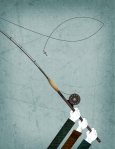
Illustration by Brain Danaher

I’m not much into fishing. In fact, I’d say I’ve gone fishing exactly one time. This metaphor for drawing people to the Christ doesn’t exactly resonate. My view of fishing: get some equipment, pick/find a spot, bait the hook, throw it out and wait; get a nibble and yank like crazy. Lose fish. Start over.

Matthew 4:19-20
As He was walking by the Sea of Galilee, He noticed two brothers, Simon who is called Peter and Andrew his brother, throwing a dragnet into the sea, for they were fishermen. And He said to them, Come after Me [as disciples—letting Me be your Guide], follow Me, and I will make you fishers of men! [Amplified]

What’s the attraction for fishing? I see people fishing off our town dock all the time. Sometimes in small groups, sometimes alone, sometimes with a kid-relative. When I go on vacation, there are signs everywhere for bait (apparently different bait works with different fish – I got that much). And the first time I actually walked around the fishing department of a sports store, I was shocked. There were so many different lures and poles and gadgets. Did these actually make someone a better fisherman or just high tech?

But let’s go back to the message behind the metaphor. Jesus was talking to fishermen who used nets. It was more like a drop it in and haul ’em out kind of fishing. The expectation was that “human fish” would be hauled in by the hundreds and even thousands. I wonder if the fishermen-disciples started out expecting some additional equipment.

In the end, the fishing was done quite differently: travel, talk, share, teaching, listen, accept, and invite. The bait was love. Only one kind: unconditional.

Some people still think fishing for people requires a lot of extra stuff like buildings and hot worship music and lights and video and an “online presence.” Are people so different today? Or are we just in a hurry?

Peter was in a hurry. By the time he got to the day of Pentecost, he was bringing in believers by the net full. But in the end, despite the initial haul, the most effective method was still travel (go to where the fish are), talking (give and take conversation), sharing (give what you have and can), teaching (what you’ve learned long the way), listening (everyone has a story), accepting (practicing the art of non-judgment), inviting (live life together) and love (do, act, and touch in their best interests).

In God’s time, I am fishing every time I with someone, every time I engage with someone, every time I touch someone, every time I share space with another human being. My success as a fisher-woman is my commitment to handing out the bait.

Read Full Post »

Come. It’s an invitation. Come see. Come along and be a part. Please come (don’t stay behind). Come with us. But it can also be a command: Come! Come here. Come on. Come away. Move! Why do I resist this word? Why do I want to go the other way? Why retreat?

Revelation 22:17, 20 b
The Spirit and the bride say, “Come!” And let the one who hears say, “Come!” Let the one who is thirsty come; and let the one who wishes take the free gift of the water of life. . . Come Lord Jesus. 

It’s a commitment to come along. It means walking or running forward. Anything else is a decrease or standing still.

When I accepted the truth of Christ as the unique being He is, I did not fully understand the implications, but I did hear the call to participate in the God Presence anyway. It was quite simple, just these words, “Come … and drink.” And these words, “Come Lord Jesus.” And with my willingness to move forward, Christ moved closer to me into a mutual embrace.

Thirty-three years ago, a friend asked me to read the New Testament as an exercise, an acting exercise if you will. In the same way that an actor should read a script for the first time, I was asked to put these words, “if this were true,” at the beginning of the text and suspend all judgments until the end. It was in this way that I heard the invitation as well as the command, to come. Like stepping through a door, I knew I would be entering a different world. For awhile, I tried to straddle the threshold, but in the end, there is only, “come” and then a decision. It’s only after the decision that a person can really know, grow, and change. Even Yoda had it right, “Do… or do not. There is no try.”

I began this particular journaling/blogging walk through the scriptures back in 2009. It’s been a very slow investigation and yet quite revealing. Of course, there have been lost days and lost verses, so I assumed I would just start over again once I finished. But is there a point? Have I lost the momentum? Am I too scattered?

I felt an actual resistance to reaching the end of Revelation. That is, until I read that same call, that allure to drawing closer, the beckoning voice of the Holy Spirit with a promise of more and deeper. Come.

What will that look like? I don’t know. But I must go.

Last week, I went to Hershey Park (amusement park) and in an uncharacteristic and spontaneous moment, I agreed to ride a roller coaster with which I was totally unfamiliar. I did not know how fast it would go or how steep it would climb or drop. I had not been watching it while walking around the park looking for my family. We met up at the entrance of the ride and they said, “Come on Mom,” and I went. It was terrifying. But I survived, as we mostly do. I screamed, I prayed, I closed my eyes, I opened my eyes. I experienced a mini-life.

God does not intend for me to know much about the ride. He just wants me to come along.

Read Full Post »

The Bible is rich with measurements, from paces and handbreadths to ephahs and hins. One of the first things described in cubits [generally considered to be the length of a forearm] was Noah’s ark. And here, New Jerusalem is described in stadia [generally considered to be 600 feet, give or take]. But really, who cares?

Revelation 21:15-16
The angel who talked with me had a measuring rod of gold to measure the city, its gates and its walls. The city was laid out like a square, as long as it was wide. He measured the city with the rod and found it to be 12,000 stadia [1,200 miles] in length, and as wide and high as it is long [a cube].

Some people seem to think these measurements confirm, by specificity, the reality of what is being written about. In other words, the ark must be real, why else describe it in such detail? Some people have taken these descriptions and measurements to such “lengths” (pun intended), to recreate the items or places, either in life size or intricate models.

Another set of folks are fascinated by the actual numbers in scripture (a type of numerology if you will), citing the repetition of certain numbers and their implication.

I’m sure all of these studies are fascinating and may even give additional insights to the richness of the text. Of course, there are a number of holy document that have received the same treatment. Numbers, measurements, dates (and dating) are just a few of the ways that humans establish themselves in space and time.

Personally, I’m still trying to come to grips with the relationship between the European kilometer and the mile, or the length of my son’s ship in the Navy in relationship to something I know (it’s about two football fields, he finally said). I can barely figure out if a chair in the store will fit in my living room, much less the size of the ark, the temple, or the New Jerusalem. In the old days, when I felt much more compelled to diligently read every word of scripture (including the begats via the King James), I tried to picture every length, breadth, Old Testament celebration and sacrifice. I was determined to figure out the secret meaning or mystery embedded there.

I confess, today, I’m much more cavalier. I’ve been through the Bible, from front to back, more times than I can accurately count (another falling down, I’ve stopped keeping track), and honestly, I’m no closer to uncovering the ultimate number or truth. If anything, I’m backing off the detail and looking for the big picture. In the same way the Pharisees were chastised by Jesus for trying to tithe on spices used in foods [Matthew 23:23], I’m letting go of it too.

I’m not counting how many people I have “brought to Christ” or with how many people I have shared the gospel. I’m done with measuring my effectiveness as a human being by how many people I speak to or speak to me, or how many agree with me or how many people read my blog. I will not be running for office so I won’t need to count how many people vote for me.

My faith and my ability to love others is not really measurable, so why try? The size of my church doesn’t really tell much of a story either. It’s time to give up the cubits and work the quality of the event, the encounter, the moment.

Read Full Post »

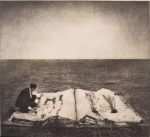
Art by Robert & Shana ParkeHarrison

I had an epiphany this morning. The Book of Life only has the good stuff in it. I mean, it’s not a list of all our mistakes, our sins, or our misdemeanors. That’s the point. If one’s name isn’t in the “book,” it’s because there’s nothing to write. That which is written there, nurtures life in others.

Revelation 20:12, 15
And I saw the dead, great and small, standing before the throne, and books were opened. Another book was opened, which is the book of life. The dead were judged according to what they had done as recorded in the books. . . . Anyone whose name was not found written in the book of life was thrown into the lake of fire.

The other day, we had our micro-church (small group) meeting and talked about the feeling some of us have about “not doing enough.” [James 2:14-26] And at that time, I shared how that feeling or self-perception can morph into condemnation, which is NOT from God [Romans 8:1]. It’s like this: the poor will always be with us [Mark 14:7], the need will always be greater than what we can give. This is the nature of our current world, filled with strife, jealousy, and yes, even evil. Everywhere we look, there are people who are in ill health, depressed, lonely, out of work, addicted, or just plain lost. Each of us cannot tackle every misfortune. But we can touch one. And then another one.

We must, as they say, “keep on keeping on.” And that means, doing what we can, when we can, because we can. Each good work, each loving deed, each prayer, and each kindness works to tip the grand scale toward love and away from despair. We tend to minimize our good actions because they seem so small in the face of a daunting and urgent need. That’s unproductive thinking.

None can know the impact that a single kind remark might have.

I remember, a long time ago, I wrote a note to a woman who was participating in a retreat (Walk to Emmaus, for those who are familiar with it). Several years after that, while sharing my story at a Women’s Aglow meeting in a completely different state, this same woman came up to me with the note, now old and somewhat crumpled in her hand, and told me, with tears in her eyes, that my note had saved her life. I have no clue what I even wrote. And yet, this tiny act, so seemingly insignificant, became the difference between life and death for someone else.

As Yoda said, “do or not do, there is no try.” And so it is with the extension of self toward others. Do. But do not judge what you do, this is not the way of love and God.

When Jesus walked this earth, did he not face even more insurmountable odds. One man, then three, and then twelve, changed the face of humanity in three years. Ok, so he did a few miracles, but ultimately, I’m not so sure those are the actions that made the real difference. I think it was his authentic presence, his touch, his listening ear, his compassion, and his unconditional of acceptance of everyone he met. He showed us “human,” the way human was intended to be from the beginning.

Today, I can choose to write into the Book of Life.

Read Full Post »

« Newer Posts - Older Posts »