Feeds:
Posts
Comments

Posts Tagged ‘Genesis’

passover-lambIt’s easier to read the story about God “testing” Abraham when you know how it turns out. As I contemplated this tale, I wondered if Jesus remembered this story as He was being dragged to the cross, knowing full well that He the was Lamb. But that’s another story. In this one, who knew?

Genesis 21:7
Isaac spoke up and said to his father Abraham, “Father?”
“Yes, my son?” Abraham replied.
The fire and wood are here,” Isaac said, “but where is the lamb for the burnt offering?”

As a mother, I cannot do anything but head right for the emotions of the moment. How did it feel to be Abraham preparing the sacrifice of his son at the command of God, who had been all about the promises of descendants as numerous as the stars? Despite departing right away the next day, it was still a three day journey to the mountain where the sacrifice was to take place. Three days of contemplating the loss of his beloved son. Three days of wondering how God would work things out. Three days of surrendering. It could not have been an easy journey.

And how did Isaac feel, once they arrived, tied up and placed on the prepared altar, wood loaded and knife in his own Father’s hand? Did he go calmly? Did he really think, “Wow, my Dad is truly faithful. He’s amazing!” I don’t think so.

In fact, we don’t really hear about the relationship between Isaac and Abraham after this experience at all until Abraham is “very old” and acquires a wife for Isaac who is now forty years old. What was Isaac up to all those years? No telling. We will never know.

But it doesn’t change the story, does it? Whether they feared or not feared, whether they cried or screamed or complained, it didn’t matter. Abraham acted. Abraham took his “here I am” seriously, because “here I am” also means I am willing to do whatever you ask me. No one says, “Here I am” to God and then follow up with, “I’ll think about it.” And because Abraham had already agreed to do whatever God asked him to do, he followed through.

And really, here’s the truth of it for me. When I became a follower of Christ more than thirty years ago, I also said, “Here I Am.” I think I’ve been forgetting what it meant. And, quite honestly, I’ve put my head in the sand about the lamb, figuring Jesus did all that hard work. And that’s basically true, but there are the daily sacrifices and the long-term ones. There are still challenges and obedience.

The lamb is here.

Read Full Post »

Photo of Beersheba by Leon Mauldin

Photo of Beersheba by Leon Mauldin

The making of oaths and treaties in ancient times was far more serious than it is today. When anyone swore an oath and broke it, the penalty was severe, even death. I cannot help but wonder how different our world would be if promises and vows had more significance. Not unlike Bonhoeffer’s “cheap grace,” we now have vows made with fingers crossed behind our backs.

Genesis 21:30-31
He replied, “Accept these seven lambs from my hand as a witness that I dug this well.” So that place was called Beersheba,because the two men swore an oath there.

Lack of trust is at pandemic proportions, the real core to our inability to make a vow or promise and keep it. We have all been betrayed so many times, we do not believe the word of others. Either we need lots of evidence or the cost for breaking trust must be so high that everyone is put in a fear position to uphold the agreement (hence, the Cold War).

Of course, those fear-based promises usually have loopholes and everyone is busy trying to find them.

Marriages have become the thing of mistrust and loopholes as well. I find it amusing, the angst over same-sex unions, while cheating, divorce, and secret lusts rage in society. How often are the ones who rail against the sins of others, forget their own?

A covenant is a binding oath, a promise that cannot be broken. An agreement with God, the acceptance of Christ as the Messiah, is on that level.

I forget this sometimes. I dishonor the agreement. I don’t hold up my end of the bargain, the treaty, the contract. In a secular world, if I broke a contract the number of times I have broken covenant with the Christ, I would be sued or forced to pay large sums of money or put in jail. But my contract, thanks be to God, is with Grace. And I get more chances to make it right.

I give “lip service” to my trust in God, but I’m afraid I don’t build my foundation on it. I am swayed and battered by the storms of life and I lose sight of trust I promised to have in God. I know intellectually that God is faithful and trustworthy, but still I stumble.

Sensitize me to Your Presence today Lord and give me courage to speak trust in the face of all circumstances. Help me build a Beersheba today, to remember my promise.

Read Full Post »

Art by Jonas Gerard

God blessed Ishmael because he was the son of Abraham. And although it may not seem like a blessing at first blush, those many tribes that descended from Ishmael only to become enemies to the progeny of Isaac: but there was still fruitfulness. And God is honored in fruitfulness.

Genesis 17:18, 20; 21:11-12a,  And Abraham said to God, “If only Ishmael might live under your blessing!” . . .  “And as for Ishmael, I [God] have heard you: I will surely bless him; I will make him fruitful and will greatly increase his numbers. He will be the father of twelve rulers, and I will make him into a great nation. . . . But God said to him [Abraham], “Do not be so distressed about the boy and your slave woman. . . .  I will make the son of the slave into a nation also, because he is your offspring.”

But the blessing of Ishmael is not simply about childbearing and big families, it is about enlarging the place of one’s tent (e.g. one’s influence).

Enlarge the place of your tent,
stretch your tent curtains wide,
do not hold back;
lengthen your cords,
strengthen your stakes.
For you will spread out to the right and to the left;
your descendants will dispossess nations
and settle in their desolate cities.  [Isaiah 54:2-3]

Children are the hope of the future, whether we have them in our immediate family or we serve them through school, church, neighborhood, or work. It is the children who carry the message of our lives into their own. If our lives are loving and giving and caring, then they will respond to the model we provide them. But the opposite is true as well.

They say, if you want to know where a person’s priorities are, look at the list of things in which they invest their money. I say, the same is true for the way money, time, knowledge, and energy are invested in children. They cannot love if they have not been loved. They cannot give grace if they never received it. They will not show compassion if they have not seen compassionate behaviors around them. What we pass to children of all ages is only limited by our own misplaced preferences and choices.

I wish I could say that my children are bearing the fruit of the blessings of God. In some ways, they are: instead of an orphanage, they live in a family and a country of great opportunity. Instead of a proscribed future dealt to them through poor diet, alcoholism, and abandonment, they do know they are loved unconditionally. But in my enthusiasm for having children, I spoiled them too. I wanted them to have some of the things I missed and I created a distorted view of value, of appreciation for the little things, of comfort. Like most Americans, they reflect a world where “need” means another car, not another meal.

So now, I am sorry dear children, what I failed to pass along, you will have to discover on your own. Life will teach you and in that life, God will teach  you. For the blessings of God are still there, the promise of good things still available, but the road may be a little longer.

Read Full Post »

In this story of Abraham, Abimelech (King of Gerar), and Sarah, her husband called her “sister” to protect their household. But that protection meant being taken by Abimelech and placed in his harem of women. Her safety was exchanged for the many. But not until the end of the story are we told what drove her redemption: barrenness.

Genesis 20:17-18
Then Abraham prayed to God, and God healed Abimelech, his wife and his slave girls so they could have children again, for the Lord had closed up every womb in Abimelech’s household because of Abraham’s wife Sarah. [NIV 1984]

God opens and closes wombs. Whether it was back then or now.

I am always intrigued by the real time that takes place within the space of a single sentence in the scripture. In order for Abimelech’s household to know that none of the women could bear children, some time had to pass by. Perhaps their monthly menstruation stopped or women who had been fruitful and continually pregnant, suddenly were not. In any case, it was not a day or a week but more like a year or more that Sarah languished amid the Philistines of that part of the Negev. Which is another reason why the story specifies that the King had not touched Sarah, a surprise, considering how long she had been among them.

In my imagination, when the King’s household discovers their barrenness, they beseech their gods and they beseech their leader to seek healing, to seek an answer, to seek a solution. In this way, it makes sense to me that Abimelech was open to hearing the voice of God in his dream. I believe his seeking was authentic. And when a person seeks from the heart, God answers.

Another interesting side note is that Sarah herself was barren. Did she reveal this fact to the other women? Undoubtedly, since the most important role of women in those days was producing children, and in particular, producing sons. Perhaps they mocked her. That would be my conjecture and yet I could see God responding to Sarah’s lament as well. That they might experience her sorrow of childlessness.

Sometimes, it takes a physical situation to wake us up. When my husband I married thirty years ago, the last thing we expected was to experience barrenness and childlessness. How could that be? We were both believers and committed to our marriage. We were faithful in things of God. And yet, we had no children for eight years. And only then did we seek adoption as a way to build a family.

And yet, despite our confidence that God was in this process, we still had people who asked if we still believed that God would give us our “own” children. Another woman told me I was probably too selfish to have children. Another said it was a curse and we should seek forgiveness for the unspoken sins in our lives. We felt the judgment of well-meaning Christians in our midst.

Our barrenness drove us to God and God’s answer was not pregnancy in the traditional sense. From this experience forward, I have been clear that we, as humans, limit God every day with our interpretation of what God’s “answers” should be or look like. And not only that, but the time it takes for the plan to unfold.

And so, for any women who sorrow over their closed wombs, I offer this one advice: accept what is today and move on so that God can bring forth the next thing. As long as we hold to our way, no other path can be revealed. Every closed womb still holds the Spirit and that is a seed for all generations.

Read Full Post »

All of us carries an inheritance from our ancestors and passes one along. Sometimes through nature (through the blood lines) or by nurture (environment and family life). We are the middle managers, standing in the gap between our history and our future.

Genesis 19:36b-38
So both of Lot’s daughters became pregnant by their father. The older daughter had a son, and she named him Moab; he is the father of the Moabites of today. The younger daughter also had a son, and she named him Ben-Ammi; he is the father of the Ammonitesof today.

There is much speculation about Lot’s daughters and why they did what they did. We are told they were virgins and yet they were promised to men of Sodom (who did not heed Lot’s warning to come with them). We know that Lot offered them to a crowd of men who were not interested in his daughters (they wanted the “angels.”) When they finally flee Sodom and later, even Zoar (the only small town on the plain that was saved), they end up in the mountains.

And here is my question: How long were they there? I am not saying that time excuses them, but I have a sense that years had passed before the daughters made this extreme choice. In those times, women without children (particularly those who were barren) were considered cursed and often outcast. By referring to their father as old, the implication is that his death might  put them in crisis.

Nonetheless, whether justified in any way or not, the result created two young men whose long-standing heritage were two of the most pagan (including human sacrifice) and violent peoples. A similar result happened when Sarai gave  Hagar, her handmaid, to Abraham and Ishmael was born.

Through no real fault of their own, these sons were cast into a destiny.

In our own lives, we will never really know what future we are setting in motion when we send our children forth. We cannot know if they are part of a long line, pre-determined by our genealogy or if it begins with us. The cycle of life in our age is complex now and crosses all borders. I suppose, this is just another form of the Butterfly Effect.

For me, today, the only reliable impact I can have, besides doing the best I can as a parent, is to pray; to embrace the presence of my God in the now who exists through all of time.

I have three adopted children, all with traumatic beginnings. By bringing them into our family, we made the first dramatic change to the course of their lives. I cannot help but wonder what will be their inheritance now.

Read Full Post »

Lot Fleeing Sodom
by Benjamin West c.1810

When Lot and Abraham’s households parted, Lot chose the lush land and the river plain that included five cities, one of which was Sodom. When the angels went to witness the “abominations”in that city, they had a first-hand encounter at the house of Lot where they were threatened with gang rape. Gadzooks! Wouldn’t this experience be enough to flee the city even without the threat of imminent destruction?

Genesis 19:15-17a
 With the coming of dawn, the angels urged Lot, saying, “Hurry! Take your wife and your two daughters who are here, or you will be swept away when the city is punished.” When he [Lot] hesitated, the men grasped his hand and the hands of his wife and of his two daughters and led them safely out of the city, for the Lord was merciful to them. As soon as they had brought them out, one of them said, “Flee for your lives! Don’t look back . . .

Had Lot become complacent about the activities in his city? Had he lost sight of right and wrong and oblivious to the sin around him?

According to the story, in the night, his house was surrounded by ALL the men of the city (even if only a handful had been there, the story is horrific), and these were men who were sexually charged and blindly so. I understand that some people have sex with one another in a kind of cannibalistic way, wanting to “take in” the characteristics of the other, to be one with the beauty or success or talent. I can well imagine somehow that the “angels” might have been desirable in this way, in their “wonder.” I can even imagine them as “light” in the dark, illuminated from within.

But whether this is true or not, Lot refused the crowd and offered his virgin daughters. I have never understood how that was possible. How could a father offer his own girls to a gang? But, now I conjecture tat he was mocking the men outside for he knew they had no interest in women because the crowd’s reaction to his suggestion was indignation as though Lot was judging them. All very odd.

The story gets more “supernatural” when the angels blind the crowd which then protects the house from entry. The tale sounds like something out of the movies or Dr. Who. What is the point? The Genesis story hadn’t had a miracle on this order for several generations. Why now?

And then, after all this, Lot hesitates about leaving the city. Doh! (as Homer Simpson would say).

It’s so easy to get caught up in these Bible stories and wonder what is God doing? But the stories are really about God more than they are about Human. Ever since Adam, we should know, mistakes were made every day. Just like us. Biblical scholar, Andrew Whyte wrote: “Lot is the father of all those men whose righteous souls are vexed with the life they are leading, but who keep on enduring the vexation.”

There is only this then: God saves Human from destruction by grace, not because of worthiness. Lot was dragged out of the city even after he hesitated (more than likely, he had invested his wealth in the city), and it’s even possible that he didn’t understand this action at the time as “saving him” since he lost everything except for his life and the lives of his two daughters. It was a close save.

And yet, it was a second chance, or perhaps a third chance or a fourth chance to enter into a God covenant, to turn a life over to God. This particular chance appears to be as a result of Abraham’s prayers (negotiations) with God.

I try to remind myself daily: there is no one who cannot be saved. I think on this a great deal since I was one of those, I was in the crowd of Sodom as a young woman living in New York City. There was no reason for God to pull me out of the City. I had not earned it. My transformation came by grace, despite my hesitations and pre-conceived ideas of what it meant to follow Christ. I was a close call too.

And God’s grace continues still. Thanks be to God.

Read Full Post »

Abraham pleaded for Sodom and Gomorrah, that God not destroy them if ten righteous people (those doing right), could be found. And God agreed. It only takes a few to save the many.

Genesis 18:32
Then he [Abraham] said, “May the Lord not be angry, but let me speak just once more. What if only ten can be found there?” He [the Lord} answered, “For the sake of ten, I will not destroy it.”

Jesus turned the world upside down with twelve disciples. These twelve were dedicated, who brought with them, their families and their neighbors and their friends. They touched lives and then those people touched lives. And today, we are the fruit of those twelve.

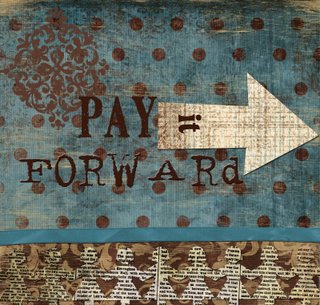
In the movie, Pay It Forward, a young boy, in response to a school assignment of coming up with direct action that could change the world, he devises a simple plan of helping three people with good deeds (things they could not do for themselves) and then challenge them to do the same. Exponentially, the impact would be as great as the disciples’ challenge, a charitable pyramid.

Sometimes, I see myself taking no action at all because I feel so insignificant in the face of our world’s despair. It is hard to remember the value of saving one, of helping one, of changing the course of a single life. It is indeed like the story of the boy throwing starfish back into the ocean one by one. An old man, who sees him, tells him how many will be lost and what difference could he possibly make, the beach was strewn with dying starfish. Yes, but the boy reminded him, he made a difference to that one, the one or few that he was able to throw back into the saving waters.

It is unlikely that I will be the next Billy Graham, speaking to thousands of a hope in the midst of despair, but I could be a friend to one more. I am not comfortable with people whose lives are a shambles. Their troubles are so overwhelming. I want to tell them how to fix it, to do this or that. But I have seen their inability to act. How do I befriend such a one?

It’s a trust issue I think. I have to earn trust and then, perhaps, there would be an opening for more than just a temporary fix. Jesus did not heal everyone, but he was present for them all. He did not feed everyone but he gave an example of how it could be done. He did not change the financial circumstances or status of individuals, but he gave them a better way of handling their situations. Except for the twelve, and the women who followed as well, those lives he changed forever.

Read Full Post »

« Newer Posts - Older Posts »