Feeds:
Posts
Comments

Posts Tagged ‘God’

Art by Lilis Boyer

Art by Lilis Boyer

The Song of Solomon (or Song of Songs) found its place in the Jewish canon by its sheer beauty and poetry. It is not really a complete piece at all, no matter how artfully publishers identify the man speaking or the woman speaking, it’s still just a series of fragments. We will never know the whole of it. And so it is about a fragment that I will respond.

Set me as a seal over your heart,
        as a seal upon your arm,
for love is as strong as death,
        passionate love unrelenting as the grave.
Its darts are darts of fire—
        divine flame!
[Song of Songs 8:6, CEB]

And another, repeated twice in the book:
Make a solemn pledge,
        daughters of Jerusalem,
        never to rouse, never to arouse love
        until it desires. [Song of Solomon 2:7; 8:4, CEB]

Love is powerful force that has gotten washed out by dime store romances and flimsy chick flicks. It’s been downgraded by pornography and trivialized by teen angst. Even Valentine’s Day has played a part in corrupting its message. Purveyors of cheap love are laughing all the way to the bank.

When love is roused at the wrong time or at the wrong place, the power of it and the joy are sucked out of it. It is sex without love, masking the truth of it, manufacturing a feeling but it is not transformative love. But when the moment is right, when there is a mutual selflessness, when it is about the giving away of it moreso than the absorption of it, then the power of God can be unleashed. This I believe.

I know, there are different words for love in Greek, but in the Hebrew, both verses use the same feminine noun, ‘ahabah אַהֲבָה which can be translated as love: human love for a human object (man to man, man to himself, man to woman, sexual desire, and incidentally, God to man too).

And so I ask myself and all of us, is my love toward others with the same intent as God’s love?

God shows love to people over and over again whether its through grace or miracles or the sacrifice of the One Son, Jesus. God’s love is pours out without measure. Jesus taught, “Give, and it will be given to you. A good portion—packed down, firmly shaken, and overflowing—will fall into your lap. The portion you give will determine the portion you receive in return.” [Luke 6:38, NIV]

But no, not me. I confess, I am hungry to be loved more than to love. Lonely. Overwhelmed. Shaken by circumstances. Distanced by disappointment still. Hardened by losses, speaking into the wind.

I am no stronger than the one beside me. My years in Christ clear my vision and for this reason, I understand why the saints and desert fathers of old cried out, “Lord Jesus Christ, Son of God, have mercy on me, a sinner.”

Art by Cyra R. Cancel

Art by Cyra R. Cancel

Or why St. Francis wrote:

Lord, make me an instrument of Your peace. Where there is hatred, let me sow love; where there is injury, pardon; where there is doubt, faith; where there is despair, hope; where there is darkness, light; where there is sadness, joy.

O, Divine Master, grant that I may not so much seek to be consoled as to console; to be understood as to understand; to be loved as to love; For it is in giving that we receive; it is in pardoning that we are pardoned; it is in dying that we are born again to eternal life.
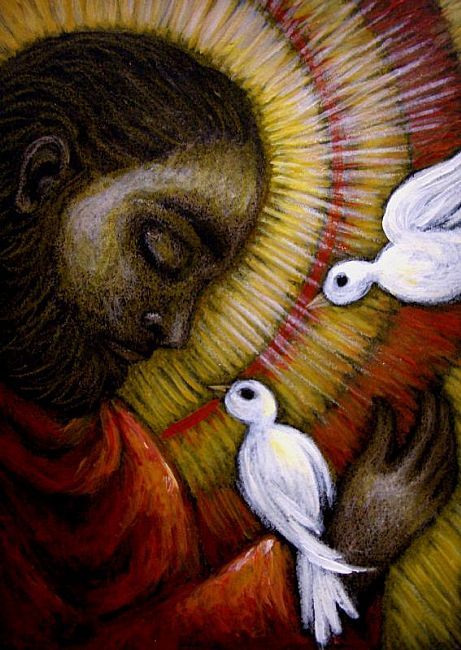
Let me know and give love as strong as death.

Read Full Post »

Everyone Forever, painting by Minako Abe

Everyone Forever, painting by Minako Abe

I am reading through the Bible in a year. I’ve done it before. Sometimes, it feels a bit of a drudgery, particularly I Chronicles. But in this chronological plan, I get to mix up some of those dry passages with the Psalms, thoughts that always move me, either to my knees or to gratitude. Today, these words resounded deeply:

But the Lord’s faithful love is from forever ago to forever from nowfor those who honor him. . . . [Psalm 103, 17a, CEB]

Forever — endless — infinite — eternal. These are God words. In fact, it is only God who can calmly say, “always,” and mean it. And because I am devoted to this forever God, I can surrender my irregularities and my sometimes and my good intentions. I can trip and fall and rise again. I can start over again–and again–if I have to. I can claim a grace that only an infinite God can give freely. I can fail and I can succeed.. I can weep or laugh. I have been loved since the beginning and I will be loved until the end. I am a child of God and beloved.

Both Psalm 103 and 104 begin this way: “Let my whole being [soul] bless the Lord! . . . ” [CEB] That is my prayer today.

Read Full Post »

right handThe most common reference to “right hand” placement is the right hand of God and the One on this side, that is the Son of Man, the Messiah, Christ Jesus. This is a place of shared power and signifies authority. This norm has carried down through the ages to the point that most “guests of honor” at a dinner table are seated to the right of the host. It is a place of And yet, in Psalm 16, there is a new take on this idea:

I keep my eyes always on the Lord.
    With him at my right hand, I will not be shaken. [Psalm 16:8, NIV]

I am moved by this proclamation and realize it should be mine each day. With it, I could give authority to God to move on my behalf and with it I could count on God’s presence to protect me, to guide me, and to support me. In addition to giving God authority, if I could practice keeping my eyes on God, symbolically speaking of course, I could focus my energy and direction, cast off distractions and, potentially, move forward without fear. Oh, what prevents me?

I remember back in acting school when we were introduced to a variety of circus skills, my favorite was tightrope walking because of the visual concentration required, to keep the eyes looking ahead at a single destination point.

But I also remember the story of Peter who walked on water, albeit briefly, as long as he kept his eyes on Jesus. Did he try it again? I always wondered. Did he remember the experience as a success or a failure? He defied, for just a few steps, the laws of gravity and science. He stepped outside the known dimensions of reality. But was it enough to believe?

spiralBut here’s a conundrum:
“You will show me the path of life; in Your presence is fullness of joy, at Your right hand there are pleasures forevermore. [Psalm 16:11, Amplified]

And here, in the same psalm, I am now at God’s right hand, receiving the benefits thereof. An interesting circle: God at my right hand and me at God’s right hand: Oneness. That is the point. Fueling and being fueled, loving and being loved, giving and receiving, all at the same time. Strength to strength [Psalm 84:7].


Read Full Post »

HonorI don’t pretend to understand the honor codes of Old Testament times. The stories that surround the lives of Saul and David are most complicated of all. Saul wants to kill David and chases him all of the country and despite opportunity, David refuses to kill “God’s anointed.” And even later, after Saul’s death, an Amalekite takes responsibility for a mercy killing of Saul but dies for it:

David asked him, “Why weren’t you afraid to lift your hand to destroy the Lord’s anointed?”Then David called one of his men and said, “Go, strike him down!” So he struck him down, and he died. For David had said to him, “Your blood be on your own head. Your own mouth testified against you when you said, ‘I killed the Lord’s anointed.'” [2 Samuel 1:14-16, NIV]

The first four chapters of 2nd Samuel are filled with revenge and death and killings in the name of honor. It is outside the norms of our culture in general, although certain societies and gangs still practice the eye for an eye practice. But, in no way do I see the anointing of God prevent or protect a leader. We have cast aside any idea that a leader, whether in that position by force or vote, could be a designee of God.

There are some basic honor codes that humans seem to try to abide by: the fair treatment of prisoners of war, the military “code of conduct,” dealings with the Red Cross and other first responders, and perhaps some locally created codes within companies or organizations, often watered down into “value statements.”

In the end, people codify behaviors based on what often appears to be a moving target: what is right, what is good, what is fair? Eventually, these determinations may become laws but often, they are simply, agreed upon or understood. Unless a person is a sociopath or in some other way, without conscience. For it is, in the end, the inner voice that agrees and supports the code. Or not.

anointedAnd yet, in David’s time, this code could be trumped by God or in the name of God’s anointed.

The one thing that came out of this reading and meandering thoughts was that our modern society puts little respect into the roles of our leaders. Perhaps it’s the democratic process that seems to somehow cheapen their position. After all, the voters could have been deluded or simply wrong and therefore, we do not need to honor this man or woman. And besides, we can count the days, eventually, they’ll be voted out (or in again) soon.

I’m just wondering if things would go differently if we all rallied behind our leaders. If we simply accepted that this person, in this now, as God’s anointed, would things go better? Oh, pie in the sky, I know. But so much energy is spent derailing leaders, from presidents to local mayors, it’s a wonder anything gets done at all.


Read Full Post »

bitternessOnce again, I am visiting the book of Ruth. I know this story well, having performed a one woman show for several years as the character of Ruth. But now, as I approach the latter part of my own life, I am more drawn to Naomi’s role.

“Don’t call me Naomi,” she told them. “Call me Mara,because the Almighty has made my life very bitter. I went away full, but the Lord has brought me back empty.” [Ruth 1:20-21a, NIV]

I have many besetting sins, as we all do, but one of the most tenacious sins is disappointment. That’s right, I call it a sin. It is my warning bell, for out of it I have seen full blown bitterness grow. Disappointment fans the flames of bitterness.

NaomiNaomi had a good life. She had the security of a husband and two sons who would care for her in her old age. When famine struck their land, the family traveled to a neighboring country to start over. Even though they had lost much in the famine, they were still a family. She could endure as long as they were together. But of course, that was not how it turned out at all. Instead, her husband died. And although she had her boys and their new wives, within ten years, the sons died as well. How could this be? All of her dreams and hopes were crushed. There were not even grandchildren to hold the family together. There was no family at all. She sent the widowed daughters away.

Despite the loyalty of Ruth, who traveled with her, Naomi lost hope. (In fact, I could imagine Naomi considered Ruth, a Moabitess after all–a foreigner, nothing but another stone around her neck.) Naomi’s deep disappointment in the outcomes of her life drove her into sorrow, grief, even despair and from those, she blundered into a growing bitterness and resentment toward God who she believed took everything away.

I can’t say my life ever hit such a deep abyss. Besides, I live in a country and in an era where women can be resilient, self-sufficient even. I am not at the complete mercy of a patriarchal society as Middle Eastern women were of that day (and some still).

And yet I have battled with my God. As a long-time believer, I imagined my life would turn out differently. I thought my aspirations had the power of God behind them. But, as the road branched and turned and twisted, I found myself continually looking back, wondering what would have been if I had chosen the other way, had I not married at eighteen or divorced five years later, if I had graduated from college in Indiana instead of Illinois, if I had not gone to New York, if I had not returned home to Indianapolis with my tail between my legs, if I had not married again and moved to Atlanta, if I had not been barren, and so on and on and on.

Oh foolish woman I know. To bemoan the loss of what could have been and not revel in what is.

disappointmentToday and tomorrow are still a wonder if I allow them to be. I am ashamed of my bouts of disappointment for they are nothing but unproductive. Disappointment prevents growth in a good way. It interferes with gratitude. And worst of all, disappointment presumes I know the better way, that my ideas of who I was to become or what I was meant to do or how my life should have unfolded were mine alone. But I surrendered that right the day I accepted the Christ spirit. In theory at least.

But surrender to the little life I have rather than the bigger life I aspired to is not always easy. Most of those dreams were self-aggrandizing. In those dreams, I was still the center of the universe.

Naomi could only see her crumbling world, she could could not see the bigger picture. We all have a bigger picture which is why it is so important to trust God in every turn of life, for better or for worse, for richer, for poorer, in sickness and in health, this is the believer’s vow to Christ. This mantra can stave off disappointment.

Through Naomi’s daughter-in-law, a child was conceived by Boaz, and the line was preserved. One of the greatest leaders was born as a result, King David, who set in motion the fulfillment of long-time prophecies of a Messiah for the world. That was Naomi’s big picture.


Read Full Post »

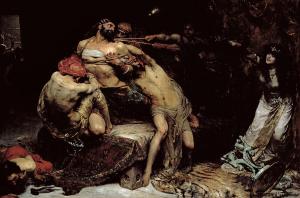
Painting by Solomon Joseph Solomon (1860-1927)

Painting by Solomon Joseph Solomon (1860-1927)

Samson had everything he needed to serve and lead. He was called from childhood, from the day he was born. He was a Nazirite: dedicated to God. But these gifts made him prideful. He lost sight of the true source of his strength.

“Samson fell in love with a woman named Delilah. The rulers of the Philistines confronted her and said to her, ‘Seduce him and find out what gives him such great strength and what we can do to overpower him.’ . . . “ [CEB, Judges 16:4-7a]

Did Samson make a mistake falling in love with the “wrong” woman? Apparently women were his weakness even more than his hair.

Delilah wasn’t the first time a woman betrayed him. Read Judges 14 where his Philistine wife [unnamed] beguiled him for the answer to a wedding riddle and told her relatives. That treachery ended badly with Samson taking revenge both in killing thirty random Philistine men and later destroying a number of his enemies’ fields and crops. The Philistines feared and hated Samson. And yet for the next twenty years, he continued to win victories with his strength alone.

Then Delilah, yet another Philistine woman, came into the picture. Her village elders offered her great sums of money for the secret of Samson’s strength. And so she double crossed Samson. Why couldn’t he see what she was doing? Why couldn’t he remember how it went the first time? Did he actually trust Delilah? I don’t think so. Pride consumed him. He could not imagine that God would allow him to be defeated. That lesson came hard when he was taken, blinded, and put to labor in prison, reduced to a stock animal grinding grain. He told Delilah the “secret” of his strength. But really, the secret was the hand of God. The hair was a symbol of the covenant.

Do I know the real secret? Or I have I fallen into Samson’s folly?

God has given us all gifts, strengths, and abilities. Certainly, God has given much to me but I take most of it for granted: my comfortable life, my health, my stage presence, my writing, my adopted children, my energy, my passion and enthusiasm, my long-standing marriage, my home, my job, my church; the list goes on and on. I am too comfortable I think. My gifts have become a norm like Samson’s long hair. As a result, I have lost my vision and gratitude for them and their purpose in my life.

Much will be demanded from everyone who has been given much, and from the one who has been entrusted with much, even more will be asked.” [Luke 12:48b]

Art by Cheryl Ward

Art by Cheryl Ward

Forgive me O God, for I have sinned in my plenty, fearful of less, but holding on too tightly to the cornucopia.

I remember, back in the high days of the Toronto Blessing (1994) when people were “catching the fire” and manifesting all kinds of strange behaviors (of course, lives were changed as well – I have no bone to pick with that revival experience), one of the popular phrases/prayers was to say, “more” Lord. They were asking for more of God, I know, but looking back, it also feels a bit narcissistic: give “me” more, touch my life, etc.  I suppose the ideal would be that God would give me more so that I might give others more. But I don’t see myself following through on such an arrangement. At least, not so far. There was a time I longed to be used of God in some miraculous way, as a conduit for healing or prophesying or wisdom . But I’m thinking, for the few who gained great popularity in those arenas, most of them went the way of Samson. With great power comes great temptation.

No, I don’t want that either.

I just want to be true to the Presence of God in me, to hold my hands and heart open, to speak truth, to forgive freely, to look and listen without comparing people to myself or to one another, to accept now with gratitude and pray for tomorrow with confident anticipation because God is sovereign. I don’t need to wait for my hair to grow long or my days to number into the seventies or eighties. Samson didn’t need to wait either. It just took him that long to figure it out.

Let this reveal have legs, Lord, and roots. Nourish my soul with your Breath. Today and always.


Read Full Post »

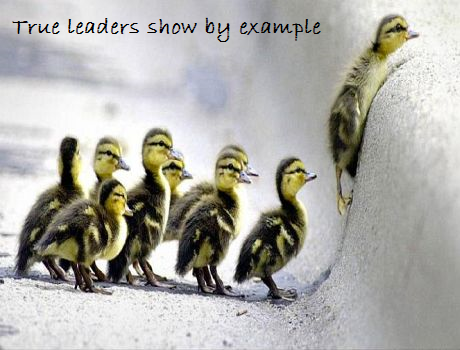
lead by exampleIs this cultural or simply part of human DNA? We seem to continually repeat our mistakes over and over again. And unfortunately, I see this both on a national and international level as well as in my own micro-world.

When that whole generation had passed away, another generation came after them who didn’t know the Lord or the things that he had done for Israel. . . . [And] then when the leader died, they would once again act in ways that weren’t as good as their ancestors’, going after other gods, to serve them and to worship them. They wouldn’t drop their bad practices or hardheaded ways. [Judges 2:10, 19, CEB]

The learnings from one generation to another are not happening. Parents are not telling or did not tell their children about the work of God in their lives in an authentic way; instead, they pass this job to Sunday Schools and Vacation Bible Weeks. In my mind, not only do we fail to tell the Bible stories, we a) water them down to make them PG and b) we don’t personalize them. Every story has a message for humanity. Every story has a message for me and my family. The Bible is not Disney World.

Miracles require effort and devotion, faith and trust. They require accessibility and openness.

I know some people have disagreed with me about telling our children about my past, particularly the darker side, but I have always felt  it was important for them to know that I am a different person today because of my faith, and that essentially, my lifestyle before Christ would have led very quickly to illness and death.

But I also think about our church and how we depend so heavily on our charismatic pastor and we are not raising up leaders to serve with him so that we don’t follow the footsteps of the Israelites who only succeeded while a particular leader was in place. It is everyone’s responsibility to tell the story, to walk the walk, to lead and train and grow. As the pastor tells his story, we must also tell our own.

authenticityOne of the ways to do this is mentoring (or discipleship). I have generally avoided this practice because it sounds so daunting, to take on a tenderfoot on the journey, to help someone else grow, to embrace him/her as family. I’m already struggling with my own adult children after all, how can I take on another, and what if I fail? But here’s the truth: all I have to do is “bring them along” when I go and do. I can’t pretend to be more than I am (nor should I assume I am less). New believers learn by being around old believers. New leaders step up when they watch old leaders in every day life, every day challenges, every day decisions, every day blunders.

Jesus didn’t turn on the leadership persona or the faith role just when the disciples were around. He lived and breathed what he knew. He healed because he could. He told stories because they meant something to him. He expressed mercy and grace because that was part of his genetic code.

We do not have to be infallible to demonstrate love and grace. In fact, authenticity goes farther. Mistakes confessed give hope to those who believe they are not worthy or that they are “too late” to change or that they can’t change. Our frailty revealed is courage demonstrated.

Generations ahead are depending on us now.


Read Full Post »

« Newer Posts - Older Posts »