Feeds:
Posts
Comments

Posts Tagged ‘Holy Spirit’

The second appearance of the Christ is critical to the faith. But I must say, it’s been an event a long time coming. No one can really imagine what the Second Coming might look like. Scriptures are fairly vague at best.

Hebrews 9:28
. . . so Christ was sacrificed once to take away the sins of many; and he will appear a second time, not to bear sin, but to bring salvation to those who are waiting for him.

There’s Revelation 1:7 — “Look, he is coming with the clouds, and every eye will see him. . . ” and Matthew 24:30 — “Then will appear the sign of the Son of Man in heaven. And then all the peoples of the earth will mourn when they see the Son of Man coming on the clouds of heaven, with power and great glory.” and II Thessalonians 1:7b — “This will happen when the Lord Jesus is revealed from heaven in blazing fire with his powerful angels.”
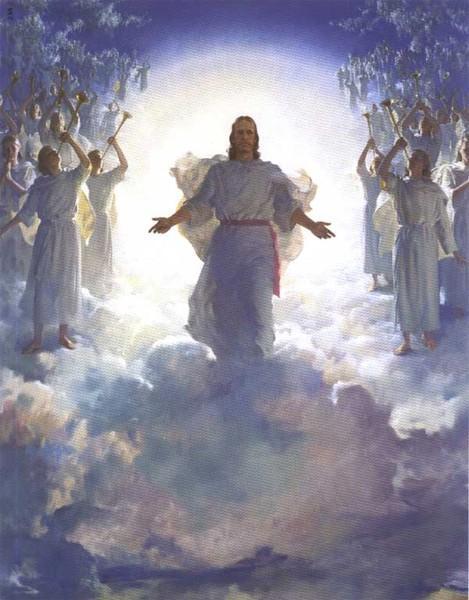
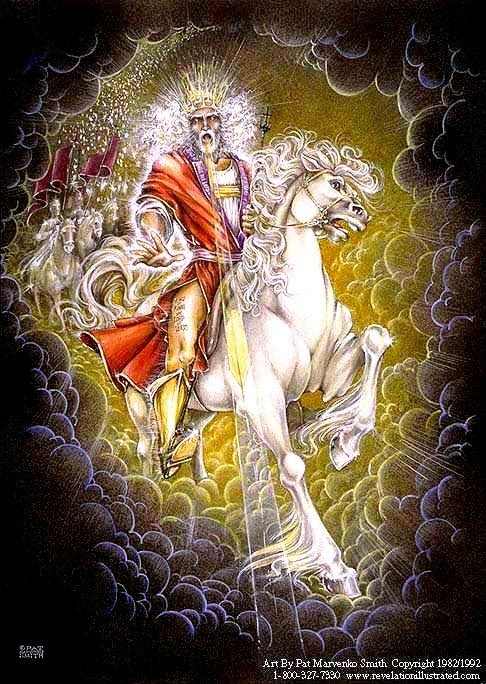
So what do we have here: clouds, flames, and signs with the Son of Man manifesting in the midst of it all. Artists have rendered this idea/image as either the Bible School Jesus all in white, robes flowing, or some kind of King image, all in gold, often times on a horse, and full of majesty (whatever that means). In either case, he is recognizable. Me? I don’t think so. I don’t think we’ll understand the Second Coming any more than we understand the ways of nature. We may be able to describe its properties, but not its essence.
Some people talk about the Second Coming of Christ as their chance to say to unbelievers, “See, I told you so,” “I warned you!” They act as though they wouldn’t be in the same shock and terror and wonder! Face it. How many times do things appear out of nowhere in the sky? I have to laugh as I consider whether all the spaceship movies are getting us ready for that appearance.

Of course, not everyone believes this can even happen. I remember standing at a bus stop every day to wait for the public bus that would carry me to high school (this is pre-school buses in Indianapolis). On the corner was a church of some type or another and on their sign, it always said, “Jesus is coming soon!” From my limited understanding of Christianity in those years, I thought they were really stupid. How could Jesus come again if he had already come. This was a teaching I never got (or understood) in Vacation Bible School or the more formal Latvian Lutheran church services. I don’t think I was alone.

A Second Coming is not something which we can prepare for in any way. When Harold Camping touted his May 21st forecast of judgment day (now pushed back to October 21st), he made it sound like people could actually do something in time for that day. That’s not the purpose of Christ’s coming. It’s the end of the age. Whatever happens next will be new, different, not recognizable. It may mean death or it may mean transformation. It’s a nexus moment. When the Christ comes, and if indeed, it’s “in the sky,” then the universe has changed dramatically. Both things cannot co-exist and be the same as before.

And why do the scriptures say that people will mourn? Is it because they didn’t believe or is it the loss of what we know. Our children and our children’s children will not know life as we know it. Everything must change. Everything will change. And if we don’t like change now, “Baby, you ain’t seen nothin’ yet.”

Read Full Post »

Wood Engraving by Gwen Raverat

Whenever the word inheritance comes up in scripture, my mind vaults to the story of the prodigal son [Luke 15] who is given and subsequently wastes his birthright share in “wild living.” But an everlasting inheritance can’t be expended, nor can it be given ahead of time, or can it?

Hebrews 9:15a
[Christ, the Messiah] is therefore the Negotiator and Mediator of an [entirely] new agreement (testament, covenant), so that those who are called and offered it may receive the fulfillment of the promised everlasting inheritance. . .
[Amplified]

So many Christian people are quite focused on the heavenly bequest and even use the promise as an appetizer to entice others into becoming followers of Christ. It sounds a little like the lottery, as though they are saying, if nothing else works out down here on Earth, at least we know we’ll have entry through the pearly gates and streets paved with gold; at last, a life of leisure with no pain, no worries, and no kids (only kidding on that last one).

But is that the point? Are we supposed to be toughing it out here because we can count on this inheritance later? This would be like our own children making no efforts now and simply waiting around until the parents kick off and the 401K’s are distributed.

I think the everlasting inheritance supersedes time. Just as there is no time in God’s world, our heritage is not limited to our death and subsequent afterlife. Instead, it was precluded by Christ’s death and the distribution included the Holy Spirit who lives in and among us now.

You want to spice up the Four Spiritual Laws or your personal proselytizing, then start including the wonder of the Holy Spirit who dwells within us now, who partners with us in this life, who draws us into being better Humans, who stimulates our internal compass toward those in need, to pricks our conscience, and teaches us to love others by loving us.

This is the everlasting inheritance that is here today.

Read Full Post »

Art by Catherine Andrews

The implication then is this: if the Christ appeared in a more perfect tabernacle not of “this” creation, there must be other creations. Hmm. The psalmists write, Selah, “pause and calmly think of that.”

Hebrews 9:11
But [that appointed time came] when Christ (the Messiah) appeared as a High Priest of the better things that have come and are to come. [Then] through the greater and more perfect tabernacle not made with [human] hands, that is, not a part of this material creation . . .
[Amplified]

Are there other clear references to another creation? I mean, it isn’t necessarily heaven designated in this passage from Hebrews, it could be anywhere. It seems a bit “woohoo” and “new agey,” right? In fact, I find it totally other-worldly, Star Trekian, multi-dimensional, and clearly, we’re “not in Kansas anymore.” We’re outside our human understanding. We don’t know about this other creation(s).

I understand, some commentators still believe the “perfect tabernacle” is in heaven because the human tabernacle was intended to mirror or replicate some heavenly place. But I think that’s simplifying the Spirit realm of God. It’s anthropomorphizing what we don’t understand and trying to put it into human terms.

It’s a similar situation with all the prophets who were given extraordinary visions of things outside their ken such as animals covered with eyes and wings in Revelation or Ezekial’s animals with four faces.

When my children were little, my husband and I liked to have fun with the various holiday characters such as Santa Claus, the Easter Bunny, etc. We always told them these characters existed in a different dimension. As the kids got older and realized how unbelievable it was that Santa could fly across the world in a single night and deposit gifts in each and every house, we reiterated: different dimension–anything can happen. Of course, our story is not as creative as C. S. Lewis and his world of Narnia, but ultimately, we share the same idea, once anyone goes through a “portal,” things are very different “there” (wherever there is).

The world and words of the Spirit realm are best depicted through the arts I think. Music, visual art, performance art, dance, film, scent, poetry: these are some of the better expressions of God’s kingdom or sphere or neighborhood.

What the Messiah did for Human is not really fathomable in our limited cosmos. One sacrifice for all? One outpouring of blood covers all sins from the beginning to the end of time? Perfection in human form? Covenants, promises, reconciliation, restoration, renewal, all of these possible by the act of one offering? Absurd, right?

Nope. It’s the link between our creation and all the other ones. The ultimate portal. Not science fiction or fantasy, but God business. And the stuff of dreams, imagination, love, resurrection, and transfiguration.

Read Full Post »

Just as the early Jews got hung up in the first covenant, today’s believers have created a version of the second covenant that resembles the first: earthly sanctuaries, regulations and time-honored traditions.

Hebrews 8:13 – 9:1
By calling this covenant “new,” he has made the first one obsolete; and what is obsolete and outdated will soon disappear. Now the first covenant had regulations for worship and also an earthly sanctuary.

Of course, it’s even more complex in our religious world of today. There is not just one version of the tabernacle, but many, depending on the sect or denomination. The worship regulations are more rigid if one is affiliated with a high church but even the seemingly “free” new churches have developed mores and practices that eventually become similarly rigid by repetition.

Until I read Pagan Christianity by Frank Viola and George Barna a few years ago, I considered contemporary churches as spontaneous and unrestricted by “ritual.” But truly, haven’t these services become equally predictable and patterned in structure? Isn’t there still a type of “call to worship,” music, prayer, announcements, and sermon structure every week?

Is that necessarily bad? Of course not. But I do wonder if we’re missing something by our focus on buildings and “ministries” and committees of various authority.

Several months ago, my family made a huge leap and ventured away from our church of twenty years just to see “what else is out there.” We visited several other churches, some larger and some smaller. We would attend for several services in a row if we felt attracted to the service. It usually takes longer than a visit or two to get a sense of a place or the priorities. In one case, we were intrigued by a very high-tech, seemingly culture-relevant church. Only to be turned off a few Sundays later when the price tag for this type of savvy “presentation” was revealed as their next “strategic” goal was announced: $14 million!

I don’t have any answers, just a lot of questions. What is important to the Church: the body of Christ? Who really requires weekly “discipleship” with state of the art video and music? Are we competing with the world? Or can we simply stand in within our culture like Jesus among the tax collectors and prostitutes and be agents for change by our steadfast faith and Holy Spirit presence? Does a Christ follower of 10 or 15 or 30 years need to hear sermons every Sunday or should he/she be the one equipping the poor and lost. . . out there?

Shouldn’t prayer and worship be a constant companion? Shouldn’t every gathering of people be a celebration of God with us, Emmanuel?

I have just started reading Brian McLaren’s new book, Naked Spirituality, and I cannot recommend it enough. He uses a single word in each chapter as an exploration into the faith journey. The first word is “here.” And I re-discovered that “here” is about “here I am.” I can choose to be aware of myself in God right now, right where I am: sitting at a computer or taking a shower or getting ready for work. Call to worship isn’t me asking God to show up, it’s me telling God I am present and ready to listen and learn and experience God in the moment.

There are no regulations for “here.”

Read Full Post »

All believers are stepping stones

Apparently I still need a priest. That title is not in my tradition although there has always been the pastor/preacher who was meant to guide or shepherd the church body (and thereby, me too) as well as deliver messages or teach by way of the inspiration of the Holy Spirit. In truth, the human versions are often found wanting. Naturally.

Hebrews 7:26, 28b
Such a high priest truly meets our need—one who is holy, blameless, pure, set apart from sinners, exalted above the heavens. . . . made perfect forever.

On occasion, there are ministers who have crossed my path who have changed my course. In my early days as a Christian in New York, I attended a pentecostal church (much to my own dismay) led by a very old pastor from Norway. I had no personal relationship with him, nor did I find him particularly accessible, but his instruction gave me a hunger for understanding scripture and he was able to explain passages that had stumped me on my own.

Another key pastor in my life was during my early years of marriage while living in Atlanta. He was a brilliant speaker, always intriguing and interesting from the pulpit. He engaged people personally and I am pretty sure everyone who attended that small church had dinner in his home several times a year. It was how his (very southern) family operated. Everyone knew him, warts and all. Through other para-church activities, we became friends and although he was flawed in many ways, his transparency, intelligence, and knowledge of the Bible made a lasting mark. He was our tipping point.

Since then, I have sat under pastors for short periods of time and long. In recent years, I’ve known several pastors of great intelligence who I admired and who gave many words of wisdom and yet, the one thing I longed for was a more personal connection, a sense of camaraderie and kinship. But how could I expect someone who was “ministering” to hundreds or even a thousand of people to guide me? They were simply too busy, too torn by their responsibilities to church and family, too sapped of energy by the truly needy. Oftentimes, I felt like the capable child in a family who everyone assumed was fine, strong, and secure which made it easier to spend time and energy with the struggling one, the emotionally unstable one. It wasn’t anyone’s fault, it’s just how things seemed to evolve.

So, what is my relationship really supposed to be with a pastor now? Having known and followed Christ over 30 years, do I still expect a pastor to be a kind of visionary guide who will come and say, “Jesus told me” that you should do such & such? I would be suspicious of that kind of approach anyway.

All right, all right, I know that Christ is the perfect pastor/priest. Christ is the ultimate shepherd, the ultimate guide, and the one to whom I should be looking for direction. I know that, honestly I do. (I also know that the success of such a relationship depends a great deal on my participation, my willingness to listen, and my time spent in silence. This is not a Sunday morning activity alone, but daily. I get that.)

But what, then, is my relationship to these human pastors? These flawed, but loving men and now women, who have felt called to operate in the role of church leader to “equip the saints.” I believe, at this point, based on experience and a certain amount of self-sufficiency (i.e. self-taught Bible study), that I want to walk beside. I skimmed an interesting online article by Craig Bluemel (who on further browse, appears to be controversial), but I did appreciate his view of the “elders” of the church as co-workers with the pastor. That we are no longer in a time when the church should be a pyramid. We all have something to share and teach by the leading of the Holy Spirit. We are all called to serve. We are indeed that priesthood of all believers [I Peter 2:9]. We need to stop looking elsewhere for “spiritual food” and spend more time looking within and sharing with others what we know.

Christ is our High Priest and will be, forever, yes. But we are the bumbling hands and feet and voice, whether trained or not. We are all imperfect. And so, we should combine our gifts and use them corporately to nurture and celebrate the Holy Spirit on earth.

Read Full Post »

Artwork by Gretchen Smith

Most of us know the short verse, “Jesus wept” [John 11:35]. We might even get a warm and fuzzy feeling at the picture of a sympathetic Christ, weeping for his friend. But how often does anyone quote this verse in Hebrews, where Jesus cries out loud and sheds tears before God?

Hebrews 5:7
During the days of Jesus’ life on earth, he offered up prayers and petitions with loud cries and tears to the one who could save him from death, and he was heard because of his reverent submission.

After a quick look at some of the commentaries, it’s interesting to me that most writers place all this “weeping and wailing” right before his death in the Garden of Gethsemane, as though this is the one time Jesus encountered his destiny and travailed before the Father. But I propose that the prayers and supplications of Jesus were ongoing. Think about it: how many times did Jesus miraculously escape the authorities? How many times did he suspect danger in his life, anticipate a shortened ministry, protect himself and his work by discouraging loose talk or gossip among his followers?

Jesus knew his life was forfeit but I can imagine him praying regularly, “Not yet . . . not yet. Give me a little more time.”

Jesus needed help and protection from God continually, not just in the garden, but throughout his ministry life. And in the same way that he emptied his heart and soul before God at Gethsemane, I believe he did this regularly and undoubtedly during many of those solitary prayers he sought out on the mountainsides, away from the disciples.

Lastly, I am intrigued by the idea of a noisy Christ. I mean, I don’t know about you, but a mental picture of Jesus roaring or wailing before God is difficult to wrap my mind around. And yet, why not? Isn’t it culturally appropriate? Would Jesus be “above” such behavior, such expression of need, desire, or supplication? Not at all.

I have experienced deep crying out to God and weeping but only at those times of deepest despair, betrayal, or fear. When I cried out to God at such times, I confess, it wasn’t that I put all my trust in God, I was merely bereft of hope, overwhelmed, and felt as if there was nowhere else to turn, I was “poor in spirit.” It was my last chance.

I wonder, were there circumstances and situations that Jesus did not expect to happen? Was he ever surprised (or surprised all the time)? Did he expect/hope his follower-disciples would “get it” sooner than they did (or did they get it while he was still alive at all?); was he troubled by the masses of people who easily followed him day after day for “bread and fish” but could not grasp the food of the Spirit; was he frustrated by his own inability to break through thousand-year-old traditions and beliefs? Did he cry out to God the day he called himself the “bread of life” and taught them about eating his flesh and drinking his blood–so many deserted him that day. I can imagine him saying, “Father, how do I reach them?”

And yet, each day, he submitted again and again and again to the role he was given to endure (in the order of Melchizedek); he pressed on. He woke up, he prayed, he taught, he ate, he miracled. And finally, he reached that God-ordained last day, that last supper, and that last prayer. My spirit tells me now: his garden prayers were not the first time he bled in sweat nor flooded the ground with his tears. His life in the Father was full of prayers and supplications every day.

Holy tears for me. Thanks be to God.

Read Full Post »

Melchizedek

When the Temple was destroyed in Jerusalem (70 AD), as much as I understand such things, the high priesthood dissolved for the Jews. And yet, the Christians, both East and West, have carried forward a similar hierarchy through the institution of Popes, Bishops, and Patriarchs, but none after the order of Melchizedek.

Hebrews 5:1, 5a, 6
For every high priest chosen from among men is appointed to act on behalf of men [and women] in things relating to God, to offer both gifts and sacrifices for sins. . . . So too Christ (the Messiah) did not exalt Himself to be made a high priest, but was appointed . . . As He says also in another place, You are a Priest [appointed] forever after the order (with the rank) of Melchizedek.
[Amplified]

I confess, I’m not the best one to write or discuss authority structures in the Church. I’m a bit of libertarian in those circles and not well versed in its history. But I do understand that one of the key roles of the Messiah is his Melchizedekian inheritance: he is both High Priest and King. He is both judge and mercy-giver. He can make the laws and forgive us for breaking those laws. He is Human and Spirit, King and Priest; Christ is paradoxical.

Melchizedek, priest and King of Salem (Jerusalem), lived in the time of Abram, 2000 BCE. And this role has been assigned to the Christ to come.

But what do we know of Kings in our age? Who do we have to model this role? What do we learn from the kings and queens of Great Britain (and their protectorates) or the Kings of Belgium, Sweden, or Norway, or the absolute monarchs of Saudi Arabia, Oman, or Qatar? [Incidentally, the Pope is also considered the absolute monarch of Vatican City.]

There are a zillion protocols for approaching a Royal, such as bowing, curtseying, proper address, proper distance, and so forth. Do I imagine King Jesus in this way? I usually ignore this perspective, don’t you?

And on the High Priest side, my only exposure to priests has been local Catholics and Episcopalians who are generally laid back around town and wouldn’t expect me to bend and kiss a ring or insist on addressing them as Father or Brother. That’s not to say the same for the “higher” priests. The protocols for the Pope, bishops, and patriarchs are equally submissive and quite extensive. Do I imagine Priest Jesus in this way? Not really.

None of these human examples of high priests or kings give much meaning to my Messiah-King. But isn’t some of that my own fault?

Are we all too casual in this day and age? Have we gotten too comfortable with our mauve carpeting and coffee club church services? Have we spent too much time humanizing Jesus/God (e.g. paintings of the laughing Jesus) or emphasizing his gentleness (drawing of Jesus with the lamb) or putting emphasis on our “family status,” making Him just one of the guys?

This is one reason why I am trying to spend more time on and in my relationship with the Holy Spirit. This is not king or priest, but a spirit union with me. This One is sister, brother, counselor, lover. Yes, I understand we learn about Jesus in those same ways, but honestly, I think we’d better understand His role as Melchizedek too. And in that semblance, I doubt I’ll be jumping up into his lap like Santa Claus.

Something to think about today.

Read Full Post »

« Newer Posts - Older Posts »